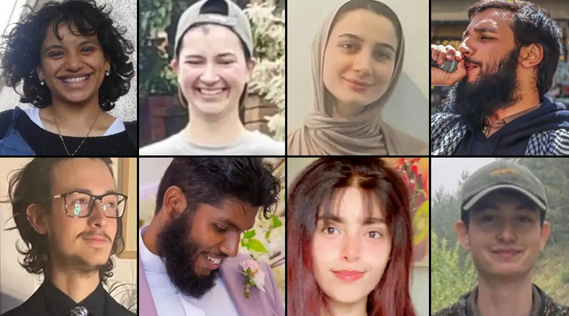
Fighting the proscription of Palestine Action has become more urgent as eight brave activists enter the crucial period of their hunger strike.
12 January has finally been set for the court hearing on holding a Scottish judicial review of the proscription of Palestine Action.
I am frankly terrified for the hunger strikers.
- Qesser Zuhrah
- Amu Gib
- Heba Muraisi
- Jon Cink
- Teuta Hoxha
- Kamran Ahmed
- Muhammad Umer Khalid
- Lewie Chiaramello (a diabetic so on modified hunger strike or he would die very rapidly).
The Starmer government is quite prepared to let them die: to emphasise devotion to Israel, to show their Zionist donors they are earning their money, and to reinforce the hardline macho image they believe appeals to Reform voters.
Indeed I have no doubt that Starmer, Mahmood, Lammy and Cooper hope for their deaths as a political positive; just as Thatcher thought she would win plaudits for facing down IRA hunger strikers.
It is important to state that none of the hunger striking prisoners has been convicted of anything – all are on remand – and none of them was in any way involved in the incident in which a policewoman was allegedly injured.
The coordinated response from government and other Zionist troll farms and stenographers is that none of the hunger strikers deserve sympathy as “a policewoman was hit by a sledgehammer”.
It remains astonishing to me that this assertion is constantly and stridently made by the state and its myriad acolytes, despite the rules against prejudicing a jury trial. This stance ignores the detailed accounts of the trial itself which paint a far more complex picture.
As well as the real danger to the hunger strikers, there are thousands of entirely peaceful protestors facing terrorism charges simply for speech. These are life-changing, bringing not just jail sentences but loss of employment, debanking and travel restrictions.
All this while the genocide of Palestinians continues, with appalling conditions in Gaza, stringent restrictions on aid (which is still at less than half the required levels), and continued Israeli bombing – despite the “ceasefire”.
The judicial review of Palestine Action in the High Court of England and Wales appears to have been “fixed”. The last-minute change of judges – including the total removal of the original judge from the panel – and the conduct of the review, have left little room for optimism.
My own most striking impression from that judicial review is the difference in how the judges treated the counsel for Huda Ammori and the counsel for the UK government.
Counsel for Huda Ammori, Raza Husain KC, was treated with impatience and at times disdain. That is difficult to quantify, but one thing that could indeed be measured was this:
Every time Raza Husain KC referred the judges to a passage in a past judgment or other quoted authority, they quickly skated over it and moved on, frequently with a phrase like “Yes, we have seen it” or “We are familiar with that”.
Every time James Eadie KC for the government referred the judges to a written authority, they ostentatiously physically found it in their bundle and took time to peruse it, on one occasion taking over a minute to demonstrate they were reading and absorbing at the government’s direction, before Eadie moved on.
The contrast was stark. Not just once, but over and over.
My favourite moment in the English judicial review was when Raza Hussain quoted the Proscription Advisory Committee’s recommendation to Yvette Cooper that Palestine Action should be proscribed because “Palestine Action kept hiring good lawyers” and defendants kept being acquitted as it was difficult to prove guilt to the criminal standard.
Yes, they really did say that. Palestine Action should be proscribed because it was being found by juries not to be criminal.
By proscribing Palestine Action, this makes it a criminal offence of strict liability to support it, whether or not you were doing anything that a jury would have found criminal before the proscription.
Raza Hussain KC described this as “Not the Proscription Advisory Committee’s finest hour”. I thought much more could have been made of it, but a feature of the English judicial review – and I think a mistake – is that there was no playing to the gallery of public opinion.
It was conducted as a legal conversation between the lawyers and the judges, often incomprehensible to the onlooker because it was based on documents to which the public do not have access. Yet there is an extremely concerned public looking on.
The demands of the hunger strikers largely refer to the appalling prison conditions in which they are kept, despite the fact that none of them have been convicted and none of them have previous convictions, or can reasonably be said to present a danger to the public, or be a particular flight risk.
- Immediate bail/release on bail for the remand prisoners (many held longer than standard limits).
- The right to a fair trial, including access to all relevant documents and an end to demonization or “terrorist connection” claims.
- An end to prison censorship/restrictions on communications (e.g., blocking letters, phone calls, and books).
- De-proscription (lifting the ban) on Palestine Action as a terrorist organization.
- Shutdown of Elbit Systems’ UK sites (Israel’s largest arms manufacturer, accused of supplying weapons used in Gaza).
On right to a fair trial, it is worth noting that there is huge evidence of outside influence on the prosecutions, and there are communications between the police and prosecutorial authorities on the one hand, and Elbit, the Israeli Embassy, and various Zionist groups on the other, which have either not been released to the defence, or have only been released in very redacted form.
In the day of the Filton trial which I attended, I found the parts the jury was not allowed to know (when they were sent out) particularly interesting. I cannot tell you more than that until the trial is over.
We can help lift the proscription of Palestine Action if we win the judicial review in Scotland. We have finally been given a court date of 12 January at 9:30am in Edinburgh.
This hearing is to decide whether there will be a judicial review. It will look at only two points.
Firstly, whether I as an individual have sufficient connection to Palestine Action, or have my rights particularly infringed by the proscription, in order to have standing in the case.
The UK Government is arguing that I have no connection to Palestine Action. (I wish they would tell their police that!!)
We will however also be relying on the Supreme Court judgment in Walton vs Scottish ministers, which states that it “is sufficient that the applicant has a genuine concern about the legality of the act or decision, and that the issues raised are of general public importance”.
The second ground to be heard is whether there can be a separate judicial review in Scotland when there is already one in the High Court of England and Wales.
Our view is that the principle has already been established in the Joanna Cherry and Gina Miller cases, where judicial reviews in London and Edinburgh came to opposing decisions on the legality of Boris Johnson’s prorogation of parliament.
I am resident in Scotland, where the High Court of England and Wales has no jurisdiction. If my rights are infringed I am entitled, even within the United Kingdom, to the protection of my own courts of my own nation in first instance.
Scots law is different. Its intellectual basis and maxims are different. There is a reason why lawyers legally qualified to plead in courts in England and Wales are not automatically qualified to appear in Scotland; and vice versa. The Court of Session is not inferior to the High Court.
We intend to submit substantive evidence of the oppression of numerous individuals in Scotland as a result of the proscription.
We will need the maximum public support inside and outside the court of session at Parliament House, Edinburgh on 12 January from 9am.
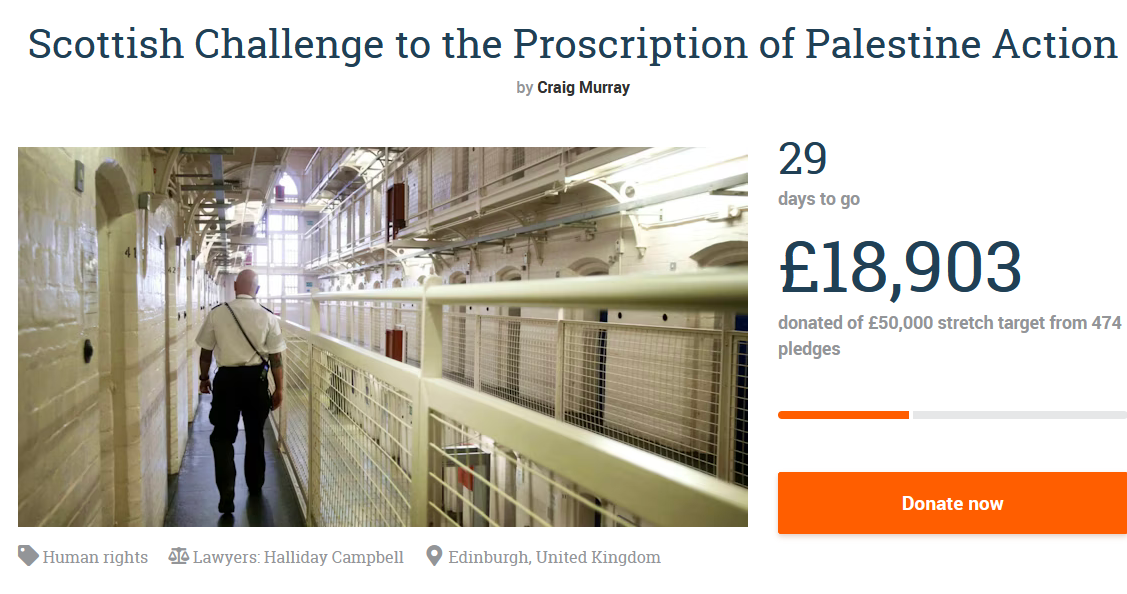
Unfortunately we will not be able to go ahead if we do not raise sufficient funds. The crowdfunder has got us into court, but needs to supercharge to get us further. Please do help:
https://www.crowdjustice.com/case/scottish-challenge-to-proscription/
I know these are the most difficult of times. But that is why we have to keep fighting. The sums needed to mount a successful legal challenge to the power of the state can be eye-watering. But we are the many. Every penny helps, but please do not cause yourself hardship. You can contribute via the crowdfunder above or via these methods:
Alternatively by bank transfer:
Account name: MURRAY CJ
Account number: 32150962
Sort code: 60–40–05
IBAN: GB98NWBK60400532150962
BIC: NWBKGB2L
Bank address: NatWest, PO Box 414, 38 Strand, London, WC2H 5JB
Or crypto:
Bitcoin: bc1q3sdm60rshynxtvfnkhhqjn83vk3e3nyw78cjx9
Ethereum/ERC-20: 0x764a6054783e86C321Cb8208442477d24834861a
USA has bombed Caracas and satellite state newspaper the Guardian calls Nicolas Maduro, head of government in the attacked country, a “dictator”. Say goodbye to even a pretence of an “international rules-based order” or the “rule of law” in non-c*ntspeak. It’s over. Note that there has never been the semblance of “democracy” on the “internet ” either, the dumbing-down advertising service, “content” for mass tracking, where most droids spend most of their time outside of the workplace. Those who have understood Guy Debord’s “Society of the Spectacle” book will get thie main lines of what’s happening here.
https://www.theguardian.com/world/2026/jan/03/explosions-reported-venezuela-caracas#img-1
An attack by the world’s leading terrorist state on Iran seems imminent too. Regime types in Britain, whether in the BBC, Whitehall, or the army – they have got their tongues out.
Who’d have thought it? Fascists and supremacists enjoy war and killing.
Trump has overthrown and captured Maduro, an act of war without so much as a by-your-leave to Congress. He must have thought that this would win him kudos and reverse his political fortunes. It might not, thanks to the problem of AFFORDABILITY (of health care as well as food, now that Obamacare provisions have gone, sending premiums through the roof) and a thrashing may still await him at the midterms. We’ll see.
In any case, will Maria Corina Machado now return and be elected President, set up a government friendly to the West and invite American oil companies back in? Will Venezuela be freed from US sanctions? But will its resources then be effectively mobilised for the good of its people?
We’ll have to wait and see.
Difficult for supporters of Putin’s war on Ukraine to criticise Trump’s invasion of Venezuela and (if true) the arrest of Maduro.
The main difference is that Trump’s illegal aggression is (for now at least) successful.
His actions will encourage Putin and Xi to use military power against their neighbours.
A troika of shits.
While it is true that the US has a long and rich documented history of overthrowing Central and South American governments it doesn’t like, it is merely speculative to claim that Russia will repeat its display of military power against Ukraine with other European countries.
By the way, JK, are there any other leaders you would nominate for your “shits” category?
For instance, “Bibi”, who also seems to like attacking his neighbours?
Netanyahu is entitled to his high position in the ranks of shits.
As are the DPRK leadership…..
Absolutely. Let’s look wider – Myanmar military “strongmen”? There must be a few African “strongmen” as well?
Jk declared Genocide Joe Biden to be “innately decent” at the height of his baby shredding in summer 2024.
Make of that what you will.
If Venezuela bordered the USA and was bristling with weapons supplied by a hostile power then there might be some logic in your claim.
I think we can expect some weapons grade hypocrisy. No suggestions that Venezuela should surrender to save lives, no objections to Russia and China pouring in arms and calls to sanction the US.
Can’t believe this happened, recently supplied S400 missiles and other Russian ‘wunderwaffe’ are supposed to have turned Venezuela into a ‘no fly’ zone for US forces.
https://www.youtube.com/watch?v=1T6ArzZZl0I
Whatever could’ve gone wrong?
https://lansinginstitute.org/2025/11/05/russian-air-defense-deliveries-to-venezuela-and-the-escalation-risk-of-u-s-venezuela-military-conflict/
Are Russia and China “pouring in arms”? Or have they been? Who says so?
Pears – pls change your handle to “Bananas”!
I didn’t say they were, just that those objecting to arms being sent to Ukraine are unlikely to object to Venezuela receiving military aid.
So you were just hypothesizing, Pears. Good to know!
But not much of a hypothesis either, I’m afraid, because not likely to occur in practice. Whereas it is easy to ship lots of arms into Ukraine (land borders!), lots of arms would have to arrive by air or sea……and risk US interdiction (the US seems mad enough).
It is quite interesting that “spontaneous” riots and protests should break out in Iran just when there is greatly increased speculation that the US and Israel are planning to attack Iran again.
And it seems that in France, various La France Insoumise politicians are coming under fire for overplaying the economic causes of those disturbances and – oh, horror! – allegedly underplaying their “political” causes.
Yes I noticed that too, just when Netanyahu, some days ago, met Trump at the White House to urge him to strike Iran – the protests kicked off just like that. Mossad bragged the other day that they had people on the ground inside Iran which is most likely true. Unfortunately Iran seems to be heavily compromised to the extent that Israel play with them like some child’s play.
Speaking on this topic, the decision to give the Nobel peace prize to the western puppet in Venezuela – María Corina Machado do not seems to be a coincidence, it looks like a managed psy-op by now. That decision molded the western media/politicians/populations to begin to hate a new boogeyman in the form of Maduro that must be dethroned to bring “democracy”.
And once again we see how Russia and China play along with US imperialism, they could easily have said past weeks that they would come to the aid of Venezuela in case of an attack but as usual they shy away. Today they look real feeble and without agency.
One wonder if the attack on Venezuela had something to do with Israel, Corina Machado is after all an outspoken zionist and Iran/Hezbollah have (or rather had) great ties to Maduro.
The biggest problem for these sovereign nations who don’t kiss the orange ring, is the enemy within.
In Syria opponents of Assad were funded by USA regime change NGOs. In Venezuela exactly the same has happened and it is happening in Iran.
First you fund an opposition, then shock and awe, then the funded traitors step in and support the overthrow. SOP.
Every country taken over by the USA, reverts to the stone age, whilst the asset strippers run off with the riches.
Iraq, Libya, Syria, Ukraine, Yemen, Haiti. Here we go again. No repercussions, no pushback by the west or the UN.
Re the no comments, I await with keen anticipation the loud condemnations from Ms von der Leyen, Ms Kallas and of course Sir Keir.
Strangely Sir Keir and the BBC, the EU, the US Democrats et al can’t even as much as condemn this textbook act of aggression, after spending the past 3 years lecturing the world on the inviolability of international borders, international law etc. (See also their response to the attack on Iran in June. Genocidal charlatans).
zoot
A dangerous precedent has been set here.
Just like ship stealing – gold stealing etc etc nicking a president of a Sovereign State
is big potatoes.
Netanyahu had better be careful where he places his size nines in the future.
And all of JK Redux’s ‘shits’ too.
Including most European leaders.
All’s fair in love/War and kidnapping.
Starmer could be kidnapped but being as he is meaningless in the affairs of the world
no-one will bother.
Iran attack next as Trump thinks he is on a roll.
Another shit.
But allegedly a democratic shit.
Of course, we (UK) have been regime changed many years ago. The Starmer cunt is not going to criticise his paymasters.
Yeah it is ridiculous, how could the same people that bemoan Russia’s invasion of Ukraine 24/7 then go on – and that with a straight face – support sheer naked aggression by the US?! Not only an unprovoked attack but a kidnapping in a clear colonialist fashion!
Imagine the reaction if Russia kidnapped Zelensky like that and took him to Russia, but when the US actually just did that, it is met with approval and support by the EU!? The double standards are sickening.
Jack, have you forgotten the Russian attack on the airbase near Kyiv in February 2022? Intended to enable a coup de main, the capture of Zelenskiy and the installation of a puppet administration…
It failed due to the incompetence of Putin’s generals, not his goodwill.
The Trump attack on Venezuela seems to be limited to seizing Maduro – the Venezuelan government wasn’t overthrown afaik.
You’re impressively good at divining Russian plans and intents without using a shred of hard evidence!
JK redux
I do not get it. You try to argue against an alleged coup in Ukraine but you support Trump’s actual kidnapping of Maduro?
Russia could have targeted Zelensky for 3 years straight – they have refused to do so, US on the other hand choose to target Maduro within the first hour of their war.
Jack,
of course I don’t support Trump’s kidnapping of Maduro.
Nor did I support Putin’s attempt to do the same to Zelenskiy…
Russian attempt to encircle Kyiv; what went wrong.
https://www.youtube.com/watch?v=Pe8AWujGuR0
Principally they dusted off an old battle plan they’d used before and the Ukrainians, having trained with the Russians during Soviet times, knew what was coming and managed to frustrate them and Russia didn’t have a Plan B.
Putin has tried numerous times to murder Zelenskyy. In the opening hours of the war special forces were parachuted into Kyiv to take him out. They all died.
https://www.independent.co.uk/news/world/europe/zelensky-assassination-ukraine-putin-russia-b2775934.html
Expecting the usual blanket denial.
Trump’s kidnapping of Maduro is the action of madman. I hope the US Supreme Court rules it illegal; they have the freedom to defy Trump which is more than can be said for certain other nations’ legal systems.
https://www.independent.co.uk/news/world/americas/us-politics/supreme-court-justices-block-trump-troops-chicago-b2889819.html
JK redux
“Putin’s attempt to do the same to Zelenskiy”
I am aware this view is shared here by some and also Craig himself I believe alluded to this possibility.
However I have always cautioned against it.
It would have made little sense IMHO. Politically and militarily.
In fact the AFU is worse off with than without Zelenksy in charge.
The Russian plan was to press Kiev to sign a peace agreement and that actually most likely would have worked.
To abduct the president 1) doesn´t come across as trustworthy in such a process 2) is not known as Russian conduct 3) Zelensky is not that important. In fact he has been under pressure by the Neo-fascists and US NGOs to escalate since he was elected. 4) Zelensky among the possible heads of state was the least extreme.
My hope is that Venezuelan society is way more resilient than US (and British?) believe it is. So eventually abducting Maduro turns out as meaningless as an abduction by Zelensky would have. Of course if CIA pulls off this kind of shit, they have a larger plan in the drawer. If that is competent on any serious level we will see.
The fact that Trump allegedly talked to Maduro about what would happen all of this look like an offer to all sides, the Trumpists, the Chinese /Russians, MAGA, and the various factions in CIA.
The Russian plan was to press Kiev to sign a peace agreement and that actually most likely would have worked.
There was no such agreement. This is a fiction invented to explain away Russia’s failure. At first it was attempted to pass it off as a feint to draw Ukrainian forces away from the east.
https://edwardslavsquat.substack.com/p/i-dont-agree-with-scott-ritter
https://euvsdisinfo.eu/report/us-and-boris-johnson-forced-ukraine-not-to-sign-the-peace-deal-in-istanbul/
Putin explicitly said that they wouldn’t target zelensky, unlike Trump with Maduro. A case of don’t interrupt your enemy when they are shooting themselves in the foot.
Pears: the column near Kiev certainly looked like a feint. It was huge but various reports said its equipment was shoddy and the troops second rate. Or was that just our propaganda? I can’t say. Anyway it sat there for quite a time doing next to nothing. A massive sitting duck for an air attack that never came and told us rather a lot about the relative strength of our and Russian air power. Along of course with Biden’s outright refusal to give Zelenskyy the no-fly zone he asked for. Then the column turned round and left but by that time Russia had seized swathes of Eastern Ukraine. They’ve now taken loads more which rather puts the lie to any perception that the Kiev column was representative of Russian equipment and forces.
Stevie Boy
January 3, 2026 at 16:43
You said that “Putin explicitly said that they wouldn’t target zelensky, unlike Trump with Maduro.”
Putin through his mouthpieces also said that he wouldn’t invade Ukraine.
Liars gotta lie…..
reports said its equipment was shoddy and the troops second rate
Well they were Russian.
Hostomel Airport was the key, Russia needed to capture it to be able to fly in reinforcements and supplies, an invading army needs hundreds of tonnes of supplies every day and they can only carry so much with them. Russia sent Spetsnaz, the equivalent of our SAS, to capture Hostomel. That’s how important it was. You don’t expend your very best forces on a feint knowing you’re going to lose them.
The column you speak off came to a halt because the fuel, ammunition and supporting infantry it needed couldn’t be got to them because the airport had been put out of use.
Pears Morgaine
Russian and Ukrainian government started to discuss possible negotiations within 24 hours of the Russian attack.
KIEV INDEPENDENT reported on February 25, see below article.
From another iink which I do not find the time to look for now, we know that Zelensky´s office itself put online, I believe that very same day, the Russian offer to negotiate. So there are mutliple sources proving the same point. Eventually whatever materialized in Istanbul as peace plan had started within 24 hours of the Russian attack.
“Ukraine ready to negotiate with Russia”
February 25, 2022
by Olga Rudenko
https://kyivindependent.com/ukraine-ready-to-negotiate-with-russia/
“(…)
The leadership of Ukraine is open to negotiations with Russia and the sides are now discussing the format of the talks, according to Serhiy Nykyforov, spokesman for President Volodymyr Zelensky.
Earlier on Feb. 25, the Kremlin spokesman Dmitriy Peskov said that Ukraine offered to hold the negotiations in Warsaw, instead of Minsk, which was proposed by Russia. Then, according to Peskov, Ukraine stopped the conversation.
Nykyforov denied it and said that Ukraine was willing to negotiate, and the talks continue.
Russia’s President Vladimir Putin offered Ukraine to meet in Minsk for negotiations, after launching an all-out war on the country in the early hours of Feb. 24. The Russian dictator wants Ukraine to agree to a neutrality status, that would prohibit it from ever joining NATO, which has been Ukraine’s aspiration for a long time.
Zelensky said that everything would depend on the security guarantees that Ukraine can receive.
“We accepted the proposition of the Russian president (to negotiate),” wrote Nykyforov. “In these very hours the sides are discussing the place and time of the negotiations.”
Russia is attacking Ukraine from several directions, and has launched an intense attack on the city of Kyiv, using airstrikes and deploying paratroopers.
The Russian invasion killed 137 Ukrainians on its first day on Feb. 24. The Ukrainian government said that over 1,000 Russian troops were killed on the first day, and added that it was the highest number of battlefield casualties that modern Russia has ever sustained in one day.
(…)”
On his fb page Nykyforov, Febr. 25 2022:
https://www.facebook.com/sergii.nykyforov/posts/4980953465305529
machine-translation
“(…)
Greetings colleagues! I must refute the statements that we have refused negotiations. Ukraine was and remains ready to talk about a ceasefire and peace. This is our unchanging position. We responded with agreement to the proposal of the President of the Russian Federation. Right now, the parties are consulting about the place and time of the negotiation process. The sooner the negotiations begin, the more chances there will be to restore normal life.
(…)”
Pears Morgaine
re: Boris Johnson issue
from a UKRAINIAN PRAVDA piece:
May 5, 2022
by Roman Romaniuk
https://www.pravda.com.ua/articles/2022/05/05/7344096/
“(…)
As soon as the Ukrainian negotiators and Abramovich/Medinsky, following the outcome of Istanbul, had agreed on the structure of a future possible agreement in general terms, UK Prime Minister Boris Johnson appeared in Kyiv almost without warning.
“Johnson brought two simple messages to Kyiv. The first is that Putin is a war criminal; he should be pressured, not negotiated with. And the second is that even if Ukraine is ready to sign some agreements on guarantees with Putin, they are not. We can sign [an agreement] with you [Ukraine], but not with him. Anyway, he will screw everyone over”, is how one of Zelenskyy’s close associates summed up the essence of Johnson’s visit.
Behind this visit and Johnson’s words, there is much more than a simple reluctance to get involved in agreements with Russia.
Johnson’s position was that the collective West, which back in February had suggested Zelenskyy should surrender and flee, now felt that Putin was not really as powerful as they had previously imagined.
(…)”
This piece was used as tag for a US text by peoples dispatch
May 9th 2022
by Abdul Rahman
“Ukrainian news outlet suggests UK and US governments are primary obstacles to peace
Recent media reports indicate that the West pressured Ukraine to stop the ongoing negotiations with Russia, which led to the collapse of the talks being held in Istanbul”
https://peoplesdispatch.org/2022/05/09/ukrainian-news-outlet-suggests-uk-and-us-governments-are-primary-obstacles-to-peace/
“(…)
A recent report in Ukrainian news outlet Ukrayinska Pravda, quoting officials from the Ukrainian president’s office, claimed that talks between Ukraine and Russia have stopped due to pressure exerted by UK Prime Minister Boris Johnson during his unannounced visit to Kiev on April 9.
According to the report, Johnson came to Kiev on a surprise visit apparently to “express solidarity” and announce financial and military aid to Ukraine in its fight against Russian aggression. However, during his meeting with Zelensky, Johnson asked him not to continue with the talks which were going on in Turkey, asserting that Putin needs to be defeated.
(…)
The UK promised fresh aid of USD 1.6 billion on Saturday, taking its total aid to above USD 3 billion. Johnson had announced billion dollars in aid during his April 9 visit.
The US alone has provided weapons worth USD 4 billion to Ukraine. The Biden administration is seeking an additional aid of USD 33 billion for Ukraine in the US Congress, of which USD 20 billion would be for weapons and military aid.
(…)”
On April 8th – I assume coordinated with Johnson´s visit – Borrell announced an additional military package worth 0.5B.
As reported here:
– use google-translate, however most is behind paywall and it´s not archived. –
“View from Russia. Moscow believes the EU wants to “sweep away” diplomacy in favor of war.
For Russian observers, recent remarks by the European Union’s foreign policy chief Josep Borrell on the need to “win the war on the battlefield” indicate that Kyiv is being pushed into military escalation by the West.”
https://www.courrierinternational.com/article/vu-de-russie-l-ue-veut-balayer-la-diplomatie-au-profit-de-la-guerre-estime-moscou
It is safe to assume had Zelensky decided to carry on with the negotiations the West would have stopped their financial and military aid which I guess would have meant immediate bankruptcy. But for Zelensky the even more unpleasant danger was the neofascists´ anger who threatened to kill him would he ever pursue peace with the Russians. This was not new and reiterated since 2019.
The argument of Bucha in this context was debunked by Zelensky himself who right after the alleged discovery of the crimes argued that regardless of Bucha negotiations would be needed. Also to my knowledge Bucha played zero role in Johnson´s message.
The last suggestion in above UKRAINIAN PRAVDA was another core argument to convince Zelensky to abort Istanbul: That Russia due to her conduct of war up to then was regarded as weak. (Which was proof of the incompetence within NATO leadership.)
I think it is no coincidence in the entire madness created by NATO that Ukrainian officers in Ramstein who opposed openly NATO strategy in the meetings laid out for the war were silenced and not invited again.
What might or might not have been said by Johnson beyond all this behind closed doors in terms of more concrete threats against Zelensky we do not know. But again it´s the context of the various parties that matters and convey the entirety of the tactics pursued by the West. One single Johnson visit is not the substance of powerplay merely a symptom.
After all it´s not one single infinitly powerful agent like Johnson who puts everything on the table and suggests to Z. “you either sign our deal now or you will be shot.” That´s not how these things work usually. Especially if every move you do has to fit the narrative of the White Knight in the shining armour as it is spread by the media. If you go out and bluntly threaten Zelensky it´s difficult for your allied media to spin it in a way that would make you look good and the Russians bad.
Also if my memory doesn´t fail me Biden or some other higher member of the administration made clear that there would be no aid if Ukraine were to sigh a deal with Russia.
Frankly it is without a doubt: If a EU or USA genuinely want peace that´s not how you operate.
p.s. When the treacherous dark queen Vicky Nuland spoke about the negotiations one year ago she did reveal something decisive:
“Victoria Nuland on Russia-NATO relations, peace negotiations with Ukraine, and the U.S. elections”
Sept. 2024
TC: 54:00-56:00
https://www.youtube.com/watch?v=HiS2dg_atfc&t=3176s
The Russians demanded that Ukraine should not have certain advanced weapons.
Nuland portrays this as a ridiculous dishonest demand by the Russians of course.
However truth is, that the entire quagmire was about this very problem: advanced weapons stationed in Ukraine.
That this would ultimately include nukes at some point in the future (with or without NATO membership IMHO) she of course doesn´t say.
But the failed exchange of suggestions for a security agreement between RU/NATO/USA in December 2021 was about this issue. So Nuland is deeply duplicitous to try and sell to the clueless reporter that Russian demands in 2022 were not simply reiterations of their security concerns of 2021 and decades before.
Mark Episkopas weighed in on the interview for RESPONSIBLE STATECRAFT:
“Nuland fuels theory that Western powers killed 2022 peace deal
Former US official says that talks ‘fell apart’ after Kyiv was counseled about Russian conditions that would ‘neuter’ Ukraine”
https://responsiblestatecraft.org/nuland-ukraine-peace-deal/
Pears, look at a map. Look at the distance between Kiev and Russia’s ally Belarus. On what planet would anyone have planned to supply a huge military force with heavy stuff like food and fuel by air when it’s that close by road?
Look at the distance between Kiev and Russia’s ally Belarus.
You’d best take that up with the Russians but the distance by road from Kyiv to the Belarus border is about 200km which would take a lorry 3-4 hours if the road was clear, a lot longer once it got congested. Ukraine blew up all the bridges as well which would’ve caused further delay.
https://www.newcivilengineer.com/latest/ukraine-road-bridge-destroyed-in-war-reconstructed-with-help-of-uk-finance-and-supplies-04-11-2025/
The precedent is set. When China, which plans for the longer term, gains military superiority, declares Taiwan to be in its sphere of influence and uses force to install a puppet government there, the USA will wail and the poodles will yap. But 85% of the world will just laugh at the blatant hypocrisy. As satire died when the Nobel Committee gave Kissinger the Peace Prize, so international law is now officially dead. Unless of course the Americans send Trump to The Hague but I’m not holding my breath.
Yes. exactly.
Putin and Xi are, I expect, delighted.
While the USA gains nothing from the debacle and loses the goodwill of its allies…
I share your grief,JK. So much better if Trump had just sent a missile down Maduro’s chimney, eh? Would have helped everyone to forgive and forget even sooner.
Luis, your sarcasm is misdirected.
I oppose Trump’s invasion and kidnapping.
I think all here do.
Was I being sarcastic?
Trumps invasion, intervention or whatever, in Venezuela is as illegal as an earlier president’s invasion of Iraq and Putin’s invasion of Ukraine. All were done for the purposes of regime change and the UN Charter is pretty clear on the matter.
However the US Delta Force has shown Putin, Xi and the rest how it’s done. Other leaders need to review their security arrangements.
No one who genuinely opposes it could have written that second paragraph.
re: Hostomel
I don´t understand what´s wrong with the idea that Russian Armed Forces took the airport. And eventually when plans changed with the negotiations being set up left again.
Of course the Russian army which was way outnumbered was not set up to permanently stay on their positions to control those huge areas against a much larger domestic army. Instead regrouping and giving up territory again eventually was a necessary part of that.
The problem is, NATO apparently thought this would be Russia´s version of the invasion of Iraq.
The idea that the Russian units took the field to prepare storming Kiev, if I remember the Western statements correctly, is built on the rather insane idea to take Kiev. And if Zelensky had been a target sending missiles to kill him would have been the easiest way. But why do that? If you want to negotiate with the guy.
Of course none of this matters if NATO is convinced of a Russian plan which the Russians themselves never intended.
And this has been the ongoing issue. NATO staff is convinced Russia wants to take all of Ukraine in 48 hours (I am being sarcastic) and then they don´t and so NATO instantly thinks, Russians forces are weak and incompetent. Never did they consider that their assumptions re: RU were mere projections of their own limited understanding and simply incorrect. Why is it so impossible to imagine that NATO failed from the outset? they did not look at what really is taking place instead projecting their preconceived expectations onto realities on the actual battelfield.
JK Redux
Would you like to name countries other than Israel that is operating ‘goodwill’ to the US.
Don’t say The EU and UK .
They are in a similar boat to all the countries Trump has bombed or threatened.
Cowering at his every crazy move just in case they are next.
Mark, the goodwill is gone. Now replaced by wary watchfulness…
Your goodwill should have gone after Gaza. As for the allies, the politicians, can you point to a single one who has condemned this gangsterism and said America no longer has their goodwill? Unsurprising when you consider their roles in Gaza.
Of course Taiwan is Chinese, part of one China, and will be properly reunified with the mainland one day, as Hong Kong was, and as north and southern Ireland will also be one day. The only fly in the ointment, as usual, is the USA, who funds the ROC separatists with the aim of undermining and surrounding the PRC.
It seems to me here in Wales that it’s up to people in territories to decide for themselves whether they should be part of a bigger entity. I expect Craig would agree. The Taiwanese *should* be allowed to choose whether to be part of China or not and might decide on rational or irrational grounds. But needless to say, China can and will apply carrots and sticks to encourage them to make the “right” choice. And might go beyond that too. Ditto for Greenland and Canada and of course Scotland, Wales, Catalonia, Ukraine? In the end it’s always us and whose army.
The ROC Taiwanese are actually chinese who fled the mainland during the civil war. The actual indigenous Taiwanese have been over run by the incomers, they may have a different view, not that we’ll ever know.
Interesting that the Venezuelan government is outraged but hasn’t retaliated. I understand that Venezuela has Russian S400 and S300 systems as well as BuK and Pantsir systems and that there is some big, fat American targets just off the coast.
Sending some of the Yankee running dogs and their F35s to the bottom of the sea would focus Trump’s tiny mind.
Stevie
unlikely that Venezuela would be capable of sinking a US ship.
But if they did, the worldwide schadenfreude would be at Moskva levels..
The Americans would fly off their trolleys if one of their ships was destroyed or their own territory attacked. Think of Pearl Harbor or 9/11. Whether Venezuela could actually do either of these things or not, they might well consider that revenge is a dish best served cold. I’d not fancy being a Gringo sent to Venezuela to work in an oil field or whatever.
Steve Hayes
Revenge is a dish best served cold and The Chinese version of Japanese Sushi will be served via US Bond Sales and other counter tactics.
The Chinese Minister was in Venezuela about 12 hours before the US attack.
Saving face is more important than anything in China.
Russia will meander to something in the way of obstruction ( not in a military way) and it will have an effect on Ukraine and Europe.
Ukraine will be Russia’s revenge on the US and the craven EU and UK>
It will all be described as ‘ not fair’ on the BBC etc but, precedents have been set by the US and will be mimicked.
They’re all anti-aircraft systems and frankly, a bit crap.
Glenn Greenwald has an intelligent take on this regime change attempt in Venezuela, he says the Maduro government is still in charge and is not sure how Trump will handle the situation, he opines on how easy it is to get the US population to approve of such attacks on countries which do not follow US policy, first by sanctions, if that doesn’t work, a campaign of vilification against the leaders, Saddam Hussein, Col Gaddafi, Assad and any opponent of US policy. They are the bad actors and we are the good guys, anyone who looks objectively and critically at US policy is immediately called a Saddam Hussein or Putin supporter etc and should be denounced, it works the same in every regime change case, and usually ends in failure.
https://www.youtube.com/watch?v=TNFB6G84Z1Q
Yes, the Maduro government is still in charge, so what happens next – if anything significant – is key. Jeffrey Sachs opines that the removal of Maduro qua President is just the beginning and that there will be consequential developments carried out by the US.
If there are in fact no developments, it is difficult to see what will have been achieved other than a kind of propaganda victory for Trump himself (we have got Mr Big Drugs Trafficker in our hands and he will face justice!); Maduro will simply be replaced by the Vice President or someone else and the country just carries on. In the same way as it carried on after the death of President Chavez.
I think it is very revealing how the media are trying to personalise the Venezuela coup. Simon Tisdall’s piece today in the Guardian puts the overthrow of Maduro almost entirely at Trump’s door, as if he could do anything at all without a supportive military and intelligence machine. All the circumstantial evidence has long-since pointed to the reality that the British media aren’t allowed to criticise the substance of United States foreign policy, so Trump is necessary as the pantomime emperor. No one is allowed to mention that perhaps the United States itself is starting to look as if it has threadbare clothes.
Pathetic stuff indeed from our media more generally.
They put all Venezuela’s economic woes squarely at the door of Maduro. What they don’t tell their readers, is that in August 2017, the Trump administration imposed sanctions which prohibited Venezuela’s access to U.S. financial markets, and in May 2018, expanded them to block purchase of Venezuelan debt. Expecting any leadership to work financial miracles in that environment, is like asking a bird with broken wings to fly.
And the worst of it is, it’s all purely ideological; for were this some right-wing military junta, that happened to be pro-Trump, they’d have no such financial restrictions. Think of all the genuine dictatorships in the world that the US props up.
Goose
It’s a bit of long shot but, if the US ( through the Swift Payment System ) can do the stopping of money to countries – it can do it to individuals.
I am reasonably convinced that in the EU and the UK that a lot of politicians ( maybe nearly all?) are scared to death of over criticising Trump and the US Foreign policies in general because they could be sanctioned as countries
and more to the point individual politicians and the scribes in the MSM.
You have to ask the question as to why all these mainly Centrist Governments are busying themselves with bowing to the US and undermining their own economies and politics in general in order to please a rapacious Imperialist powerful country?
Starmer is clearly terrified of Trump. Some claim Starmer’s obsequious behaviour around Trump won Britain the best trade deal possible in Europe, ‘winning’ a 10% baseline tariff. But the US runs a surplus in terms of exports to the UK, so why we didn’t insist on 0% – leveraging that fact – as a better trade negotiator would have, is a mystery?
Trump’s clearly a ridiculously thin-skinned capricious fella, as we’ve seen with tariffs being slapped on countries over perceived insults.
As to your point. I think it’s likely more due to the fact we are so indebted as nations, and in hoc to the Bond markets. Minor fluctuations throw all govt expenditure off, due to the enormous debt interest repayments.
The Epstein stories are revealing what some might have suspected before as to why political leaders do inexplicable things against their own nations’ interests. We haven’t heard much recently about those young men who Starmer was playing chess with. I suspect possible Swift sanctions aren’t what keeps him awake at night. At least before Brexit, London was supposed to have world-beating financial services. Surely they could figure out ways to transfer money without using a Swift keyboard.
Venezuela is the obsession of Marco Rubio, an exemplary establishment neocon. A regime change fanatic who was appointed Secretary of State with the endorsement of every member of the US Senate, including Bernie Sanders.
Even the most ‘radical’ US politicians like Mamdani and AOC went well out of their way to demonise Maduro as a dictator, helping prepare the ground for what has happened.
Tisdall of course knows all of this very well.
It looks like Senior members of Venezuela’s government and senior military leaders have been co opted, by various means, hence the US could waltz into the country kidnap the leader and his wife without a shot being fired. Many slow moving and low flying helicopters achieved their mission unchallenged. Maduro was flown to New York where he was charged with being a drug Lord, and possessing machine guns [you did hear that correctly]. Trump now is threatening Colombia, Nigeria, Iran and together with Israel are threatening to use the big stick to anyone opposing Israel/US hegemony, in other words the US war sec was not bluffing when addressing those assembled top Generals not long ago.
Trump has put the world on notice, the former ‘International law’ is dead, the latest ‘Rules based order’ is now also dead replaced by US hegemony over the whole world. The BRICS have taken notice,
If China genuinely is thinking of blockading, or even invading Taiwan, Trump’s lowered the bar to dong that. An “unprovoked aggression” probably won’t be used as much now by EU leaders, when speaking about Russia’s attack on Ukraine.
Kallas and UvdL may ponder their security arrangements and whether they could be snatched and taken to Russia to be charged, using a similar security threat pretext. The U.S. have really opened up a can of worms here.
Zelenskyy, when asked today, looked uncomfortable, saying merely, that dictators should be toppled. But does Maduro qualify as a dictator? It’s early days, admittedly, but thus far his supporters have rallied. No one wants their leaders picked by a country(the U.S) with such a despicable record in S.America, such as in Chile, under brutal Pinochet.. And the people the U.S wants in power tend to be from very rich families, people who lost out due to the sweeping renationalisation programme undertaken by Hugo Chávez.
Leaving aside possible future kidnappings (oh, sorry, “bringings to justice”), if I were the EU and the Danish Prime Minister I would be seriously worried right now. Given that Trump is on a roll and that it is in the western hemisphere, of plausible increasing importance in a military/geo-strategical sense, mineral rich and indefensible by its current masters (it is in essence still a colony), what are the odds against the US taking over Greenland? Not as the 51st state but as a kind of “protectorate”?
I wonder what the EU would do in such an event?
The population of Greenland is approx 55,000 people, if the US offered each family, say $1 Million dollars that would be chump change to the Empire, but why pay for it, after all it is for the greater good that Denmark give it up? They could say it is ‘tribute’ to the leader of the free world, rather like the EU/UK paying tribute to the master in the form of tariffs and overpriced weapons systems from Lockheed Martin and Boeing. It is rather like two men in trench coats visiting a shopkeeper and offering protection, when the shopkeeper asks who are you protecting me from, they reply ‘us’?
The US can see it is slowly losing its hegemony to the other big boys, hence it is lashing out while it still has the power to project it.
In Mafia world they regard the above analogy as a proven business model, knowing that rubbing out one recalcitrant ‘client’ [Denmark] is a necessary inconvenience [for the greater good you understand].
Russia and particularly China have billions of investments in Venezuela, all this could be lost because Maduro refused to surrender or in the words of US Defence Sec Hegseth, he [Maduro] FA and FO. Just like Biden calculated Russia would do nothing when expanding NATO to Russia’s front porch, [oh how wrong that assumption was]. so Trump has calculated that Russia/China are too far away to act effectively, therefore the US can kidnap other countries leaders, blow boats out the water and invade other countries when it suits them.
Trump has announced…
“We’re going to run the country until such time as we can do a safe, proper and judicious transition,” Trump said Saturday at a press conference at his Mar-a-Lago estate in Florida.
“So we don’t want to be involved with having somebody else get in, and we have the same situation that we had for the last long period of years.”
“We can’t take a chance that somebody else takes over Venezuela that doesn’t have the good of the Venezuelan people in mind,” Trump said Saturday in a news conference in Palm Beach, Florida.
“We’re going to stay until such time as the proper transition can take place.”
Additionally, President Trump said Saturday he would allow American oil companies to head into Venezuela to tap its massive crude reserves: https://www.zerohedge.com/geopolitical/us-forces-strike-venezuela-trump-reveals-maduro-has-been-captured
That last sentence is proof positive that the greatest reserves of oil in the world [Venezuela] was the real reason [not drugs] for the invasion.
Luis Cunha da Silva
January 4, 2026 at 08:40
Luis.
I wonder what NATO would do in such an event.
Don Trump reminds me of Michael Corleone. Michael joined the US military before becoming Organised crime boss. It seems with Don Don, it is not just fiction , but a fait accomplishment.
Unlike Corleone, the Donald avoided military service, which seems to be the norm for most politicians and their spawn. None of them think that much of their country that they’d put their life on the line for it. Go figure.
I should have said this administration and the merging of organised crime with the military
Good oppo for the Bolivarian revolutionaries to rally.
Did someone say that the US , China and Russia will agree to divi up their respective areas? No, imperialism never retreats. US imperialism will end when their citizens rally. It’s a paper tiger. Same everywhere.
Lets hope that the true character of mankind as a moral and creative species finds its way
Back at the Woolwich Crown Court meanwhile, a legendary brief from Rajiv Menon QC:
https://realmedia.press/the-filton-trial-defence-speeches/
Encore respect to Real Media for their coverage !
Livestream of court hearing available here:
https://www.scotcourts.gov.uk/livestream/court-of-session/case-p1017-25/