On the face of it the English High Court ruling that the Palestine Action proscription is unlawful makes the decision that the proscription remains in place pending appeal utterly illogical. But what if the High Court ruling is deliberately designed to fail at appeal?
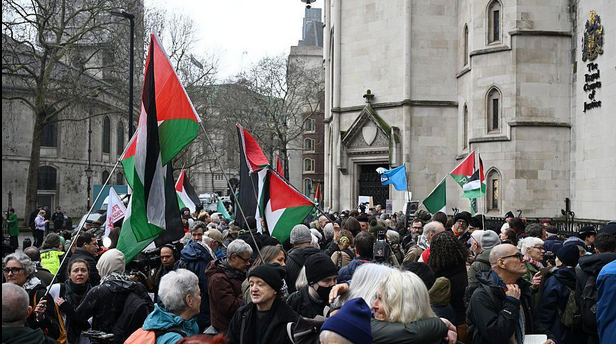
I believe that it is. They chose an extremely narrow path to rule that proscription was unlawful and produced an extremely weak judgment. This gives an impression of fairness in the judicial system – except that nothing has changed, the ban remains in force. And it remains in force because the judgment is designed for the government to win at appeal.
The judgment for the most part is precisely what you would expect from three hand-picked, known right-wing, judges. They:
- State that Palestine Action is a terrorist group within the meaning of the 2000 Terrorism Act (para 134);
- State that they do not accept the United Nations assertion that the UK definition of Terrorism is incompatible with international norms (para 141);
- State that in any case international law has no impact on English statute law (para 142);
- State that all those arrested for showing support for Palestine Action – specifically including for holding placards – were rightly arrested as they were deliberately committing a criminal act (para 118);
- State that there was no need for Yvette Cooper to consult before the proscription (para 60);
- Repeat the Crown’s assertions of the Filton case as fact with no reference at all to the findings of the jury (paras 34, 139);
- State that comparisons with Just Stop Oil and Extinction Rebellion are not valid as those organisations have not carried out serious property damage (para 144);
- State that the motive of Palestine Action in trying to stop Genocide is not “material” (para 70);
- Argue that the interests of national security and protection of the rights and freedoms of others justify the interference with freedom of speech and assembly (para 128).
The judges have therefore supported the government on almost all of its key propositions. You may well ask, how did they find all that and still find the proscription unlawful?
Well, they chose a deliberately narrow and precarious path through. They first found that the proscription was unlawful in that it contradicted the Home Office’s published policy on how the discretion of the Secretary of State would be applied in deciding whether to proscribe a terrorist organisation.
It is important to understand this. The ruling is that Palestine Action is a terrorist organisation, but that the Secretary of State is not obliged to proscribe all terrorist organisations but may use her discretion.
I have read the judgment again and again and it is incredibly obscure as to in what way the Home Secretary did not follow her policy. It seems to be that she did not consider the factors peculiar to Palestine Action, but merely proscribed as though that automatically followed a determination that an organisation is terrorist. Rather than consider the question in the round, she merely looked at the “operational advantages” of proscription.
I assume the underlying assumption is that this means she failed to take into account the disadvantages of proscription, but it does not say that. I don’t think I am being obtuse. You try.
92. This conclusion may appear to rest on a very narrow basis – the Home Secretary had, after all, formed the belief that Palestine Action is an organisation concerned in terrorism and in these proceedings the claimant does not challenge that decision. However, this conclusion is a direct and necessary consequence of the policy the Home Secretary has applied to the exercise of her discretion to proscribe such organisations. The purpose of the policy is that not all organisations that meet the concerned in terrorism requirement should be proscribed.
93. Any decision-maker who adopts a policy for a particular purpose is at liberty to disapply or modify that policy in a particular case, but any such disapplication or modification must be express and must be for a sufficient reason. In this case, the Home Secretary’s approach was to apply the policy (a policy of long-standing, dating back to the time the 2000 Act was enacted), without modification.
94. The operational consequences and advantages of proscription is not a factor consistent with the policy for the obvious reason that such consequences and advantages will apply equally to any organisation that could be proscribed – i.e. any and every organisation that meets the requirement to be an organisation concerned in terrorism. In principle the position could be otherwise if in a particular case, by reason of an organisation’s structure, membership, activities or otherwise, the measures in the 2000 Act that are the consequences of proscription would be unusually effective. In such a case, it could be consistent with the policy to regard the operational consequences of proscription as an “other factor”. But that is not the present case. There is no such evidence so far as concerns Palestine Action. Nor in the present case could it be contended that the reliance placed on the consequences of proscription was immaterial to the exercise of the discretion or the application of the policy. Both in the note of the meeting of the Proscription Review Group and in the 26 March 2025 ministerial submission, the operational advantages are relied on as providing a clear case to use the discretion to proscribe. Each suggests that it is an important matter going to the exercise of the discretion, if not the central consideration in that exercise in that case.
95. The consequence and conclusion of this point is that, notwithstanding the latitude that the policy provides, the Home Secretary’s decision to proscribe Palestine Action was not consistent with her policy. The closed material does not affect our conclusion on this ground.
There are two problems with this aspect of the judgment.
Firstly it seems so obscure that it is designed to fail at appeal.
The notion that its proscription was unlawful because the Secretary of State had failed to follow, not the established law, but the precise procedures in some buried Home Office policy document that nobody had ever read, is not one that I would have expected to carry the day compared to all the other issues.
It is indeed an established legal point, but one used in objections to planning applications rather than cases of alleged terrorism. Which is what I believe the Court of Appeal will say.
Secondly it leaves it open to the Secretary of State just to change the published policy, then proscribe again.
The second ground on which the court found against the government is that the proscription is incompatible with Articles X and XI of the European Convention on Human Rights – Freedom of Speech and Assembly.
But again this is not what you think.
Remember the judges found that the 2700 people arrested for opposing the ban have been quite rightly arrested, as expressing support for Palestine Action is a criminal act. The court does not hold that their right to freedom of speech is infringed.
In fact the court rehearses all the ways that speech will be chilled and people will be de-platformed as a result of the proscription, but does not find they are unreasonable to combat “terrorism”.
128. The Home Secretary’s pleaded case is that the purpose of proscription was to “disrupt and degrade PA so as to protect the rights of others and maintain national security”. The submissions on behalf of the Home Secretary sought to define the objective as “controlling terrorism” or “controlling terrorist organisations” through proscription of organisations that engage in “terrorism” as defined in s.1 of the 2000 Act. It seems to us that the latter is a description of the means of obtaining the objective. The identified legitimate aims of the proscription decision are “the protection of the rights and freedoms of others” and “the interests of national security”. Those aims appear in each of articles 10(2) and 11(2), respectively and are objectives that, in principle, are capable of warranting an interference with each Convention right.
129. Although the claimant raised the question whether there is a rational connection between the means chosen and the aim in view, no basis for suggesting there is not a rational connection was put forward. Proscription is rationally connected to the objective of disrupting Palestine Action so as to protect the rights of others and the interests of national security. That is so whether the objective was limited to curtailing actions by Palestine Action causing serious property damage within the meaning of section 1 of the 2000 Act, or extended more broadly
When after all this support for the government, the judgment finally delivers the key paragraph on why the proscription was unlawful, it suddenly leaps out at you: the result of a proportionality exercise the judgment had not previously defined or given a methodology.
140. Considering in the round the evidence available to the Home Secretary when the decision to proscribe was made, the nature and scale of Palestine Action’s activities, so far as they comprise acts of terrorism, has not yet reached the level, scale and persistence that would justify the application of the criminal law measures that are the consequence of proscription, and the very significant interference with Convention rights consequent on those measures.
It is a goal entirely against the run of play in the previous 139 paragraphs. I am afraid to say that I think the marked lack of intellectual underpinning again makes it a structure designed to fail.
Three known very conservative judges were appointed at the last moment to replace the liberal judge Chamberlain, who was unceremoniously booted off the case. It seemed astonishing that these known sympathisers with the security state had found the proscription unlawful.
But they cannot really think both that it is unlawful, and that it should continue pending appeal. That is utterly illogical.
They cannot really think it is an unlawfully disproportionate interference with freedom of speech, and that those arrested for holding placards opposing it were criminals and rightfully charged.
That is a logical impossibility also. Yet both sit side by side in this judgment.
The judges are not stupid. It can only be that they do not really mean it when they state one of those opinions. All the signs are that it is para 140, swinging entirely unsupported and exposed and waiting to be struck down, that they do not really mean.
If they believed in their own judgment, the judges would have quashed the proscription pending appeal.
Palestine Action was a proscribed organisation before this judgment and it is a proscribed organisation after this judgment. Everything else is smoke and mirrors.
That is why it is essential that the Scottish judicial review goes ahead. I for one am very interested to discover whether the paragraph
142. We doubt that the consensus claimed exists: see and compare R v Gul (Mohammed) [2013] UKSC 64, [2014] AC 1260 per Lords Neuberger and Judge at paragraphs 44 – 51. In any event, this submission faces the further obstacle that, when taking her decision, the Home Secretary was entitled to rely on the definition of terrorism in the 2000 Act. Indeed, she was required to apply that definition. Had she purported to rely on any other definition for the purposes of her decision she would have acted unlawfully. A “consensus” in international law is not a trump card in English law; any such consensus cannot permit either disregard of or derogation from an English statute save to the extent permitted by statute.
which specifically references “English law”, applies equally in Scotland. The English legal tradition is that the “Crown in parliament” is sovereign and may do absolutely anything it wishes, irrespective of international law, individual rights or any other consideration. The Scottish legal tradition is that the people are sovereign and protected from arbitrary or oppressive executive action.
Should Huda Ammori again win at appeal, Shabana Mahmood will certainly appeal to the Supreme Court. It would be extremely difficult for the Supreme Court to rule against the highest courts of both England and Scotland. So there is reason to continue the Scottish action even if the English case continues to win.
Should the UK government win at appeal in England, the Scottish case becomes still more crucial.
The UK government has succeeded in postponing the Scottish case, in order to give time to prepare for the admission of secret evidence. This is an incredible authoritarian procedure where they can submit “intelligence” to the court, which neither I nor my legal team will ever be permitted to know about, let alone have a chance to reply.
My interest will be “represented” by a “special advocate” with whom I shall never be able to communicate and thus will have no ability to give them the answer to whatever lies the UK government has put forward – probably about non-existent Iranian funding or entirely invented bomb plots.
This system is simply fascist. We have no idea to what extent the “secret evidence” used in the English case contributed to the court’s agreement that Palestine Action is a terrorist organisation.
We push on. I hate to say this, but we are now desperately short of funds to continue this action. I cannot keep asking the same supporters to give more, but if you know people who can afford it and will contribute, please activate them.
You can donate through the link via Crowd Justice, which goes straight to the lawyers, or through this blog.
https://www.crowdjustice.com/case/scottish-challenge-to-proscription/
Alternatively by bank transfer:
Account name
MURRAY CJ
Account number 3 2 1 5 0 9 6 2
Sort code 6 0 – 4 0 – 0 5
IBAN GB98NWBK60400532150962
BIC NWBKGB2L
Bank address NatWest, PO Box 414, 38 Strand, London, WC2H 5JB
Or crypto:
Bitcoin: bc1q3sdm60rshynxtvfnkhhqjn83vk3e3nyw78cjx9
Ethereum/ERC-20: 0x764a6054783e86C321Cb8208442477d24834861a
Thank you for your excellent analysis. This judgment chimed (in my head at least) with Baraister’s initial judgment in the Assange Extradition case (Jan 2021). You first addressed that judgment, which appeared to free Assange, in “Julian Assange: Imminent Freedom” [https://www.craigmurray.org.uk/archives/2021/01/julian-assange-imminent-freedom/ ]
“It has been a long and tiring day, with the startlingly unexpected decision to block Julian’s extradition. The judgement is in fact very concerning, in that it accepted all of the prosecution’s case on the right of the US Government to prosecute publishers worldwide of US official secrets under the Espionage Act. The judge also stated specifically that the UK Extradition Act of 2003 deliberately permits extradition for political offences. These points need to be addressed. But for now we are all delighted at the ultimate decision that extradition should be blocked.
The decision was based equally on two points; the appalling conditions in US supermax prisons, and the effect of those conditions on Julian specifically given his history of depression. The media has concentrated on the mental health aspect, and given insufficient attention to the explicit condemnation of the inhumanity of the US prison system.”
This judgment seemed suspicious at the time, especially with Assange kept in prison pending an appeal by the US (with the US being permitted to submit new undertakings to counter the concerns expressed in the initial ruling – undertakings not subject to scrutiny by Assange’s legal team) which were then used to reverse the outcome of the previos judgment. Assange then spent many more years in jail, without any conviction, as the case progress up the hierarchy of courts on appeal.
It does seem, in retrospect, that the initial judgment was a set-up which was doomed to fail, although for different reasons than the initial judgment under current consideration. My own view was that Baraitser wanted to make sure that she could not be blamed for a seriously unpopular ruling, so her judgment was set up for the dominos to fall at a future date.
Whatever, there seems to be a very similar playbook in operation here, in the case of the proscription of Palestine Action.
One wishes that the judges would use their “cleverness” to better ends.
Spot on. In one of Crispin Flintoff’s interviews with a lawyer who was arrested for participating in Defend Our Juries’ protests, the lawyer explains that this is a direct response by judges to the Daily Heil calling a particular judge an “Enemy of the People” over Brexit
Actually, now I think about it again it wasn’t Brexit in that case, it was environmental protesters whom the judge had described as having a noble cause. But exactly the same “newspaper” described judges ruling on Brexit cases in the same manner.
I note that that lawyer disagreed with Mr. Murray’s analysis here but he didn’t challenge the very specific substance of it…
I don’t know if anyone posted about it in this thread (and I’m pretty sure I’ve read all the comments since Craig posted this article, and don’t recall seeing anything in relation to it), but Francesca Albanese is under attack by the zionist scumbags as of a few days ago. I happened to come across a video about it on youtube by Yanis Varoufakis three days ago, and when I checked my email an hour or so ago, there was one from Avaaz who have started a petition, which over a million people have signed already. And I just did a search and found the following, posted by Amnesty International on Friday:
Global: European states must retract outrageous attacks on UN Special Rapporteur Francesca Albanese
Reacting to calls by ministers and officials in France and Czechia for Francesca Albanese, the UN Special Rapporteur on the situation of human rights in the Palestinian Territory occupied since 1967, to resign, Amnesty International’s Secretary General Agnès Callamard said:
“It is reprehensible that ministers in Austria, Czechia, France, Germany and Italy have attacked the UN Special Rapporteur on the Occupied Palestinian Territory, Francesca Albanese, based on a deliberately truncated video to misrepresent and gravely misconstrue her messages – as is clear from watching her original address in its entirety.
“The ministers that have spread disinformation must act beyond merely deleting their comments on social media – as some have done. They must publicly apologize and retract any calls for Francesca Albanese’s resignation. Their governments must also investigate how this disinformation happened with a view to preventing such situations.
“If only these ministers had been as loud and forceful in confronting a state committing genocide, unlawful occupation and apartheid as they have in attacking a UN expert. Their cowardice and refusal to hold Israel accountable stand in stark contrast to the Special Rapporteur’s unwavering commitment to speaking truth to power….
On 7 February, UN Special Rapporteur on the situation of human rights in the Palestinian Territory occupied since 1967, Francesca Albanese, spoke at a forum in Doha organized by Al Jazeera. She said:
“The fact that instead of stopping Israel, most of the world has armed, given Israel political excuses, political sheltering, economic and financial support […] We who do not control large amounts of financial capitals, algorithms and weapons, we now see that we as a humanity have a common enemy, and freedoms, the respect of fundamental freedoms is the last peaceful avenue, the last peaceful toolbox that we have to regain our freedom.”
These comments were misconstrued as describing Israel as that “common enemy”. Albanese rejected these accusations and clarified her comments on social media that “the common enemy of humanity is the system that has enabled the genocide in Palestine, including the financial capital that funds it, the algorithms that obscure it and the weapons that enable it”.
On 11 February, the French Foreign Minister Jean-Noel Barrot made a statement calling for the Special Rapporteur to resign. This was followed by similarly harmful statements from Austrian, Czech, German and Italian ministers.
https://www.amnesty.org/en/latest/news/2026/02/european-states-must-retract-attacks-francesca-albanese/
And here’s a link to the Avaaz petition. Please share far and wide:
https://secure.avaaz.org/campaign/en/stand_with_francesca_4b_1_0/
And I just came across the following by Chris Hedges, posted a couple of hours ago (there’s a transcript on the website, and if you click on the video it takes you straight to youtube)
The Increasing Attacks on Francesca Albanese Presage a New Dark Age
https://borderslynn.com/2026/02/16/francesca-albanese-being-on-the-right-side-of-history-attracts-vicious-penalties/ (the vid is 5mins)
Also came across this on the Irish Legal News website, posted today:
European governments ‘spreading disinformation’ on Francesca Albanese
Human rights campaigners have rallied behind the UN’s top expert on Palestine, Francesca Albanese, following calls for her resignation based on a misreported speech.
Ms Albanese has served since May 2022 as the UN’s special rapporteur on the situation of human rights in the Palestinian territory occupied since 1967 and soon rose to global prominence as an outspoken opponent of Israel’s destruction of Gaza….
The France-based Association of Jurists for the Respect of International Law (JURDI) said it has filed a criminal complaint against the French foreign minister, Jean-Noël Barrot, with the public prosecutor of Paris.
The lawyers’ group said Mr Barrot’s statements calling for Ms Albanese’s resignation “may amount to the criminal offence provided for under French law relating to the dissemination of false information”.
https://www.irishlegal.com/articles/european-governments-spreading-disinformation-on-francesca-albanese
And I just this minute came across the following, which includes additional details:
Over 100 artists for Palestine back UN’s Albanese after resignation calls
https://www.aljazeera.com/news/2026/2/14/over-100-artists-for-palestine-back-uns-albanese-after-resignation-calls
And THIS, by the ADL (Anti-Defamation League), which is ironic, to say the least! It was posted last October, but recently updated, and entitled ‘Francesca Albanese in Her Own Words’. Here are a couple of passages from it:
From the start Francesca Albanese’s bias and lack of impartiality towards Israel has been obvious. She has a long record of promoting antisemitic tropes and using hateful language to attack the Jewish State of Israel, which includes comparing Israel to the Nazis, conspiracies about Jewish power, denying and diminishing the Oct 7th massacre, and supporting and advocating violence against the Jewish state.
On February 7, 2026, during the Al Jazeera Forum in Doha, Qatar, where Hamas leader Khaled Mashaal and Iranian Foreign Minister Abbas Araghchi also spoke, Albanese described Israel as a “common enemy” of humanity.
During a session in the French parliament on February 11, 2026, French Foreign Minister Jean-Noel Barrot condemned Albanese’s remarks that, “target not the Israeli government, whose policies can be criticized, but Israel as a people and as a nation, which is absolutely unacceptable.” He added that Albanese, “presents herself as a UN independent expert, yet she is neither an expert nor independent — she is a political activist who stirs up hate speech and undermines the cause of the Palestinian people that she claims to defend.”
https://www.adl.org/resources/article/francesca-albanese-her-own-words
Yet more of UKLFI sinistry https://www.middleeasteye.net/news/british-museum-removal-term-palestine-displays-part-systematic-attempt-erase-it-history
Very insightful, thank you, Craig.
“If the spooks trust tor, you should do.”
That is one of the most unhelpful statements about security I have ever heard.
The advice on the site that you link to is suicidal, e.g.
“Use a dumb phone as your only daily-carry phone.
Calls + SMS only, no apps.
No location tracking or social graph harvesting.”
“Default to not trusting anyone who says you’ll be fine with Tor” is better advice. All mobile phones are location tracked.
Tor wasn’t “hacked”. It was created by the US military in the first place. Will you be telling everyone to “ignore” that fact too? Or, wait, is it mostly people who want to “chat about Palestine” that you’re telling to ignore it?
May I remind readers of the duck test. If it looks like a duck, quacks like a duck, and waddles like a duck, then it probably is a duck.
It’s noted that you seem to love it that Tor is used in Iran. By “opponents of the regime”, right?
And you assume everyone should have a “daily-carry” phone with them. Tell them that in the Lebanon.
please advise. last week I saw the current level of funding for the case – it stood at – I think- about £128.000. today it looks like approx £125,000, I am confused as to why it shold have gone down?
Our lovely impartial, independent judiciary.
Richard Simon Hermer, Baron Hermer, life peer, who serves as Attorney General for England and Wales . Born into a “blue-box” Jewish family.
Sarah Rebecca Sackman of Jewish descent and a member of the New North London Synagogue, appointed Minister of State for Courts and Legal Services at the Ministry of Justice.
“In July 2023, Richard Hermer KC, a “close confidante” of Labour Prime Minister Keir Starmer, proudly declared that he had “dear family members” serving in the Israeli military.”
https://www.thecanary.co/uk/analysis/2026/02/17/labour-idf-family-members/
Meanwhile, “Israel sought secret advice on the legal implications of UK nationals serving in its army”
“In September 2011, David Cameron’s coalition government passed new legislation requiring the consent of the DPP before universal jurisdiction arrest warrants could be issued – precisely what Israel had requested.”
https://www.declassifieduk.org/israel-secretly-sought-legal-advice-about-britons-serving-in-the-idf/
With these sort of people in charge does anyone believe that justice is possible for critics of Israel ?
Old folk holding placards have been arrested by the score and branded as terrorist supporters.
Meanwhile the former head of MI6, Richard Moore, admits to helping a proscribed terrorist organisation to gain control of Syria.
The powers that be must think that holding a placard is much worse than actively helping a terrorist organisation to take control of a country, or Richard Moore would surely have also been arrested and charged and be facing many years in jail.
In a way, the proscription of PA shows the duplicity of the government (both the Labour and Tory parties are increasingly Trump-like).
The proscription was instigated by israel and Elbit. These are the people who control our parliament and all other western governments. ZOG in action.
@Dave__G: Is it that news that among all people equal, some are more equal than others?
Hi Craig,
Did you ever find Cooper’s policy document about terrorism proscription to which you refer in this informative article? If so, can you direct me as to where it may be?
Many thanks
A penny for Craig’s thoughts on the Gorton and Denton by-election? Looks to me like very good news and I don’t see how much longer ‘the law’ (and main stream media) can hold back the tidal wave of public opinion that is developing.
Archive note for anyone later returning to this article (added at the time the Govt appeal has still to take shape). At the UK constitutional law site:
A critique of the Court’s finding against proscription under Ground 6, from Dane Luo and Gabriel Tan – Non-Textual, Purposive Limits on Policy? The Divisional Court’s Errors on the Home Secretary’s Proscription Policy in the Palestine Action Judgment
And a formidable counter-analysis (especially contextual and the legislative referencing) by way of riposte from Daniella Lock – In Defence of the Divisional Court’s Palestine Action Ruling
Re-surfacing from the sub-atomic parsing, one would assume that, unless relying on the argument for the policy document as a general ‘information brochure‘, the limits self-evidently are going to be textually purposive by their very articulation … surely ?