I woke up at 5am, and rather than dashing back to court, I made good progress on writing up the first day. The surprising lack of demand for the public gallery was probably due to the fact that you were not actually allowed in the courtroom, but an overflow court. So I arrived about 9am confident that I would get in with no problems. There were fewer protestors around, but a great many more policemen.
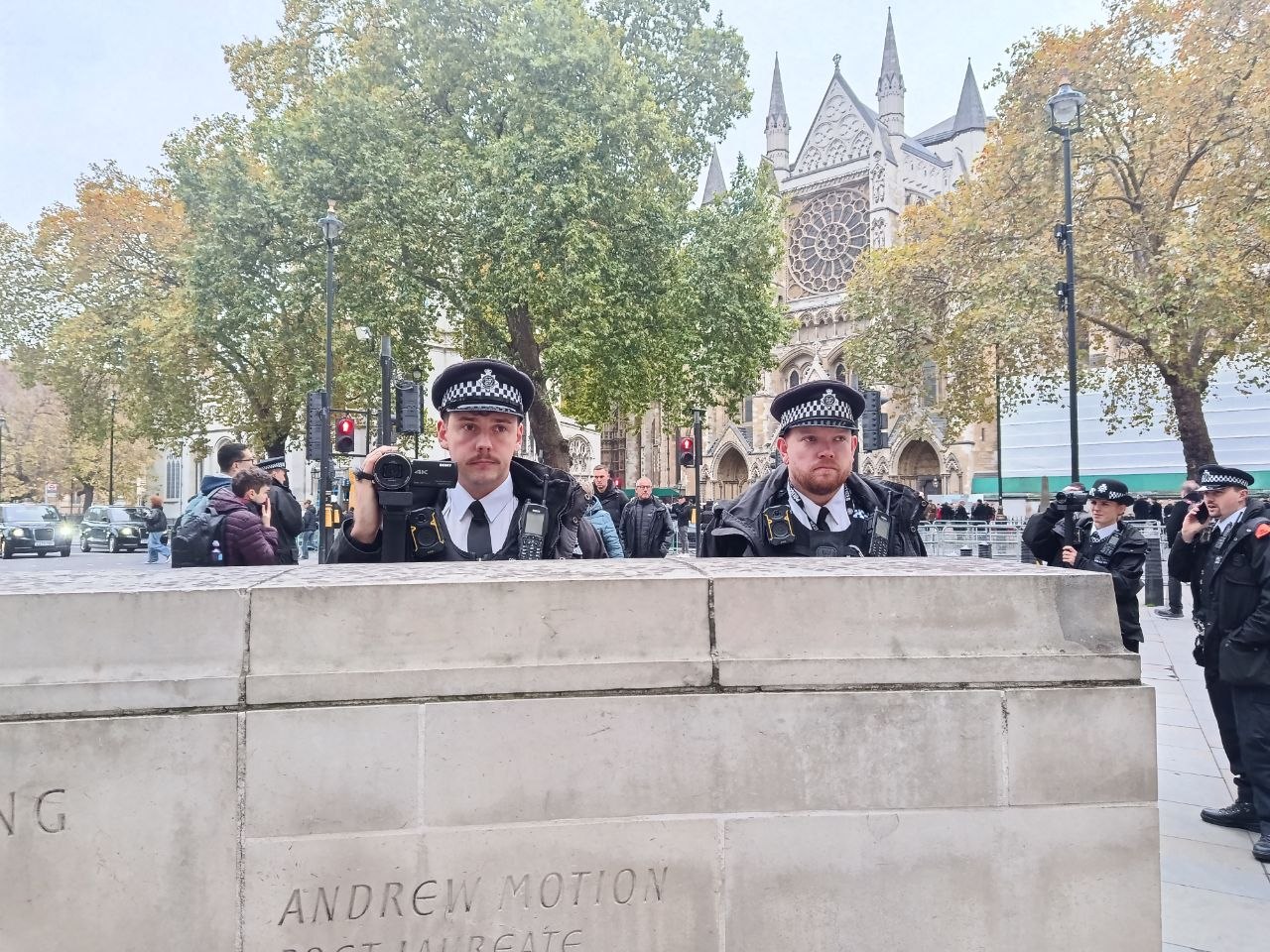
There were four separate teams of policemen photographing demonstrators. Each was a two man team, and two of these teams functioned with a camera operator plus a man with a hefty backpack, which was presumably uploading for facial recognition in real time.
Due to the lack of demonstrators, the police camera teams were forced to queue up to photograph individuals. I felt perhaps the police would feel left out of the game if nobody photographed them, so I took this nice picture of one of the teams, who were playing hide and seek behind a wall. I have since uploaded to our own website facial recognition technology, which tells me that the policeman in the left is named Jimmy Palantir, and the policeman on the right is Xavier Wellington Felixstowe-Gillespie, a distant cousin of the Marchioness of Accrington.
Once in court, Sir James Eadie KC was continuing the case for the government. It is very, very important to understand that Eadie is representing the government view. He is not outlining some neutral analysis of the law. It would be entirely fair to replace his name with Shabana Mahmood, Ed Miliband or Andy Burnham, because that is on whose behalf he is talking.
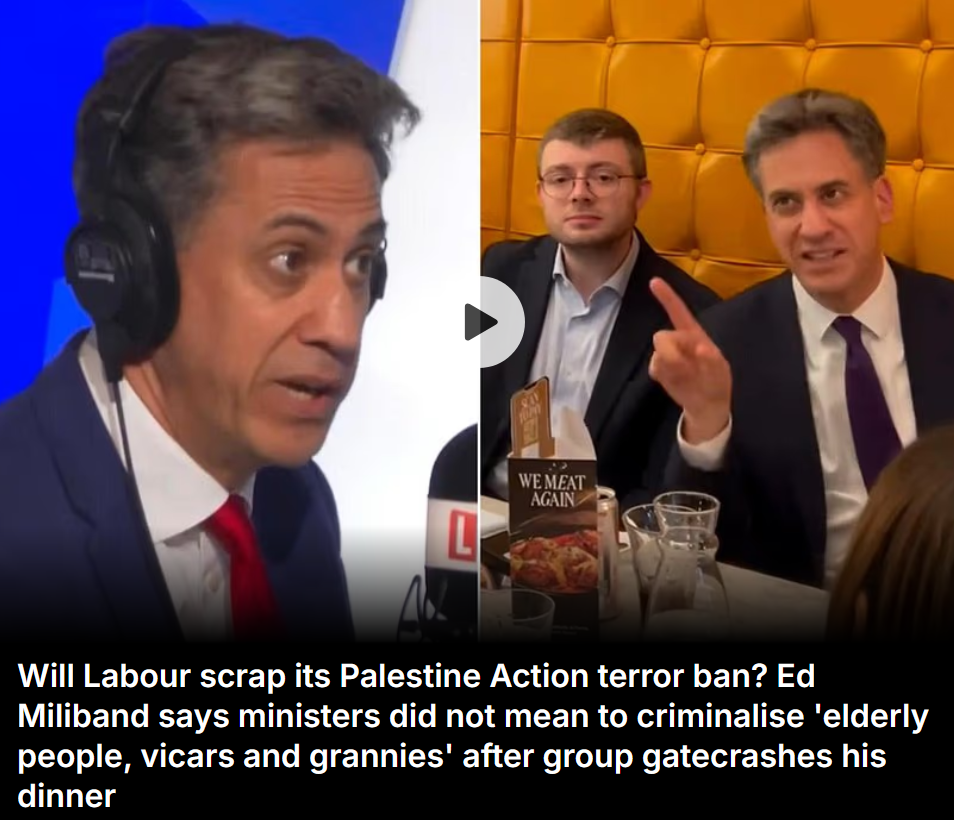
I make this point because of the appalling hypocrisy of the Burnham government (proprietors Labour Friends of Israel). Ed Miliband directly lied when he said that nobody wanted to criminalise grannies. Compare that with the account below of what Eadie actually argued on his government’s behalf in court.
Sir James Eadie KC opened by saying for the Burnham government that Palestine Action meets the statutory definition of terrorism. No permission had been given to appeal that decision and it was not a matter that could be disputed before this court.
The threshold test is set by parliament. The Joint Terrorism Assessment Centre had identified three incidents which met the threshold of terrorism.
Lord Briggs interrupted that this was before the Brize Norton attack.
Sir James agreed that at the time of the JTAC assessment, the Brize Norton incident had not yet happened. The lower courts had assessed that the three terrorist incidents were in fact not outliers as to scale and intent.
The Court of Appeal had said Palestine Action’s activities were the antithesis of a democratic society, said Sir James. Palestine Action in fact lauds those actions described as terrorist, including Filton.
Eadie’s second point for the Burnham government was that Palestine Action had a wide range of targets, not just Elbit, but also any other company in the UK considered by Palestine Action to enable Israel. The Secretary of State (Yvette Cooper) had told parliament that Palestine Action claimed responsibility for attacking Jewish businesses in North London, including smashing windows.
The JTAC assessment was that Palestine Action’s activities included incidents being investigated by the Metropolitan Police as hate crimes against the Jewish community. There were recent incidents but these were in closed material.
[In addition to the public hearing, the government can introduce “closed” secret evidence from the security services. Huda Ammori and her legal team are never shown this, are given no idea of what it alleges, and no opportunity to answer it).
James Eadie said thirdly for the Burnham government that it was not sustainable to call Palestine Action a non-violent organisation. The lower courts had rejected the claim that Palestine Action were engaged in civil disobedience. The attempt to place it in this tradition was disproved by the lower courts’ findings of fact.
The Underground Manual encourages the use of an “efficient sledgehammer”. Activists had carried sledgehammers and crowbars as weapons. JTAC’s assessment of the Filton incident was that Palestine Action entered the factory with weapons including sledgehammers intending to attack. Subsequently security guards and a policewoman were injured.
[Eadie was not ever interrupted by the judges except for a very few occasions when they intervened to agree with him. If the judges had been testing Eadie’s argument in the same way they had constantly attacked Raza Hussain KC when he spoke for Ammori, they might have pointed out that this JTAC assessment had been completely rejected by successive juries. All charges of carrying weapons had directly been found not guilty. One one person had been convicted of a violent offence, and that specifically without intent.
The judges had this information in front of them from Henry Blaxland KC. But the judges allowed Eadie, who was speaking for the Burnham government, to continue his factually untrue allegations with no intervention].
Eadie continued on behalf of the Burnham government that the Underground Manual instructs activists in how to conceal their actions. It calls on people to “dream up crazy actions”. It tells them to “damage, disrupt and destroy” and to “think big”.
A major part of Palestine Action’s funding went into these destructive actions.
The Margaret Jones case makes clear that there are proper bounds to the scope of civil disobedience. Damage to property can be violence. The attempt by Raza Hussain KC to draw a distinction between violence to the person and violence to property had not substance whatever. You end up making a virtue of not advocating serious harm to persons.
This was shown by the JTAC assessment of Filton. Also at Thales, pyrotechnics were thrown into an area where people were gathering. This could hardly be termed non-violent.
Mr Blaxland’s characterisation was entirely untenable. There was no intention to accept arrest. The Underground Manual taught encryption, use of burner phones etc to avoid detection.
At Filton the sledgehammer attack upon Sergeant Evans was of particular concern. Judge Johnson had found a terrorist connection. He analyses serious damage to property, but that pales into insignificance compared to the assaults.
This level of criminal damage and use of reckless force with no restraint did not amount to civil disobedience.
Lord Briggs asked what sentences had been imposed, and was told six to eight years.
Lord Sales asked whether the sentencing remarks could be taken into account in the proportionately exercise, as they were post proscription, then he convinced himself that they could.
James Eadie on behalf of the government said yes it was agreed they could be included. The remarks about the sledgehammer attack were particularly important.
[Again the judges tested Eadie with no contrary questions. They could have pointed out that those sentences were given without proscription, with which they had no connection as it happened after the Filton incident. So they might be viewed as showing that proscription was not necessary. But of course, they said nothing against the government case. The contrast between how they treated Eadie and how they had treated Hussain and Blaxland was stark indeed].
For the Burnham government, James Eadie continued that Brize Norton was dealt with in the second statement of Mr Sinclair of the Home Office. Palestine Action has sprayed paint from repurposed fire extinguishers directly into the turbines of planes and had done damage with a crowbar. This plainly falls within the definition of terrorism as serious damage to property.
The Secretary of State had been entitled to take it into account as part of the proportionality exercise.
Lord Briggs said that the only question was, was the damage serious? Eadie replied that paint into turbines is undoubtedly serious. These planes were used for humanitarian relief missions. What if one had been needed the next day?
Speaking for the Burnham government, James Eadie now made his fourth point. Palestine Action’s membership and structure was obscure. It operated in secret cells. Huda Ammori had been found to lack candour about this.
Eadie’s fifth point for the Burnham government was that the advice received by the Secretary of State was that Palestine Action’s activities showed an escalating pattern of violence. This escalation had begun with the 7 October Hamas attack on Israel. JTAC stated that Palestine Action members intended to further escalate their activities.
Palestine Action had a footprint within all 45 policing jurisdictions in the UK and had pledged escalation. Any suggestion it was moderating after Filton was disproved by Brize Norton.
Lord Lloyd Jones asked if there had been any indication from Huda Ammori that she was planning to escalate. Eadie replied no, but there were judgements on the facts from two lower courts that violence was escalating. The Filton sentencing remarks showed this. Palestine Action was not engaged in any kind of domestic campaigning.
For the last ten minutes Eadie had been repeating the same few points. He asked for a recession to confer with his team, which was granted.
On behalf of the Burnham government, James Eadie KC then said he would now address the decision-making process.
1) The Secretary of State (Yvette Cooper) had been advised throughout by experienced and competent people on the security side on the benefits of proscription. The Proscription Review Group were themselves advised by JTAC and by Counter Terrorism Police (CTP).
CTP had produced a lengthy report weighing up the pros and cons of proscription.
Lord Stephens said the Secretary of State had presumably also received legal advice. Eadie confirmed that she had.
JTAC had justified proscription in terms of the statutory tests. Counter Terrorism Police had listed the benefits of proscribing Palestine Action. They had weighed the benefits of proscribing against use of the criminal law in terms of operational impact. They identified the need for a holistic approach to go after the organisation’s activities.
This included the point made by Lord Briggs, that the existing law had not prevented the attacks, including the violent one at Filton.
[If the judges were scrutinising Eadie in the same way they did Hussain, they would logically have asked him at this stage how this had worked out. Had the attacks stopped? Of course, they did no such thing but continued to show Eadie great deference as the government’s representative].
On behalf of the government, James Eadie stated that the proportionality exercise had to be about the legislative context and about margin.
[The margin of appreciation is a legal term roughly corresponding to benefit of the doubt. The doctrine is that a large amount of discretion or deference should be shown to the executive in matters of national security].
Eadie said on behalf of the Burnham government that the 2002 Terrorism Act makes the provision for the Secretary of State to proscribe against set criteria. The law confers both the power and the responsibility on the Secretary of State. There is an affirmative vote procedure in parliament for democratic accountability.
On behalf of the Burnham government, James Eadie set out multiple judgements by the Supreme Court under Lord Reed the current President, which had argued a wide margin for the Secretary of State. In weighing proportionality the court must give a wide margin for constitutional reasons of the separation of powers. It was for the executive, not the court, to safeguard national security. National security decisions must have the widest margin.
James Eadie argued on behalf of the Burnham government that it was the government, not the court, which had the expertise and competence to judge questions of national security. It was the government which had the democratic mandate and responsibility. Eadie quoted a judgement in another case, on which he said four of the five members of the current court sat, which said precisely that.
There was, he said, a long line of top court authority which gave the Secretary of State the widest margin in cases of national security.
On behalf of the Burnham government, Sir James Eadie said that a wide margin is to be given to the government’s discretion in the area of national security, even when applying criminal prohibitions to freedom of speech.
This margin applies at all points of the proportionality analysis, including in assessing the impact on freedom of speech.
On behalf of the Burnham government James Eadie KC stated “Amnesty and Liberty are wrong about this.”
Lord Briggs said that the Appeal Court had suggested in some decisions that less margin should be given to the Secretary of State in terms of the effect upon individuals. Lord Lloyd Jones said that seemed to be the same point being made by UN Special Rapporteurs in this case.
Sir James Eadie said yes it was, but that argument had been rejected by the Court of Appeal. There are limits to proportionality.
On behalf of the Burnham government, Eadie said that the aim of proscription is to protect the lives and liberties of ordinary citizens from Palestine Action. Proscription is not the objective, degrading the capabilities of Palestine Action is the objective.
The government was entitled to take into account the escalating patterns of violence as shown in the very serious attacks at Bristol and Brize Norton.
The second point on proportionality, said Sir James Eadie on behalf of the Burnham government, was that proscription operated at a national and international level. It would enable authorities to degrade and disrupt Palestine Action as a network.
On behalf of the Burnham government, Sir James Eadie said that the third point was that less intensive measures were not available which would be equally effective, and they would compromise the achievement of the objective. This he said had been set out in another earlier Lord Reed judgement (they gazed at each other smoulderingly and there was a beat, during which I wondered if I should book them a room).
On behalf of the Burnham government, Sir James continued that proscription brings with it a fixed suite of measures which had been mandated by parliament. It amounted to a holistic attack on the organisation itself.
Lord Reed commented that here the Secretary of State had agreed the Counter Terrorism Police analysis. On behalf of the Burnham government, SIr James simpered in agreement. He said none of the proposed lesser measures would, individually or together, achieve the same effect.
The lesser measures proposed were not such as to take the proscription outside the margin to be allowed to the Secretary of State in choosing proscription instead..
The covert nature of Palestine Action’s activities required proscription rather than criminal prosecution. There was nothing in the evidence before this court about Red Teams and Black Teams. Some participants wished to escape arrest. That is the advice from CTP. The criminal law had not stopped this activity or prevented damage to property or people.
[Again there was no attempt by the judges to intervene and test some incredible underlying assertions here. Is criminal law expected to actually prevent any crime from ever happening? Do ordinary criminals never seek to evade arrest?]
Sir James then continued that civil injunctions were utterly hopeless in this case, as stated by the Court of Appeal.
On behalf of the Burnham government Sir James stated that none of the proposed alternatives to proscription passes muster when judged objectively. But the minimum position is that the Secretary of State, within her wide margin of discretion, was entitled to conclude based on the advice she received that proscription was necessary.
Finally, Sir James Eadie said the would address on behalf of the Burnham government the question of the balance of proportionality. The Secretary of State must be afforded a wide margin of discretion on national security matters.
You will have noted by now that Sir James was endlessly repeating himself. He kept glancing at the court clock. Due to well over 100 highly hostile interventions by the judges, Huda Ammori’s legal team had needed to cut their arguments very substantially short, but still overran by 20 minutes. That meant they would only have 10 minutes for rebuttal when Sir James finished speaking; but could regain some of that time if he finished early.
It had been obvious for some time that Sir James was padding out his thin material to take up the time, and as he said “margin of appreciation” and “serious attack at Bristol” for the umpteenth time, it was difficult to stay awake.
Sir James droned on, on behalf of the Burnham government. The fundamental question, he opined, is the nature of Palestine Action as an organisation. It is not, he said, a non-violent direct action group in the tradition of civil disobedience.
It is the opposite. It engages in covert action. It does not accept responsibility and punishment. It bears no resemblance to non-violent civil disobedience groups. It took crowbars and sledgehammers as weapons. It could not be a surprise if in the heat of the moment that turned into serious violence as at Bristol.
On behalf of the Burnham government, Sir James Eadie said that any criminal conduct is outside the protection of Articles X and XI (freedom of speech and freedom of assembly). This applies even more strongly if the activity falls within the definition of terrorism.
Lord Briggs suggested that those who spoke up for Palestine Action were not involved in the terrorism itself.
On behalf of the Burnham government, Sir James Eadie KC said that parliament had foreseen that terrorist organisations would have such supporters and parliament had set out the criminal provisions that would be applied against them. Parliament had decided that these measures against the organisation and its supporters are appropriate to degrade the organisation.
Palestine Action had been engaged on an escalating trajectory of violence. There was a benefit to degrading Palestine Action and its finances. The aim was to prevent and discourage terrorism and to degrade the organisation, taking all of its activities into account.
Lord Reed stated that as described by the Secretary of State, the organisation had attacked Jewish businesses in North London. Sir James Eadie agreed that this is very important; all of its activities have to be looked at.
Sir James then argued on behalf of the Burnham government that the Appeal court had rejected the argument about impact on Article X and XI rights. He stated that the proscription will not prevent any protests against Israel or Palestine or against Elbit.
On behalf of the Burnham government, Sir James Eadie KC said that the Court of Appeal had found that only a small number of people were likely to face arrest as supporters of Palestine Action. In any event, little weight ought to be given to those who made a conscious decision to break the law by supporting Palestine Action.
Indeed, said Sir James on behalf of the Burnham government, there is evidence that Palestine Action are deliberately engaged in an effort to encourage people to get arrested to overwhelm the justice system.
Huda Ammori had overstated the effects of proscription. The Court of Appeal had said that the number of people whose speech might be chilled was significant, but whatever level it is at is outweighed by the benefits of proscription.
It was a strange performance. Sir James had saved up until the last two minutes the utter demonic callousness of the government’s attitude to the thousands of protestors being arrested for holding placards, and then rushed it all out at once, completely unvarnished.
I suppose as his time then ended he avoided being challenged on it by the judges, but there was no chance of that happening anyway.
Raza Hussain KC now had 11 minutes to respond to Sir James on behalf of Huda Ammori. He stated that he would address 9 topics. This was very ambitious, and I am not sure it was wise, as he bolted through them so fast I could hardly get any notes. let alone weigh their significance, but here we go.
- The proportionality framework does not give primacy to the Secretary of State, only a degree of discretion. This was the omniscience problem: parliament could not foresee all future events. That is why the proscription regime is subject to the provisions of the Human Rights Act.
- Eadie said that the divisional court and Court of Appeal stated that the three incidents analysed as terrorist were not “outliers”. But what they actually said was that they were “at one end of a spectrum”.
- Eadie repeatedly said that Palestine Action were a “self-styled” non violent direct action group. But that was what every single one of the official Home Office papers and assessments called them. There was not one document before the Secretary of State that said they were violent. Lord Stephens at this stage looked apoplectic and demanded whether Palestine Action had condemned the sledgehammer attack. Raza Hussain KC said that the matter was sub judice as currently subject to a criminal case appeal. Judge Johnson’s rulings were under challenge which should be borne in mind in considering his sentencing remarks. The Underground Manual was very similar to guides produced by other non-proscribed groups, especially in climate action. Trident Ploughshares had also used hammers in their actions.
- It was untrue that Palestine Action did not try to convince democratically through their arguments. They did so in the same kinds of way as the Suffragettes.
- I couldn’t follow
- Palestine Action has legitimate aims. It is seeking to prevent material supply to an active and widely seen Genocide.
- Palestine Action had never attacked Jewish businesses or Jewish people per se. The court had evidence from Andrew Feinstein that he would never support Palestine Action were it anti-semitic. The accusation of anti-semitism was rejected in the strongest possible terms.
- Impact on free speech had been widespread. Lord Lloyd Jones intervened to say that if you supported a proscribed organisation you opened yourself up to the suite of measures under the Terrorism Act. Hussain countered that the point was that Palestine Action did not pose a threat to society.
- There was now under a minute left. Raza Hussain KC said that this was about the most important issue of our time: Israel’s annihilation of the already oppressed Palestinian people. Palestine Action’s activities ranged from protest to the destruction of drones intended to kill Palestinian children. That was the true import of these proceedings.
So the last sixty seconds from each side showed what they truly thought. The Burnham government said that all those pensioners being arrested are anti-semitic terrorists and should be in jail. Raza Hussain said that Israel is murdering children and it is legitimate to try and stop it.
That was it for the public sessions. There was to be a closed session. That would be held before the judges without Huda Ammori’s legal team. The government presents its “secret” evidence from the intelligence services. Huda’s team are never told what they say and never get any chance to answer it.
We can be pretty certain they will claim that Palestine Action is funded by Iran or is part of Russia’s “hybrid warfare”. They probably make claims about bombs and guns and other lies. These are coming from the same security services who told you that Iraq had weapons of mass destruction.
The irony is that the very day before these Palestine Action hearings, the High Court ruled that MI5 would not face contempt of court action for lying in another case – not misleading, not misjudging, but actually lying. They conveniently decided that for MI5 to face charges would “not be in the public interest”.
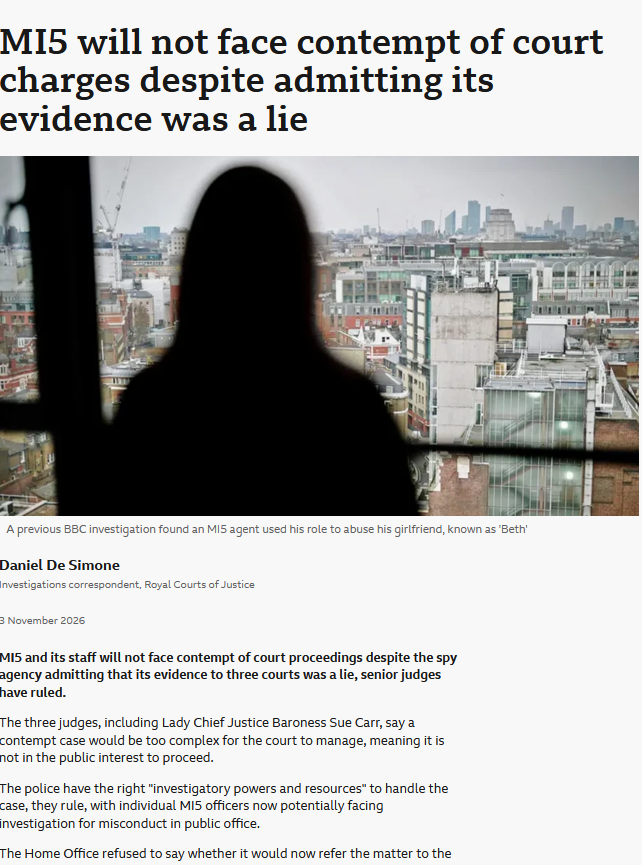
The court was now going to give these liars a secret hearing where they could tell more lies about Palestine Action.
The implications of all of this are truly chilling. The Court’s doctrine is that in matters the government deems “national security”, the Human Rights Act is a dead letter because the decision of the “democratically elected” Secretary of State must be respected, also because she has “national security” technical experts.
National security and the security services is precisely the area where the Human Rights Act is most needed and the state abuse it protects against is most likely to occur. Under Lord Reed the British “justice system” proudly announces that it is entirely at the service of power in an increasingly fascist state.
As I walked out into London there was an entirely appropriate postscript. A small group had gathered around a police van. I took a photo and then walked over.
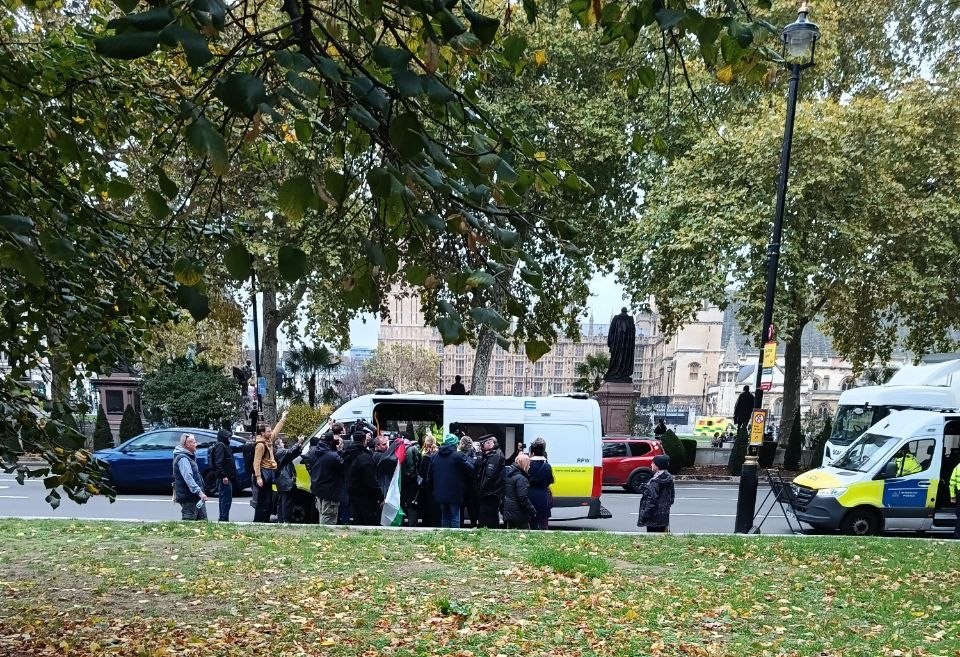
An eighty four year old lady named Margaret had been arrested for supporting Palestine Action. I stood in the rain and waved as the police drove her away.
—————————————–
Anybody is welcome to republish and reuse my work, including in translation.
My work has no funding at all except for your subscriptions. If you already subscribe, I would be grateful if you could check if your subscription is still active. Over 80% of my subscriptions lapse when debit or credit cards expire: the systems do not warn you.
Because some people wish an alternative to PayPal, I have set up additional new methods of subscription payment including Patreon account and a Substack account, if you wish to subscribe that way. The content will be the same as you get on this blog. Substack has the advantage of overcoming social media suppression by emailing you direct every time I post. You can, if you wish, subscribe free to Substack and use the email notifications as a trigger to come to this blog and read the articles for free.
I am determined to maintain free access for those who cannot afford a subscription.
Choose subscription amount from dropdown box:
PayPal address for one-off donations: [email protected]
Alternatively by bank transfer or standing order:
Account name
MURRAY CJ
Account number 3 2 1 5 0 9 6 2
Sort code 6 0 – 4 0 – 0 5
IBAN GB98NWBK60400532150962
BIC NWBKGB2L
Bank address NatWest, PO Box 414, 38 Strand, London, WC2H 5JB
Bitcoin: bc1q3sdm60rshynxtvfnkhhqjn83vk3e3nyw78cjx9
Ethereum/ERC-20: 0x764a6054783e86C321Cb8208442477d24834861a
How can there be a trial with a secret part to it ??? This should not be alloud under any pretense. There is no independent judicial power anymore, so much is clear. So it means we are in for abuses without recourse. Shall this have to end in front of the International Court of Justice ? How long is this going to take…
Truly Kafka-sequel. There is no Reason or logic in this