As I was leaving the University of the Communes in Tocuyito, after a joyful and uplifting visit, an earnest young Professor came up to me and pulled me aside. Very quietly, he asked me what was going to happen. A number of the students were terrified there would be regime change and they, picked as young socialist leaders in the commune movement, would be imprisoned, tortured and executed.
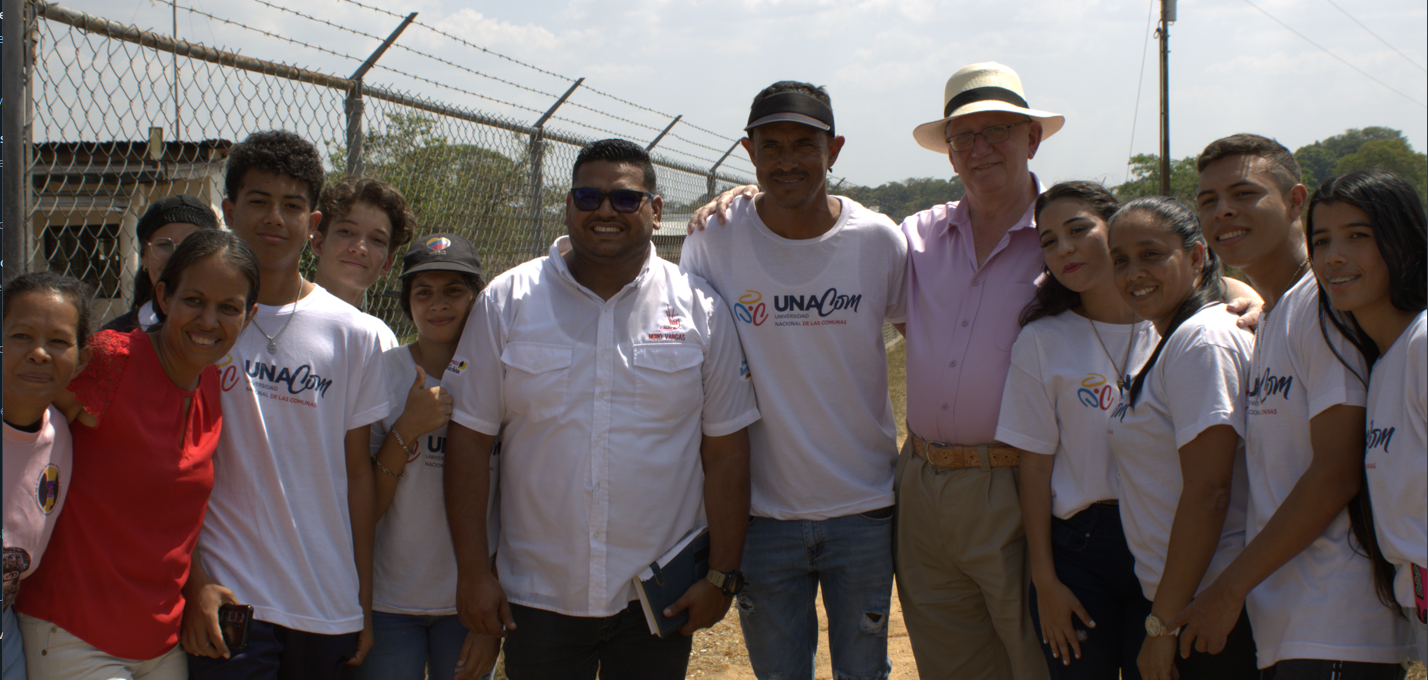
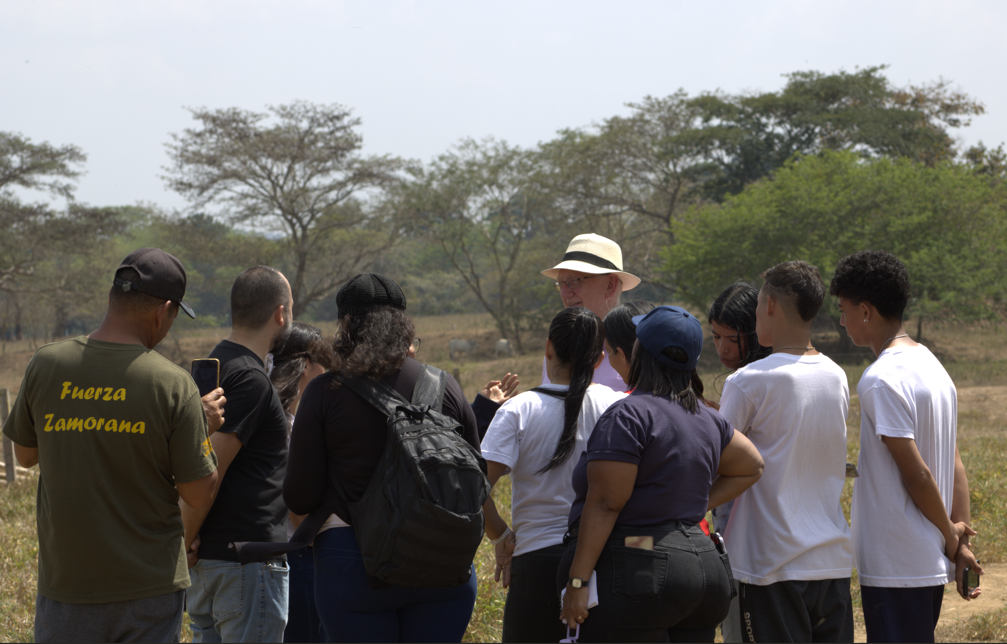
With students at an agricultural project of the Vittoria commune
It was a sharp reality check after a great day at this fledgling university. But it is very real. I had met sober and professional diplomats at the Ministry of Foreign Affairs who knew exactly which part of the mountains they would flee to with assault rifles in the event of the right coming to power, and were resigned to a life of guerilla warfare, including partners and children. I have met nobody who doubts that a change of regime in Caracas would lead to immediate mass killings of leftists, and a lengthy civil war.
Almost everything you are told in the West about Venezuela is untrue, and the biggest lie is that Machado, Guaidó and the groupings around them are in any sense democrats or liberal. They are not, and have direct family and political links to the murderous CIA-sponsored regimes of the pre-Chávez years. They also have many scores to settle – Machado’s family, to give just one example, dominated the electricity supply before it was nationalised.
A very large number of the “political prisoners” the West is so concerned about, were involved in efforts at military coup or violent insurrection, of which Guaidó’s comic opera attempt in 2019 was only the most publicised. After the disputed 2024 elections many of those imprisoned were actually brandishing weapons – I met the families of three young men who told me their sons were misled into taking to the streets with guns, and hoped they would get out in the current amnesty.
Sanctions caused great economic hardship which affected government popularity. But it is a huge error to conflate discontent at the Maduro government with support for Machado – there is almost no evidence of the latter, no matter how hard you look. That Machado does not have the internal support to run the country is one of the few things Trump has stated truthfully. The alternative to the socialist government is chaos.
So Delcy Rodríguez has to maintain the Socialist Party in government, or see supporters butchered and the start of a civil war. At the same time she has to contend with the blatant colonialist assertion of control over Venezuela’s assets and finances by the USA, while placating the irascible and irrational Trump.
Let us get one thing straight. I have spoken personally to those closest to President Nicolás Maduro. I have spoken with Francisco Torrealba, who followed Maduro as President of the Transport Workers Union and also took over Maduro’s seat in the National Assembly. I have spoken to Maduro’s son, also Nicolás. None of these people believe for one second that Delcy Rodríguez was in any way implicated in the kidnap of Nicolás and Cilia Maduro.
Why does almost everybody in the West believe a narrative that nobody in Venezuela believes, and which I am quite certain is untrue?
That narrative has been force-fed to you. Trump undermined Delcy Rodríguez by open praise of her and assertion that she is his choice. The truth of course is different: as Maduro’s Vice-President, she naturally assumes the duties of President, as confirmed by the Venezuelan Supreme Court. A co-ordinated effort of briefings to journalists by the Trump administration, by the security services, and by Machado-aligned Venezuelans in Miami, gave to the media in a coordinated fashion a detailed story of negotiations between Delcy and her brother Jorge and the Americans, for a strategy of economic reform that included Maduro’s removal.
I have looked again through many articles that forward this narrative, and all of them very obviously come primarily from Washington sources, and it is a narrative that the United States has been very, very assiduous in feeding you.
It begs the question, if Delcy really is a Western puppet, why is the Western Establishment so keen to tell you that? In every other circumstance, like the Gulf monarchies or al-Jolani, they are always anxious to promote the myth that their puppets are not puppets.
My maxim, that if the government really wants you to know something, it probably means it isn’t true, holds in this case. Trump wants it known that Delcy Rodríguez is his puppet because it is part of his victory narrative, the fake story of Trump greatness. It is also intended to divide and weaken the socialist movement in Venezuela.
We have to look at the night of 3 January when Maduro was kidnapped. There is one key fact which again is simply not part of the Western narrative. It was Nicolás Maduro who instructed the military to stand down and not to fight, in the event of an attempt to take him. In fact he was aware that such an event was imminent, though he did not know the exact date.
Maduro’s primary concern was to avoid war between Venezuela and the United States, war which would devastate this peaceful country.
It is important to note that Maduro was consciously following the template of his mentor President Hugo Chávez in his kidnapping in a CIA-orchestrated coup in 2002. (That link is a wrenching reminder that there was once a Guardian and Observer not captured by the security services). Following armed opposition insurrection on 11 April 2002, in which 19 Chávez supporters were massacred and 150 injured, a military coup captured President Chávez and he was flown to the island of La Orchila in a CIA-chartered plane.
Opposition leader Pedro Carmona was sworn in as President by the military leaders and instantly recognised by the Bush regime in Washington. He announced the immediate repeal of all of Chávez’s reform measures. However the people and bulk of the armed forces rose against the plotters and after only 48 hours took back control. Chávez returned to power. This is the basis of the brilliant Irish documentary The Revolution Will Not Be Televised (which, naturally, was never televised).
The key thing to understand is that – remarkably – Chávez did not execute any of the coup participants, not even those in the military. There were in fact few prosecutions, jail sentences were remarkably light and many – including “President” Carmona – were allowed to “escape” into exile. The longest jailings were for those who actually took part in the massacre of April 11. Chávez gave a December 2007 general amnesty.
The same astonishing tolerance was shown to Juan Guaidó, the Western puppet who attempted a farcical military coup on 30 April 2019. While his coup was a pathetic failure and his total number of military defectors was 50, he nevertheless caused the deaths of four people and wounding of 230.
Again the response of the socialist government was astonishingly lenient. Nobody was executed. Proper trials were held of those accused and jail sentences were remarkably light even for those convicted of treason. It is worth saying that the numbers tried and the sentences were notably lighter than those handed down for the Washington Capitol Hill “insurrection” of 2021.
A group of thirty who took refuge in Bolsonaro’s Brazilian Embassy were allowed peacefully to leave the country. Guaidó was never arrested and was tolerated to wander around the country for years claiming to be President, and travel freely in and out, until he was indicted by the Government of Colombia for entering that country illegally in 2023.
The socialists’ refusal to spill blood has never been mirrored on the right. The large majority of those “political prisoners” you constantly hear about were involved in these or a whole series of lesser-known armed attempts, or in the opposition’s very real links to narcotics trafficking and organised crime.
What is surprising to me is not the claimed authoritarianism of the socialist government but, on the contrary, its quite astonishing leniency with the opposition in the face of repeated CIA-sponsored, frequently armed attempts at overthrow.
One has only to envisage how a right-wing Latin American government would deal with repeated left-wing armed coup attempts, to appreciate just how extraordinary this restraint has been. Lack of violence or vengeance has always characterised the Bolivarian Revolution’s reaction to right-wing coup attempts. Though it is admirably principled, I am not even sure I think this extreme degree of tolerance is wise.
It is in the context of this longstanding socialist reluctance to use violence that you have to view Maduro’s decision to stand down the defence forces in the event of an American kidnap mission. This is a government which does not just use revolutionary slogans, it lives by them, and “peace” is a key one. Maduro almost certainly hoped that domestic solidarity would oblige his return quickly, as had happened with Chávez. It is unlikely it occurred to him that Trump would simply – and pointlessly – remove Maduro and leave his government in power.
Multiple sources have confirmed to me that the Venezuelan forces were ordered to stand down. I visited the hillside location at Fuerte Tiuna where young female Lieutenant Alejandra del Valle Oliveros Velásquez, age 23, refused the order to stand down and continued to stand guard with her gun at a vital hilltop communications facility. She died as it was struck by American missiles.

This is also a point missing from the Western narrative of military events. Venezuela’s defensive posture is hopelessly outdated in the age of precision missile warfare. Its radar installations and anti-aircraft batteries are highly visible on open hilltop locations, not in hardened bunkers. Its troops are in open barracks, like the unnecessarily murdered Cuban guards.
Outrage at the entirely unprovoked American assault has restored a much-needed sense of national unity to Venezuela. In the bitter aftermath of the disputed July 2024 presidential election, many government supporters, including some in office, concede that the wave of arrests went too far. That overreach damaged the government’s moral authority at home and handed valuable propaganda ammunition to its critics abroad.
There was not sufficient discrimination between armed and unarmed protestors, and while many would argue that emergency measures were essential to prevent immediate anarchic violence, it is generally admitted that many incarcerations have gone on far too long.
Acknowledging this does not mean accepting the inflated figures and politicised methodology pushed by Western-funded NGOs such as Foro Penal and their international partners. Those counts routinely lump together genuine dissidents with armed plotters, participants in violent insurrection attempts, and outright criminals — many of whom were brandishing weapons or linked to coup networks.
The NGOs’ inflated numbers are not neutral human rights monitoring; they are part of a longstanding information warfare operation, generously funded by the very governments and foundations that have spent years supporting regime change efforts in Venezuela. Their selective outrage and consistent inflation of “political prisoner” tallies serve a clear political purpose: to delegitimise the Bolivarian process and justify external interference.
Broader perspective is essential. The arrests did not emerge from a vacuum. They followed years of sanctions-induced economic pain, repeated opposition attempts to subvert constitutional order through street violence, election disruption both physical and electronic, and what were forged or selectively manipulated election returns from the opposition. The response was heavy-handed, but it occurred against a backdrop of genuine security threats.
The narrative that the opposition won 70% of the votes in the 2024 election is simply absurd to anyone who knows Venezuela. In their final election rallies, Maduro had 1 million people on the streets of Caracas and the opposition had 50,000. Many of the alleged voting machine printouts bandied about by the Biden regime were very evident forgeries – with the same handwriting in different locations, and multiple examples of returning officers or party officials signing with an X in a country with almost 100% literacy.
The Opposition refused to present these printouts to the Supreme Court for verification. The truth is that the electronic electoral process (I am not a fan) was badly affected by external hacking, almost certainly by the USA. There was indeed popular discontent with the effects of economic sanctions, and many seasoned observers think the elections were close. It will never be possible to discover the real result. But Western claims of 70% opposition support are absolute nonsense.
In fact, I do not believe that either the government or the Supreme Court really knew the true result. I certainly do not. But it was American-orchestrated disruption that made it impossible.
Venezuela is a substantively free country. People have criticised the government to me openly and without fear, including on camera. There was an opposition demonstration in Caracas a few weeks ago. It was very lightly policed. Speakers could say what they wished – support for Donald Trump was a key theme – and nobody has been subsequently questioned. About 500 people turned out. I have seen three or four opposition posters around town. Nobody takes them down.
I have been filming all around Venezuela in total for six weeks, and have never been asked who I am by officials or police, or required to produce identity papers. I received a permit from the Ministry of Communications but nobody has ever looked at it. Nobody has ever suggested what I should say, or instructed me not to film something.
I have been to many different areas and provinces. Everywhere the shops are fully stocked and the bars and restaurants fully operational. People look well fed. I have not seen one drug addict, beggar or homeless person. I have seen five police or military checkpoints in six weeks – three at the Presidential residence, Police HQ, and National Assembly; one checking car tyres and lights; and one at the exit to a national park doing wildlife conservation enforcement.
I have been rather obsessively keeping check because Western journalists always put in police and military checkpoints in their imaginary descriptions of Venezuela, penned from thousands of miles away. The Machado opposition have made it a meme, putting out advice saying you are not obliged to show identity documents at police checkpoints. It would be very hard to find a checkpoint to show your documents to.
This is not a repressive government. The atmosphere of repression is entirely absent and that is because the mechanisms of repression are entirely absent. There is no heavy police presence. People are not scared of informers. I have seen very few guns carried by police, and zero guns carried by anybody else.
The narrative now dominating Western media — that any economic liberalisation or pragmatic opening under Delcy Rodríguez is a sudden capitulation forced by Trump’s pressure — is simply false. Nicolás Maduro himself initiated processes of economic liberalisation years earlier, as a direct survival response to the crushing weight of sanctions. These are Maduro’s policies. The recent legislation liberalising the hydrocarbons sector was entirely developed under, and approved by, Nicolás Maduro.
Dollarisation spread from below as ordinary people sought stability; the government gradually relaxed price controls, permitted greater private-sector involvement in imports and distribution, and developed workarounds for oil sales. These were pragmatic adaptations forced on the revolution long before Trump returned to the White House.
As I told the students at the University of the Communes, if late-stage capitalism were (as it claims) the natural order of society, rather than a series of entirely artificial institutions and arrangements designed to produce an extreme concentration of resources in the hands of an elite, enforced ultimately through the violence of the state, then the capitalist states would not need to crush states practising other systems, through crippling sanctions and isolation from exchange of resources and capital, and ultimately through military force.
Its own founding ideology states that capitalism will naturally prevail eventually in any society through its greater beneficence and more efficient distribution of resources. Yet the rulers of the capitalist states constantly seek to crush any state practising any alternative system. They do this for fear that their own population will see the possibility of a better path than working as effective slaves while the value produced by their labour concentrates entirely into the hands of the Epstein class.
We will never know how the Bolivarian Revolution would have developed were it not for the financial and trade sanctions that crippled it.
But this is the key fact. Venezuela was targeted because of the extraordinary successes of Chavismo, not because it was a failed state. Poverty was more than halved. Literacy increased to better rates than the United States. Free education and healthcare were instituted. Pension recipients were tripled. Utilities were nationalised. Massive amounts of social housing were provided. These were the achievements that precipitated sanctions.
The economic collapse of 2017 was not caused by failures of a socialist system. The collapse – and the subsequent mass wave of emigration – was caused entirely by the sanctions regime, and particularly the blocking of all payment systems and financial transactions.
There is an obvious point seldom discussed: sanctions — particularly the financial sanctions that block normal international payment transactions and banking channels — do not merely cause hardship.
Sanctions actively breed corruption.
When a sovereign government is prevented from conducting legitimate trade and finance through standard global systems, it is driven into the arms of those who specialise in sanctions-busting, informal transfer networks, and money laundering. These forced partnerships with elements outside the formal economy then infect the state apparatus itself, creating new avenues for graft and abuse.
It is a vicious, predictable cycle engineered by Washington policy.
Sanctions force states for very survival to do things classified as illegal, and draw their operatives into the ambit of actual criminals. Some of the criticisms of the Maduro government should be viewed through this prism; and of course there is not, and has never been, any state entirely free of corruption.
Maduro’s rule is not the failure that is routinely portrayed in the West. The economy has rebounded remarkably. Under Maduro, the government scored measurable successes in public security. Murder rates have dropped by over two thirds and the narco gangs are almost entirely off the streets.
Large-scale operations significantly curtailed narcotics production and trafficking routes through Venezuelan territory. Venezuela reported record drug seizures to the UN Commission on Narcotic Drugs — nearly 66 tonnes in 2025 alone, the highest level in two decades. UN data states that Venezuela plays only a very marginal role in global cocaine flows, and almost none in production. On fentanyl it doesn’t feature at all.
Maduro has succeeded to an extraordinary degree in suppressing drugs on the streets of Venezuela and in stopping trafficking. That he is now in a US jail charged with “narco-terrorism” is truly a sign of how depraved the United States has become.
At the same time, the overall crime rate fell sharply. Cities that once ranked among the most dangerous in the world became noticeably safer for ordinary citizens. Even Venezuelans critical of the government on other grounds acknowledge this improvement in daily life and personal safety. Just two nights ago I was talking to a Venezuelan visiting home from Germany, who told me she used to be terrified to walk the streets of Caracas at night, but now felt perfectly safe.
It is important to understand what kind of socialism Venezuela actually practised under Chávez and Maduro.
The Bolivarian project was never the full state ownership of the means of production and distribution envisaged in classical Marxist texts. Venezuela has always been a mixed economy. Its distinctive feature — and its greatest strength — was the heavy reliance of the state on ownership of the full range of oil sector activity, upstream and downstream, to channel large public revenues into socialist-oriented goals: universal free education from cradle to university, a national health service that brought clinics and hospitals into every barrio, expanded social security, housing programmes such as the Gran Misión Vivienda, and subsidies that kept basic foodstuffs affordable for the poor.
The nationalisation of utilities — electricity, telecommunications, water — followed the same logic. In many respects it resembled the Western social-democratic model of the 1970s, when European governments used progressive taxation to fund the welfare state while leaving large parts of the economy in private hands. The massive scale of affordable decent quality public housing in Venezuela is truly a marvel to behold for a developing economy.
What made Bolivarianism different, and ultimately more radical, was the commune movement. Its philosophy is genuinely grassroots. The communes did not spring from decrees in Miraflores Palace; they grew from below, from the communal councils that ordinary people in poor neighbourhoods formed to solve their own problems — fixing roads, organising rubbish collection, building clinics.
Chávez gave these organic commune structures constitutional recognition and legal power, but the energy came from the communities themselves.
Decision-making in the communes is direct democracy in action: assemblies debate and vote on how to spend the funds allocated to them. The people decide their own priorities. I have always been a sceptic of people’s assemblies and direct democracy. Visiting Venezuela’s communes has converted me. The key factor is the quite astonishing prevalence of political education and social awareness among the ordinary members of the Venezuelan working class.
For a long time the communes remained largely a mechanism for redistributing oil revenue in a more democratic and transparent way. But it was still, in essence, social democracy with revolutionary rhetoric — spending the rents from oil on social goods.
But the commune movement has not stood still. It has begun to push outward, asserting communal ownership over the means of production and distribution. Increasing numbers of communes now run their own small factories, agricultural cooperatives, bakeries, abattoirs, transport collectives and distribution networks. I have discussed with senior government figures how to use commune-owned enterprises as a spearhead in liberalised sectors of the economy, to socialise profit.
Communes are moving beyond simply receiving and spending state money and towards controlling the actual creation and allocation of wealth. This is the qualitative leap that marks Bolivarian socialism as something more than 1970s-style welfare statism.
Maduro instituted the University of the Communes in 2025. It is predicated on providing practical university-level teaching in the areas of particular value to the communes, ranging from public administration to electrical engineering and agriculture. Agricultural production is an area where many of Venezuela’s over 7,000 communes are engaged.
Agriculture collapsed in Venezuela long before Chávez. This is in common with many oil states.
My first overseas diplomatic post was an appointment to Nigeria in 1986, as Second Secretary (Agriculture and Water Resources), where my favourite statistic was that Nigeria went, in just 8 years, from being the world’s largest exporter of palm oil to being the world’s largest importer of palm oil. Oil-backed currencies frequently make agricultural exports uncompetitive and imported agricultural products cheaper than domestic.
This collapsed Venezuela’s cocoa, coffee, maize and other agricultural sectors decades before Chávez came to power.
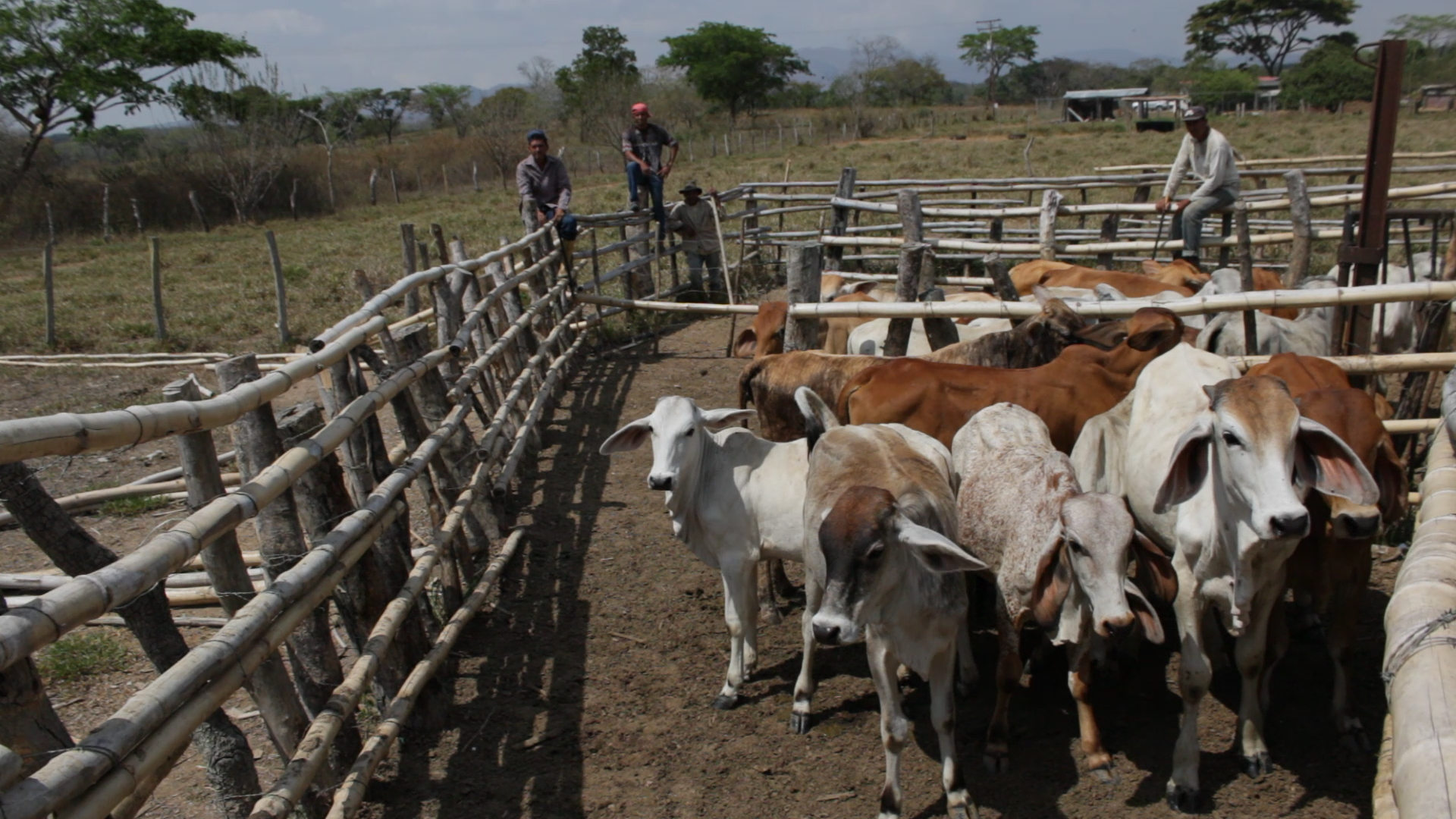
The communes are reintroducing agricultural production from ground level up. I visited local commune Vittoria not far from the University. It has over 20 agricultural production units, and students were assisting in developing, for example, bamboo cattle pens to replace iron hurdles no longer imported due to Western sanctions.
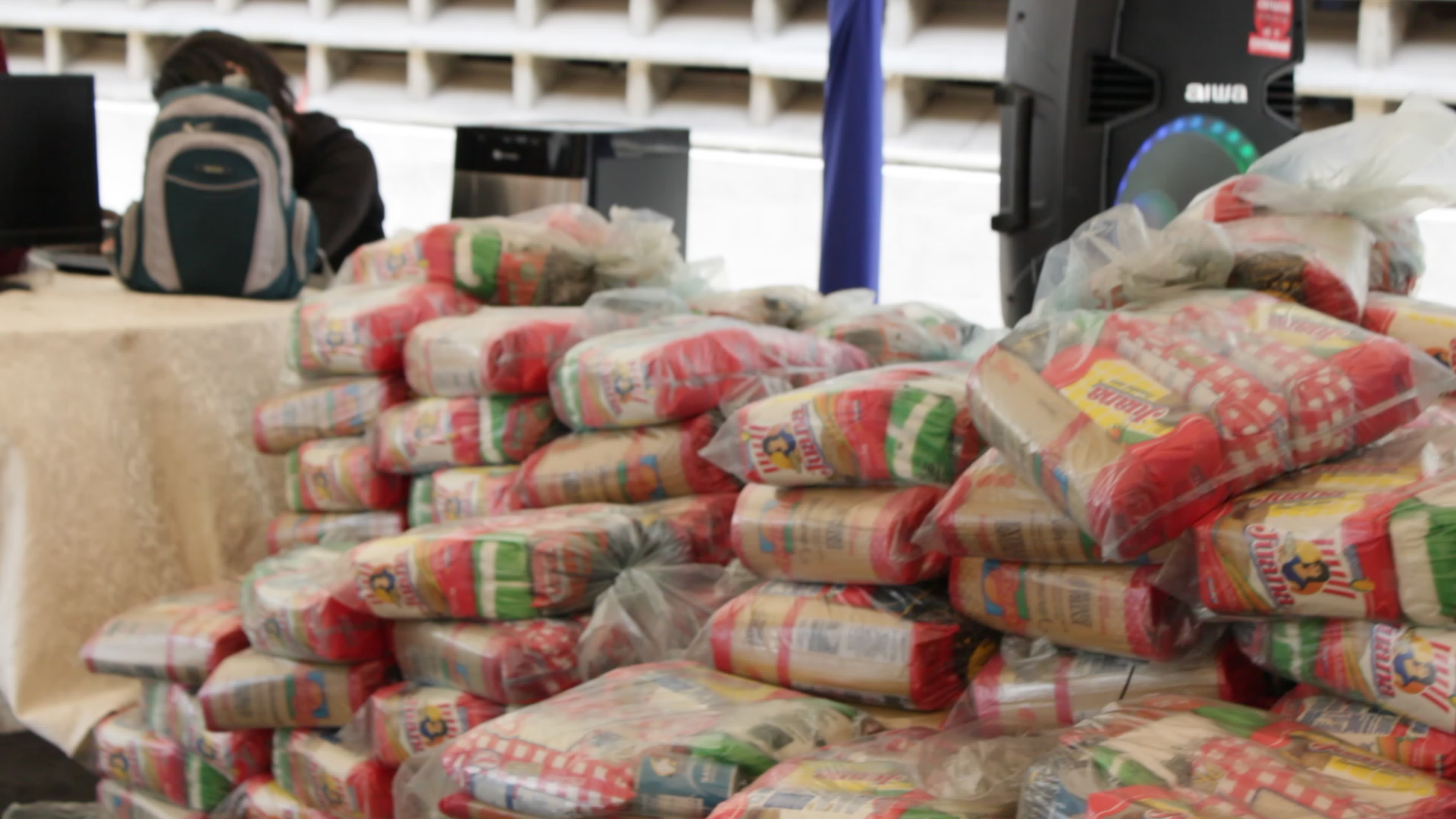
At the other end of the production process I visited the Metro HQ in Caracas on the day when all the Metro workers and pensioners are given monthly packages including cooking oil, pasta, flour, eggs and tinned meat and fruit, all of it now produced in Venezuela, and almost all are new products since the 2018 crisis.
What strikes every visitor is the extraordinary level of public awareness of socialist philosophy. In the communes, in the Bolivarian universities, in political education circles, ordinary people discuss with real knowledge the difference between social democracy and socialism, the role of the commune as the “cellular tissue” of the new society, and the necessity of moving from distribution to production.
Ideology is lived daily practice. I have heard teenagers and market sellers quote Chávez and Marx with ease, and with confidence their interlocutors will follow.
These are the fundamental elements of Bolivarian socialism that Delcy Rodríguez is now fighting to preserve and safeguard in the face of the Trump onslaught: the oil-funded social democratic state, the nationalised utilities, the direct-democracy structures of the communes, and the moves to spread the assertion of popular ownership over production.
Consider this: Venezuela has the most beautiful Caribbean beaches I have ever seen. They are as good as Mauritius or the Maldives. These are my own photos and the colours are not retouched.
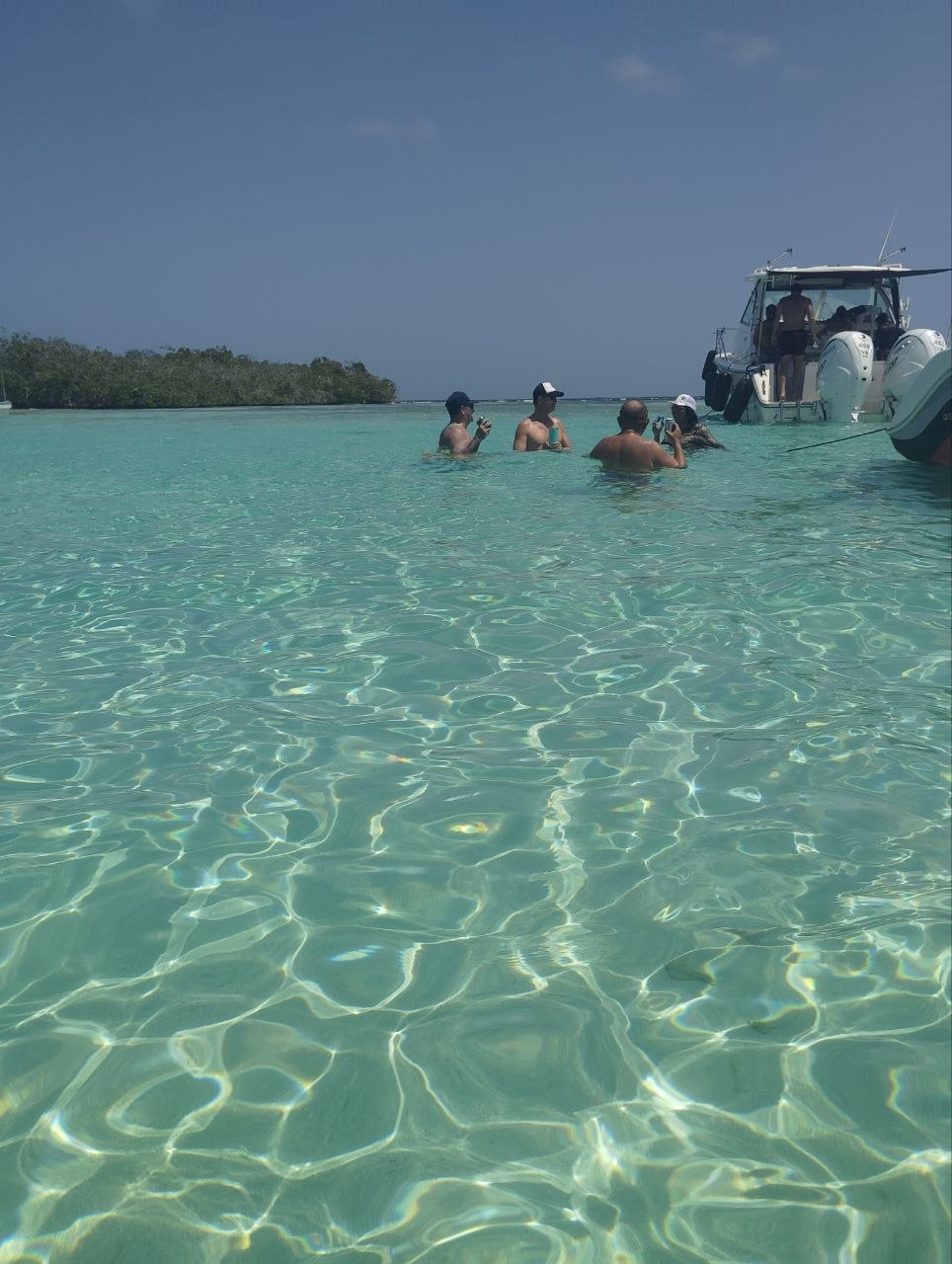
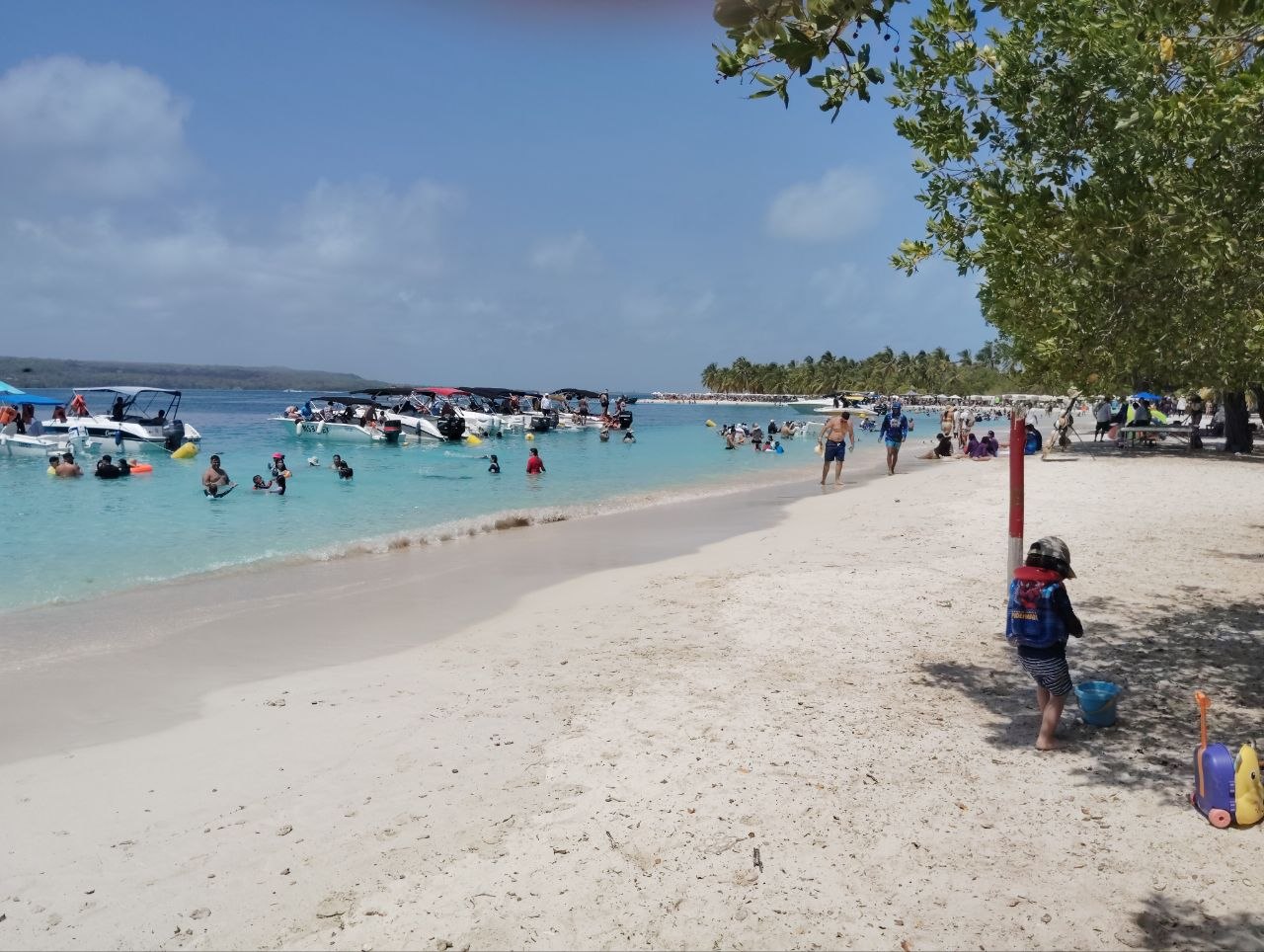
What is remarkable about this is that all the people you see are ordinary Venezuelans. There is not a foreign tourist in sight: no beachside bar, restaurant or hotel chaining off stretches and covering them in sunbeds. Instead you have happy Venezuelan families with coolboxes enjoying the day for free. That is because, Isla Margarita aside, the Bolivarian Revolution protects Venezuela’s hundreds of miles of white sand beach by National Parks.
Where Chavismo sees a great amenity for the people and an astonishing habitat to be preserved, the Kushner and Machado worldview sees billions of dollars of prime beachside real estate, ripe for condominiums and huge hotels. Do not for one moment believe that they do not have their eye on it as part of the Imperialist grab. They do not want Venezuelans frolicking with their families on those beaches. They want them reserved to American and Israeli tourists, with the only Venezuelans in white shirt and bow tie carrying trays of drinks.
It may seem a small digression, but it is I believe a potent, and poignant, symbol of the clash of worldview that is at the heart of the struggle in Venezuela.
What the opposition wish to do is dismantle this entire architecture. Machado is pledged to abolish communes, to privatise utilities, to return Venezuela to the pre-Chávez model in which oil wealth flowed upward to a tiny elite and foreign corporations, while the majority existed only to serve. Delcy’s task is to hold the line so that the communes, and the consciousness they have created, can continue to develop while the universal education, healthcare and social provision are retained.
But this is the reality Delcy Rodríguez now confronts: Trump imposed a physical naval blockade on Venezuelan oil exports. Tankers carrying Venezuelan oil to buyers not approved by the US were physically seized by the US Navy. The US thus, by military force, imposed control over Venezuelan crude sales.
Revenues were initially routed to a US-controlled account in Qatar, later shifted to US Treasury accounts. Disbursements to the Rodríguez government are discretionary and ad hoc — for example, only $300 million of the first $500 million was released, with US approval required for its spending. The mechanism operates under executive emergency powers in the USA but under no Venezuelan authority. This is not with Delcy Rodríguez’s agreement.
It is totally illegal in every possible way. The naval blockade, the seizure of tankers, the stealing of oil revenue. All of this is absolutely against international law. Precisely what “Emergency” is justifying Trump’s powers, even in US domestic law, I have no idea.
The United States has no treaty agreement with Venezuela or international mandate permitting it to seize Venezuela’s oil and sell it. It is simple theft.
By controlling the tankers, Washington seized control of Venezuela’s only significant source of foreign revenue and crippled the government of Delcy Rodríguez. Oil accounts for over 70% of Venezuelan government revenue.
Oil cargoes approved by the United States are now sold on the international market, but the proceeds are not paid to Caracas. They are, incredibly, paid to the United States Treasury. The Trump regime dispenses ad hoc payments back to the Venezuelan government — whatever portion it chooses, whenever it chooses — to allow basic state functions to continue. It is a system entirely governed by the whims of Donald Trump, controlling another sovereign state.
This is less structured than the formal occupation authority the United States imposed on Iraq after 2003, but the principle is identical. Iraq’s oil revenues have been treated this way for 25 years. A great many people are unaware that all of Iraq’s oil revenue is stolen into United States Treasury accounts: the legacy media never tell you.
It is the classical colonial model. It is exactly how the British East India Company ran the princely states of India in the eighteenth and nineteenth centuries: the local ruler was allowed to remain in nominal office, but the taxes were collected by the British and the local ruler given back whatever they chose. Senior East India Company officials in post were actually titled “Collector”.
Western coverage calls it “safeguarding,” “protection,” or “leverage”; the reality is pure, physical piracy.
Yet Delcy Rodríguez is stuck. She has no military force capable of countering it. The Venezuelan navy cannot challenge the US fleet, while the USA’s giant bombers can reach Caracas with 2,000lb bombs direct from US airbases in Florida. Any open attempt at defiance would spark the US military regime change which would lead to massacre.
Rodríguez is therefore reduced to negotiating with the occupiers over how much of Venezuela’s own money she is allowed to spend on her own people. She is obliged to host a series of sickening visits from smirking Trump henchmen, openly humiliating and raping Venezuela. The claims that Rodríguez wants this, still more that she engineered this, are nuts.
I have seen criticism from the political left in the West, that Venezuela should have fought, should still fight, should join the anti-Imperial resistance. I have seen Venezuelans criticised as “sell-outs”.
Rather few of those making these criticisms have personally taken to the mountains with an AK47 to fight a superpower which has openly abandoned all pretence to follow the laws of war on protection of civilian life and infrastructure. It is certainly an option; but the death toll would be appalling and Venezuela would be condemned to many years of civil war and US military occupation.
It is a suicidal option, as Maduro himself recognised.
Delcy Rodríguez is struggling under an almost unbearable burden. A lifelong socialist whose own father was tortured to death by a CIA-run Venezuelan security service, she now finds herself effectively a prisoner of the United States. Venezuela is not Iran. It does not possess the military capacity, the strategic depth or the alliances to fight the United States. If Trump wakes up one morning and decides on full regime change — and he could — the result would be an immediate bloodbath and the total erasure of all the social gains of twenty-five years of Chavismo.
To prevent that catastrophe Rodríguez must placate Trump. She must speak the language of economic liberalisation that Washington wants to hear, even though the actual policy shifts amount to only the smallest rightward adjustment in an economy that remains overwhelmingly mixed. The fundamental social-democratic achievements — the education, the health missions, the housing programmes, the pensions and welfare, the privatised utilities — are being preserved.
Rodríguez’s strategy is therefore one of grim endurance: hunker down, preserve what can be preserved, and wait for a change of political wind in Washington. Sources very close to her repeatedly mention the November midterms in the USA as the next possible turning point.
The tragedy is that this woman must endure the portrayal abroad, spread from Washington, as a traitor to her class and her country. She cannot publicly kick too hard against Trump without risking the provocation of the psychopath to the very violence she is trying to avert. A friend who has known her for decades told me: “She is doing what she can to keep the peace in this time of war.”
There is very concrete evidence of Rodríguez’s loyalty to Maduro. Far from erasing Maduro or positioning herself as the new face of the revolution, Delcy Rodríguez has covered Venezuela in highly visible “Free Nicolás and Cilia” billboards and street art, while introducing no material that praises herself or attempts to construct her own cult of personality. This public symbolism is a powerful, real-life counter to narratives of disloyalty or betrayal. 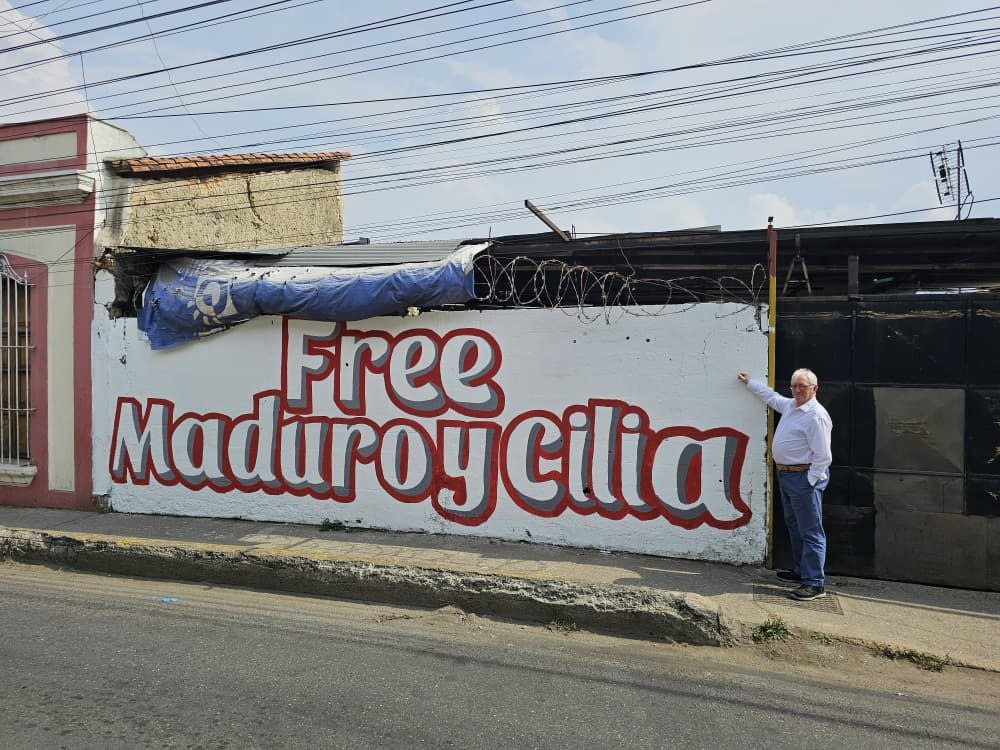
One of my personal critiques of Chavismo is that it is too centred on cult of personality. It is a key fact that Rodríguez is doing the very opposite of trying to move that spotlight onto herself.
Most of Rodríguez’s critics, especially those in the Western media and commentariat, know almost nothing of Venezuela. Most of what the Western public think they know is the very opposite of the truth; the ability of Western media to maintain a false narrative is astonishingly evident on a visit here.
I have now spent a total of six weeks in the country over two trips, talking to students, diplomats, union leaders, commune activists and people inside the government – and a great many barmen. What I have seen and heard convinces me of one thing above all: Delcy Rodríguez is not a traitor. She is a socialist doing the only thing possible to her in this impossible situation — buying time for the Bolivarian Revolution to survive.
———————–
As I end my second Venezuelan visit, we have now spent substantially more on this than we raised and I am personally out of pocket. There is still quite a lot of video footage and the editing process is stalled for lack of funds. Please help if you are able – Our GoFundMe link for the Venezuelan operation is here:
This is the same crowdfunding account we used for Lebanon so discount the first £35,000 raised as it was spent in Lebanon.
Anybody is welcome to republish and reuse my work, including in translation.
Because some people wish an alternative to PayPal, I have set up new methods of subscription payment including a Patreon account and a Substack account if you wish to subscribe that way. The content will be the same as you get on this blog. Substack has the advantage of overcoming social media suppression by emailing you direct every time I post. You can if you wish, subscribe free to Substack and use the email notifications as a trigger to come to this blog and read the articles for free. I am determined to maintain free access for those who cannot afford a subscription.
Subscriptions to keep this blog going are gratefully received.
Choose subscription amount from dropdown box:
PayPal address for one-off donations: [email protected]
Alternatively by bank transfer or standing order:
Account name
MURRAY CJ
Account number 3 2 1 5 0 9 6 2
Sort code 6 0 – 4 0 – 0 5
IBAN GB98NWBK60400532150962
BIC NWBKGB2L
Bank address NatWest, PO Box 414, 38 Strand, London, WC2H 5JB
Bitcoin: bc1q3sdm60rshynxtvfnkhhqjn83vk3e3nyw78cjx9
Ethereum/ERC-20: 0x764a6054783e86C321Cb8208442477d24834861a
Marks, “Sayanim“, and Spencer, very much part of ZOG, and which has long operated premises at terrorist targets such as major railway station termini, seems to be about to get the host government to pay for its face recognition technology etc.
https://www.ft.com/content/52ba8264-ebce-4b54-bd2b-a669190c2520?syn-25a6b1a6=1
PR for this has included scare stories for Daily Mail and BBC consumers etc., saying that teenagers are arranging on Tiktok to run havoc in the high streets.
https://archive.is/DlBoM
https://www.ft.com/content/52ba8264-ebce-4b54-bd2b-a669190c2520?syn-25a6b1a6=1
“Writing in the Telegraph, M&S retail director Thinus Keeve said his chief executive Stuart Machin had contacted Home Secretary Shabana Mahmood and London mayor Sir Sadiq Khan, urging them to prioritise effective policing.”
M&S are very powerful on the high street. If you live in an area where there is an anti-begging program, the likelihood is that M&S is involved.
No fashion journalist ever got fired for saying, y’know, Marks and Spencer are offering some really nice clothes right now.
Could be that among other goals, ZOG wants Sadiq Khan out of office.
Could be that the royal favourite Sebastian Coe, the Nike-connected, Occupation-supporting, former “early morning judo partner” of William Hague, and a man who allegedly is not at all ignorant regarding matters of international sports corruption, will enter the fray as Tory candidate for the London mayoralty.
For chocoholics: I like M&S’s chocolate tiffin cake. IMHO it may well be better than the royals’ chocolate biscuit cake than I saw demonstrated on Youtube. Even better than Costa’s, as it has dried fruit in the base.
Mind you, chocolate cannoli (Italian tubular biscuit with loads of chocolate filling) is pretty nice. Any alternatives?
“Leave the gun. Take the cannoli.” M&S have long had support for the Occupation as one of their missions.
Corr. ‘than’ -> ‘that’
https://www.williescacao.com
Oh, and make yourself Nigella’s Chocolate and Guinness cake with cream cheese icing.
You can thank me later.
ET not EY
Chocolate with Guinness or cheese in the same item doesn’t appeal to me personally, though I saw a recipe “Guinness cake” in a magazine decades ago (if people put spirits in cakes, why not Guinness?), and have enjoyed blue stilton with Hovis digestive biscuits occasionally.
Guinness is excellent in Christmas puddings!
I’m not that fond of Christmas pudding myself, but is there Guinness Dundee cake?
“PR for this has included scare stories for Daily Mail and BBC consumers etc., saying that teenagers are arranging on Tiktok to run havoc in the high streets.”
Ah, I was wondering why there were videos of kids running riot in a supermarket on the news earlier in the week.
The pressure is increasing. M&S are now putting it out that their staff are scared of coming into work:
https://www.independent.co.uk/news/business/london-british-retail-consortium-clapham-government-shabana-mahmood-b2951407.html
That is a serious level of public relations effort.
Meanwhile Sadiq Khan, although there was once a glimmer of resistance in him in the past, seems to be kowtowing:
https://www.theguardian.com/uk-news/2026/apr/02/sadiq-khan-warns-of-zero-tolerance-approach-towards-any-repeat-of-clapham-disorder
Clearly he is far from having the guts of Ken Livingstone.
Aye, trouble in londonistan, the natives are revolting …
Almost certainly this is an example of ol’ Geordie Hegel’s Problem-Reaction-Solution dialectic; in this instance the ” solution ” will, entirely predictably, be more State control/* clampdown * on what’s labelled ” Anti-Social Behaviour “.
I mean, it could be an * organic/spontaneous * display of youthful ( criminal ) behaviour, maybe young people witness the lawless Anti-Social/Human behaviour of * our * glorious leaders and think…..” well, I want this, so I’m just going to take it – fuck Right n Wrong “. Who could blame them if so?
But I doubt it’s THAT straightforward
Has there been a government policy that increases freedom sine the 60s?
Re. “Meanwhile Sadiq Khan, … , seems to be kowtowing:”
Talking of kowtowing, as previosly predicted:
“Jeremy Corbyn’s Your Party (YP) and Zack Polanski’s Green Party appear to be making moves towards rehabilitating Zionism. Instead of opposing its colonialist ideology, they seem more inclined to support it.”
https://www.thecanary.co/uk/2026/04/02/zionism-is-racism-saga/
The UK and most of the western regimes are totally beholden to zionism, the idealogy that promotes: Infanticide, genocide, war crimes and Exceptionalism. There is no-one to stand up against these monsters, you can vote for who you like but you’ll always get zionists, and if you complain you’ll get arrested.
” she describes zionism as “Jewish peoples movement for self-determination in their historic homeland.”
ah, right, that’s what it is: bet the people in Gaza/Palestine/Libya/Syria/Iraq/Yemen/Egypt/Turkey/Iran will be really pleased & relieved to hear this; no doubt they’ll be very proud to think that all their decades of suffering, incalculable loss of lives, devastation on levels unimaginable in the West have been in service of another State’s ” self-determination “.
Zionism – as cute n cuddly as Teletubbies: with exploding pagers
“in their historic homeland.”
Ah, yes, not the historic homeland of the people who have lived there for the last 2000 years, but the historic homeland of the people who lived there before that, and not the historic homeland of the people who were there before them, probably because the newcomers slaughtered them all.
It would be a useful first move if someone could explain clearly and with scientific accuracy just who “the Jewish people” are. Does that sound a silly, or difficult, question?
Well, how do you determine whether a given person is, or is not, Jewish? As far as I know there is no clear genetic profile – and I believe that the government of Israel and most other Jewish authorities are very much against any research in that direction. (What if a “Jewish genome” were published and it turned out that Palestinians correspond to it more closely then “Israelis”?)
But how would you even find a sample of people who are Jewish for certain, which you would need as the very first step in such a project? All we have is a lot of people who claim to be Jewish, because they follow the Judaic religion and customs, or because their ancestors claimed to be Jewish…
Now I claim to be Scottish because my parents were Scottish and lived in Scotland, as did three of my grandparents and their parents. (My other grandparent was of Northern Irish parentage, although their ancestors may have emigrated from Scotland; he was brought up and lived out his life in Scotland). Moreover, although I have not had it done, analysis of my genes would probably show them to be largely, at least, Scottish or at least Celtic.
It seems to me that when people say “So-and-so is Japanese, or Chinese, or Tanzanian, or Chilean, etc.” the main evidence for such a claim is residence. If their parents and ancestors lived in that country for a long while back, that makes them native to that country. Of course, like many other attributes, nationality is “fuzzy” – hardly anyone can claim to be 100% British or Mongolian, because if you go back far enough in history you always come across migrations, invasions, etc.
The “new” definition of nationality, whose epitome is the USA, is more like a football club whose players come from all over the world – and that suits those who would prefer the concept of nationality to disappear. For a start, most US citizens would not like to think of Native Americans as the only real natives of their country. (As opposed to citizens, which is a legal status that anyone can attain).
AI facial recognition probably won’t work if the targets are wearing masks and balaclavas.
I’d also suggest, with no evidence, that facial recognition would struggle with dark skinned and/or bearded individuals.
As with most things, I suggest you never take at face value what ‘they’ tell you.
Facial recognition generally uses infrared. As far as I can gather the software reads the geometry of your face. Key factors include the distance between your eyes, the depth of your eye sockets, the distance from forehead to chin, the shape of your cheekbones, and the contour of the lips, ears, and chin. The aim is to identify the facial landmarks that are key to distinguishing your face.
Skin colour (definitely will not work), balaclavas, beards may not (and probably won’t) work unless they are blocking IR radiation.
I don’t know what will work but if your research uncovers anything do share.
Gait recognition would work. Chinese authorities could identify people wearing masks during Covid. Changing gait requires serious training and practice.
Brian. I’d be careful about blindly repeating what the state tells us.
Put a small stone in your shoe….😁😖
What an extensive report and videos, very good and a guide for other journalists to follow. Latin America’s young are well placed to create a future for the whole of Venezuelas society.
I felt like running into the sea for a swim when I saw the white sand and pristine coastline, what a.jewel to have available after a weeks hard work.
Looking forward to Delcy’s plans circumnavigating burglar Donalds regime of oil pirates.
Thank you for this long situation report Craig,
might see you on the stump next week if you are campaigning.
Hello from Greece and thank you very much for your work in Venezouela. I want donate on euro. Is that possible?
https://www.bbc.co.uk/news/articles/cz0ey7z2jx3o
Two men and a boy have been charged with the ambulance action in Golders Green. They are aged 17, 19, and 20. They are due to appear in court today (Saturday). The British authorities have named the adults but not the 17yo.
No further news about the two men aged 45 and 47 who were arrested and bailed.
The police say they have now arrested a sixth man, aged 19, “after officers recognised him at a court hearing over the incident”:
https://uk.news.yahoo.com/police-arrest-suspect-jewish-ambulance-145403697.html
Thank you Craig. I am so much the better for reading this long and detailed article. I feel so much for the dilemma of Delcy Rodriguez and the people of Venezuela. How disgusting the US and it’s lapdogs destroy a system offering free education, housing and medicine, while they kidnap and imprison the president and his wife, and steal the oil. Disgusting. Free #NicolasMaduro and Celia.
“How disgusting the US and it’s lapdogs destroy a system offering free education, housing and medicine, while they kidnap and imprison the president and his wife, and steal the oil”.
Just as they did in Libya – except that they murdered that president. The owners of the USA hate to see a prosperous socialist country, because it casts doubt on their dogma that socialism inevitably causes grinding poverty, whereas capitalism makes everyone rich, paves the streets with gold, and causes them to run with milk and honey.
Just browsing online shows, very depressingly, how many mugs believe that. I recall seeing the results of a survey, some time ago, that showed most Americans – even among the poor – were convinced that one day they would be rich and successful. That causes them to align their views with the wealthy, and to vote for them and in their interests.
“And strong belief in opportunity and upward mobility is the explanation that is often given for Americans’ high tolerance for inequality. The majority of Americans surveyed believe that they will be above mean income in the future (even though that is a mathematical impossibility)”.
– Carol Graham and Soumya Chattopadhyay (cited by Barbara Ehrenreich, “Smile or Die”, p180)
Good article by Simon Tisdall in the Guardian today:
As Team Trump wage unceasing war on Iran, evangelical nationalists are destroying any moral world order we once had
That combative old hymn, Onward Christian Soldiers, is not much heard these days, though it was once a favourite with church congregations and school assemblies. Written in 1865 by Sabine Baring-Gould, an English clergyman and religious scholar, its belligerent refrain urges the faithful on to battle, victory and conquest: “Onward, Christian soldiers / Marching as to war / With the cross of Jesus / Going on before!” Its martial tone suited the Victorian zeitgeist but it made succeeding generations uneasy (though it was still sung in my primary school in the early 1960s). Nowadays, this sort of triumphalism gives religion a bad name.
Pete Hegseth, US defence secretary, and a leading Christian soldier, would certainly disagree. He probably hums it on his way to work. At a recent Christian worship service in the Pentagon – an irregular event, given the constitution’s dislike of anything smacking of state religion – Hegseth, referencing Iran, prayed for “overwhelming violence of action against those who deserve no mercy”. Hegseth’s creed is killing. He describes Iranians as “religious fanatics”. And he should know. His intolerant brand of evangelical Christian nationalism is extreme even by US standards – yet has Donald Trump’s backing. Trump was a Presbyterian until 2020, when he abruptly declared he wasn’t. God knows what he is now…..
https://www.theguardian.com/commentisfree/2026/apr/04/donald-trump-iran-war-evangelical-nationalists-moral-world-order-pete-hegseth
I’d completely forgotten about Onward Christian Soldiers (as of about two seconds after last singing it in assembly at the Secondary Modern School I went to, before abruptly leaving). It’s a good sing-along melody though…. maybe someone could put some new lyrics to it. Also a couple of pics taken of planet Earth by the crew on their way to the moon in another Guardian article….and no doubt by the rest of the war-mongering MSM!
A planet drifting through infinite space, run and controlled and dominated by by psychopathic massmurdering planet-destroying lunatics.
Funny (not haha), given what I just said above, that I should check out my inbox shortly after posting it, and the first article I should come across (and click on and read) was this:
‘A Moral Obscenity’: Trump Budget Pairs Record Military Boost With Billions in Cuts to Social Programs
“To pay for his endless wars, he wants the biggest increase to military spending in 70 years,” said Rep. Greg Casar. “Hell no.”
President Donald Trump’s White House released a budget proposal on Friday that pairs an unprecedented, debt-exploding $1.5 trillion in military spending with tens of billions of dollars in cuts to domestic agencies and education, healthcare, climate, and housing programs.
Trump’s budget request for fiscal year 2027, which must be approved by Congress, includes $73 billion in total cuts to nondefense spending while boosting military outlays by 42%—or nearly $500 billion—compared to current levels.
Programs cut or eliminated in the proposed budget—under the guise of slashing “woke programs” and “ending the Green New Scam”—include the Environmental Protection Agency’s Environmental Justice program, Community Services Block Grants, electric vehicle charging subsidies, renewable energy initiatives at the Interior Department, the Agency for Healthcare Research and Quality, and Pathways to Removing Obstacles to Housing….
https://www.commondreams.org/news/trump-2027-budget
All together now…. Onward Christian soldiers, Marching as to war, With the cross.. ♪ ♫♫ ♫♫♪♪♫ ♫♪
“As president my highest aspiration is to bring peace and stability to the world”
President Trump is the President of Peace
https://www.youtube.com/watch?v=E73zBLitV6o (The White House, 42secs)
Only in a slightly different manner to the one Jesus had in mind
Bob Dylan: “The Masters of War” – music video, 5m 56s [ YouTube ]
NB It’s a real shame that Bob’s had nothing to say about what’s been happening in the passed few years, one way or another, or ever thought to apologise for the irony of his ironic song about Israel.
Afterthought:
Midnight Oil: “Bedlam Bridge” – music video, 4m 30s [ YouTube ]
The Call: “The Walls Came Down” – music video, 3m 44s [ YouTube ]
And that should probably have been… *past* few years
PS Where on Earth IS everyone?!
—
[ Mod: The bare YouTube URLs have been replaced with explanatory text.
A reminder to everyone – please do not paste links to other sites without explaining what they actually link to. People should not have to click the link to find out what relevance it may have. That goes especially for links to video content. ]
Getting drunk, it’s Easter.
As a long time Bobophile I’ve often been dismayed at some of his * controversial * statements & changes of orientation, eg becoming a ” born again ” Christian in the late 70s – which did, if nothing else, generate Slow Train Coming, a brilliant album if you can bear the proselytising lyrics.
His statements on Israel, that I’ve seen, have been, perhaps typically, ambiguous and at times contradictory: maybe informed by his rather literal interpretation of the biblical ideas/prophecy. Not seen any outright support for current Israeli actions though one infamous quote has him saying daft things like ” Arabs are gonna take over the world “.
I learned long ago not to pay too much heed to the opinions of celebrities, at least, not give them any higher status than the opinions of anyone else; Dylan no exception. His early, overtly political, material has stood the test of time and, tragically, songs like Masters Of War are just as relevant today as they were when they were written – maybe even more so, as the U.S is currently being consumed and led to the edge of bankrupt, lawless chaos by those same Masters Of War
Any long time Bobophiles might be amused by this reported conversation with the great man. I know I was.
======================================================
Walter Yetnikoff was head of CBS Records for nearly 20 years. One of the stars on the CBS label during his time in charge was Bob Dylan (formerly Robert Zimmerman), and when Dylan performed at Madison Square Garden in the 1980s Yetnikoff gave a dinner for him afterwards:
As much as you could deal with Dylan, I dealt with him. I understood how hard he worked to protect his mystique. He was entitled. I saw him as a master poet, master folk rocker, voice of a generation, American icon and a guy who still sold a shitload of records. If he wanted to sulk in the corner, let him sulk in the corner.
After the concert, I hosted a private dinner for him at a swanky restaurant. We planned to eat at midnight. By 2 A.M. he still hadn’t arrived. I was about to go home – the hell with him – when, just like that, he and his entourage walked through the door. His entourage surprised me. I was expecting Bohemian groupies and scruffy musicians. Instead he arrived with his family – his Jewish uncles, his Jewish mother, Mrs Zimmermann, his Jewish girlfriend Carol Childs and his Jewish dog, an oversized mastiff.
Sitting next to Bob and his mother, I was astonished by their dialogue. The mysterious poet suddenly turned into little Bobby Zimmermann.
‘You’re not eating, Bobby’, said Mom as his girlfriend Carol was cutting up his food as though he were an infant.
‘Please, Ma. You’re embarrassing me’.
‘I saw you ate nothing for lunch. You’re skin and bones’.
‘I’m eating, Ma. I’m eating’.
‘And have you thanked Mr Yetnikoff for this lovely dinner?’
‘Thank you, Walter’.
‘You’re mumbling, Bobby. I don’t think Mr. Yetnikoff heard you’.
‘He heard me’, Dylan said sarcastically.
‘Bobby, be nice’.
‘Does your son always give you this much trouble?’ I asked.
‘Bobby? God forbid. Bobby gives me such naches. He’s a good boy, a regular mensch. He calls, he writes, he listens to his mother. Every mother should have such a son’.
‘Stop, Ma’, said Bob. ‘You’re embarrassing me’.
‘You should be embarrassed’, I said to Dylan. ‘You’re a fraud’.
He looked at me quizzically. I explained, ‘Aren’t you the guy who wrote, “And don’t criticize/what you don’t understand/your sons and your daughters/ are beyond your command…”? So why are you whining to your mother?’
‘I wrote that a long time ago. Is it okay with you if I love my mother?’
‘That’s wonderful. I understand you’ve done the definitive version of “My Yiddishe Momma”’.
He smiled.
– Walter Yetnikoff with David Ritz, Howling at the Moon, 2004.
(From the Oxford Book of Literary [sic] Anecdotes, p. 347)
“As president my highest aspiration is to bring peace and stability to the world”.
Sounds familiar… ah yes, here it is:
“Auferre, trucidare, rapere, falsis nominibus imperium; atque, ubi solitudinem faciunt, pacem appellant”.
‘(To plunder, butcher, steal, these things they misname empire: they make a desolation and they call it peace)’.
– Calgacus, according to Tacitus.
Damn you, you’ve given me an earworm. I used to know some alternative words, but I’ve forgotten everything but that I once knew them.
This is a reply to Bayard’s comment here https://www.craigmurray.org.uk/archives/2026/03/the-weight-on-delcy-rodriguez/comment-page-1/#comment-1096604
I’m responding to points about the disputed 2024 presidential election etc.
The results site was updated three times with version control, and version dates and SHA-256 integrity hashes were published for each release. Most of the actas were uploaded within the first 48 hours. Since the datasets are versioned and tamper-evident, changes between versions can be reliably tracked. That creates an audit trail, not a single dataset uploaded long afterwards. You can view the info on the versions at the foot of the page here: https://resultadosconvzla.com/
As we covered earlier in the discussion, if forgery is claimed, it should be demonstrable by identifying specific forged documents and explaining what is wrong with them. Without that, it remains an assertion unsupported by evidence.
We covered this too, along with the question of political repression. Speculation about how people “should” behave, is not evidence about whether results are accurate. Election results are not verified based on protest levels or how many people check a website. It is a procedural and evidential matter, not a behavioural one.
This is actually the fundamental area where we disagree. I strongly believe that the legitimacy of a government comes from the will of the voters expressed in a transparent and verifiable election. You appear to be saying that what matters is the political outcome, regardless of how that’s arrived at. That denies the Venezuelan people political agency. If people only get to choose when they choose the “correct” government then they don’t really have the right to choose at all. It essentially means that an illegitimate election result would be acceptable to you if the government produced was one you found politically desirable.
Governments derive legitimacy from the consent of the governed. It is a fundamental human right in international law.
I actually did exactly that in my first comment in this thread. I suggested that the claims about forged tally sheets and opposition fraud were a crucial issue that deserved proper scrutiny and possibly a separate article.
The only reason there is any discussion about the opposition’s dataset at all is because the official electoral authority has never published the required results and audit data required to independently verify the result. If the official results were fully transparent and auditable, the opposition dataset would be irrelevant and this entire debate would not be happening.
The refusal of the government to follow the required electoral procedures (by releasing the detailed results) is enough on its own to seriously question legitimacy.
” I strongly believe that the legitimacy of a government comes from the will of the voters expressed in a transparent and verifiable election. You appear to be saying that what matters is the political outcome, regardless of how that’s arrived at. That denies the Venezuelan people political agency.”
Can you eat political agency? Drink it? Can you put it in your car and make it go? Will it stop thugs murdering you in the street, or dragging you out of bed in the middle of the night and hauling you off to be tortured to death? Will it provide you with a decent job at a decent wage? Will it keep a roof over your head for a price you can afford? No, none of those things. All it will do is lessen the sense of powerlessness you feel for a few weeks every five years or so, or whenever election time rolls round. Whoopie-do! Most people prioritise such things as food, shelter, security, employment and a modicum of wealth over legal niceties like the transparency and verifiability of the election that put their government into power, that is if it is the country that they are living in that they are considering. Of course, when it is someone else’s country, then such things as following due election process assume a much greater importance, especially when the wrong team has appeared to have won the game.
Are you really suggesting that the Nazi government in Germany was somehow preferable to the current Venezuelan government, simply because there are more question marks about the latter got elected? That you would prefer to have been living in early 1940’s Germany than 2020s Venezuela?
“I actually did exactly that in my first comment in this thread”
There are other ways of contacting him you know. That is what I meant by asking him.
“The refusal of the government to follow the required electoral procedures (by releasing the detailed results) is enough on its own to seriously question legitimacy.”
And the refusal of the opposition to submit the disputed printouts to the Supreme Court? What does that say about their legitimacy, or is this another falsehood from our host?
In any case, why does the government need to do anything about its perceived legitimacy? No-one, except you and a few people like you gives a stuff about legitimacy. The US isn’t going to behave any differently towards Venezuela depending on whether its government can prove its electoral legitimacy or not. As far as the US and it’s allies are concerned, the only legitimate election is one that the returns the government that the US wants in power. See also the EU and the Romanian election. Even back in the 50’s, Tom Lehrer wrote in “Send the Marines”, “For might makes right, Until they see the light, They’ve got to be protected, All their rights respected, Until someone we like can get elected.” Look at the current president of Syria, a terrorist with a US price on his head who slaughtered his way into power like some mediaeval warlord, now hobnobbing with world leaders and a ruler accepted by all. Where’s his electoral legitimacy?
The main point is not whether some pieces of paper showed that 70 of the Venezuelan electorate voted against the current government and that the government hasn’t managed to refute this charge to your satisfaction, but that such a thing occurred without either the disruption or repression anyone would reasonably expect from such an event, something that you have not explained apart from reference to a lot of sources which say the sort of thing that anyone would expect them to say and are no rebuttal to one man’s first hand evidence of what is actually happening on the ground. The choice is simple: either Craig is lying, or your sources are. I know which one I believe.
We are in agreement. Food, security, employment and stability absolutely matter far more to people than political theory. The long-standing conditions in Venezuela (economic collapse, hyperinflation, crime, corruption, poverty and mass emigration) are very strong reasons to want political change, which is precisely why elections matter. Without fair elections, what is the peaceful mechanism by which people can change a government if they believe it is failing to provide those essentials that you mention?
I am not going to follow you down the “reductio ad Hitlerum” rabbit hole, as it does not address the issue we are discussing
Under the Venezuelan constitutional system, the electoral authority (the CNE), not the Supreme Court, is the body responsible for running elections, publishing detailed results and conducting audits. Court proceedings after the event are secondary to that primary obligation.
If the opposition’s figures are even broadly correct, then millions of Venezuelan voters clearly do care about legitimacy, because it would mean the published result does not reflect how they voted.
There were protests and there were politically-motivated arrests, and Craig acknowledges in the article above that the crackdown went too far and damaged the government’s moral authority. Reports from the UN, Amnesty International and many others have documented political repression in Venezuela for decades. I gave you links earlier (https://www.craigmurray.org.uk/archives/2026/03/the-weight-on-delcy-rodriguez/comment-page-1/#comment-1096564) to reputable sources with detailed, evidence-based reports. Dismissing all such reports as lies requires assuming that a very large number of independent organisations and observers – including the likes of Michelle Bachelet – are all acting in bad faith, which seems unlikely. So the situation is not simply “nothing happened so the result must be correct”.
It’s clearly not that simple. It isn’t a choice between two individuals or two narratives. Different observers can have different experiences and governments obviously present their own version of events. That is exactly why election legitimacy should not depend on personal impressions, alleged rally sizes, the level of protests or anecdotes, but on transparent publication of results.
When we are discussing primary evidence such as tally sheets, datasets, hashes and electoral procedures, we are not dealing with “sources” in the sense of opinions, but with information that anyone can examine independently. Documents cannot lie.
There is a fundamental principle recognised in international human rights law, which states that the will of the people shall be the basis of the authority of government, expressed through genuine elections. Craig has spent many years writing about human rights and international law, which is why I thought the question of whether the 2024 election result can actually be independently verified was worth raising here. I think that principle matters regardless of which side wins an election. You appear to take the view that what matters most is the political outcome rather than the process by which governments obtain authority. If that is the case, then I suspect we are unlikely to resolve that disagreement here, so I will leave it there.
A champion of human rights and international law who obsessively smears a socialist government besieged for decades by the Axis of Genocide with pitiless economic sanctions and sponsored violent coup attempts; just after its leader and his wife have been kidnapped and imprisoned by the USA.
Very normal reaction from somebody who claims to be concerned with human rights and international law.
As Craig details above, and as you have already been directly reminded, the level of ‘political repression’ Maduro handed out to violent right-wing seditionists was laughably lenient. Not compared to what Pinochet or other military dictatorships did, but to what any western regime or so-called ‘moderate’, Washington-approved Latin American government would do in the wake of repeated violent left-wing coup attempts.
Besieged socialist governments like Venezuela’s are going to be demonized by Western media and human rights agencies no matter what they do, so it’s imperative they do not treat violent coup attempts more leniently than they would be dealt with in any other society.
Human rights are universal. They do not depend on whether a government is socialist, capitalist, pro-US or anti-US.
Vast swathes of evidence of political repression in Venezuela have come not only from Western governments but from Amnesty, Human Rights Watch and the UN High Commissioner for Human Rights, including Michelle Bachelet, who is herself a left-wing former President of Chile and a victim of political repression. Pointing this out, when others are claiming there’s been no repression, is not “smearing a socialist government”, it’s simply acknowledging documented evidence.
In any case, my point throughout this discussion has been about whether the 2024 election result can be independently verified from published results and audits. That question doesn’t depend on whether one supports or opposes the Venezuelan government, but on whether the evidence exists to verify the result.
@Zoot – your latest reply (https://www.craigmurray.org.uk/archives/2026/03/the-weight-on-delcy-rodriguez/comment-page-2/#comment-1096623) is more or less a repeat of the one above, to which I have already responded.
You keep saying I am “smearing” the Venezuelan government, but all I have done is refer to documented reports, as well as the arrests and overreach acknowledged by Craig in the article above. If citing such reports counts as “smearing”, then any discussion of human rights violations anywhere in the world would also be smearing. If you believe the reports are incorrect, then the way to address that is to show what is factually wrong with them.
You also keep moving the discussion to sanctions, coups and geopolitics, without ever addressing the points I have raised about the 2024 election itself.
“The long-standing conditions in Venezuela (economic collapse, hyperinflation, crime, corruption, poverty and mass emigration)”
Perhaps you would like to explain why Craig has been unable to find evidence of economic collapse, hyperinflation, crime, corruption and poverty more than one would expect in any country? Could it be that these problems are largely the figments of the imaginations of the opponenets of the Maduro regime?
“I am not going to follow you down the “reductio ad Hitlerum” rabbit hole, as it does not address the issue we are discussing”
Of course it doesn’t as it is not a territory where you are able to occupy the moral high ground. However the issue as to whether a government, however evil, exploitative and oppressive but with impeccable election credentials is preferable to one that does not have these credentials, however fair, good and tolerant is still very germane to this argument as you appear to be very much on the side of those that say that it is. Is it really too hard for you to say that there are more important things than electoral probity?
“Under the Venezuelan constitutional system, the electoral authority (the CNE), not the Supreme Court, is the body responsible for running elections, publishing detailed results and conducting audits. Court proceedings after the event are secondary to that primary obligation.”
If it was as obvious as you say it is, there would be absolutely no harm in supplying the Supreme Court with the papers requested. The only reason for not doing so is that the opposition didn’t want the Supreme Court looking at them for fear of what they would conclude. Come on, this is exactly the same argument that you are using about the government not producing their copies of the actas – why don’t they just produce them and clear this matter up? What’s sauce for the goose is sauce for the gander.
“If the opposition’s figures are even broadly correct, then millions of Venezuelan voters clearly do care about legitimacy, because it would mean the published result does not reflect how they voted.”
and then failed to do very much about it, which shows that they hardly cared at all. Where are the equivalents to Nicaragua’s Contras?
“There were protests and there were politically-motivated arrests, and Craig acknowledges in the article above that the crackdown went too far and damaged the government’s moral authority. Reports from the UN, Amnesty International and many others have documented political repression in Venezuela for decades.”
AS I pointed out before, and as you ignored before, such protests are par for the course these days. The point is not that there were no protests, but that there were no protests on the scale that anyone would expect in the case of electoral fraud on the scale you that you allege and that there is not the ongoing repression that anyone would expect to account for a lack of protests. As for your sources, that is what I meant by the sort of people that would say that kind of thing. There’s nearly always someone in the world who will be writing something to back up your theory, no matter what that theory is, especially if it’s that a left wing government is bad. There are thousands, probably tens of thousands of people in this world whose sole job it is to make up and print things bad about left-wing governments, especially one where an alternative system to Western free-market and financial capitalism seems to be working. Just because it’s on the internet doesn’t make it true.
“It’s clearly not that simple. ”
It clearly is from where I and most of the people commenting on this blog, who you are trying and failing to convince, stand.
What is simple is that you are trying to argue, using internet sources, against the first hand experience of someone who is there on the ground. Either he is wrong or you are. Which is it?
“When we are discussing primary evidence such as tally sheets, datasets, hashes and electoral procedures, we are not dealing with “sources” in the sense of opinions, but with information that anyone can examine independently. Documents cannot lie.”
Really, then what’s a forgery, then? Unless you have seen every one of these documents, physically, then what you are looking at is a copy and a copy can be altered, these days pretty undetectably. Meanwhile Craig has looked at things, read things, met people, talked to them and writes from hiis first-hand experience and somehow this is not more valid that your copies published on the internet.
“There is a fundamental principle recognised in international human rights law, which states that the will of the people shall be the basis of the authority of government, expressed through genuine elections.”
Yeah right, and in how many countries in the world is this observed, even to the extent that “the people” get to choose, from a preselected list, once every five years or so, a bunch of representatives who are under absolutely no obligation to carry out the will of the people who chose them? That’s really governing on the basis of the will of the people, isn’t it?
@Bayard
This is not a matter of opposition propaganda or internet rumours. Public sector salaries are around $130 per month while the cost of basic food for a family is several times that amount. Average salaries in the private sector are roughly $100–200 per month. Overseas remittances from family members living outside Venezuela account for a significant part of the economy. Up to 60% of Venezuelan households rely on such payments to survive. That is not a normal economic situation. The fact that millions of Venezuelans have left the country as refugees is a symptom of the challenges Venezuela has faced for more than a decade and a half. Countries without major economic problems do not lose almost a quarter of their population to emigration.
Whether Craig personally saw poverty or crime during his visit is not really evidence either way. National economic collapse and inflation are measured by economic data, not by what one visitor happens to observe during a trip.
Elections are not an abstract moral luxury; they are the peaceful mechanism by which people can change a government if they believe it is failing to provide food, security, employment or stability. Without credible elections, there is no peaceful way to change a government and the only alternatives are coups or violence.
We’ve covered this in detail in an earlier exchange where I explained how repression affects political protest. Besides, elections exist precisely so that political change does not depend on protests or violence.
I don’t see the logic behind the claim that someone like Michelle Bachelet would fabricate reports against left-wing governments. Besides which, the reports I’m referring to are not random internet posts or opinion-pieces. They are structured reports that typically include interviews, witness statements, court records, statistical data and methodology explaining how the investigation was undertaken.
I agree in principle. The internet contains both accurate information and misinformation. The question is not whether something is on the internet, but what the source is and what evidence is presented.
If reports of the kind I’ve referenced in these posts are dismissed simply because they are published online, then it becomes unclear what evidence would ever be acceptable to you. Government statements are published online. Election results are published online. Academic papers are published online. News reports are published online. Even Craig’s article is published online.
So the issue is not the internet as a medium, but the credibility of sources and the evidence they present.
Elections are not verified by impressions, conversations or rally sizes. They are verified by tally sheets, data and audits. If I didn’t think Craig had missed a trick when it comes to the 2024 election issue, then I wouldn’t have suggested he re-examine it or consider writing a separate article on the topic. That’s precisely where this thread started.
We’ve been through the forgery question in detail, so I’m not going to relitigate it here. Suffice to say, I don’t agree that such a vast quantity of tally sheets could be forged in a such a short time whilst maintaining internal consistency. Furthermore, the solution to doubts about documents is more transparency, not less. You seem content with the CNE not publishing the detailed results. I find that difficult to understand, because transparency would resolve the dispute very quickly.
As for Craig’s first hand experience, maybe the results of his investigation might make for a good article, as I suggested at the outset. I’d be interested in knowing who he has spoken to. For example, which experts did he consult, what are their credentials and what information did they impart?
Fundamentally, we disagree on the issue of whether elections and electoral integrity matter. You appear to believe that other factors are more important than whether an election result can be independently verified. Saying that democracy does not really exist anyway, which seems to be your position, is a philosophical argument rather than a factual one.
Bayard
April 6, 2026 at 10:17
Your position is that US accusations of electoral malpractice against the Venezuelan government are unimportant and that Russian accusations of electoral malpractice against the Ukrainian government are irrelevant to this discussion.
An eccentric position to adopt but there you go.
Another superb comment/answer, B. Mr Sanchez does seem intent on flogging this ” electoral illegitimacy ” narrative and, to his credit, does seem well-informed, on Venezuelan Politics generally, if not quite so on the ” fine print ” of the election in question.
Obviously I – and none of the readership – can say definitively what transpired there; Craig being bettered informed than any of us, having took the time/effort to actually go there – and talk to * ordinary * people : WOWZA! like a real journalist – remember them?
But whatever the truth of that situation, it’s a bit rich to be demanding absolutely impeccably * democratic * transparency in a country that has been/is being relentlessly attacked by, eg severely punitive sanctions, not to mention the malign influence/presence of ” freedom – loving paragon of exemplary morality ” US regime change junkies, constantly fomenting discord in an effort to install their puppet-of-choice.
Whatever it’s success in applying Socialist ideas/principles/policies – and there has been great success with that in some areas of Venezuelan life – the very fact that it has been trying to apply such ideas AND is * cursed * with an abundance of oil means that it was always going to be in the crosshairs of Yankee violence. Socialism can NEVER be allowed to work as intended; if it ever was, even coming close to the ideals thereof, it would expose the lies, psychological contortions, and overall human & planetary demerits of the dominant/domineering paradigm of our times – NeoLibCon Transnational Capitalism
My original comment here actually suggested that the detailed mechanics of the 2024 election deserved closer examination, because most discussions were ideological rather than technical. So, far from flogging a narrative”, I’m suggesting looking at evidence rather than listening to narratives.
I have made every effort to understand exactly how the Venezuelan electoral system works, what the legal obligations of the CNE are, how the tally sheets are generated, how audits work, and whether the result can be independently verified. If there are specific areas where I have misunderstood the technical details of the election process, I would genuinely be interested to hear what they are.
I have also spent time in Venezuela – albeit not since 2020. I still have close family connections there, so like Craig I have spoken to ordinary people in the country. But personal conversations and impressions can vary widely depending on who you speak to, which is why I think election results need to be verified using documented evidence rather than relying on personal impressions alone.
I am not demanding “impeccable democratic transparency” or some idealised Western model. The basic requirement of any election is simply that the votes are counted and that the detailed results are published so that the result can be independently verified. That is the fundamental arithmetic of an election.
Bien, Ricardo. Gracias por tu respuesta. Como decimos… la Verdad saldrá a la luz (aunque no siempre)
The only evidence for your claims to be apolitical and a stickler for democratic exactitudes, human rights and international law is smearing a brutally besieged socialist government.
That is the sole content of all your contributions.
Unfortunately the deadly sanctions, the repeat coup attempts, the abduction of the President and his wife by a foreign power are all common knowledge. Everyone knows what has happened and who is responsible, regardless of whether apolitical Ricardo Sanchez mentions it or not.
zoot
April 5, 2026 at 17:53
I haven’t posted for a week or two, preoccupied by the shit show in Iran and the Gulf of Trump (sic).
We all acknowledge that Trump acted illegally in attacking Caracas and kidnapping Maduro and his wife.
But there are legitimate questions about the conduct of the election in Venezuela.
What is the excuse for the Venezuelan Government not releasing the documentation for the election?
Saying “they are good Socialists” isn’t enough.
After all, elections in the USSR were conducted impeccably…
Why should the Bolivarians have lower standards?
Yes I know, you’re just another apolitical stickler for democracy, human rights and international law. Another whose sole contributions on this topic are to try and smear and delegitimise a defiantly independent government, one that you know has been brutally besieged for decades by the western Axis of Genocide. See also your contributions on Iran. Talking of the Genocide, remind me which ‘innately decent’ figure presided through the teeth of it, his very last act being legislation to send still more bombs?
zoot
April 5, 2026 at 18:37
Come on Zoot.
Two or more things can be simultaneously true.
The Mango Mussolini is a demented quasi-fascist.
But the Venezuelan government has questions to answer about the conduct of Maduro’s election.
A state standing bravely against impossible odds may have a questionable democratic mandate.
I recall posters here making that charge against the Ukrainian government. Unjustly.
Of course a State further East is both an aggressor and ruled by an authoritarian regime.
“What is the excuse for the Venezuelan Government not releasing the documentation for the election?”
Probably the same excuse that the opposition give for not providing the documentation to the Supreme Court – they don’t have to – if Mr Sanchez is to be believed (and I see no reason to doubt him on this particular matter). They obviously don’t care if the opposition and the Western governments think their government is illegal, presumably on the grounds that those people will always think it anyway. Ditto the opposition, they, probably think that the government will judge their case wanting whatever they do. It’s a Venezuelan stand-off.
“I recall posters here making that charge against the Ukrainian government. Unjustly.”
That would indeed be unjust, as would the same charge laid against Nazi Germany. It wasn’t the election where Zelensky’s party went wrong, it was afterwards, when they went back on all their election promises.
Bayard
April 5, 2026 at 20:00
You are being disingenuous.
The Ukrainian government and President Zelenskiy in particular are often accused here (and by the Russian government) of being illegitimate due to presidential elections being delayed because the country is being bombarded by Russkiy missiles and drones.
The humanity..
Ricardo Sanchez
An honest question.
The alleged tally sheets as proof of the election was from polling data and extrapolated
further by the opposition.
As far as I can see the Opposition seemed to be more willing to provide the media with the proof but not The National Electoral Council.
The question remains ( if you doubt the legitimacy of the Elections ) who in the end was the final arbiter?
Or who would have been the final arbiter?
The Carter Centre or The New York times?
If The Opposition had ‘ the proof ‘ why not provide it to the media and the National Electoral Council ?
That would have been double proof?
I’m afraid that the state the so called Democratic world is in at the moment that anyone has any faith in anything concerning Democracy.
You have a lot it seems hence this comment:
‘ Human rights are universal. They do not depend on whether a government is socialist, capitalist, pro-US or anti-US.’
Have you had a word with Mr Trump and Netanyahu about this phrase?
Or perhaps the UN?
@Bayard
Elections are designed so that legitimacy does not depend on whether the government trusts the opposition or the opposition trusts the government. Legitimacy comes from transparent results that anyone can verify independently.
The electoral authority (CNE) has a legal responsibility to publish detailed results and audit documentation as part of the election process itself. That’s a normal and basic function of an electoral authority. That fundamental obligation exists regardless of whether anyone later files a case in the Supreme Court. Court proceedings to challenge a result are secondary; publication of results is a basic component of an election.
It’s worth point out that, initially, the Venezuelan government itself made it very clear that it had every intention of releasing the required information, just as it had always done in the past. For example, on July 29th the Ministerio Público Venezolano posted this on X:
This was echoed by the president of the CNE:
However, those polling station level results were never published.
By the way, it is not only “the opposition and the Western governments” that questioned the results.
1) Argentina, Costa Rica, Ecuador, Guatemala, Panama, Paraguay, Peru, the Dominican Republic, and Uruguay issued a joint statement calling for transparency and verification. – link here: https://prensa.gob.gt/comunicado/comunicado-conjunto-sobre-elecciones-en-venezuela
2) the OAS issued a detailed report on the election irregularities and stated “The worst form of repression, the most vile, is to prevent the people from finding solutions through elections. The obligation of each institution in Venezuela should be to ensure freedom, justice, and transparency in the electoral process.” link here: https://www.oas.org/fpdb/press/Report-for-Secretary-General-Luis-Almagro-of-the-DECO-of-the-Secretariat-for-Strengthening-Democracy-of-the-OAS-on-the-presidential-elections-in-Venezuela.pdf
3) President Mulino of Panama suspended diplomatic relations with Caracas and called for an emergency meeting of the OAS to discuss the situation in Venezuela.
4) President Boric of Chile posted this on X on 29 July 2024:
5) President Erdogan of Turkey – supposedly very close to Maduro – was careful not to congratulate him and instead expressed only his support for “the dialogue process in Venezuela…”
6) Colombia’s foreign minister posted this on X on 29th July 2024:
7) The governments of Brazil, Colombia and Mexico issued a joint communique on 1st August 2024:
8) The Carter Center – the official independent observers of the election, appointed by the CNE itself – issued a statement on 29th July 2024:
It seems quite reasonable to ask why the detailed polling station results were never published. After all, if the CNE’s declared result is correct, being transparent would merely strengthen legitimacy.
@MARK M CUTTS
All very fair questions. I’ll do my best to address each point.
The opposition’s claim rests on having collected copies or photographs of the official tally sheets from polling stations (the actas), which party witnesses receive at the end of voting. They then aggregated those results and published both the totals for each candidate, broken down by voting table, and the matching tally sheets from over 80% of the total voting machines.
The opposition was confident of victory, based on polling running up to the election, but it also suspected the Maduro government would refuse to respect the result. It therefore organised as never before, mobilising volunteers to acts as witnesses at the voting centres and instructing them to stay and collect copies of the actas when the polls closed. These were then uploaded to the website.
The important point to note is that there was no need for the opposition to give the CNE “proof” because the proof is the CNE’s own data. The actas are central to the whole election audit process and the CNE already had its own copies of every tally sheet, as did the representatives of the candidates, and the witnesses. The CNE also had data that was transmitted from the voting machines which obviously matched what was shown on the tally sheets. The system is a very well-designed and fraud-proof hybrid of electronic and paper records.
It’s the CNE’s refusal to publish its own data that’s at the heart of this issue.
In a properly-run election the final arbiter is not a newspaper, an opposition party, or an international organisation. The final arbiter is the electoral process itself, through transparent publication of results and audits so that anyone can verify the outcome independently.
That is why electoral authorities (including Venezuela’s CNE until 2024) publish detailed results and conduct audits. If the official results match the detailed polling station data and audits, then the result is verified and legitimacy is guaranteed.
On the human rights point, I would say the same standard applies everywhere. Human rights are universal. Violations by one country do not justify violations by another. That principle should apply equally regardless of whether the country is the USA, Israel, Venezuela, Iran or anywhere else.
“You are being disingenuous.”
Nope, you were being irrelevant, as usual. Desperate to shoehorn the single issue on which you are fanatical into a discussion on a completely different subject, you inserted a remark about the democratic legitimacy of Ukraine’s government in a discussion about alleged electoral malpractice in Venezuela, thus leading me, and possibly others, to think that it may, at least, have had peripheral relevance to the subject under discussion and that the alleged lack of democratic legitimacy was also founded on claims of electoral malpractice. Of course it wasn’t. I suppose I should have known better.
“Elections are designed so that legitimacy does not depend on whether the government trusts the opposition or the opposition trusts the government. Legitimacy comes from transparent results that anyone can verify independently.”
Quite possibly, but the legitimacy of a government comes very far down in Maslow’s hierarchy of needs, as you have agreed with me. So it can reasonably be said that so does its importance. It obviously matters a lot to you, and I look forward to you joining in with the chorus of condemnation next time the EU pulls a stunt like they did in Romania and our host writes a post about it, but to most people it is as important as it’s position in the hierarchy of needs indicates it would be. Forgive me if I say that your attitude reminds me of the screams of outrage that came from the lovers of steam trains, when one of the Harry Potter films featured an ex-Great Western Railway steam locomotives painted red (the GWR never painted them any colour other than green). That such a travesty of Britain’s railway heritage should be perpetrated in a popular film was of great importance to them, but the majority of film-goers didn’t even notice, steam trains having disappeared from service some fifty years previously.
The point is, that even if there was widespread electoral fraud, the people most nearly affected by it, i.e. the Venezuelan people, don’t seem to be particularly bothered. There is neither the continued level of protest anyone would expect if they were bothered, nor the level of government repression one would expect if such ill-feeling towards the government were still present. There is also the almost complete lack of support for Juan Gaido’s attempt on the presidency and the discrepancy between the number of people who turned out to support Maduro compared to the opposition’s rally count. There is no guerrilla movement in the countryside, there are no no-go areas for police and government troops, well nothing that Craig has heard about, anyway. People seem to be happy to talk to him about politics and there is no groundswell of dissatisfaction dating back to the “stolen” election. In short, the Venezuelan people seem happy with their lot, whether or not it was the lot they voted for. Sadly, contrary to all your high minded principles, people don’t really care who rules them, so long as they treat the people well. The Romans knew this: keep the people happy with bread and circuses and no-one will be bothered about much else, or, at least, not bothered enough to cause trouble.
@Bayard
Since it is elections that determine who runs the economy, food supply, policing, etc., that reasoning does not work. Democracy is not a luxury.
If your logic was sound, it would follow that these populations were perfectly happy with their lot: Soviet Union, East Germany, Spain under Franco and Chile under Pinochet. This is demonstrably false. Absence of armed rebellion does not equal political legitimacy.
You are choosing to prioritise anecdotal evidence over public opinion polling, election data, independent reports, arrest records, protests, and migration statistics.
We started this discussion about whether the 2024 election result could be independently verified.
You are now arguing that even if it couldn’t be verified, it doesn’t matter. That is a completely different argument and a case study in goalpost shifting.
Me: – “Election results must be transparent”
You: – “Maybe, but not important. cf Harry Potter”
Me: – “The actas are primary evidence”
You: – “People don’t care”
Me: – “Repression”
You: – “Protests not big enough”
Me: – “Economy”
You: – “Venezuelans seem fine”
Me: – “Long, well-documented history of human rights abuses”
You: – “Internet sources unreliable”
Me: – “Democracy”
You: – “Not important anyway”
Me: – “Legitimacy”
You: – “Bread and circuses”
You’ve moved from “The election wasn’t stolen” to “Even if it was stolen, it doesn’t matter.” Those are two completely different arguments.
Even the Communist Party of Venezuela criticised the Maduro government during and after the election, supported a different candidate, demanded publication of results, and called for democratic freedoms. So this is not a right-wing vs left-wing argument or foreign propaganda issue. It is a dispute within Venezuelan politics itself.
“Since it is elections that determine who runs the economy, food supply, policing, etc., that reasoning does not work. ”
It may determine who runs the economy etc to a very limited extent, but it doesn’t determine how well they run it. Belgium managed for months without a government nobody starved, there was not chaos on the streets. Unless Venezuela is a very totalitarian society, the influence of the government on the day-to-day running of the economy and the supply of food is likely to be minimal. What aspects of life in Venezuela do you think would be different if it could be clearly shown that a large majority had voted for the government in the last election? i.e. exactly the same government was in power pursuing exactly the same policies, the only difference being that there was nobody like you waving tally sheets and claiming a stolen election?
“If your logic was sound, it would follow that these populations were perfectly happy with their lot: Soviet Union, East Germany, Spain under Franco and Chile under Pinochet.”
Do try to read what I write before replying, which was, There is neither the continued level of protest anyone would expect if they were bothered, nor the level of government repression one would expect if such ill-feeling towards the government were still present. . It may surprise you to know that, yes, the majority of the population in the Soviet Union were happy with their lot, or, at least happier with their lot than they were under Yeltsin’s “democracy”.
“You are choosing to prioritise anecdotal evidence over public opinion polling, election data, independent reports, arrest records, protests, and migration statistics.”
All those can be falsified and frequently are. I happen to trust Craig, so I will believe his “anecdotal evidence”. All the others are usually compiled by people with a point to prove, people of whom I know absolutely nothing and therefore have no reason to trust even as far as I can throw them.
“We started this discussion about whether the 2024 election result could be independently verified. You are now arguing that even if it couldn’t be verified, it doesn’t matter. That is a completely different argument and a case study in goalpost shifting.”
Well, it seems they can’t. Happy? You appear to be new to commenting on this blog, so you may not have noticed that discussions tend to be fairly wide-ranging and are encouraged to be so, so long as they remain vaguely on-topic. This one is quite unusual in that it sticks quite closely to the subject of the post. I am sorry if I have offended your sense of propriety by straying from a strict adherence to a subject obviously dear to your heart (why am I thinking of red steam locomotives again?), but you do seem to be focused on what should happen in an ideal world and ignoring what actually happens in the real world.
“You’ve moved from “The election wasn’t stolen” to “Even if it was stolen, it doesn’t matter.” Those are two completely different arguments.”
I never said the election wasn’t stolen. I was simply sceptical about your evidence that it was. Why should I believe you, I have no idea who you are? All I can go by is whether it seems likely and, given that the things that normally happen when the government steals an election don’t appear to be happening, at least on the scale anyone would expect, then I remain to be convinced. Nor did I say it didn’t matter if the election was stolen, again, all I said that it doesn’t seem to matter enough to the Venezulelan people for them to do the sort of things anyone would expect when a fraud this large has been perpetrated on them. That is all I have to go by. I am old enough to know that in politics, it is reasonable to hold the view that all are guilty of lying until proved otherwise. That is why I am not impressed by any of your claimed evidence. I am not claiming that the government didn’t steal the election because it was too good and right to do so, nor because it is a socialist government and socialist governments can do no wrong, nor yet that the opposition must be lying because they are right wing and enjoy the support of the US. All I am saying is that, going by Craig’s first hand evidence, things don’t add up, something you have, so far, failed to give any explanation for.
@Bayard
This is factually incorrect. The problem is not that verification is impossible. It is that the detailed results and audits were not published.
The Venezuelan economy operates within a structure created under Chavismo: exchange controls, price controls, nationalisation, extensive public sector, and oil dependence, and it is also heavily affected by sanctions and oil revenue restrictions. So whether you attribute the economic situation to government policy, sanctions or a combination of both, it is simply not correct to say that the government has little influence on the economy or the supply of food. The government is central to the economic system.
This is a red herring. You are conflating economic hardship after regime change with legitimacy of authoritarian rule. Those are different issues.
So, your scepticism is selective. You reject all evidence, but you trust one journalist’s personal impressions.
Labelled unreliable
– Polls
– Reports from academics, experts in their field, human rights organisations, Michelle Bachelet, et al
– Statistics
– Election data
– Arrest records
– Migration data
Deemed reliable
– One journalist’s impressions
If everything can be falsified, then anecdotal impressions can be wrong too. This begs the (rhetorical) question “what evidence would you actually accept?”
As I said from the outset – indeed it’s the very reason I posted in the first place – Craig does not appear to have examined the 2024 election dispute in any detail, based on what he has written in the article above. He provides political commentary and opinion whilst glossing over several key aspects. For example, he makes several inaccurate claims:
– “It will never be possible to discover the real result.”
– “the electronic electoral process (I am not a fan) was badly affected by external hacking”
For him to have made such statements, I’m afraid Craig must have misunderstood some fundamental aspects of the Venezuelan voting system.
Great choice of words, in the circumstances! If things don’t add up, the solution is for the CNE to publish the full results and audits so that everyone can examine them. The government has the data and could publish it. They have chosen not to.
In any country, if the electoral authority refuses to publish detailed results after a disputed election, people will question the result. That is neither propaganda nor controversial. It is simply how elections work.
The solution to disputed elections is transparency, not speculation.
““Well, it seems they [the election results] can’t [be verified]”
This is factually incorrect. ”
The election result was that the government stayed in power. Your position is that this is a false result, i.e. it can’t be verified. Do you no longer believe that?
“The Venezuelan economy operates within a structure created under Chavismo: exchange controls, price controls, nationalisation, extensive public sector, and oil dependence, ”
Are you claiming that all this would have been swept away if the opposition had come to power and that it was obvious to the mass of voters that they would be better off if it had been? There must have been something that persuaded 70% of the electorate that they would be better off under a government formed by the current opposition than they would be under a continuation of the present government. Perhaps you would like to point out what these advantages were and how they made themselves manifest. Please don’t start talking about electoral legitimacy again, as we are now talking about the period before the election, when voters were choosing who to vote for.
“This is a red herring. You are conflating economic hardship after regime change with legitimacy of authoritarian rule. ”
Indeed, but it is one that you drew across the scent, so consider your own wrist slapped.
“Labelled unreliable
….
– Reports from academics, experts in their field, human rights organisations, Michelle Bachelet, et al”
Who is she and what possible reason would I have for thinking she would never lie to me?
“If everything can be falsified, then anecdotal impressions can be wrong too. This begs the (rhetorical) question “what evidence would you actually accept?”
I’ve already addressed that point, so there is little use in me doing it again, since it is obviously something your brain refuses to process. I accept that Craig’s impressions can be false, but even you are not disputing the majority of them. I am not relying on Craig to tell me whether the election results were falsified or not, I am relying on him to tell me the mood on the streets and whether there appears to be curbs on free speech or any other signs of repression, whether there is food in the shops, whether people are fearful, homeless or hungry, whether there is crime, how safe the place feels, all things like that. In that respect, his evidence is far more valuable than the evidence of organisations or people far outside the country whose only connection with the country is the internet.
“The solution to disputed elections is transparency, not speculation.”
No, the solution to disputed elections can also be to ignore the dispute and just get on with things. You can’t please all the people any of the time. It may not be right in the narrow sense of that international morality that is more often honoured in the breach than in the observance, but in the broad sense of whether the country functions without the necessity of heavy repression or financial support from outside, it does seem to be. You may think that you have a cast iron case, but why has nothing been done about it? It’s as cast-iron now as it was immediately after the election. Obviously not enough people in Venezuela or outside care enough about such things to change the result. Even the opposition’s big buddy, the US, hasn’t done anything about it, now that they have got their grubby hands on Venezuela’s oil, which was all they were interested in anyway. Governments don’t do what is right, they do what they want until either their rich sponsors or their not-so-rich subjects let them know that they should desist. That’s the difference between Machiavelli and More, between realpolitik and Utopia.
If the 2024 Presidential election result was rigged, then by implication President Rodriguez cannot be the legitimate President either. Yet I do not read of any campaign to oust her for that reason now that she appears to be appeasing both the anti – socialist opposition and the USA, albeit for all the good reasons this article gives.
@Crispa
I think you may be looking at this from the perspective of what the USA wants. Ultimately, the legitimacy of a Venezuelan government should depend on what Venezuelan voters decide and what the Venezuelan constitution requires, not on whether the US, the EU or anyone else is advocating for or against a particular leader.
Opposition leaders have continued to criticise the Rodríguez government and call for democratic transition and elections, and various political parties and organisations inside Venezuela are calling for elections as well. So it is not really accurate to say that nobody is challenging the current situation.
Equally importantly, under the Venezuelan constitution, an interim president is temporary, and if the presidency becomes permanently vacant, new elections must be held. The current legal arrangement – based on the idea of “forced absence” – appears to avoid triggering those elections, which is why many people are now arguing that the constitutional solution is simply to hold fresh elections and let Venezuelan voters decide.
No – one disputes the first part of your sentence, “Ultimately, the legitimacy of a Venezuelan government should depend on what Venezuelan voters decide and what the Venezuelan constitution requires”. But it is “disingenuous” to think that the USA has ever been other than the proverbial elephant in the Venezuelan political room. And it will continue to be so, thereby negating the possibility of there ever being free and fair elections.
As John Perry & Roger Harris comment in an article published today, “In Venezuela, USAID corroborated the use of NGOs to further US regime-change activities; since 2017 it provided “more than $158 million in humanitarian aid in Venezuela” through questionably “impartial” organisations.
https://venezuelanalysis.com/opinion/amnesty-international-defends-us-regime-change-ngos-in-venezuela-nicaragua-and-cuba .
If the 2024 election was rigged in Maduro’s favour it would certainly have been rigged had it gone the other way.
@Crispa
US influence in Venezuelan politics is indisputable. As is (was) Cuban, Iranian and Russian influence. But that is a geopolitical issue. It does not remove the basic requirement for elections to be transparent and verifiable.
Countries across the world operate under varying degrees of external influence. That doesn’t make free and fair elections impossible as a matter of principle. If it did, no election anywhere could ever be considered legitimate.
The suggestion that the election would have been rigged either way is speculative.
Ricardo Sanchez
Thank you for your reply re: the ‘actas ‘ in the Venezuelan presidential Election.
As far as I can discern from your reply there is an Electronic Vote and an agreed
(overseen by all parties) paper record ( a receipt for each voter).
So, there should be three verifications?
The CNE could theoretically ask the question ( they have the electronic record) as to how do they know that the Oppositions tally sheets are legitimate?
In other words do they know that these tally sheets are illigitemate because they have the electronic record?
The total of Electronic votes must be known by the CNE – fiddle or no fiddle.
I can’t see how the CNE could ‘ lose ‘ such a big number of votes from the Opposition.
One way of proving yes or know would be to match each voter who cast a vote electronically to the tally sheets.
If it is just an an agreed total with no names or individual reference numbers how can you do that?
In the UK when I voted I had to show my Polling Card to the people in charge of the Ballot.
It had a number on and that number could only be used to cast a vote once.
One number – one vote only.
It appears all was under scrutiny but for all the elaboration you would ( in the event of questioning the result) need a recount.
With names matching all the voters for instance.
Electronic vote.
The tally sheets – I assume these are total numbers of votes for each party?
Does the individual voter get an individual receipt as well as proof that they actually voted and whom they voted for?
As I said previously now that The Venezuelan Temporary president is under the ‘ guidance/care ‘of the US then surely they would automatically install Mrs Muchado or the Older Bloke?
They haven’t insisted on replacing Delcy Rodriguez ( she is illegitimate in the US’s opinion) but Trump has ruled out Muchado because she is ” unpopular ” with e Venezuelan people.
If all the claims from the parties involved in the accusations of election fraud are consistent the Old Bloke ( I can’t remember his name ) should The President of Venezuela and not Delcy Rodriguez.
Not heard anything about that view from The Land of the Free and the Home of the Brave which is strange.
Trump ( democratically elected ) is going to reign (sic) down hell on the Iranians later today and I’m still not aware of what the charges are against President Maduro?
Only proving that Democracy does not always provide good outcomes.
No -one in the Western MSM has asked that question neither.
Anyone else know the answer?
“If it did, no election anywhere could ever be considered legitimate.”
That’s a reasonable view to take, especially if you are going to judge the legitimacy of an election by its result.
Trump says he has given Iran an “extension” to his deadline and if they don’t reopen the Strait of Hormuz (meaning to every country’s shipping?) “(e)very bridge in Iran will be decimated by 12 o’clock tomorrow night.” Leaving aside his apparent belief that it’s possible to “decimate” a bridge, he says the airstrikes on bridges and power plants will start at 8pm tomorrow (Tuesday). He is using Eastern Time. The promised assault would take place between 1 and 5 am on Wednesday, by British Summer Time.
He also seems to think that if US forces are successful in causing this level of destruction, Iran will then accept the “help” of the USA in rebuilding the country – a delusion from which AFAIAA Nixon and Kissinger didn’t suffer in relation to Kampuchea.
Meanwhile, amongst all the illegality and war crimes no-one in the western government’s or UN bats an eyelid. Someone please remind me what WW2 was supposed to be about.
The timing of the 10 executions at Nuremburg was interesting… So is Trump’s timing now, as he and Hegseth’s declarations become increasingly religious in theme.
“Someone please remind me what WW2 was supposed to be about.”
Do you mean what it was actually about, or what is now the official narrative of what it was about, i.e. the “Fight against Fascism”?
Ricardo Sanchez
Please tell me your thoughts in respect of this video?
https://www.youtube.com/watch?v=obq8FHMoGDo
I agree by the way that the CNE’s responsibility is to make sure the tallies tally.
What you are saying is that the CNE knew that the tallies didn’t tally and kept the real results hidden.
I don’t know whether the Opposition demanded that the CNE prove to them that the results didn’t match.
Were they invited to meet the CNE or were they rebuffed?
Were they invited to meet with the CNE with their ‘proof?’
The media were shown the proof though so, why not show the proof to the CNE?
Double proof?
Now that the government of Venezuela is further under the ‘guidance’ of the US why not have an Inquiry?
Or new elections?
Whatever happens it will still come down to the question of who is the final arbiter of the result?
The ever trustworthy USA or the Western media in general?
p.s. I’m afraid Liberals can’t have these things both ways.
Talking about Freedoms or Freedom is abstract and nebulous unless, you ask what that freedom actually means to ordinary unfree people across the world – never mind in The West.
Otherwise it is just a catch-phrase.
I am no fan of President Zelensky but, if he was snatched from Kiev that would not be a good thing to do.
I would like to know if you agree with any Imperialist Power kidnapping a President of any country (free or unfree) in the name of Democracy.
In Iran the new Democratic Sport of the Free West (including ‘Democratic’ Israel) is the assassination of Clerics and government ministers also Army Chiefs.
Imagine the outcry in the UK Guardian if something similar happened?
Liberals would be crying and moaning like Donald Trump does each time on Rant Social.
@@MARK M CUTTS
Thanks for sharing the video – I’ve just watched it.
It contains some accurate background on the voting system, but I think parts of it are slightly misleading by omission, particularly in how it frames the opposition’s claims.
When it says that the opposition “collected 73% of the paper results” and that these “don’t match the electronic results”, it gives the impression that two equivalent datasets are being compared – one official and one from the opposition. In reality, the CNE did not publish disaggregated, polling station-level results. It only announced overall national totals. So the situation was not one of two competing detailed datasets, but of an absence of official detailed data on one side and a published dataset on the other. That distinction is important.
On the point that the opposition had said they would only accept the result if they won, I don’t think that is a fair characterisation. What they did say in advance was that there were risks of fraud and that transparency would be essential. Raising concerns about the integrity of the process beforehand is not the same as refusing to accept any possible result.
The video also explains the existence of paper ballots and audits, which is correct, but it does not really explain the role of the actas. At the end of voting, each machine produces a printed tally sheet, and copies are given to party witnesses and officials as well as transmitted to the CNE. Those actas are central to the audit process, because they are the primary record of the votes at each polling station. That is why the question of publishing them is so important.
That is one possible explanation. The CNE received exactly the same actas as the opposition possessed, plus it received the results from each machine via electronic transmission once the actas had been printed. The CNE officials would have seen the results and the consequent totals for the candidates in real time, as the transmissions came in from each centre.
Yes, they called for the publication of detailed results and audits, which is the CNE’s primary responsibility. Many others did the same – see this comment for details – https://www.craigmurray.org.uk/archives/2026/03/the-weight-on-delcy-rodriguez/comment-page-2/#comment-1096632
They didn’t need to meet the CNE. The electoral authority is required to publish the results as part of the process.
The CNE already holds the same primary data. They did not need to show the CNE something the CNE already possessed. The opposition published the actas not only for the media, but also for the voters, to back up their claim of having won. The issue has never been an absence of data at the CNE, but rather absence of publication by the CNE.
An independent audit or new elections would be a straightforward way to resolve the issue.
The “arbiter” is the transparency of the process itself. If the detailed results and audits are published and consistent, the result is verified. We don’t usually get to the end of an election process and then have to think about who should determine the winner. We use mathematics.
On your final point, no, I don’t support any country abducting a president or intervening in that way. Countries should abide by international law.
“An independent audit or new elections would be a straightforward way to resolve the issue.”
Agreed, as soon as Maduro is acquitted and returns to Venezuela, may it be sooner than later.
M.J.
Yes I certainly agree that Maduro and his wife should be back in Venezuela.
No allegedly ‘ democratic ‘ country should kidnap any leaders of any country just
because they don’t like how they voted.
The US hates China but it can’t just nip smartly into there and remove President Xi.
Little countries yes – bigger nuke armed countries no.
Too dangerous and they fight back – which is not fair in American and Israeli eyes.
But,that’s what bullies do.
They also cry like babies when they are hurt.
Someone, sometime, has to tell the truth.
And the next President of Venezuela following a free and fair election unfettered by external influence will be……
Trump (yesterday 6th April) : “I’m polling higher than anybody has ever polled in Venezuela. So after I’m finished with this, I can go to Venezuela. I will quickly learn Spanish. It won’t take too long. I’m good at language, and I will go to Venezuela. I’m going to run for president”.
Idi Amin – last king of Scotland.
Donald Trump – first king of Venezuela?
Netanyahu is invoking the “Ten Plagues” with reference to the Zionists’ “ten blows” against Iran. He is very serious about what he is saying:
“Netanyahu listed strikes against Hamas, Hezbollah, Bashar Assad’s fallen regime in Syria, Palestinian terror groups and the Houthis in Yemen, alongside five direct blows to Iran — targeting its nuclear program, missile capabilities, regime infrastructure, repression forces and senior leadership.”
“On the eve of Passover, “Israel is stronger than ever,” Netanyahu said at the beginning of his address. “The entire world hears our lion’s roar,” he added, referencing Israel’s “Operation Roaring Lion” with the United States against the Iranian regime, which he called “evil.” ”
After the Ten Plagues in the Jewish religious story comes the Angel of Death’s killing of the enemy’s firstborn.
Netanyahu twists this, with a wink and a nudge:
“One of the “plagues” that Israel dealt Iran, Netanyahu said, was comparable to the plague of the firstborns, or makat bechorot in Hebrew, in which God killed all of the firstborns of the Egyptians. The plague against Iran can be better characterized as makat bechirim, he said—Hebrew for senior officials. Israel and the United States have killed dozens of Iranian senior officials, among them the former spiritual leader of Iran, Ali Khamenei, who was killed on the first day of the campaign.”
https://www.jns.org/news/israel-news/netanyahu-casts-iran-war-as-modern-exodus
“Iran’s regime is “weaker than ever,” Netanyahu continued, and “is destined to collapse.””
Given what will soon be a shortage of air fuel in western Europe, we may see a literal exodus too…
The latest from Donald Trump:
https://truthsocial.com/@realDonaldTrump/posts/116363336033995961
“A whole civilization will die tonight, never to be brought back again. I don’t want that to happen, but it probably will. However, now that we have Complete and Total Regime Change, where different, smarter, and less radicalized minds prevail, maybe something revolutionarily wonderful can happen, WHO KNOWS? We will find out tonight, one of the most important moments in the long and complex history of the World. 47 years of extortion, corruption, and death, will finally end. God Bless the Great People of Iran!”
Pathology notes:
1. This guy doesn’t seem to know whether he has already been successful in bringing about “regime change” or not. He knows some stuff to do with huge importance and the quality of being “complete and total”, though.
2. This guy doesn’t seem to know whether he’s inside himself looking out (“I don’t want…”) or outside himself looking in (“We will find out”).
3. Maybe stating the obvious, but he’s obviously gaga.
More on Trump’s failure in Iran.
“Despite the ongoing American celebrations, there remain huge questions about exactly what happened in the Iranian desert in the aftermath of the U.S. rescue of one of its downed F-15 pilots on Sunday. ”
This article contains GPS coordinates that can be directly put into google maps to see the falsehoods.
https://consortiumnews.com/2026/04/06/days-35-37-war-on-iran-and-now-a-word-from-the-president-of-the-united-states-open-the-fuckin-strait-you-crazy-bastards/
And.
Multiple american deaths and evidence of long term planning.
“Alive or dead, US Air Force (USAF) Major Amanda Ryder has just destroyed President Donald Trump’s future.”
https://johnhelmer.net/what-the-captured-ryder-documents-reveal-of-the-us-israeli-plan-to-destroy-iran-and-what-comes-next/
Do you really need C130s to evacuate two pilots?
Would you care to elaborate on this plan?
RTFM.
With respect, I don’t care for Helmer’s blog, which is why I asked you
What’s the difference between reading it on his blog and reading a cut-and-paste of it on here?
Bayard, the answer is: internet traffic
“The latest from Donald Trump: A whole civilization will die tonight..”
I thought he was bluffing as usual, and sure enough, an hour before the deadline, it was extended by a fortnight, buying time and space for his second Marine Expeditionary Force and the 82nd Airborne to slide into place.
Then perhaps the regime of the ayatollahs will be overthrown, so that the Crown Prince in exile, Reza Pahlavi, can return and be enthroned, 1953 all over again.
Unless perhaps Iran has kept back the best of its ballistic missiles till now, and when all the major aircraft carriers are in the Gulf, anticipates the attack and gives America its Teutoburg moment.
We should know within the next fortnight either way.
A word from the British government through its broadcaster:
https://www.bbc.co.uk/news/articles/cwyvp55xrlro
“(The Iranian 10-point plan) includes the US withdrawing its military forces from the region, lifting economic sanctions on Iran, paying compensation for war damages and allowing Iran to maintain control over Hormuz. It is hard to imagine Trump actually agreeing to any of those conditions”
Oopsadaisy, the Zionist “BBC Verify” desk seems to have okayed a misdescription of one of the Iranian points. Much as those of us who value humanity would love the US military to withdraw completely from the Middle East (meaning inter alia no more US bases in the region), actually the point only refers to US combat forces:
https://www.presstv.ir/Detail/2026/04/07/766472/iran-declares-historic-victory-enemy-forced-accept-its-proposal
PS At least Iran has got a civilisation, and not a fly-by-night combination of gambling, drugs, violence, protection rackets, hucksterism, tele-evangelism, and harmful plastic food, the bedrock of the social arrangement in the USA.
I remember it being said that the US is the only country that has managed to go from barbarism to decadence without a period of civilisation in between.
Do you think the UK “stopped” sharing intelligence with their US counterparts over the illegal strikes on Venezuelan fishermen in the same way Starmer is “not” allowing the US to make use of British infrastructure for offensive strikes on Iran? (So the intelligence sharing actually carried on regardless?)
Smoke and Mirrors.
Ich bin ein zionist Starmer has been supporting his zionist mates non stop since he got into power. Because of Starmer the UK is 100% complicit in the Gaza genocide and the illegal invasions of Lebenon and Iran and is cozying up to head choppers from Syria.
And it just keeps on getting worse, “Israel’s claim Hezbollah hit UK warship off Lebanese coast raises thorny questions”
https://www.thecanary.co/skwawkbox/2026/04/07/israel-warship/
He agreed to cede the air bases to Trump only after it was confirmed that the US had targeted and blown up 180 little girls. By deed and action, as well words, ‘A zionist without qualification’.
Smoke and mirrors indeed.
Oof they really don’t help themselves, do they…
Looks like the Home Secretary may have difficulty not banning Herzog and Trump from entry to the UK over their overtly genocidal comments, given the decision she has just taken on Kanye West. None of them are “conducive to the Public good”!
Donald Trump: billions must die and we’ll use British airbases to do it
Keir Starmer: i condemn wireless festival
Trump and Starmer: Stan and Ollie. Another fine mess …
Meanwhile, HMS Dragon finally made it to the Med … and now has to go into port for repairs ! The British Navy reduced to a joke by the clowns in government.
Laurel and Hardy are the epitome of sanity by comparison to these bastards
Damn laundry fires keep breaking out whenever they arrive in that part of the world.
Down in the world’s poorest country meanwhile the mighty Hegemon has become a figure of fun..
https://x.com/DD_Geopolitics/status/2041607191380082793
Speaking of laundry fires/blocked pipes, makes you wonder about that loo incident on Artemis II’s Orion?
Iranian forces have been pounding the Dimona area in Occupied Palestine with drones.
The area is home not only to a nuclear reactor but probably also to much of the zioNazi nuclear arsenal and also to chemicals “produced for certain military purposes”.
https://www.presstv.ir/Detail/2026/04/07/766451/Iran-s-Army-pounds-Israeli-petrochemical-plants-near-Dimona,-US-bases-in-UAE-Kuwait
I will be staying up to see what happens. It’s been nice knowing you all.
I believe dimona is where the nukes are made, but the warheads are actually stored at a military Base west of Jerusalem.
Brian. Off to bed, it’s another TACO – thank goodness.
Indeed. With each TACO USA loses more credibility.
Great for us.
Boycott America.
“When a man takes a farm from which another had been evicted you must shun him on the roadside when you meet him, you must shun him in the streets of the town, you must shun him in the shop, you must shun him in the fairgreen and in the marketplace and even in the place of worship, by leaving him alone, by putting him in a moral Coventry, by isolating him from the rest of his country as if he were the leper of old, you must show your detestation of the crime he has committed.”
I am guilty of enjoying american culture and paying americans for such stuff as microsoft, games, movies, music and so on etc.
I apologise to all.
Kill all trade with america.
Tell that to the Syrians.
The deaths of Cuban military and intelligence advisors don’t really fit a clean “stand down” story. These weren’t just random troops, they were embedded in the core security and intelligence apparatus. Around 30+ Cuban personnel were killed along with parts of the presidential guard, which suggests that at least some of the inner security structure was caught off guard or operating under a completely different understanding than the rest of the state.
That points less to a unified, coordinated retreat and more to a fracture inside the command and intelligence system. It looks like some actors were either excluded from decision-making, bypassed, or simply unable to act. When you see the most loyal and security-linked elements fighting and dying while the broader apparatus doesn’t respond, that’s a sign the state wasn’t acting as a single coherent force.
From a Marxist perspective, that’s what a state under internal contradiction looks like. Uneven information, uneven loyalty, possibly competing political lines inside the same structure.
That doesn’t automatically prove betrayal, but it definitely creates the conditions where betrayal or class realignment becomes possible. Especially when you combine it with reports of a negotiated outcome and the fact that everything since has moved toward accommodation and negotiation rather than strengthening anti-imperialist resistance.
At minimum, what we can say is the outcome so far hasn’t strengthened the revolutionary side. It’s opened space for compromise and for bourgeois or comprador elements to gain ground. Whether that’s temporary or something deeper is still an open question, but the fractures exposed by the operation are real.
Written like a true robot
This is just another example of how, these days, everything is simplified, or dumbed down, if you like. The world is divided into two, good and evil, for us and against us, black and white, night and day. No middle ground is allowed, because that would just complicate matters. Similarly each half is monolithic. Good is totally good, evil is completely evil, neither can have elements of the other, because that, too, would complicate matters. Complications mean people have to think and, if they start thinking, they might spot holes in the grand narrative they are supposed to believe. Besides, thinking is hard and often boring. The politician’s stock in trade is simple answers to complex problems, because very few people have the attention span to listen to complex answers. Unfortunately, such simple answers are almost always wrong. It was always going to be unlikely that it was a simple “stand down” story: much more the case that that was just an element in a far more complicated set of events.
To be clear, I wasn’t referring to whether it is wise to merely accept Mr. Murray’s word (just like any human being there are some things about which he is profoundly correct, and others where he is incontrovertibly, maybe even “covertly”, wrong) or whether we should exercise our brains and give the question more thought.
I was referring specifically to the comment by “Stanley Burburinho” being devoid of human thought.
In case you can’t tell, their entire comment has been generated by slop machine..
The fact of the matter remains: Calling it “robotic” doesn’t replace engaging with the point being made.
The issue I raised here is absolutely concrete: If there was a general stand down, then why was the Cuban intelligence and Venezuelan presidential security personnel (part of the inner apparatus) killed in the operation? That’s neither an abstract nor a “black and white” question. It’s actually a specific contradiction. As it means that either: 1) They weren’t informed; 2) Couldn’t act, or 3) Different parts of the state were operating under different assumptions / information / prerogatives. All of the possibilities point to some kind of fracture in command / coordination. Saying “it’s more complicated” doesn’t really address that. Of course it is complicated. The question is how.
And let me clarify that I don’t think that any of it justify US actions in any way. It simply means that the internal situation was not as coherent as presented by the article. Pretending that everything was unified / rehearsed or negotiated doesn’t help us understand what actually happened.
“That’s neither an abstract nor a “black and white” question. It’s actually a specific contradiction. ”
I was agreeing with you: things are very seldom as simple as they are made out to be. However, on the particular matter of the stand-down order, it could have been given, but not universally obeyed. Perhaps the Cubans thought “F*ck this, we are not surrendering to those damned Yanks, not for no-one.” (except in Spanish, of course). It would hardly be the first time that troops have been ordered to surrender but have refused.
I get what you’re saying, Bayard and yeah in general that kind of thing could happen. Sure, units don’t always obey orders, especially in chaotic situations.
But I think that explanation fits better for regular troops than for what we’re talking about here. These weren’t random foot soldier nor militia units, they were senior intelligence-linked personnel embedded in the inner security structure. Think older Military intelligence colonels.
Those kinds of actors usually operate under much tighter coordination and awareness of what’s going on. It’s not really their role to just improvise or go rogue based on emotion.
Also, if that was the case of them deciding to fight it out anyway, you’d expect at least some noticeable impact on the attacking force. But from what’s been reported, it looks more like they were overwhelmed or caught exposed rather than engaging on equal footing.
That’s why it still raises the same question for me. Not necessarily betrayal as a certainty, but at least some kind of breakdown or uneven situation inside the command structure that isn’t explained just by “they refused to surrender”
I suppose we should be relieved it’s proven to be TACO Time, again. I say ” should ” – with the implied qualification of the provisional – because, like everything that demented clown utters, was his latest set of hyperbolic threats ever serious in the first place, or just more extreme attempted Epstein Files divagation? If so, it appears to be working; even if it’s the only thing in this Administration of Absolute Arseholery that is: no one is talking about the EFs currently; nor the astronomical-and-rising U.S Debt ( they can’t find enough zeroes to describe it ); nor the deleterious effect on the U.S psyche of the rising price of what Americans have come believe is their divine right, ie cheap * gas * and the knock-on effect on U.S Cost/s Of Living of rising oil costs generally; nor how Trump + Admin are making the U.S look like an absolute basket case that can’t either be trusted nor taken seriously as anything other that an insane circus; albeit a circus with potentially planet-destroying capacity. Though it’s becoming impossible for even some of his former advocates to ignore this fact.
From ” The American Century ( 20th ) ” to The American Cemetery ( Earth ); GO YANKS!!
In other news…….We should definitely be – unqualifiedly – relieved our fearless embodiment of all things naff, ie Sir Queer, has, with his customary lack-of-gorm, protected us from the terrifying threat posed by Darth Kanye and his lethal * Anti-Semitic * WMD’s ( Words of Mass Distraction ). Even though he ( D.K.West ) has long since recanted of his sins of daring to criticise God’s Chosen and offered grovelling ( career-rescuing? ) apology : just contemplate the sheer megalomania of that conceit, ie here we have ( allegedly ) an omniscient/omnipotent Supreme Being, Creator Of Everything – the * outer * macro Cosmos + the * inner * Quantum Universe – the guy can do anything, right? so, having done ALL THAT he think’s ” you know what, I think I’ll make those Jewish dudes my personal favourites and give them carte blanche to do WTF they like, when they like and to whomever they like ” ……why?……..” oy vey, just because………”.
And so it came to pass( over ). Except……..like, eg everything Yahweh Netanyahu’s rep in the White House – Trump – says…..IT’S ALL TOTAL MINCE: not even good quality steak mince, but, low grade shite a hungry dog would refuse. Utter delusion * forged * into a lethal sociopolitical weapon and pointed at/ used on anyone/anything that disputes the psychotic ” Chosen People ” fairy tale.
https://www.independent.co.uk/news/world/americas/us-politics/trump-cnn-threat-iran-ceasefire-b2953429.html
“White House Communications Director Steven Cheung had a meltdown on X after leftist writer Owen Jones said that Trump accepting Iran’s 10-point plan would be “the biggest strategic defeat suffered by the U.S. since its emergence as a superpower.”
“You have no idea what the f*** you’re talking about you loser. Go back to whatever hole you crawled out of because you clearly can’t read,” Cheung replied.”
Nice one, Owen.
Maria Zakharova for the Russian foreign ministry says pretty much the same thing, so maybe White House officials should adopt dignified demeanours and call her a poophead too.
Meanwhile, Iran’s 10 points:
*********************************
1 No new aggression against Iran
2 Continued Iranian control over the Strait of Hormuz
3 Acceptance of enrichment
4 Removal of all primary sanctions
5 Removal of all secondary sanctions
6 Termination of all UN Security Council resolutions
7 Termination of all Board of Governors resolutions
8 Payment of compensation to Iran
9 Withdrawal of US combat forces from the region
10 Cessation of war on all fronts, including against the heroic Islamic Resistance of Lebanon (Hezbollah)
*********************************
https://www.presstv.ir/Detail/2026/04/07/766472/iran-declares-historic-victory-enemy-forced-accept-its-proposal
I give it 1-2 days before Israel breaks No 10 and the whole shooting match starts up again. Of course they will claim that Hezbollah attacked them first, that’s a given.
I’ll raise you, I’ll give ’em 12hrs.
You win, damn you!
Yes, B, and the ZioNihilists assassinate any Iranian negotiators – again. You’d think, in a sane world, it would be obvious to everyone everywhere that they ( Zios ) are not remotely interested in negotiations of any kind if it involves them having to make even the slightest amendments to their all-too-evident Greater Israel ambition/plan; why else would they murder every putative negotiator and – at times literally – blow-up every mooted negotiation?
The zionazis always do as they’re told.
Of course they will. They’re already saying the ceasefire doesn’t apply to Lebanon. The question is what the Americans and Iranians do. Iran might hit Israel while maintaining the ceasefire with the US. Will the Americans lean on Israel or even walk away (as they should have done half a century ago)? It’ll depend on the balance of all the different pressures on Trump and which way the wonky shopping trolley veers in response.
The Iranians have agreed to a fortnight’s breathing space, I hope that they don’t think it’s over.
Squeeth.
The ceasefire will not make it to Friday’s talks.
Meanwhile Trump is talking tough again on his media platform.
“Trump: Any country supplying weapons to Iran will be tarrifed 50% immediately”
“The ceasefire will not make it to Friday’s talks.”
It didn’t even make it until today (Wednesday).
“It’ll depend on the balance of all the different pressures on Trump ”
Like a voice whispering in his ear, “Come on Donald, be reasonable, you don’t want all those photos of you with little kids all over the internet, do you?”?
That’s right Brian – there’s this as well, like some have said, the US won’t hold to the ceasefire and will attack Iran again at some point, you have already posted the below.
Iran’s Supreme Council has released this statement.
“‘The United States has accepted a humiliating defeat and agreed to all of Iran’s ceasefire conditions:
1. Commitment to non-aggression.
2. Continued Iranian control over the Strait of Hormuz.
3. Acceptance of uranium enrichment.
4. Lifting of all primary and secondary sanctions.
5. Termination of all resolutions of the UN Security Council and the IEAE Board of Governors.
6. Payments of compensation for Iran.
7. Withdrawal of American combat forces from the region.
8. Cessation of war on all fronts.”
There’s a two-weeks ceasefire between Iran, the US and Israel, Iran will open the straits, but charge a toll for every tanker/ship passing through it, Oman will share in the tolls, the toll per ship especially oil tankers could be as much as $2 million dollars per tanker.
The ceasefire includes the lifting of ALL sanctions on Iran by the US right back to the Bush era.
Source : NYT.
Lebanon is also part of the ceasefire, as requested by Iran.
The ceasefire for two-weeks – is to see if it can be extended, and negotiations will take place from the 10th of April in Islamabad to see if that’s possible.
I wouldn’t hold negotiations anywhere where the USA or Israel could bomb. Russia or China are the only secure locations.
Good point Stevie, maybe that’s the plan to bomb them (Iranian negotiators) during the talks, we know for sure Israel would, and apparently the Zionists have said they will continue to attack Lebanon regardless of the ceasefire.
Incidentally the so called rescue mission of the downed F-15 military jet pilot, with two C-130’s and a bunch of Back Hawk helicopters which were all destroyed was a ruse, the rescued pilot was rescued 200 Km away from the site of the burned out military planes, their job was to sneak in and take the uranium – whilst everyone was occupied searching for the downed pilot, but it didn’t quite go to plan.
What is it about the Yanks that they think that the ad hom is the killer argument that silences all others? I have seen this so often on internet comments:
Commenter 1 – long and well-argued comment on the topic under discussion –
Commenter 2 “F*ck off, commie faggot, go back to sucking Putin’s arse”
Ignorance, preaching to the choir, the usual help from the “independent” TV interviewer and the willingness of commenter 1 to back down.
There is nothing Commenter 1 can do except ignore it. Answering in kind would just bring them down to Commenter 2’s level. Any other reply will just elicit more of the same.
The UN has voted to move its September sessions from NY to Geneva, due to the banning of Palestinians attending by the US Admin.
Im hoping the UN moves its HQ to Geneva on a permanent basis.
I wonder what the original rationale was for basing the UN in NY. Maybe it was easier to pass over the bribes !
Zionists are bombing Lebanon heavily right now. “There were 100 air strikes in the span of 10 minutes, many targeting areas in Beirut that wouldn’t be traditionally seen as in any way related to Hezbollah.”
https://www.aljazeera.com/news/liveblog/2026/4/8/iran-war-live-trump-announces-truce-tehran-agrees-safe-transit-in-hormuz?update=4473680
“We could hear a series of enormous, deep, booming explosions coming not just from the southern suburbs, but many other parts of the city.”
“Many of the locations were in places where nobody expected strikes to hit. It caused panic and chaos in the streets. Children were crying, people were shouting. Many people, injured, were running through the streets trying to get to hospitals. Others have abandoned their cars in the traffic.”
The American University of Beirut Medical Centre is asking for urgent donations of blood by people with all blood types.
Let’s call this cowardly Zionist attack exactly what it is: terrorism.
Brian.
Apparently an unnamed source from the Tasnim News Agency – has said that Iran will exit the ceasefire agreement, if Israel doesn’t stop bombing/attacking Lebanon.
The Iranians appear to be serious about attacking the Zionists – if they don’t stop attacking Lebanon, I doubt the ceasefire will hold much longer.
“Senior Iranian official to Al Jazeera:
“We will punish Israel in response to the crime it committed in Lebanon and the violation of the ceasefire terms.”
Craig Murray make it sound like FPV Drones, Shaheds / Geranium lotering munitions, IR seeking AA manpads and marine suicide drones are something of prohibitive costs for an Oil exporting nation like Venezuela. Newsflash: They are not. Russia, China, Iran, would all have gladly sold them at cost price. The Bolivarian armed forces and government slept through the Russian – Ukrainian and the Israeli vs Iran. 12 days conflict. President Maduro and the oil were both captured. Hezbollah and Ansar Al Allah (Houthis) are both much poorer than Venezuela and still dared facing AND WINNING against the imperialist forces. Bolivarianism failed to fully conquer political power at home, from Judiciary, Legislative and Media from the hands of the old comprador elites and bourgeoisie. It became complacent. It distributed oil profits for military loyalty. Once that was over, this is the result. Given the conditions, the defeat is still mild. The examples of new military doctrine and political classist anti-imperialist proletarian determination still exist though. Venezuela can either follow or fall further.
Ah, the reckless courage of the non-combatant! Ever thought that the government of a country the size of Venezuela realises it can’t win any war against a country the size of the US without huge loss of life?
I think that argument skips over something important: There was already a significant loss of life in the operation itself, including dozens of Venezuelan and Cuban personnel, while US forces had no fatalities and only a few injuries. So this wasn’t a case of “avoiding violence” in any absolute sense, it was already a very one-sided use of force.
The question isn’t really whether war is costly, of course it is. The question is whether the outcome we saw reflects an unavoidable imbalance, or whether there was a lack of coordinated response that made it even more one-sided than it needed to be.
Also, when we talk about “avoiding loss of life”, we should be careful not to treat that abstractly. Across Latin America, the current system already produces massive levels of preventable deaths and state violence, whether through policing, poverty or paramilitary dynamics. That violence is just less visible because it’s normalized.
So I don’t think it’s about glorifying confrontation. It’s about understanding whether the situation reflects a necessary restraint, or whether weaknesses inside the state made the outcome worse.
“I think that argument skips over something important: There was already a significant loss of life in the operation itself, including dozens of Venezuelan and Cuban personnel, while US forces had no fatalities and only a few injuries. So this wasn’t a case of “avoiding violence” in any absolute sense, it was already a very one-sided use of force.”
If you think that there is no difference, ethical or physical, between a few people getting killed in a kidnapping and many hundreds of thousands of people getting killed in a war (over a million Vietnamese were killed in the Vietnam War), then it is really not worth discussing anything with you.
“No one is talking about a Vietnam-scale war, and the US is in no political, military or regional position to carry out something like that in Venezuela today. ”
This is just sophism. It is very unlikely that, if the Venezuelan armed forces had counter attacked the US forces sent to kidnap Maduro, thta the US would simply have said “that didn’t work” and gone away, never to bother Venezuela again. The US wanted to be counter-attacked as it would have given them an excuse to attack in much greater force. The end result would have been the same, but the death toll would have been orders of magnitude greater on the Venezuelan side.
In any case your argument is specious. Maduro gave the stand-down order because he wanted to prevent bloodshed. That some troops disregarded it doesn’t affect whether it was the right thing to do. If everyone avoided doing things because they might go wrong, nothing would ever get done.
Russia, China, Iran, would all have gladly sold them at cost price.
Nice bit of wishful thinking but things are different in the real world:-
https://www.themoscowtimes.com/2025/11/24/china-hikes-prices-on-dual-use-goods-exports-to-russia-study-a91227
Should also be noted that China, India etc buy Russian oil at a significant discount.
I only yesterday got round to reading this wonderful description of Venezuela and its current political leaders; your long posts deserve careful reading and I never rush that. Delcy Rodríguez must be a remarkable person to balance the various forces affecting the stability of the country. She must have the same human wish as most of us to be a good person seen to be doing good. That she is prepared to sacrifice that image for the benefit of the majority makes her a saint. We are in an almighty battle for the soul of humanity as never before. Bless you Craig for your fearless reporting.
A quick recovery.
I’ve been back and fore to Venezuela for the last 30 plus years and your assessment is exactly in line with my experience. There’s a lot of hope for the future particularly from the young generation, quite a mature generation with a grounded common sense. Most I meet are pro Delcy and very wary of others and of being recolonised !
A good Venezuelan friend recently returned from a Caracas clinic having a pacesetter fitted. All very competent characters involved. He had to spend a few days in Caracas for observation only as part of the procedure . He’s back to normal. Saw him yesterday and he looks a lot better.
I lived in Mauritius for three years and they have some fine beaches as you pointed out but Venezuelan beaches are unbeatable.
Fresh fruit and vegetables everywhere and all organic too. Waitrose couldn’t compete (Co-op(y)) neither !
All the Best and a speedy recovery.
“She is a socialist doing the only thing possible to her in this impossible situation — buying time for the Bolivarian Revolution to survive.”
Socialists don’t capitulate to extremist capitalist coups.
This is one of the worst puff pieces I’ve ever read here Craig. Shame on you for this.