I went through yesterday’s preliminary hearing in the Scottish judicial review of the proscription of Palestine Action with a sense of mounting horror. We had the same judge as at the permission hearing, Lord Young. We had exactly the same arguments and the same case law being deployed again by the UK government as at the permission hearing. But there the sense of déjà vu ended. The judge, Lord Young, appeared to be rowing backwards from his decision to grant the judicial review, as fast as he possibly could.
I may be wrong – we will have his decision in three hours’ time. I hope I am wrong. I quite often am wrong.
But every indication was that I am not wrong. English proceedings at an advanced stage seemed in his mind to have shifted, from an irrelevance in a different jurisdiction, to a fundamental reason not to proceed. The costs of holding a physical review, in terms of the actual pounds and pennies of having courts, had been dismissed contemptuously by Lord Young when advanced by the government as a reason not to hold a judicial review at the permission hearing.
Lord Young now himself raised the cost of a Scottish judicial review as a potential reason for not having one. Three times.
He also made plain from the outset that he was considering the Starmer regime motion for sisting (postponing in effect forever) the Scottish judicial review as a matter of case management, not as a matter of principle of whether the court had jurisdiction. For that reason, if he decided to sist he would not be contradicting his previous decision that the review could go ahead.
The solution was not openly to deny Scotland’s rights, but administrative delay. Forever.
The main obvious thing that had changed was not the government arguments, but the person making them. This hearing had itself been postponed almost three weeks to fit the diary of the Advocate General, Catherine Smith KC, who was representing the Starmer regime in person because – as the Government submission directly stated – of the great constitutional importance of the case.
Catherine Smith KC is political royalty. Daughter of former Labour leader the late John Smith and of Baroness Smith, sister of the BBC’s Washington correspondent Sarah Smith, and sister-in-law of the son of former Secretary General of NATO, Lord Robertson. I could go on.
She is also rubbish in court. She presented the government’s arguments much worse that they had originally been presented, with a really revolting mix of personal arrogance and profound lack of articulacy. She sometimes appeared unable to put a coherent sentence together, and on the rare occasions when she did so, we were generally left wondering in what way it linked to the last one. Lord Young frequently rescued her by expressing the idea she had been groping her way towards with all the alacrity of a blindfolded person in handcuffs.
At one point Lord Young actually said to the Advocate General: “You haven’t explained that very well”.
Nevertheless, he took it that there was great force behind her arguments, now that it had been made very plain by the despatch of this august personage that London took this very seriously indeed. He gave every indication of a willingness to be herded. It merely made his life so difficult that they had despatched such an incompetent shepherd.
Very early in proceedings Lord Young had been at great pains to point out that his agreement that we had the right to a Scottish judicial review had always been subject to possible cancellation for reasons of “case management”. In principle there was a right to a Scottish judicial review. But there were practicalities of case management to consider, and one of those practicalities was the existence in England of the Ammori case which was now at a much more advanced stage, with the English Court of Appeal going to announce its decision on 15 June. It may then proceed to the UK Supreme Court which covers Scotland anyway.
In the course of the day, Joanna Cherry pointed out that our Scottish judicial review had been due to happen back in March – and the reason it had been delayed was the UK government introducing “secret intelligence” evidence which had been heard in closed sessions. To “sist” or postpone the case until the end of UK proceedings meant to drop it forever. To do this on procedural grounds because of delays introduced by the government being reviewed would be unfair on the petitioner.
In the Cherry and Miller cases the UK Supreme Court had been faced with different decisions of the English and Scottish courts on the same issue. The English court could be wrong. Mr Murray as a resident of Scotland was entitled to the protection of the courts of his place of domicile. Scotland and England were separate jurisdictions with separate legal systems and separate legal traditions.
Catherine Smith for the Starmer regime took a hardline unionist position. It was undesirable for Palestine Action to be legal in Scotland and not in England, and she did not believe that such a position could be “competent” as terrorism was a reserved matter under the Scotland Act. She was very scathing about the evidence that, two months before the proscription, the Scottish CONTEST board (the official counter-terrorism strategy board of the Scottish government, which includes Police Scotland and the security services) had minuted that Palestine Action in Scotland “did not come close” to meeting the definition of a terrorist organisation. The Scottish board is a “local board”, she said, which did not have access to all the intelligence available to the main counter terrorism bodies in London.
London sent a regime minister to overawe the court in Edinburgh and remind us of our position in the world. We have been telt.
The Starmer regime’s arguments were founded on “judicial comity”, which amounted to simply an argument that the judiciaries of the different jurisdictions of the United Kingdom should not disagree with each other, as expressed by the High Court of England in the “liberty case”. This was almost word for word the argument they had made, and was the case they had advanced, at the permission hearing. Even Lord Young rather bridled at this.
“Are you saying I got this wrong?” he asked.
“Yes”, Smith replied.
There was so much more to report, but my current state of health doesn’t allow me to spend long days in court followed by long evenings writing up, and I suppose the decision today will overtake much of it. I paste below the original decision by Lord Young to grant the appeal – you will notice that is quite a ringing declaration that citizens in Scotland are entitled to the protection of the Scottish courts – is indeed then undercut by an escape route that issues of “case management” may make proceeding with the review undesirable and are a different question.
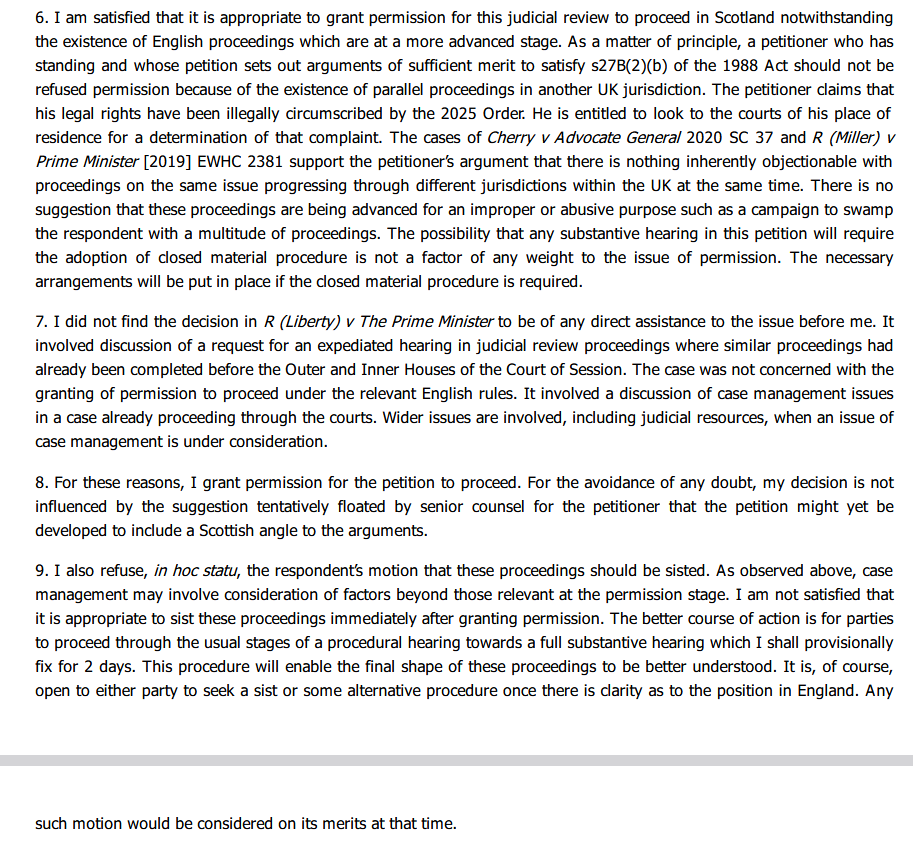
I hope I am wrong, but I suspect that Lord Young will today rule that I was entitled to a judicial review but “case management” means it should be shelved in favour of the English case.
The one time I was actually furious during the proceedings yesterday was when Catherine Smith said that the Scottish judicial review should be closed down for reasons of cost, and specifically stated that the closed evidence sessions – on which I am given no information and do not even know when they happen – are costing the court system £10,000 a day.
The UK government is introducing spurious and fake intelligence material – making who-knows-what allegations about Palestine Action – and using the cost of fake intelligence hearings to close down scrutiny. It stinks.
We desperately need more money to continue this legal case. Each stage of hearing like this costs us about £30,000 and the eventual judicial review will cost much more.
Again please contribute if you can but do not contribute if it causes you difficulty. If you know people who are able to afford to help and likely to be sympathetic, please do contact them and ask their assistance. We are trying to keep a lot of very good people out of prison.
You can donate through the link via Crowd Justice, which goes straight to the lawyers, or through this blog.
https://www.crowdjustice.com/case/scottish-challenge-to-proscription/
Alternatively by bank transfer:
Account name
MURRAY CJ
Account number 3 2 1 5 0 9 6 2
Sort code 6 0 – 4 0 – 0 5
IBAN GB98NWBK60400532150962
BIC NWBKGB2L
Bank address NatWest, PO Box 414, 38 Strand, London, WC2H 5JB
Or crypto:
Bitcoin: bc1q3sdm60rshynxtvfnkhhqjn83vk3e3nyw78cjx9
Ethereum/ERC-20: 0x764a6054783e86C321Cb8208442477d24834861a
On-topic…
Is anti-monarchy the way to get past the divisions in the left in Scotland regarding independence? How about calling for a Scottish republic, while leaving the question open as to whether it will combine in a union republic with other republics in the world or not (including an English republic if that comes about)?
People on the left who say monarchy isn’t an issue can shove it, as far as I’m concerned.
Of course whether or not extreme deference is due to a posh billionaire because of the family he comes from is an issue!
And anyway it’s best for the left to define what some issues are, okay, rather than only accept issues that rightists agree are issues. If the enemy doesn’t want something to be an issue, they’ve probably got a weakness there. And the weaknesses are exactly where you need to attack. Any serious understanding of conflict and strategy will make all of this very clear.
The traditional monarchist response to republicanism in Britain has been to pick a divisive politician (Tony Benn used to be a favoured example) and ask whether you’d like him to be the president.
The correct answer to this stupid challenge is that if a former-politician president were to be caught accepting loads of cash from Qatar in a suitcase, he’d probably be hoofed out of office soon after. Similarly if he had something like the 1997 Paris car crash in his background, it would be viewed the same way Chappaquiddick is for Ted Kennedy. And we haven’t even got to the demise of Barry Mannakee and “royal servant” George Smith yet. Nor to questions of vetting and Jeffrey Epstein either.
Basically there is no f*cking argument for monarchy whatsoever, unless you think some should be born to rule and others should be born to lick their boots and clean up after them. And Old Etonians can shove their “Chesterton’s Fence” argument, because those of us who oppose the monarchy DO understand very well what the monarchy is for.
“The correct answer to this stupid challenge is that if a former-politician president were to be caught accepting loads of cash from Qatar in a suitcase, he’d probably be hoofed out of office soon after.”
As usual, you are offering an ideal solution to a current problem, not a realistic one. If Britain had a president, they would either be mainly ceremonial, like Ireland’s president and so politically irrelevant, or replace the PM as the Head of State, in which case the Establishment would make damn sure that they were one of them. So, if a former-politician president were to be caught accepting loads of cash from Qatar, and was subsequently hoofed out of office at the next election, they would simply become a passenger on the non-exec directorship / advance payment for memoirs / after dinner speaking / NGO exec gravy train, as all the Establishment’s placemen and placewomen are rewarded. Meanwhile they would be replaced by another Establishment pick.
The British PM is not the head of state.
Main point is that there would be a written procedure for removal of a president. It’s not like with a monarch where the idea is that he can stay in office as long as he likes, because of who is father or mother was.
I am not in favour of an executive presidency.
Totally accepted that I am essentially playing silly b*ggers in the sense of talking about progressive reform of the bourgeois state. Sometimes there can be an element of sticking it up the rulers when doing this though.
“The British PM is not the head of state.”
They may not be de jure, but they are de facto. Admittedly, neither Der Stürmer nor Bigears is the head of state in the sense that they are in charge of the running of the country, but to the extent that the nominal head of state is the actual head of state, this is the case.
I can’t believe you’re still out here acting like you know things after you were caught thinking that the UK PM is the head of state
Ok, who is the head of state, then, in your universe?
The British prime minister is the executive president who controls a unicameral legislature. These are the efficient parts (cf. Bagehot) off the constitution, the rest are bumflufferies.
Britain is a republic with an executive president and a unicameral legislature, all beholden to the oligarchs who really run the place.
@Squeeth repeating a lie does not make it true. The British Empire is not a Republic. Republicanism is an opposing movement (which should remove Governors-General, for example, around the world) that contrasts with a monarchy. Much of government policy is determined, under Royal prerogative, in secret, not even Parliamentary committees getting oversight. This is form of private government (see for instance secret treaties with USA and Israel), where there is no effective public accountability, treason is legally defined as criminal disloyalty to the monarch and heirs (which elected officials swear to) instead of the people or state, the armed forces are commanded by the monarch on an oath of personal loyalty, who is also head of the established Church of England, the Crown has sweeping rights and immunities, and is the major blocker to a codified Constitution.
What makes you think any of that would change if the monarch was replaced by a president?
“treason is legally defined as criminal disloyalty to the monarch and heirs (which elected officials swear to) instead of the people or state, ”
Nope, that’s high treason.
@Bayard, wrong question, but anyway that basic modernising change would be highly disruptive and at least a new Constitution would be needed, with attention paid to checks and balances, and light shone in dark corners. But I’m not advocating humanistic or theistic government.
#biocracynow
Is any other kind of treason still legally prosecutable? I don’t think petty treason is a thing in Scotland. High treason is treason. But OK, high treason then. My point, and I’m not alone, is that British treason law is long overdue for a rewrite if not repeal, but the Crown has significant interest in blocking that. Which it has (governmental excuses are particularly pitiful here).
” but anyway that basic modernising change would be highly disruptive and at least a new Constitution would be needed, with attention paid to checks and balances, and light shone in dark corners. ”
There is not the slightest evidence in history to suggest that this would be the case. What is overwhelmingly likely is that, barring a successful popular revolution, which is unlikely to happen due to the unavailability of weapons to the general populace, the whole panoply of royal power and wealth would be slid seamlessly onto the shoulders of the new republican state, just like it was last time.
You’re confusing style with substance. Who decided the fate of the “monarchy” in 1936, thick Eddie Windsor or Stanley Baldwin? Powers reserved to the crown is a euphemism for powers reserved to the Prime Minister.
@Brian Red, there are no monarchists on the Left. You can squeeze and stretch definitions as much as you like, but you cannot get Left-monarchists. And British theocratic hereditary monarchy is an extreme form of hierarchy (and therefore royalists are extremists). Yes, the monarchy, as the capstone of the British Empire, should be attacked, but there are myriad alternatives to an elected presidential head of state no matter what views the Republic campaign holds. And even then, ways to make such an election tend to more moderate than divisive leaders than pluralist FPTP.
Why is royal secrecy increasing? What realms of policy are reserved from public influence under royal prerogative? What is the relationship of the Privy Council to Empire? What is the true history of the British monarchy, so long suppressed (see the Georgian Papers etc)? And so forth.
Simple question, was Mandelson competent, I think yes, was he a crook, also yes. Could the security services keep him in check, probably, so the only thing they had on him , was being a friend of the worlds worst pedo.
Now our lovely king a friend of two of the worst pedos Saville and Jake the peg must surely be thrown out, along with the rest of that wretched family. Up against the wall mother f–kers
Competence is not a desired attribute in our idiocracy, which is probably why mandelson is targeted but big ears is free to muddle along with all his dubious associates and sycophants. But it really doesn’t matter because the UK government is not run out of Westminster and all important decisions are made elsewhere. Ours is not to reason why, ours is just to pay our taxes and die, quietly.
@GFL, no, kept getting caught, and incontinent too. Mandelson was obviously protected, though. The British establishment values other things than competence.
The power of the state …
“A cafe owner in northern England has said British police offered him financial incentives and promised to turn a blind eye to some low-level offences if he informed on the proscribed group Palestine Action.”
https://www.middleeasteye.net/news/cafe-owner-says-uk-police-tried-recruit-him-spy-palestine-action
The police are NOT your friend. Patsy’s invariably end up dead.
Stevie Boy – A hypothetical situation – if the security services have someone on the inside, then to gain extra confidence within the group, he or she will grass up the police informer to them, after getting that operational info from cops. The informer will suddenly find his friends in the police aren’t his friends. And maybe people stop coming to his, in this case, café.
It’s a sad fact that virtually every protest group will be infiltrated by the Police/SS, either directly or with informers.
We see this with Hamas in Gaza and it was true with the IRA and UDF. So, it’s a fair conclusion that PA also has its infiltraitors.
Trust no-one !
@Stevie Boy, my old Contemporary Issues in British Politics lecturer told us Special Branch sent undercover officers to every public political meeting, and this was decades before Spycops broke. We know that British political policing has been fantastically well-resourced, and directed against people and groups that the Establishment were horribly afraid of (like communal garden centres and animal welfare protesters, apparently).
I’ve started reading Fakers: A Top-Secret Tale of Phantoms and Forgeries on the Disinformation Front Line by Rory Carmac (2026), and it occurs that these people were so up their own black propaganda that they were curiously hollow individuals prone to delusion, fabrication and jumping at shadows.
‘…… (like communal garden centres and animal welfare protesters, apparently) ‘. Yes to the extent in the animal welfare group case of a Gov operative forming a relationship and even having a child with a group member. If they – the State – are prepared to go to that length to infiltrate and subvert a group like that, one that presented zero threat to ” the integrity of the U.K “, think how far they’re willing to go to do similar damage to an actual threat to the ” integrity of the U.K ” , ie Scottish Nationalism/Independence. They will have had their ” assets ” installed probably since the inception of the snP: the only question is how far up/into that party they have penetrated. My guess is at least as far as the controlling hierarchy – if not to the very top of that party.
And we can see – with ever-increasingly appalled eyes – how far the Brit State is going to serve Zionist interests: and that’s just what we CAN see; we can only speculate the depths/lengths they operate clandestinely.
We have to wonder why Murrell ( aka The Lalique Loving Lag ) openly * called-in * the Brit Security Services to ‘ oversee ‘ the Leadership Election after Sturgeon, about 5 mins after publicly stating she had ” plenty of fuel left in her tank ” – and after being forewarned by Scotland’s top cop – ” there may be trouble ahead ” ( but while there’s Jaguars n luxuryyyy campervans …..let’s NOT face the music, and scram ). And, * conveniently * it was Sturgeon lap-dog Yousaf who * won * that contest: thus ensuring ‘ continuity of agenda ‘, eg utter stasis on Independence & continued emphasis/promotion of * Gender * issues
With Swinney they didn’t even bother going through the charade of a contest, he was simply installed by the cabal: in his case to ensure none of the evidence concerning the fitting-up of Alex Salmond came to light.
I meant to say…….Sturgeon’s * performance * on TV yesterday ( when faced with awkward questions, always try to squeeze a few tears out: audience’s love a bit of the ol’ waterworks and it makes it harder for an interviewer to press home the most salient points when the interviewee is getting all * emotional * ) was not for the benefit of the people of Scotland; snP members/ Independence supporters, never mind the people who gave money to the daisy-ring-fenced ” Indy Campaign ” ( which the cynical swine of the snP hierarchy KNEW was never happening )
No, that appearance was her last-ditch, desperate attempt to keep alive the prospects, her ambition, of getting the nod for a ‘ prominent ‘ ‘ important ‘ job with one of the globalist entities, eg EU/WHO/UN that all her scheming & posturing – remember the No Fly Zone Lunacy she was so quick to advocate at the beginning of the Proxy War? – she believed was heading her way after she’d successfully screwed-up, possibly terminally, the Independence Movement, made Scotland a political laughing-stock and the former Party of Independence/Holyrood more a perpetual Pride rally than any threat to the Brit State. She took what should have been a wreaking ball and turned it into a glitter ball.
She may still get that * nod *: after all, failing upwards is the defining characteristic of modern Politics, right?
” wrecking ball ” though ” wreaking ( havoc ) ball ” is just as apposite
“She may still get that * nod *: after all, failing upwards is the defining characteristic of modern Politics, right?”
The Gravy Train only stops to pick up, never to set down.
@ Bayard. If you’re in the 1st Class compartment of the Gravy Train it will take you through a succession of Corporate/Globalist Institution revolving doors before terminating @ *Made* For Life Station.
And if you’re really quoted, eg former Israeli PM, a ” Royal ” or Gatesian Controligarch ( there’s an excellent book of that title ) you may even be invited onto the Lolita Express or it’s many oligarchic equivalents
To no-one not a member of the Sturgeon Cult’s – inc those who’ve undergone deprogramming to shed the psychologically deleterious effects thereof – surprise, I learn from comments elsewhere ( I can’t stand the sight or sound of her now + I don’t watch/read ANY MSM slop ) that, in her characteristic manner of shying away from the public spotlight and the immense value she places on her privacy, she has appeared on the most watched * News * & Current Affairs TV Prog in the UK to tell – a probably mostly hungover/bored to catatonia audience that, yes, it was/is indeed men – or as she likes to call of them ..” Violators ” who are to blame for ALL her past, present & future travails.
Yes, the Mother Teresa of Scottish – if not Global – Politics has whipped-out one of the go-to blame deflectors of these demented times, now the weapons-of choice of every corrupt, lying wank-sock/ snatch-rag Political Caste clown – in this instance ” Misogyny ” – to ” explain ” ( chicksplain? ) the torrent of disbelief, ridicule and scorn her notorious selective amnesia, optional blindness and ability to spout pish out of both sides of her mouth simultaneously has brought down on her.
Homo -Trans – Phobic – Racist – Bigot – Aunty – Semite – Uncle – Vanya – Ageist/Disablist – Fascist Nationalist …..just ad Nauseum and we have the complete and sole required lexicon of contemporary * Progressive * Potty-Licks
I’m not a vengeful person, but in this case, as the ” kids ” say……Ima luuuuvin’ it
Another one of modern societies perpetual victims !
“always the victim never the problem”, how often do we hear that ?
Indeed. I just wish she would fuck-off and disappear permanently from public view; but being a pathological narcissist/liar she probably won’t.
it was/is indeed men – or as she likes to call of them ..” Violators ” who are to blame for ALL her past, present & future travails.
Has Nicola Sturgeon used the word “violators” even once?
I was being satirical. She may not have used that word, at least publicly, but having been party to her utterances over the years, it’s obvious she has a ” thing ” about ” men “; even remarking on one occasion how she hopes ” never to have to shake a man’s hand ever again “; not to mention her consistent attempts to blame all HER mistakes directly or indirectly on ” men “.
Just like Misogyny, Misandry is a thing; just as not all racism is by Whites against Black/Browns – Non-White Racism is a thing. Wanna start on ” Transphobia ” ? Have you ever seen/heard some of the despicable things these ” special people ” have said about Women over the years “? I have, they are the polar opposite of the gentle, innocent permanent victims they are almost always portrayed as?
You could have just said “no”
I checked out JVL last night – having not done so for getting on for a couple of weeks – and came across the following, posted on May 22nd:
ELSC & PILC file legal complaint against UK Lawyers For Israel patrons
The European Legal Support Centre (ELSC) and the Public Interest Law Centre (PILC) have submitted a formal complaint to the Bar Standards Board (BSB), the regulator of barristers in England and Wales, concerning senior barristers Lord David Pannick KC, Lord Anthony Grabiner KC, and Stephen Hockman KC in their role as patrons of UK Lawyers for Israel (UKLFI).
The complaint raises concerns that repeated references to the barristers’ professional status in UKLFI correspondence may have amplified the authority and perceived seriousness of legal threats and allegations directed at individuals and organisations engaged in lawful advocacy, cultural work, education, and public expression relating to Palestine. It argues that this dynamic has increased pressure on recipients, often non-lawyers, required to respond to complex legal claims without equivalent resources or representation…..
The complaint is brought on behalf of a cross-sector coalition including teachers, migrant organisations, student unions, NGOs, healthcare professionals, and cultural practitioners, all of whom have submitted impact statements. It situates these concerns within a wider pattern documented by ELSC across education, healthcare, culture, workplaces, and grassroots organisations, with UKLFI appearing 128 times in the ELSC Britain Index of Repression, a database recording the systematic repression of Palestine solidarity in Britain.
Across these sectors, teachers, students, healthcare workers, cultural practitioners, and activists are among those most frequently affected. As outlined in the complaint, the cumulative effect is a chilling environment in which individuals and organisations adjust or withdraw lawful Palestine-related activity in anticipation of legal or institutional escalation……
https://jewishvoiceforliberation.org.uk/article/elsc-pilc-file-legal-complaint-against-uk-lawyers-for-israel-patrons/
And here’s a link to the ELSC report entitled On All Fronts referred to in the article:
On All Fronts:The Multi-Sited Repression of Palestine Solidarity in Britain
https://elsc.support/wp-content/uploads/2026/03/On-All-Fronts-The-Multi-Sited-Repression-of-Palestine-Solidarity-in-Britain.pdf
The very first article I checked out when I went on JVLs website last night mentions the Nazis use of the octopus to depict and demonise Jews as having power and control and influence around the world, and it’s regarded as antisemitic, as such…. but my god, if it was a Big Lie back then, it certainly isn’t now. The malign and malevolent influence of the Israeli zionists is everywhere!
So Sturgeon says she feels British – apparently she’s moved to London – and whilst she was being interviewed by Laura Kuenssberg – she had the high profile lawyer Amer Anwar waiting in the wings, just incase any really tricky questions came up.
Talk about kowtowing her neck must’ve been sore for weeks after that.
https://nitter.poast.org/pic/orig/media%2FHJpHXZHWcAAnFca.jpg
I am not Scottish but from afar I never cared for Sturgeon as a politician. Nevertheless, when the ex-First Minister of Scotland is on the front page of the London-edition of the Metro today because of the alleged relatively minor transgressions of her husband, it is plainly out of proportion, and I smell a UK establishment-run smear campaign going on. I suspect it comes down to discrediting the SNP, so the field is left clear for either a Burnham-run Labour Party or Reform in the next General Election or even the strategic goal of marginalising the independence movement. Mind you, if so, the phrase ‘There’s many a slip ‘twixt the cup and the lip’ comes to mind – same with the Labour leadership plot, by the way. But actually, when it comes to the ‘UK state’ as Craig describes it, Scotland is actually in a better position than England, because at least you have devolved parliament and other constitutional powers.
“discrediting the SNP”. Really ? What else do they have to do ? They are a joke.
Anyone who still believes the SNP is ever going to deliver independence is medically deluded.
lol, yeah the snP are doing a magnificent job of screwing themselves up without the need of any external help.
Nonetheless, as stated previously, it’s 99.9 certain the party has ( long ) been infiltrated by bad/State actors; so Tom is not wrong when he says there is something suspicious about how this Sturgeon + Murrell Affair is being parlayed.
On the other hand……not sure I would call Murrell’s crimes ‘ relatively minor transgressions ‘ and we have to ask why the larger sum that * disappeared *, ie the £700,000 ” Indy Campaign Fund ” has been airbrushed out the picture – not even referred to in that interview yesterday. And let’s NEVER forgot – though the perps are straining mightily to make us do so – the very, very unminor transgression of the plot to politically assassinate Alex Salmond. For which not a single participant has been called to account and the ” Inquiry ” related to it was a completely partisan ( in Sturgeon’s favour ) farce.
I’m certain Sturgeon has been protected, up till now: the question is whether her protectors will continue doing so, or, having served her purpose, they’ll throw her to the dogs
Yes, an Alex Salmond SNP would have been very risky for the westminster regime, so there is certainly a case for assuming the security services (incl CIA) were involved in his downfall. The set-up was to my mind very reminiscent of the Julian Assange affair. Wee Kranky has links to the USA regime, as do some of her coven.
Questions that bourgeois journalists are too chickensh*t to think of, and would also be too scared to ask if they were ever to think of them, numbers 72104 and 72105:
Number 72104
If Reform UK win the Makerfield by-election and Nigel Farage calls for a general election, what does Kemi Badenoch then do?
1. Say “hell yeah”, accepting the position of second fiddle to Reform?
2. Say “nope”, giving Reform ammunition to say “Watch the uniparty close its ranks”?
3. Something else?
Number 72105
If Labour win the Makerfield by-election and Andy Burnham returns to the Commons, what happens if Keir Starmer’s handlers instruct Starmer to tell Burnham to pipe down or else he’ll “ask the king” to call a general election? (Cf. John Major calling a confidence vote in his own government.)
1. Burnham pipes down?
2. Burnham says “f*cking do it then – see if I care”?
3. Something else.
I see the passionate believers in Free Speech in the Ziobour Gov/ Security State have banned Cenk Uygur of The Young Turks podcast from entering the U.K; at the behest of the Chosen Psychos and for the reason of Mr Uygur’s criticism of Israel’s – ongoing – genocide of Palestinians, it’s attempts to reduce Lebanon to the same destroyed state as Gaza and for precipitating and continually enflaming the globally disastrous, unprovoked war on Iran.
All valid reasons for criticism, any reasonable person would agree: and even if they don’t agree, what does it say about the governance of a country, ie the U.K, that it’s far more concerned about doing the bidding of another country, ie Israel, than it is protecting the interests of it’s own people; not to mention upholding – supposedly – universal rights/values which – allegedly – are held to be the, much vaunted, core principles of that country’s system of governance?
Here is the response of Cenk Uygur and Hasan Piker to their being refused admission to the UK.
The american people are slowly waking up to the evil influence of Israel on their country, unfortunately the British people are still asleep, mainly due to the totally infiltrated MSM and the manufactured distraction of Islamic invasion. However, the issues are all related and all feed back to Israel.
Aye, if recent polling is accurate, support for Israel in the U.S has declined drastically, particularly amongst young/younger people, though such is the stranglehold AIPAC still has on the U.S Political/MSM Caste, there is no discernible diminishment of that malignant entity’s grip on U.S Policy.
That will only change when incumbent & prospective members of the Senate come to understand that actually being or being perceived as being in the pocket of AIPAC/Israel is not the magic requirement for electoral success it has been for decades.
I think you’re right that the UK Public is nowhere near a similar Israeli influence-rejecting tipping-point as in the US and for the reason you give, ie the constant iterations of the ” Islamic Threat ” both domestically in terms of the ethnicity of immigrants and globally in terms of how ” those bastard Iranians are causing us to pay more for fuel for our moatas “.
Outside of ” closed societies ” eg N.Korea, I think it could be said that the UK populace is the least well-informed of the so-called ” developed ” country extant
An interesting piece by Philip Giraldi.
‘ Congress is considering passing a bill that will give Americans serving in the Israeli army US government provided full benefits like education, jobs and medical care just as if they had been serving in the United States military. Indeed, the legislation currently working its way through Congress would, for the first time in American history, treat service in a foreign army both legally and in practice as equivalent to service in the US armed forces — but only where that foreign army is Israeli.
In addition to that, … , is the national Defense Authorization Act (NDAA) for 2027 released on May 13th. Section 224 of the House version of the Act entitled “United States-Israel Defense Technology Cooperation Initiative” integrates “US-Israeli military research and development, co-production of weapons systems, licensing agreements, AI, directed energy, data integration, and missile defense.” ‘
[Link: Search Unz Review, then article by Philip Giraldi – ‘The Israelization of the United States Military Is Proceeding’]
These bills essentially give Israel legal control of the USA MIC, something that it unofficially had with its permanent office and staff in the Pentagon and elsewhere.
USA today, UK tomorrow !
‘Kin hell. The Israeli takeover of the U.S continues apace.
Direct link now available.
https://www.globalresearch.ca/israelization-united-states-military/5928401
Cheers M.J, I forgot to mention Hasan, but did watch the response earlier.
Apparently Hasan is the nephew of Cenk. Their family get togethers must be interesting !
Do Emily Thornberry’s remarks indicate a resurgence of the left and accompanying pro-Palestinian sympathy in the Labour party?
Emily thornberry is a self declared zionist. FACT
You’re right, she’s listed among the Friends of Israel. Possibly, as the Labour FoI officially favour the two-state solution, she considers herself to be a “liberal Zionist”, as might the PM.
I guess a ‘liberal zionist’ is one who gives you a great big hug before killing you !
“as the Labour FoI officially favour the two-state solution, ”
Well, they would, wouldn’t they: the “two-state solution” is no different from apartheid South Africa and its “multi-state solution” with all the Bantustans.
@MJ – “Do Emily Thornberry’s remarks indicate a resurgence of the left and accompanying pro-Palestinian sympathy in the Labour party?”
No.
I thought for a moment this might be another case of someone formerly involved at a senior level in foreign policy politics deciding to say 1% of the truth about the Zionazi entity once they’re safely ensconced in retirement. (She was shadow foreign minister for four years and then shadow international trade minister for a year. Then after that she was shadow attorney general, supposedly on her way to becoming the real attorney general, but as soon as Labour won the election Starmer appointed the Jewish Richard Hermer to the job instead – he wasn’t an MP but he got made a lord – and didn’t give Thornberry a government post at all.)
But the problem with this line of thought is that she hasn’t actually retired. She is chair of the foreign affairs select committee.
This is probably to do with Qatari and Saudi money in the British parliament (doubtless with a member or two of this specific select committee trousering some) and SIS not wanting all their Qatari and Saudi “friends” to tell them they can do one. I doubt it’s anything to do with Labour party politics.
I’ve been reading more of Rory Cormac’s new book Fakers: a Top-Secret Tale of Phantoms and Forgeries on the Disinformation Front Line (about the black propaganda work of the IRD from 1960), when it occurred to me to check via casual Web search where the stories that Scottish Independence was being fuelled by Russian and Iranian bots was coming from, and saw a mention of a report by Tel Aviv-based Cyabra as a source. Cormac’s book indicates times when the British Foreign Office were taken in by their own IRD’s forgeries, which is a recipe for self-delusion, but could be more widely applied.
Is there a secret department in the Foreign Office that treats Scotland as a foreign country? Perhaps in anticipation?
Quite possibly. Certainly the IRD worked on Northern Ireland. Be aware that the best disinformation contains large elements of the truth. Russian intelligence probably does stir it up in Scotland. Iranian intelligence probably couldn’t give a toss.
Another point to bear in mind is that the British state treats the whole of Britain, not just Scotland, as if it were another country, populated by “natives”.
See also the work of the British Council in Scotland. Ironically the BC, originally known as the British Committee for Relations with Other Countries, was modelled on the USSR’s All-Union Society for Cultural Relations with Foreign Countries, run by Kamenev’s wife who was also Trotsky’s sister. Just as the laws of warfare in general don’t change according to who you are, nor do the laws of psychological warfare.
Last – quite a lot of internet propaganda in Britain is handled by the military. The same point that you are making about the Foreign Office (acting as if they are acting against a foreign country) applies.
@Brian Red, I guess the military employs more than its share of fantasists, from reading the likes of Joe Glenton on Walting (behaving like Walter Mitty), which lends itself to fabrications and delusions of grandeur. Plus the military’s (growing?) immunity under Royal prerogative.
But I’m also interested (given the understandable political current concern about AI-powered fakery) in what lasting effects all these Cold War forgeries and fakes had. Not only that, but the whole CIA-funded culture (Frances Stonor Saunders’ Who Paid the Piper?) that MI6 tapped into, how securocrats and spooks shaped national creative sectors (MI5 vetting BBC applicants, funding business-friendly modern arts, supine poetry and national security cinema — Alford and Secker on last). Then surveilling and infiltrating counterculture.
Control over court listings and court dates is an important power in any country.
See the conviction of Vikrum Digwa for murdering Henry Nowak, which was probably arranged in good time for the Makerfield by-election.
There has even been a demand from the US government in response to the conviction. It goes on about “civilisational decline”. Actually there is civilisational decline, and guys such as NARCO Rubio are excellent illustration of it.
https://archive.is/F8GJk
It seems it is not only the free Irish whom something calling itself ‘Lord’ Young could never command to treat anti-genocide activists as terrorists, because a genocide-abetting government in London says so.
His Lordship and those puppeting him also know better than to enforce such a command on the Irish of the occupied north. Whereas the crackdown across Britain has been ferocious for anyone expressing support for Palestine Action – mass arrests and detention without trial, in the occupied north of Ireland enforcement has been much more tentative and uneven. Cops have chosen not to make arrests at Palestine Action solidarity protests. No one who has violated the proscription has yet been kept in custody or brought to court.
The veteran Derry civil rights activist Eamon McCann was asked about this recently by Oliver Eagleton and he said, ‘It would be much harder to take in people here. There would be serious resistance. The north has its problems, but it’s easier to be a militant for Palestine here than in many other places. Including Britain and France with their large Muslim populations.’
Scotland by contrast was seen by the English genocidaires as somewhere there would be no meaningful resistance. That is something that should make independence-minded Scots cringe.
” That is something that should make independence-minded Scots cringe.”
Oh it does, Z, it does. There have been * static * protests in my nearest city – Inverness – outside the Town House ( the equivalent of a City Chambers ) and on a city centre bridge every week almost since the beginning of the Genocide – later a FOI group ( much smaller ) appeared, of course, and similar manifestations of Pro-Palestine support in other Scottish cities & towns and whatever his shortcomings may have been as MSP/FM, Humza Yousaf was one of the very few UK Politicians to voice any criticism of Israel, in fact, I’m fairly sure that was reason he was pulled from the position of FM.
Other than that, the Scottish Political Caste has been just as craven and spineless about opposing the Genocide as it’s counterparts in rUK and the West in general. The idea of Swinney aka The Undertaker voicing ANYTHING that might that might not meet the approval of his colonial masters about is about as likely as Sturgeon ever admitting she made a mistake and taking even a scintilla of responsibility for the trail of carnage she has left in her wake
Indeed. The outspokenness of Humza and that SNP motion at Westminster condemning collective punishment seem to belong to a different age now. Even so, with support for independence so high I’m surprised the zog genocidaires would impose such an anti-human law on Scotland. They seem to think Scots can be humiliated without consequence, equating an entire nation with its political inverterbrates.
WTF – Murrell has over 600k in his pension funds yet:
“The decision to grant legal aid to Peter Murrell, the former SNP chief executive who embezzled £400,310.65 from the party, has caused controversy.
Murrell admitted to a 12-year embezzlement spree between 2010 and 2022. He was granted access to legal aid last year.”
Here’s an interesting fact …
Not to downplay Murrell’s pilfering but, ‘Oxfam reports that “in 2025, the world’s 12 richest men owned more wealth than half of humanity.” Yes, you read that right: a dozen obscenely rich individuals, all of whom use maximums of coercive state power to enrich themselves at the public expense, have more wealth than more than 4 billion people combined’
Think on that for a moment.
Another interesting fact is that the desire to own more wealth than you could possibly use was already recognised as a mental illness at the time of ancient Greece. We are ruled by madmen.
Following yesterday’s ruling from the UK court of appeal that they consider proscription lawful and proportionate, I am donating a further £30 to Craig’s legal fund to support a Scottish judicial review