[UPDATE: this article is now complete; I published just the start yesterday.]
It was a remarkably mild early November morning at 6am as I left the Chelsea Cloisters hotel to get the tube to Westminster and the Supreme Court. I had been worried because I had forgotten to pack my thermal underwear.
I had queued overnight for the Assange hearings, the Salmond trial and the ICJ Genocide case – the latter in minus 5 degrees at The Hague – and thermals were an essential part of the kit. On the first night for the Assange hearings, at Woolwich Crown Court, I stood for seven hours in freezing drizzle with Patrick Henningsen and Randy Credico. Immediately that first day in court finished, I headed to Mountain Warehouse to buy a large, warm, waterproof jacket.
I found the one I wanted which was on sale, and tried it on. I then took it to the counter and explained to the young lady that it was labelled XXL, but I couldn’t get the zip to do up. She looked at me coolly and replied, “Fat people don’t climb mountains”.
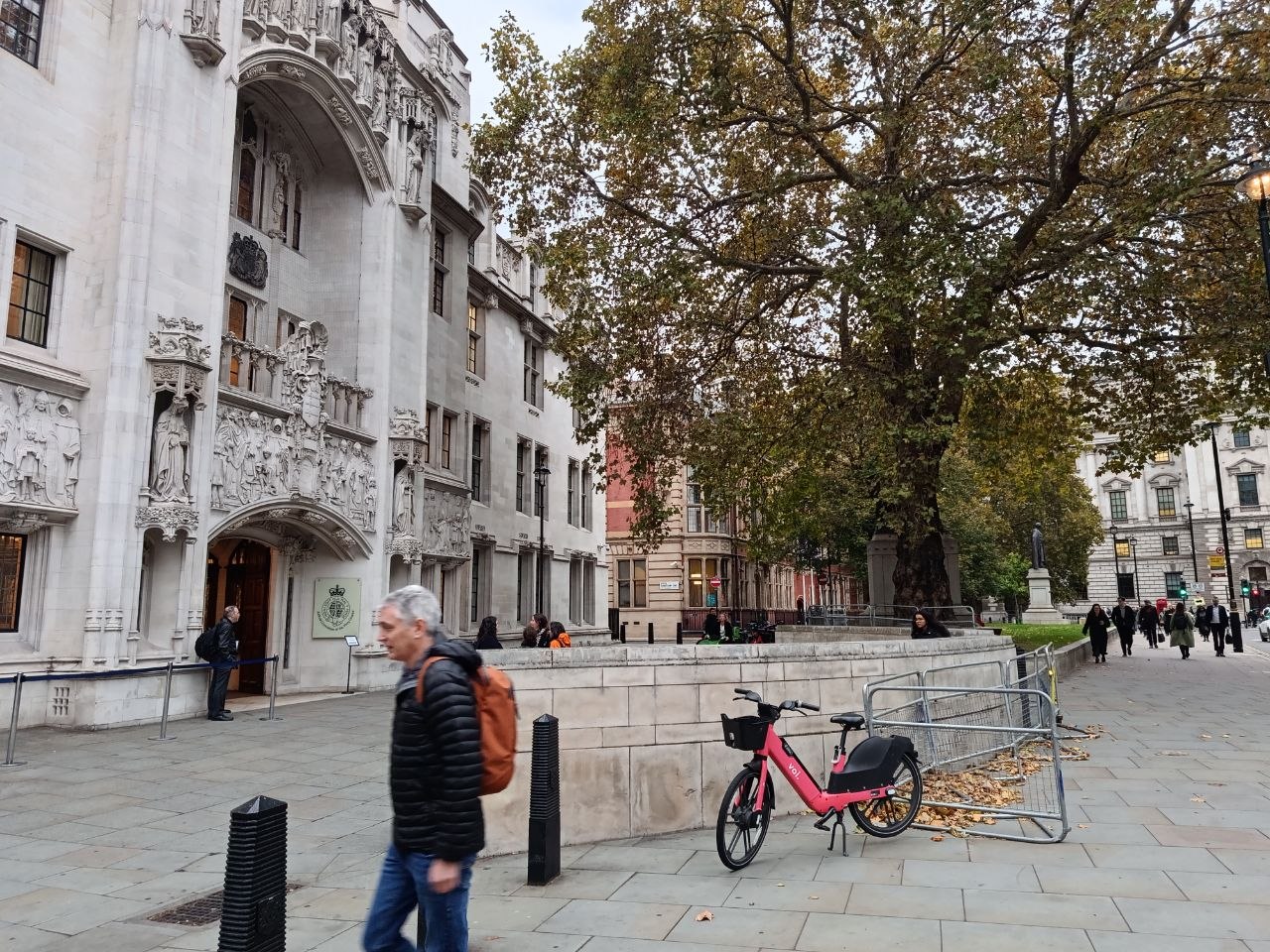
My ego somehow survived, and now as I approached the Supreme Court I saw the flashing orange lights of three trucks parked outside, and heard the ringing metallic sound of crews putting up metal crowd barriers around the building. I had slightly worried I was late for the queue, but there was only one tall young man sitting on the benches outside. He was a journalism student from City University, and neither of us having anything else to do, he interviewed me.
There were three men in sleeping bags along the front of the court building, one right across the door. We speculated as to whether they were part of the queue or simply homeless. As barriers were clamped into place behind us, we worried where the front of the queue was meant to be. I approached the man wearing a Hi-Vis jacket, who looked in charge. He had long hair and beard and a friendly open face. He wore a builder’s helmet, presumably in case the Supreme Court somehow fell on top of him.
“Do you know what the system is for installing these barriers?”, I asked.
“I’d be pretty bad at my job if I didn’t”, he replied.
I explained we were the queue. He laughed and said we were fine where we were. About five minutes later the crew left with two-and-three-quarter trucks still full of barriers, presumably to cordon off somewhere else. Their work was inexplicably pointless – they had pit barriers up against an existing wall, with others randomly dotted on the pavement, and left a thirty-yard gap anybody could walk past to the court on the west side.
I pointed out to Tony this seemed strangely pointless and he said its purpose might become clear later. It didn’t.
His name, incidentally, probably wasn’t Tony. I introduced myself but he didn’t volunteer a name so I didn’t press him.
At 7:30am a young lady arrived. She was pleasant and joined our conversation, but again did not give her name. She worked for a Westminster lobbying company, so I would assume was in the Israeli interest. It was 8:45am before a real queue began to gather. Public information had been that doors would open at 9am, and they did – but we were kept standing outside until after 10am.
There was then a great disappointment as an official arrived and told us no members of the public would be admitted to the courtroom. Court No. 1, he explained, has no public gallery and all the rows of benches would be fully occupied by the legal teams. The public would be allowed into an overspill Court No. 3, where screens were set up.
This was very annoying. It was also later plainly observable on the screens that the official explanation of no seats being available was untrue. Exactly the same thing had happened at the High Court hearing. I have no doubt that “security” was the motivation, and having designated Palestine Action supporters as terrorists, they were determined to treat any of the public interested in the case as potential terrorists.
The building is a very late flowering of Victorian medieval revivalist architecture and was originally Middlesex County Council. When the Supreme Court was established a quarter century ago, it was converted to the purpose, the county of Middlesex itself having essentially already been abolished.
It is rather a good building, which is important as a close neighbour to Westminster Abbey. Unfortunately the principle of open justice had not been applied in its conversion to the creation of public galleries.
Today was the last gasp of the UK legal system in challenging the legality of the proscription of Palestine Action, in the case brought by its founder Huda Ammori. This judicial review had proceeded through the High Court, which found the proscription unlawful, and the Appeal Court, which found it lawful.
As the process went through these courts, the grounds for permitted appeal were whittled down until only one was allowed: whether the effect of the proscription on Article X and XI rights (freedom of speech and freedom of assembly) were disproportionate in terms of what was necessary to protect the public from the terrorist organisation.
Articles X and XI are from the European Convention on Human Rights, enshrined into UK law by the Human Rights Act.
In the Supreme Court they do not wear old horsehair wigs and gowns, including the judges. This felt rather strange, as such costume had been worn at all the prior stages. The five judges were situated on a curved dais, with the lines of lawyers below them.
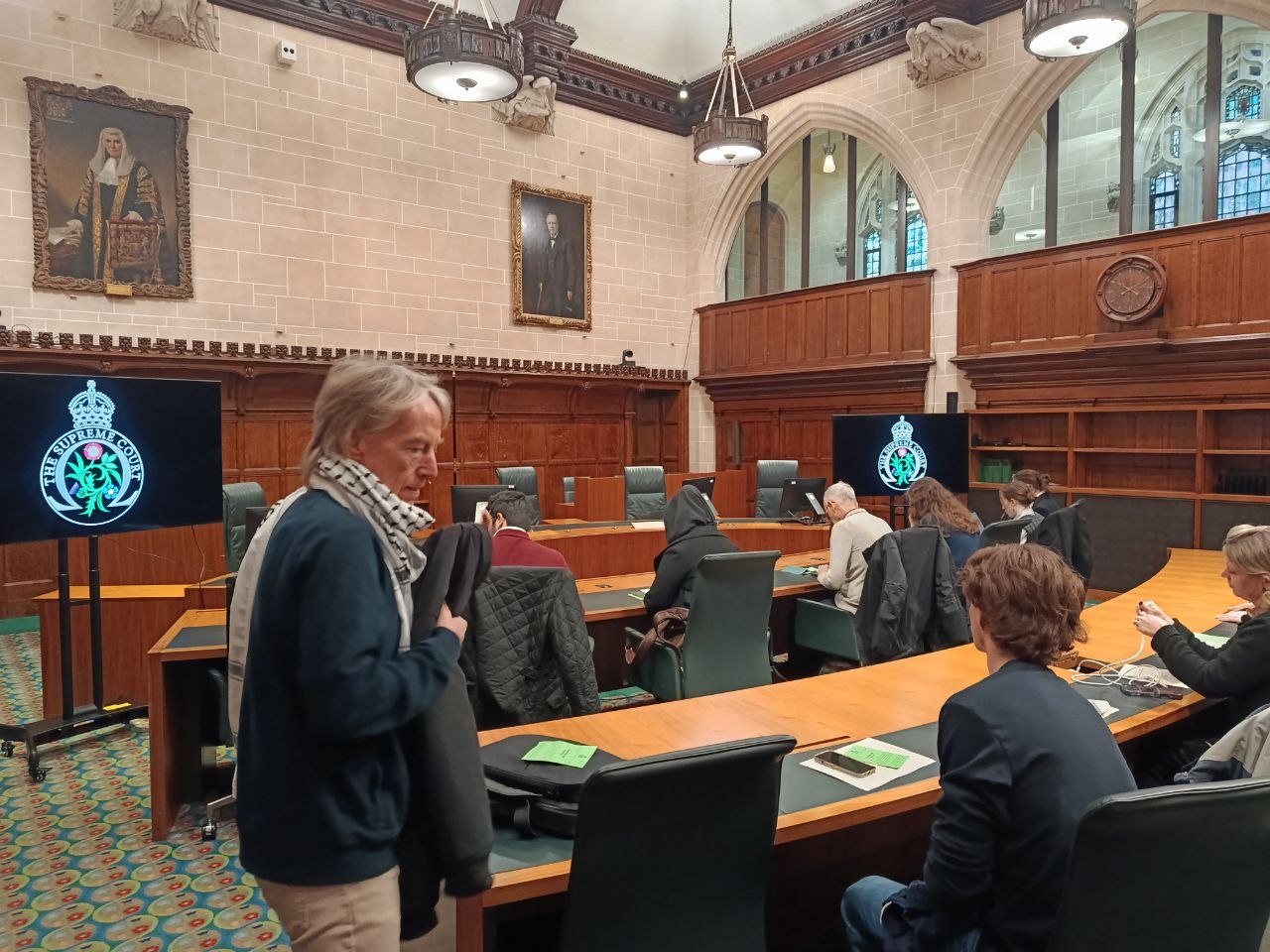
The public were only allowed in courtroom 3.
One problem with not being in the real courtroom was that, every time a judge spoke, the camera immediately cut to that judge in close up. The judges all looked extremely similar – white men aged about sixty in suits and ties. It was very difficult to tell in close-up which judge was which. Some of the identifications in this account are therefore almost certainly wrong, but not deliberate.
When you think about it, in our diverse society the difficulty of telling Supreme Court judges physically apart is a problem.
Raza Husain KC opened for Huda Ammori. Raza seemed a much more imposing figure without his wig and gown, and spoke with a force and fluency that I had not really seen in full flow in the earlier hearings.
His first point may have been excellent but as the screens in Court No. 3 had no sound for the first five minutes I did not catch it. We therefore join him at point number 2.
2) Husain said that Palestine Action was not a terrorist group, but a protest group that takes direct action. He said it could only be caught by stretching the outer limits of the definition of terrorism in the Terrorism Act, a definition which the Supreme Court had already described in an earlier case as “striking in its breadth”.
3) Husain said that according to the Home Secretary herself, the vast majority of Palestine Action’s activities did not fall within the definition of terrorism. Only 3 actions out of 385 were so described. Yet these three were used to make all fall as terrorism.
4) Unlike other proscribed organisations, the objectives of Palestine Action were in line with the principles of liberal democracy. They simply wished to impede genocide and war crimes.
5) Contrary to the Appeal Court judgement, Palestine Action did fall within the tradition of other direct action groups, such as the suffragettes, and environmentalist and animal rights groups, which were not treated as terrorist.
6) Important civil society groups such as Amnesty, Liberty and PEN, and international organisations including UN Special Rapporteurs had expressed opposition to the proscription.
7) Proscription of Palestine Action had wider effects on public confidence in the proscription regime itself and in the Terrorism Act. There was public revulsion at the arrest of over 4,000 for supporting Palestine Action, many of them elderly and distinguished.
8) Proscription of Palestine Action was prone to upset the court’s judgements in many other compatibility cases over the years. (A compatibility case tests whether a law is compatible with the Human Rights Act.) The decision on proportionality of the effect on civil liberties must itself depend on whether the anterior exercise of the proscription power was proportionate to the alleged threat.
If an elderly and distinguished person arrested for expressing non-violent support for Palestine Action were to win a case against their arrest at the European Court of Human Rights in Strasbourg – he gave the example of an 81-year-old female Christian ex-magistrate arrested at a vigil at a Truro church – that could strike down all the Supreme Court’s previous decisions on Section 13 of the Terrorism Act (expressing support for a terrorist organisation) where other, real terrorist organisations were concerned.
This last was a very good argument I had never heard before, and one tailored to meet the sensibilities of a court with no interest in civil liberties. Maintaining this absurd proscription could ultimately result, by the law of unintended consequences, in more freedom of speech, not less.
Lord Sales now interrupted from the judicial bench to ask whether Husain’s description of just three terrorist incidents included that at RAF Brize Norton.
Raza Husain replied that incident did not meet the bar of terrorism. It should rather be seen in the light of the famous Margaret Jones case, which was not assessed by anybody to be terrorism. The anti-militarist tradition is not terrorist.
Lord Sales then asked whether the proportionality exercise should not be conducted by this court on the facts as of now, as opposed to the facts at the initial hearing. Husain replied that Lord Justice Lewis had ruled at an earlier stage that material that had happened after the initial Divisional (High) Court ruling was not admissible. Lord Stephens asked why the Court of Appeal had made this ruling.
There was a hiatus as everybody in court went through sheaves of papers looking for the answer to this question, but nobody seemed able to find one.
Lord Sales asked why Husain said Brize Norton was not a terrorist attack. Raza Husain replied that it was the Secretary of State’s judgement it was not a terrorist attack. He suggested the government lawyers might explain that. Lord Sales said he was asking Husain why he would say it was not terrorism. Husain replied because of the limited amount of damage done, and because of the Jones case.
Lord Stephens then interjected that RAF planes had been damaged. Why was that not terrorism? Raza Husain said that was a precise comparison to the Jones case, which was judged not to be terrorism. The Jones case involved attempted arson at RAF Fairford. The Brize Norton case was merely spraying paint.
Lord Briggs said that surely the seriousness of damage depended on what the paint was sprayed upon? There was a difference between spraying paint on a railing and spraying paint on a Van Gogh.
Lord Sales then asked why it was not for the Supreme Court, rather than the Secretary of State, to decide whether Brize Norton was terrorism?
James Eadie KC for the government intervened to say that the extent of the damage at Brize Norton was the disputed subject of a current criminal trial. But there were other factors to be considered in determining whether an incident was terrorism.
Lord Sales said Raza Husain appeared to accept it was for this court to determine whether Brize Norton was terrorism.
Raza Husain suggested that whether one individual act was characterised as terrorism was not determinative of the proportionality of the interference with Article X and XI rights. The definition of terrorism in UK legislation is very broad. The power to proscribe is very broad. The effects of proscription are very severe. The “guardrails” provided by the Convention rights were therefore very necessary.
He outlined the draconian powers of the act, in empowering the police to arrest people on suspicion of supporting Palestine Action, and criminalising speech which could lead somebody else to support Palestine Action, irrespective of whether that was the intention of the speaker.
Lord Stephens asked whether speaking against the proscription of Palestine Action, rather than in support of Palestine Action as such would be an offence. Raza Husain replied that people are being arrested for doing exactly that.
Lord Sales asked whether, if he wrote a judgement opposing the proscription of Palestine Action, that would itself be an offence. Raza Husain replied that on the ground people were being arrested for just opposing proscription, as well as those being arrested specifically for supporting Palestine Action.
Lord Briggs said that people opposing proscription were not necessarily supporting Palestine Action, and therefore there was no offence. Raza Husain said that it was an offence under the Act to make a statement that gave rise to a suspicion of supporting Palestine Action. People opposing proscription were being arrested for that. These offences carried up to 14 years in jail.
Lord Reid said that if an academic published “I understand why Hamas (also a proscribed organisation) did what they did”, that would not be actionable.
Raza Husain said people simply do not know what they may or may not say. There is no clear line. That is precisely the chilling effect on free speech.
Raza Husain next moved on to say that he would address the findings of the Court of Appeal that Palestine Action was not in the tradition of civil disobedience groups and not non-violent. Husain said this finding was an error of fact and ignored the evidence, including that contained in the various Home Office documents. The Court of Appeal’s characterisation of other movements was ahistorical. In particular it was simply untrue to say that the suffragettes only engaged in non-violent and overt campaigning.
His submission was that Palestine Action never advocated violence. He accepted that there had been a few isolated instances of violence, but these were not deliberate.
The context was important, and the context was the enormous suffering of the Palestinian people. The aims of Palestine Action were to prevent jus cogens breaches of international law by Israel, including war crimes, apartheid and genocide.
The Court of Appeal had stated that the complicity of Elbit Systems in Israeli war crimes “must be a matter of contention” but it was not in fact open to contention. Elbit describes itself as the backbone of the Israeli Defence Force. It is Israel’s main supplier of weapons.
The International Court of Justice had issued interim measures against Israel in the Genocide case. The International Criminal Court had issued warrants for both the Prime Minister of Israel and the former Defence Minister. These were indisputable facts.
An organisation such as Palestine Action with the aim of countering this illegality was clearly in the honourable tradition of British direct action.
There were many precedents, such as the Animal Liberation Front, Extinction Rebellion, Just Stop Oil as well as anti-hunting and anti-GM food groups, who used very similar tactics to Palestine Action and were not terrorist.
Lord Sales interrupted to say that this was not an admissible argument. Palestine Action’s ground that the proscription was unfairly discriminatory against Palestinians had been refused and permission to appeal on this point had been refused.
Raza Husain continued that the tactics employed by Palestinian Action were commonplace. The Greenham Common women and Trident Ploughshares stood in the same tradition.
Lord Sales interrupted again to ask why this argument was different to a claim of discrimination, which was not allowed?
Lord Sales looks like an uglier version of Toby Young, which rather surprised me, as I had not realised that “Uglier than Toby Young” existed, even as a theoretical concept. He is very much from the Tony Blair stable and was a protégé of Tony Blair’s mate Lord Gerry Irvine KC.
Sales represented the Blair government in opposing a judicial review into the decision to start the illegal invasion of Iraq, on the grounds that judges should not interfere in ministerial decisions on national security.
They say that true beauty emanates from inside, from the soul. Lord Sales proves that you can get true ugliness that way too.
Raza Husain tried to plough on despite Sales’s interventions. The suffragettes had engaged in firebombing, arson and serious property damage. They planned such events in secret. But history viewed them as vindicated. This is because, like Palestine Action, they had a legitimate aim. Unlike other proscribed organisations the aims of Palestine Action in stopping genocide were entirely compatible with the ideals of a liberal democracy.
The aim of proscription was to prevent the actions described in Section 1 and Section 3 of the Terrorism Act. The necessity of the proscription must strike a fair balance with its impact on statutory Article X and XI rights. Was there need for proscription? Elbit’s property rights were protected by the full range of criminal law and not just by Sections 1 and 3.
The aim of proscription must be limited to preventing actions which fell under Sections 1 and 3, not to disrupting the vast majority of Palestine Action’s activities which did not meet the definition of terrorism. Proscription was being used to prevent acts which the government simply considered as irritant. In the proportionality exercise it must be considered that they are preventing Palestine Action’s activities as a whole, not just those which fell under Sections 1 and 3.
Raza Husain then handed over to Henry Blaxland KC to tackle the Home Office claim of “an escalating pattern of violence”.
Henry Blaxland said that the question to be asked is whether the criminal law is equipped to deal with Palestine Action without proscription. The state should not prematurely exercise a power to prevent crime. Sweeping preventative powers were a fundamental change to the order of a liberal democracy.
There were many charges in the criminal law which could be and had been used against Palestine Action activities. These included criminal damage, burglary, aggravated burglary, assault and violent disorder.
Lord Sales interrupted that criminal law might not prevail. You might not catch the criminal. If you did catch them then it might be difficult to prosecute and bring witnesses. The fundamental criticism of the Divisional (High) Court by the Court of Appeal was that they did not accord due respect to the constitutional position and democratic mandate of the Secretary of State in making this judgement.
Lord Stephens asked if the criminal law is sufficient deterrent. It may be like director disqualification when a company goes bankrupt – it was no real deterrent at all.
Blaxland continued that the proscription was an excessive reaction to a particular problem. They should look at the three cases on which the determination of terrorism was made.
Lord Stephens asked whether the three cases included Brize Norton. Blaxfield replied no, but he would come on to it.
In the Thales factory case in Scotland, six defendants had climbed onto the roof of the building and were supported by a crowd gathered outside. There was no attempt to escape and all six had pled guilty to breach of the peace. They received 12-month prison sentences, with one getting an extra 2 months.
This was not assessed as a terrorist action by the police at the time, nor by the Scottish Counter Terrorism Board (CONTEST). It was only later elevated to one of three instances of terrorism. But nobody was hurt.
The second “terrorism” case, the June 2024 action at the Instro Precision factory in Sandwich, Kent, was still being tried at the Old Bailey. In this action the protestors had been divided into black (covert) and red (overt) teams.
The black team had protested outside and provided a diversion before making good their escape, while the red team had entered the factory to cause damage and had intentionally been arrested. This was being tried under criminal law with charges of threatening behaviour, burglary, violent disorder and criminal damage.
The third case was at the Elbit factory at Filton, Bristol in August 2024. Here the black team trial was in progress and the red team trial had concluded. One security guard and one police officer had been injured.
This had been charged as aggravated burglary but all were acquitted of that. The charge of GBH with intent had also been acquitted. There was a conviction of GBH with no intent. The judge had found that the action had a “terrorist connection” which increased sentencing. Jail sentences were very substantial, of six to eight years.
Filton had been a watershed for Palestine Action. The arrests had been made under Section 21 of the Terrorism Act and all had been remanded in custody for 18 months before trial. This was not dependent upon proscription and was before proscription. It had changed how Palestine Action operated thereafter.
On the Appeal Court’s assessment that these were covert actions –
• At Thales there was no attempt to avoid arrest.
• At Instro Precision the black team evaded arrest but the red team had volunteered for arrest.
• At Filton all were arrested and the Red Team had volunteered for arrest.
The actions were not covert. The point of the action was to gather publicity for their cause by volunteering for arrest.
Lord Stevens asked where could he see that they volunteered for arrest.
Blaxland replied this has been plain from the evidence at trial where they received substantial custodial sentences. That was the meaning of the designations “overt” and “covert”.
Lord Sales said that the Court of Appeal went well beyond the question of avoiding arrest. They spoke of Palestine Action’s hidden funding, its cell structure, and of Ms Ammori’s lack of transparency.
Henry Blaxland replied that Palestine Action was an open organisation. It had a website. It held Training Days and Open Days which anybody could attend.
Lord Sales responded that Palestine Action had a cell structure. Blaxland countered that when it came to the serious incidents on which reliance is placed, they volunteered themselves for arrest.
Lord Lloyd Jones asked about the injury to the police officer. Blaxland stated it was not intentional and it was subject to a criminal appeal. After Filton Palestine Action confined themselves to action which entailed only low level criminality.
Lord Stephens asked about Brize Norton. Blaxland replied that Brize Norton was the exception that proved the rule.
The proper comparator was with the Margaret Jones case. That action had involved actual damage to refuelling tankers, with an intention and equipment to damage aircraft by arson. The resulting sentences for the two defendants had been merely a curfew order and conditional discharge.
Lord Sales said that the Jones case was serious criminality. How did comparison to that help Blaxland’s case?
Blaxland replied that there had been no suggestion that the Jones case was terrorism.
Lord Stephens interjected that it plainly was terrorism. It involved serious damage to property.
Blaxland replied that there was no suggestion that the defendants in the Jones case should be described as terrorists or treated as terrorists.
Lord Sales said that the Jones case was prosecuted. This criminality was not tolerated.
Blaxland replied it was prosecuted, but not as terrorism. If he might move on with his argument, at Brize Norton, rather than arson, two aircraft had been sprayed with paint.
Lord Lloyd Jones asked which part of the aircraft? The idea was to disable the plane.
Henry Blaxland KC was plainly struggling. The judges were deliberately preventing him from articulating his argument. He is a criminal defence barrister and used to addressing juries, which are a cross section of the decent British public. Here his audience was much more difficult: four rather stupid, elderly white men hand-picked for their extreme right-wing opinions, plus Lord Briggs.
He explained that the agreed evidence was that these were refuelling aircraft which had been regularly deployed to RAF Akrotiri for operations in support of Israel. When damaged by paint they had been operationally replaced in 45 minutes. The incident could be dealt with by the ordinary criminal law.
Lord Stephens said that the ordinary criminal law did not deter them from damaging RAF planes.
Lord Lloyd Jones said that Brize Norton was a more serious incident as it affected national security.
Henry Blaxland said he must now speedily conclude (having lost most of his time with the judges speaking more than he did).
The activities of Palestine Action were within the reach of ordinary criminal law. There were several alternatives to proscription which did not entail wide impacts on freedom of speech and had never been properly considered.
1) Conspiracy. This covered a wide range of organisational behaviours and could have been used.
2) Encouragement and Incitement. It should have been very straightforward to detect and arrest people for holding Open Days and Training Days and publishing information online which encouraged people to break the law and taught them how to do it.
3) The Online Safety Act covered the web activity.
4) The Public Order Act – this had not been considered.
5) Civil injunctions. The Court of Appeal had dismissed this point, but these had been effective against Just Stop Oil and the Campaign Against Animal Cruelty.
Lord Sales said that the decision on proscription was for Parliament and the Secretary of State to make.
Henry Blaxland went on: What were the effects of the unnecessary proscription? A wide impact on freedom of speech. On a point raised earlier, Blaxland could attest that people had been charged as supporting Palestine Action on the evidence that they campaigned against its proscription.
Far from depriving Palestine Action of the oxygen of publicity and destroying its brand, the proscription plainly had the opposite effect.
Henry Blaxland KC then handed back to Raza Husain KC to conclude Palestine Action’s case.
Husain said that the Margaret Jones case was the locus classicus for this kind of action. It stood in a long and noble history. The suffragettes had been vindicated by history. In a liberal democracy the police and prosecution should behave with restraint when faced with non-violent civil disobedience in a matter of conscience. Lord Hoffman had stated in the judgement:
My Lords, civil disobedience on conscientious grounds has a long and honourable history in this country. People who break the law to affirm their belief in the injustice of a law or government action are sometimes vindicated by history. The suffragettes are an example which comes immediately to mind. It is the mark of a civilised community that it can accommodate protests and demonstrations of this kind. But there are conventions which are generally accepted by the law-breakers on one side and the law-enforcers of the other. The protesters behave with a sense of proportion and do not cause excessive damage or inconvenience. And they vouch the sincerity of their beliefs by accepting the penalties imposed by the law. The police and prosecutors, on the other hand, behave with restraint and the magistrates impose sentences which take the conscientious motives of the protesters into account. The conditional discharges ordered by the magistrates in the case which came before them exemplifies their sensitivity to these conventions.
Lord Sales interjected that it is for parliament and the Secretary of State to make the decision on proscription. (This was the seventh time he had interrupted to make this exact same assertion. I have not noted all his repetitive interruptions.)
Raza Husain continued that there had been a major impact from proscription. Thousands of people had been arrested for expressing their support for Palestine Action.
Lord Reed interrupted that this was the consequence of Section 12 of the Terrorism Act which the Secretary of State, who had the democratic mandate, had decided to bring into force by proscription and which had been approved by parliament.
Raza Husain continued it was not only freedom of expression which had been constrained. It was an offence carrying up to 14 years in prison to arrange a meeting which might give rise to a suspicion that it was in support of Palestine Action. 14 years for arranging a meeting.
Palestine Action had produced educational materials about the Israeli arms trade in the UK. This freedom of expression was also being disrupted. Palestine Action had a genuine belief that in the context of the genocide taking place in Gaza, disruptive action was necessary.
If you even say that you support only Palestine Action’s low-level activities, those which did not meet the official definition of terrorism, you are still liable to 14 years in jail. The legislation makes plain your intention is irrelevant.
Thousands of people have now been arrested. Hundreds of thousands more people wished to speak out but their freedom of speech is curtailed because they could not afford to be arrested.
Freedom of speech and assembly are elevated rights and political speech and activity is at the top of elevated rights. This was being severely affected, while the legislation gave very extensive intrusive powers to police and other officials.
The deference given to the Home Secretary in matters affecting national security should be attenuated in this case. On the Home Office’s own documents, the threat from Palestine Action was to the property rights of Elbit and other companies. The FCDO assessed that their activities had no foreign policy knock-on effect. Their overall impact on the UK defence industry was assessed as low.
Raza Husain accepted that some deference needed to be accorded to the Secretary of State in matters affecting national security. But this was not primary. It depended on the reasons invoked in the evidence available to the Secretary of State in making her decision. There was very little good evidence. The open documents revealed no detailed assessment of threat to national security. Not all national security risks are equal.
Lord Stephens said that it is for the Secretary of State to strike that balance and she is democratically elected.
Raza Husain said that there was no evidence to show that the Secretary of State had evaluated the balance between the national security threat and the impact on civil liberties.
The Secretary of State may have available expertise on the national security background. But she does not have available expertise on the impact on civil liberties of proscription, nor had she sought expertise. No deference should be given to her in assessing the weight of the opposing basket in the balance to be struck.
That concluded the case for Huda Ammori (which the government lawyers were to refer to throughout as the case for Palestine Action). Sir James Eadie KC now stood to open the government’s response.
It is very important, given that the Burnham government has attempted to hide behind this court case as an independent arbiter of whether they will continue with the proscription of Palestine Action, to understand that every word spoken here by James Eadie is spoken on behalf of Shabana Mahmood and the government of Andy Burnham.
Sir James Eadie stated that the Court of Appeal had applied longstanding legal principles in a proper way. It had also restricted the extent of this appeal. It had excluded any challenge to the factual basis of the proscription. Palestine Action is an organisation concerned in terrorism. That is the factual basis from which this court must start.
Palestine Action intended to promote the use of violence. The court would consider whether any fresh proportionality exercise was even required. If the court chose to do such an exercise, it must rest upon the facts established by the lower courts.
The purpose of the Terrorism Act was to allow our society to exist and people to live without fear. Parliament had decided what activities constitute terrorism and serious damage to property was one.
Parliament had placed no constraints on the powers of the Secretary of State to proscribe terrorist organisations. It is for parliament to decide the consequences that follow on proscription. These were designed by parliament to be effective and to stifle and disrupt the organisation.
Parliament was alive to the fact that these are significant powers with significant effects, that is why the decision is by the Secretary of State but requires approval by parliament.
This is a case of socio-political importance, went on Sir James…
Lord Sales interrupted to agree, and said that was why the appeal court had made a fresh proportionality balance (which cancelled the victory of Palestine Action in the High Court).
Sir James agreed with Lord Sales. He said this was in effect a second appeal and it was important that appeal courts should take a similar view.
Lord Sales said yes, and subsequent appeal courts should look to agree.
Sir James evidently felt that Lord Sales was going a bit far in making the government’s case for him, and suggested that the permission to appeal process acted as a filter to decide on which issues the courts may differ, as they excluded many grounds on which the original case had been made.
Lord Sales said yes, but granting permission to appeal does not necessarily mean that a fresh view should be taken.
Sir James Eadie said that he agreed that in principle a second appellate court should seek to reach the same view as the first. However perhaps the court could follow the same procedure but reach a different conclusion. Important points of fact which had been accepted should however not be reopened.
Sales and Eadie continued this pointless cycle of mutual backslapping for another few rounds. I gave up and wrote “Sales Eadie blah blah blah” in my notebook. When I zoned in again, incredibly they were still doing the same thing.
Lord Sales said that the court should look again but give significant weight to the view of the appellate court. It was important to maintain appeal discipline.
Eadie said that before closing for the day, he had one further point to make, which was to draw the attention of the judges to the (infamous) sentencing remarks of Mr Justice Johnson in the Filton case.
With that we thankfully reached 4pm and adjourned for the day.
I have not noted every judicial intervention during the presentation of Huda Ammori’s case as there were well over one hundred.
It became very plain to me that this went beyond judicial testing of the strength of the case into active hostility designed to present the case from being developed, with elements of ridicule. It was extraordinary and very unpleasant. Lord Briggs was the only judge whose behaviour appeared to me professional, whatever his actual opinions.
The interruption was so extreme that the case against proscription was not fully developed and both KC’s were forced by the judges taking up their time to cut major parts of their presentations.
These are top KCs who in any normal circumstances can keep a time limit. Even with severe cuts, due to the judges they overran their allotted time of 3 hours and 45 minutes by 20 minutes. This means their final rebuttal will be cut from 30 minutes to just 10 minutes.
However, should Sir James Eadie take less than his allotted 2 hours and 45 minutes for the government case, then Raza Husain could recover some of that lost time. The government will therefore seek to stretch out their rather thin arguments to the full time.
So you may think that the prolonged backscratching between Lord Sales and James Eadie was a pointless waste of time. No. It was a pointed waste of time.
While the court was in session, over thirty people had been arrested outside the court for expressing support for Palestine Action. On leaving I gave a few interviews, then left with some friends including Matt O’Branain for a bite to eat and a pint in the nearby Westminster Arms. Matt wanted to record me singing his Palestine Action song which begins:
In the UK it is illegal to say, I support Palestine Action.
I told Matt I needed a pint before I sang in public. On arrival at the pub, Matt had vanished. I asked if anyone had seen him. I later discovered that Matt had been arrested just behind me and carted off by the police, for singing his song! I am afraid I was so intent on getting to the pub I had not noticed.
@CraigMurrayOrg Bless you Craig,
Sorry didn’t make it to the pub, I was arrested under the Terrorism Act for…… Pausing.
(allegedly)
https://t.co/oDwI5skLet— Matt Ó B (@MattOBranain) November 5, 2026
That was not the end of the strangeness. When I got back to Chelsea Cloisters I found that the door of my room had been forced open and the door jamb spilt apart in the process. Nothing had however been taken – there was still £180 in cash I had left on the table. I reported the break-in to the front desk, who said that the CCTV was managed by an external security company.
This could have been an interrupted burglary, but burglaries involving smashing doors in busy hotels are pretty rare. Obviously serious security services can enter a room undetectably. This seems more of a frighteners exercise.
Oh well, on to day 2.
—————————————–
Anybody is welcome to republish and reuse my work, including in translation.
My work has no funding at all except for your subscriptions. If you already subscribe, I would be grateful if you could check if your subscription is still active. Over 80% of my subscriptions lapse when debit or credit cards expire: the systems do not warn you.
Because some people wish an alternative to PayPal, I have set up additional new methods of subscription payment including Patreon account and a Substack account, if you wish to subscribe that way. The content will be the same as you get on this blog. Substack has the advantage of overcoming social media suppression by emailing you direct every time I post. You can, if you wish, subscribe free to Substack and use the email notifications as a trigger to come to this blog and read the articles for free.
I am determined to maintain free access for those who cannot afford a subscription.
Choose subscription amount from dropdown box:
PayPal address for one-off donations: [email protected]
Alternatively by bank transfer or standing order:
Account name
MURRAY CJ
Account number 3 2 1 5 0 9 6 2
Sort code 6 0 – 4 0 – 0 5
IBAN GB98NWBK60400532150962
BIC NWBKGB2L
Bank address NatWest, PO Box 414, 38 Strand, London, WC2H 5JB
Bitcoin: bc1q3sdm60rshynxtvfnkhhqjn83vk3e3nyw78cjx9
Ethereum/ERC-20: 0x764a6054783e86C321Cb8208442477d24834861a
Thanks so much for doing this, Craig. You almost uniquely have the courage, the skills and experience to understand and communicate the court proceedings. As a complete layman it sounds as if there’s a bunch of judges whose main aim is to show off how clever they are but overall very depressing.
Thank you for your detailed reporting of the case & the arguments. My god, I hope the proscription is overturned.
Thanks a million Craig!
Thank you.
And even greater thanks, and immense admiration, to the thousands of ordinary people who have courageously stood up against this “proscription”, risking long prison sentences for daring to challenge the Zionist grip on our politicians and judiciary.
I want to comment here, where you are more likely to see it, on your previously stated reasons for believing the Supreme Court decision will go against Huda.
There is a useful exercise in doing the arithmetic on time needed by the courts to hear the cases. I.e. 4000+ arrests to date and the authorities seem intent on hearing them separately (bad mistake!). 36 minutes is to be allowed per defendant. 4000 x 36 = 144,000 minutes = 2400 hours = 300 days. There will be 253 working days in 2027. So if everything goes swimmingly they can rush the entire hearings through in 14 months. In their dreams! There are a lot of serious activists involved here (even though there are probably less than 2000 in total rather than the 4000 constantly touted). People have already been forcibly removed from court in the preliminary hearings causing the judges to have to flounce off to the boudoir. Some of the defendants will be coming in wheelchairs and many of the elderly will take time to move around the court. Some have already failed (refused?) to turn up. Realistically the system is going to struggle to get these hearings done in two years. Meanwhile DOJ continues to up the ante: 300+ arrests last week, 25 yesterday…
The courts are in muddle. People are being told they must attend court on a certain day in letters that subsequently tell them not to appear. Some of them are now being compensated for turning up unnecessarily. Some have been charged for actions which they did not even attend. At least one person has been (wrongfully?) arrested entering Britain for breaching bail of which they had not been notified. And there are plenty of other signs that the courts are in a muddle.
The police are similarly stretched. Arrestees have been asked to cooperate in order to hasten their processing because the police have better things to do with their time. They have rightly been told that it was the police themselves that made this choice so it is for them to sort out the mess, not the activist’s responsibility to cooperate. And the press are losing patience too as the police go completely berserk arresting people for clapping, laughing, wearing coloured clothing and reciting poetry (unconnected with Palestine Action). This of course increases the amount of litigation for wrongful arrest.
So the government has a problem here, and it is getting worse. The likes of Miliband and even Cooper have openly suggested that perhaps it wasn’t a good idea. So how does it get out of this mess that DoJ continues to turn the screws on? Burnham seems to have missed his chance to blame it all on Starmer, sack Cooper, move Mahmoud, rescind the proscription and move forward. That leaves only one option, the one that government ministers suggest they are waiting on. They desperately need the Supreme Court to bail them out. So if Lord Reed is as compliant as you suggest perhaps certain persons will have a word in his ear. It only needs three judges after all. Based on some of the horseshit I heard in court yesterday about the “democratically elected government” some of them live in wonderland and might be amenable to further democracy by getting Burnham’s gang out of the mess of their own making.
Hope springs eternal!
A shabby compromise may have been agreed. Support for PA no longer to be deemed a terrorist offence; but direct action (especially on MoD territory) to be judged as such.
Craig,
Whilst your laptop was not taken, it was almost certainly cloned. I hope your encryption is strong.
One has to surmise that Mossad, the CIA, MI5 and other nefarious agencies can hack your PC at will, whatever the level of encryption. The point is not to have anything too incri stored on it.
This break-in doesn’t look like foreign state operatives or local helpers – it looks like a private security company hired to intimidate.
If so, they made a big mistake. They are now criminals. By speaking out, you’ve ruined the scare tactic.
The real question is how they found you. An insider who leaked your location committed a serious data crime.
I hope that your shining a light on this and pushing for police action will make these tactics too risky for them to try again.
High-profile ‘terrorism’ arrests of extremely elderly and disabled anti-genocide protesters had already made Britain an international laughing stock.
Now it’s being reported that Sarah Helm – wife of the National Security Advisor Jonathan Powell – has been singled out for exemption from arrest despite also expressing public support for PA.
No government minister has offered an explanation for the discrepancy. Nor has one been demanded from them, either by Our BBC or the conservative ‘Opposition’ and its press.
Indeed, people were arrested outside the court for holding signs repeating exactly what Sarah Helm wrote!
Would a protester be arrested for holding up a sign reading: “I support National Security Advisor’ s wife, who supports Palestine Action”
Cynicus:
Boom !
🙂
How thuggish they are.Awful thuggery.
The public valuation of the Ministry of Defence may be due for a precipitous fall, not least from the nuclear test veterans campaign which cuts across UK party politics in unusual ways, but what likelihood might they find themselves in embroiled in parallel court cases while facing much more damaging historical scrutiny for crimes including terrorism, torture, slavery, a military rape culture? How much protection can the royal prerogatives give them if the Crown fears damage to its own standing?
“Fat people don’t climb mountains” – and neither do most of the people who buy stuff from Mountain Warehouse, most are posers with their latte’s in one hand and their mobile phone in the other.
As for England’s highest court the Supreme Court – didn’t Gordon Brown use it bypass HoL decisions, and that treacherous b&stard the ex-LA Dorothy Bain kowtowed in it with regards to Scotland and the non existent union.
The defence lawyer got of to a good start – however the judges appear hostile to him – an expected sign.
What an extremely rude woman. Typical of many nowadays. I suppose there are other shops.
If “serious damage to property” — even without injury to people — can be considered “terrorism”, then the IDF and everybody who supports them with weapons has to be considered a terrorist. Not only those missiles are meant to senselessly destroy property of considerable value of the palestinians, these weapons are also self-destructive and thus senselessly destroy property of the citizens of western nations. Not to mention the destruction of the evironment.
Hi Anne,
I’d love to hear a lawyer explain all this stuff. Dispassionately reading the legal definition of terrorism at the start of the Terrorism Act 2000, the thing that strikes me is it’s basically just an accurate description of what our own army does all the time. By that definition, 99.99% of all UK terrorism is done by the Army, and so we all fund terrorism.
David Anderson
Law is meaningless. Enforcement is the only thing that matters. The sociopaths who rule over england and its American Master are unimpressed by our cleverness, our precious wordplay, our cute memes, our tightly reasoned arguments and close readings of texts, unmoved by facts, logic, evidence or morality, as long as they have force on their side, as long as the cops and army will shoot when ordered to do so.
It’s like trying to reason with a schoolyard bully or trying to convince a virus to go bother someone else. Truly, this never grows old:
“A WOLF, meeting with a lamb astray from the fold, resolved not to lay violent hands on him, but to find some plea, which should justify to the lamb himself, his right to eat him.
He then addressed him: Sirrah, last year you grossly insulted me.
Indeed, bleated the lamb in a mournful tone of voice: I was not then born.
Then said the wolf: You feed in my pasture.
No, good sir, replied the lamb: I have not yet tasted grass.
Again said the wolf: You drink of my well.
No, exclaimed the lamb: I never yet drank water, for as yet my mother’s milk is both food and drink to me.
Upon which the wolf seized him and ate him up, saying: Well! I won’t remain supper-less, even though you refute every one of my imputations.
Moral: The tyrant will always find a pretext for his tyranny, and it is useless for the innocent to try by reasoning to get justice, when the oppressor intends to be unjust.”
Feral Finster:
The battle must be fought on all fronts.
Socrates in Plato’s dialogue Gorgias is a touchstone in this field.
David, I believe it has been generally understood for decades that governments are the only serious terrorist organisations. Criminals are amateurs operating on a tiny scale.
Anarchists have said it for far longer!
State Terrorism and Neoliberalism: The North in the South (2009) by Ruth Blakeley is an academic work and a little out of date now, but covers your topic in some depth, explaining some of the history around the opposition to defining state terrorism in law, noting that torture is often used to terrorise a population (as our Host well knows), and noting (p133):
although the focus is more on the hypocrisy of ‘Northern liberal democracies’.
The IDF and everyone who supports them are obviously terrorists because their raison d’etre is genocide. Every Zionist from the founders in the 19th century to the current Israeli civil and military leaders has openly declared that Israel is supposed to be a state for Jews only – and that therefore all Palestinians need to vanish. Either under their own steam, or by other means – which the IDF and the “settlers” are happy to provide.
Hi Tom, Cliff,
Yes I know the saying attributed to Peter Ustinov “terrorism is the war of the poor, and war is the terrorism of the rich”, and it wouldn’t surprise me if that was actually an older saying. And I can understand from Feral Finster, that the principle is to create a wide law so you can pick and choose who to prosecute, but what I don’t understand is if you have such a wide law as the Terrorism Act, doesn’t it bring in all sorts of unintended consequences? I can remember when architectural photography was considered in breach of the Terrorism Act 2000 until there was a sensible court ruling on the subject.
But if most military action is terrorism… Aren’t there consequence under the act? Any praise of our armed forces is ‘glorification’ of terrorism etc?
The Cold War nuclear arms race was called the Balance of Terror early on, itself developed from WW2 city bombing, where Germans denouncements of terror flyers were matched by British newsreel descriptions of RAF air raids on Gernany as Terror from the Skies (1942). This in turn was developed from Colonial Air Policing, typically bombing villages from the air to extract taxes, resources, labour, compliance through terror. Being British, they employed lots of euphemisms too, like morale bombing or ‘dehousing’, but terror was once the name of the game, and as Anglo-British as Henry V’s speech to the citizens of Harfleur.
The word you are looking for is “pretext”. The criminal laws in the US or the uk are far reaching enough and broad enough in scope, that an aggressive prosecutor can find a reason to bring charges against anyone, especially anyone involved in higher level business or politics.
“Three Felonies A Day”.
What a fatuous pantomime. How much do the clowns get paid?
More than you.
Thanks, I feel better now.
I noted that the proceedings put a lot of emphasis on the Brize Norton incident to nail the terrorist connection which convinces me even more that it was a deliberate false flag. Eadie also claimed the Terrorist Act came as a package requiring all the clauses to be used to help degrade the terrorist organisation, including therefore the placard bearing pensioners. All under the banner of democracy at work. All travesty.
Man arrested by the Shomrim – aka the Met Police outside the Supreme Court today for saying outloud.
“In the UK, it’s a crime to say, I support Palestine Action”
Police said he paused too long on finishing the sentence so they carted him off.
https://nitter.click/newscord_org/status/2118048756536889780#m
Perhaps he’ll receive a suspended sentence?
It’s just totally impausable!
What’s the legal requirement regarding the amount of time yur allowed to pause?
Hilarious Twirlip!
It’s the Parsing Police! Obviously discriminatory towards anyone with a speech impediment.
The grammar police will allege that a full stop “appeared” in the pause instead of a comma.
@Jen, I look forward to the day when: Grammar Cop arrested for expressing support for parsing infractions.
In the aftermath of Trump/Republicans’ Midterm slaughter, the other cheek of the Uniparty arse is positively manic at the v likely prospect of them regaining their prime position as dominant buttock on the gold-upholstered throne of Corporate Yankville. And what is their – the heir-presumptive Demotwats – rousing call-to-arms? ……’ WHAT DO WE WANT? MORE!! More What? MORE OF THE SAME!! YEAH!!!! ‘
Oh sure, they may be savvy enough to acknowledge that the whole U.S of Israel First psychopathy was a major factor in this electoral bitch-slapping of the Reps, but will that translate into the complete repudiation of that toxic relationship by an incumbent Democratic Party? Will it fuck, for that would require the same type of internal revolution in that party as the UK * Labour * Party requires to recover it’s soul from beneath the fetid dunghill of Neoliberal Militarised Capitalism and Zionist Idolatry – and there is zero sign of that in either party. Both still being dominated/controlled the embodiments of that latter ideology.
No, I fear Trump’s descent into Lameduckery will only embolden the demented Hilarious Clinton-Blob Russophobes & the Euro Clown Show toy soldiers into screaming for more direct inflammation of the Proxy War. They – a Democrat Gov – may end the USRael war on Iran – only because it has having such a deleterious effect on the * average * American household costs, ergo on the political parties fuelling/supporting it – in order to reengage with their other main * theatre * – Ukraine. That all assumes they DO win the next U.S Elections: granted, the Reps have fucked-up so * magnificently * the Dems look just about guaranteed victory.
Unless a 3rd party arises, eg one fronted by someone like Tucker Carlson, that is able to capitalise on what appears to be mass disillusion with the existing Rep-Dem-Rep-Dem-Rep-Dem…….Dysfunctional ( for most ) Duopoly. Again, the same applies in the U.K. On that point, has the APB on Your Party had any success; any sightings, any confirmation of a heartbeat, any signs of life at all?
The only – realistic – prospect of an improvement in UK governance and a return to sanity is some kind of pact between the Greens & Your Party ( assuming the latter DOES still have a pulse ) and whatever smattering of the smaller entities that are not equally consumed by idiocy of one type or another.
That’s funny Robert, cos I was just thinking the same myself a couple of days ago, and it would be called Your Green Party!
Ditto, I wrote that, below, about having the same thought as yrsel, before seeing this comment above! Hey, maaaan, like we’re communicating, like, telepathically: most bodacious, dude. Pass the bong, bruh 😉
The uk political class would be happy to drop Israel like a hot turd – or a liability – as soon as the Americans say they are permitted to do so.
I rather prefer the words of Barbara Streisand’s character in the film “What’s Up, Doc?”
Judy: I know I’m different, but from now on I’m going to try and be the same.
Howard: The same as what?
Judy: The same as people who aren’t different.
Robert Hughes November 6, 2026 at 08:16
“The only – realistic – prospect of an improvement in UK governance and a return to sanity is some kind of pact between the Greens & Your Party”
Your wish may have been granted, insofar as Corbynites who were members or sympathisers of YP joined the Greens, which is how Lubna Speitan’s proposed motion “Zionism is Racism” got passed at the Green party conference, and so became official party doctrine.
The racist motion that horrified Andy, Sir Ed and all the other zionist anti-racists.
So WE were right, and THEY were wrong, but nothing whatsoever has changed (as many posters have pointed out in the past few weeks), except for a nothing-burger, obviously contrived with the Holborn and St Pancras by-election in mind. In fact I’d even go so far as to say that Netty’s response to it was quite likely all part of the deception. Talking of which, did any of the other 11/12 countries actually end up taking any ‘action’, cos I’ve not come across it if they did. And if we were right about Israel/Gaza etc, then I wonder how it is that they think we’ve got it wrong about Ukraine, and about Iran, which they obviously MUST do (if what they said about Gaza was sincere). The reality is of course that THEY know we’ve got it spot on cos we see through all their propaganda lies and falsehoods.
Anyway, I posted the following at the end of the last thread, by which time everyone had moved on to Craig’s post about the Supreme Court hearing, so I don’t expect many people saw it and read it. It was in response to Robert’s response to a comment I posted, and although one can’t actually prove it, I’m sure everyone will agree that it was a rather remarkable coincidence, and very fortuitous for Burnham and the LP. Here it is:
… And on that point, what I find a bit suspect is on the one hand the ‘history’ regarding the ZiR motion, and on the other hand the Starmerfuher standing down as an MP when he did, and the by-election being scheduled and held on the date it was, leading to the motion being voted through just four days beforehand, at the GP party conference, if you get my drift.
Having no idea whatsoever, and never having had reason to think about it before, I did a search, and the Search Assist informed me thus:
A by-election in the UK is typically held between 21 and 27 working days after a vacancy is officially recognized. This timeframe begins once the House of Commons has moved a motion to issue a writ for the election…. with polling day set for 17 to 19 days after nominations close [I don’t know about this writ bit, but it was 37 days between Starmer standing down on September 1st, and the Holborn and St Pancras by-election]
And then there’s this, that happened to be in an article (posted on September 1st) that I clicked on, which I’d not come across before:
Former Prime Minister Sir Keir Starmer has announced that he is officially standing down as a Member of Parliament, setting off a high-profile parliamentary by-election in his long-held north London stronghold of Holborn and St Pancras. Sir Keir, who departed from Downing Street in July, had originally indicated to constituents and colleagues that he intended to remain on the backbenches as an MP until the next scheduled UK general election in 2029. However, in a surprise statement delivered just hours before his successor, Prime Minister Andy Burnham, was due to make his debut appearance in the House of Commons, Sir Keir reversed his position, confirming his exit from domestic parliamentary politics to pursue a career centred around global and humanitarian challenges. [humanitarian; what a sick joke!]
So my conspiracy theory goes something like this (and I’d be grateful if you could point out any glaring great big holes in it Robert):
Starmer was intending to stand down as an MP shortly after he resigned as PM on June 22nd, but then someone had a word in his lughole to the effect that the GP will be voting on their ZiR motion at their party conference at the beginning of October, so why don’t you stand down as MP for H&StP at a more conducive date, but, so as to put everyone off the scent, announce that you are intending to stay on as MP until just after the next scheduled GE in 2029, and/but then…..
Put it this way, if the by-election had been held BEFORE the GP conference and the motion being voted on – and the tsunami wave of (faux) outrage and condemnation that it engendered, along with the black propaganda B/S about the party being infiltrated by hard leftists etc, etc – then I think the H&StP vote would have been much closer, and quite possibly a GP win.
PS I did in fact forget to put a link to the article about Starmer, so here it is:
Keir Starmer Resigns as MP Holborn and St Pancras 2026
https://extralondon.co.uk/politics/keir-starmer-resigns-as-mp-holborn-and-st-pancras-2026
These people just absolutely lurve ‘machinating’ and deceiving folk, and totally thrive on it.
‘ And if we were right about Israel/Gaza etc, then I wonder how it is that they think we’ve got it wrong about Ukraine, and about Iran, ….’
I had that very thought, verbatim. Allan. You would THINK the logic of the point inescapable and the requisite response, ie the ending of the Proxy and Iran Wars, immediate priorities. For the reasons stated, above, and the fact of the U.S’s pathological need to be permanently inflicting pain somewhere in the world at all times, this opportunity for a global ‘ cessation of hostilities ‘ will be spurned by the Dems – and, of course, by the yapping Blimps of EUK
Trump sacrificed economic interests of Americans to Israel, Dems will sacrifice economic interests of Americans to Ukraine. They are already doing it by turning back the tankers with Russian diesel. Either way, Americans pay more.
I predict, there will be a tide back against Dems soon. They do not have any program in economoics, so the only thing they can do is to push the DEI agenda.
Yes, Yuri, it’s really frustrating that in both the UK & US there is great discontent with the * major * ( ie Establishment ) Parties and – as yet – no other Party on the horizon with the requisite support – or solidity – to capitalise on this woeful situation.
Hopefully you’re right that the Democrats’ current Midterm * bounce * will be short-lived and, crucially, something new will appear to offer a credible and much better alternative
No, he sacrificed the interests of poor Americans, the rich bastards are doing very well out of it.
Not just poor, the middle class too.
Yuri K
November 6, 2026 at 14:47
Eh. Unfortunately Yuri, Trump and Hegseth are still running the US military and more generally the Executive…
For another 2 years. Though it looks like Hegseth will be dumped in the near future…
So the Democratic Party have fvck all to do with “turning back the tankers with Russian diesel”…
Russian tankers turned back because the [Democratic] Governor of NJ said he will procecute companies that will try to unload the fuel. Either way, Americans – I mean, common folks, not he upperty – are screwed.
No logic is ever inescapable to those who wish to escape it. “None so blind as they who will not see”.
Upton Sinclair famously observed, over a century ago, that “It is difficult to get a man to understand something when his salary depends upon his not understanding it”.
One might add, or when his self-image, amour propre, or K depends on not understanding.
Someone whose name I regret having forgotten remarked recently that some beliefs are “load-bearing”, like load-bearing walls in a house. Remove them and the whole structure of beliefs might collapse. Such beliefs are rigorously guarded and never abandoned.
One such is the faith that governments and media usually tell the truth.
I’d just like to rephrase that last line in my post, for posterity:
These motherfuckers just absolutely lurve ‘machinating’ and deceiving folk, and totally thrive on it.
“…in terms of what was necessary to protect the public from the terrorist organisation”.
What “terrorist organisation”? There seems to be none, except of course the UK and US governments.
And now, of course, the court now goes into secret session to hear the evidence from the government to the effect that there are economic advantages to colluding with the Israeli genocide in the form of contracts for the the UK killing industry and that if the judges want to keep their lucrative posts they better not upset the apple-cart. Naturally we will learn nothing of these events in order to protect the reputations of all those involved.
“They simply wished to impede genocide and war crimes”.
And as the UK government seeks to prevent them doing that, we may infer that it seeks to encourage genocide and war crimes. Obvious as that may seem, it is worth underlining.
“…Tony Blair’s mate Lord Gerry Irvine KC”.
Should be “Derry Irvine”. Sorry if that has already been pointed out.
“Sweeping preventative powers were a fundamental change to the order of a liberal democracy”.
Has a liberal democracy entered the discussion? What is it, and where? I thought the topic was Britain – a fascist plutocracy controlled by foreigners.
“The fundamental criticism of the Divisional (High) Court by the Court of Appeal was that they did not accord due respect to the constitutional position and democratic mandate of the Secretary of State in making this judgement”.
Is the “democratic mandate” a reference to the 2024 General Election, in which the Labour Party obtained about 20% of the possible votes?
“It was an offence carrying up to 14 years in prison to arrange a meeting which might give rise to a suspicion that it was in support of Palestine Action”.
If that is the actual wording, or near enough to be representative, we can give up on Parliament as well as this government. The wording has obviously been carefully chosen to be well-nigh meaningless but open to more or less any interpretation. What Lord Sales, for instance, might choose to make it mean is terrifying.
A meeting is a real event. But meetings do not “give rise to” anything. The people who attend the meetings sometimes do or say things, but the meeting itself is an abstraction. “…give rise to a suspicion” is even worse: now the abstraction is causing, somehow, a “suspicion” that is apparently hovering in mid air. A suspicion is a thought in the mind of a person. In whose mind(s) is this suspicion supposed to take shape? It’s utterly hopeless – gibberish. Any ten-year-old school child writing such garbage would need careful help.
Yet we are supposed to plan and conduct our lives in such ways as to avoid offending against such “laws”. Lewis Carroll meeting in prolonged committee with Franz Kafka could not cook up such a masterpiece of obfuscation. Although it is not strictly relevant, I feel compelled to quote about the only piece of prose I have ever read that is almost in the same class. It sounds exactly like something Lord Sales might say.
“My dear young friend, the golden rule is simple. There are only two errors that could be fatal to one placed in the peculiar situation which certain parts of your previous conduct have unfortunately created for you. On the one hand, anything like a lack of initiative or enterprise would be disastrous. On the other, the slightest approach to unauthorized action – anything which suggested that you were assuming a liberty of decision which, in all the circumstances, is not really yours – might have consequences from which even I could not protect you. But as long as you keep quite clear of those two extremes, there is no reason (speaking unofficially) why you should not be perfectly safe”.
– Dr Wither, “That Hideous Strength”, C. S. Lewis
“Lord Stephens said that it is for the Secretary of State to strike that balance and she is democratically elected”.
Yes – by about one-fifth of the voters. I know I am repeating myself, but why let the Noble Lords have all the fun? Although of course I am not obstructing someone’s very limited right to defend their clients.
Thank you for your persistence upon what is right. Your integrity shames this political farce.
“The purpose of the Terrorism Act was to allow our society to exist and people to live without fear”.
Well, if so it is doing a damned poor job. Our society is increasingly torn by dissension – religious, political, social, philosophical, and personal – and many people are frightened much of the time. If the UK government ceased to provoke violence by attacking foreigners in their own countries and by encouraging unrestricted immigration, legal and illegal, there would be far less fear.
There is a yawning gulf between a few civilians throwing paint on aircraft and people sitting in similar aircraft several miles up in the sky while they drop bombs and fire missiles at helpless civilians on the ground. But which of these activities does our government concern itself with and label “terrorism”?
One thing which comes to mind in this absurd situation is if Palestine Action is a terrorist organisation as supposed why has Huda Ammori herself not been arrested and charged as the Osama bin Laden figure of the movement? The judges after all banged on about cells, underground manuals etc as all highly sinister akin to leading to the IRA, Euston Square and Manchester arena incidents. If the government genuinely thought Palestine Action was a real terrorist threat along those lines it would not be wasting its time arresting pensioners but would be going after the real terrorists which of course it can’t find. Judges allusions to “democratic processes” were just risible.
Those UK citizens who support Israel, for whatever reason, should be asked whether they support the killing of 750 Britons in Palestine in 1948. And they should answer.
Has there ever been any recognition of their deaths in the last 50 years! – supporting Israel is approval of their deaths.
Why don’t PA hold up Einstein’s letter to the NYTimes in 1948 that states that Israel is a fascist state. WE could also find out if Einstein is anti-semitic. Would the police arrest someone for it?
As a document the letter is a good starting point for a discussion on the validity of the Israeli state.
That’s why the Queen never visited Israel and never received Israeli officials at Buckingham Palace. Whether she would have condemned the Genocide is an open question. Her son and grandson certainly haven’t, despite saying they were ‘appalled’ by the ‘barbarism’ of Hamas.
Diana was a different kettle of fish, saying shortly before her death she was going to launch a humanitarian campaign on behalf of the Palestinians. Shortly before her death that was.
@zoot, Elizabeth Windsor was a co-conspirator with Israeli and French counterparts in their Tripartite Invasion of Egypt, early in her Reign of Terror, as even her own government blog boasted about, although with curious re-editing over the years. Sort of a reverse-Shylock: I will conspire with you, I will bomb brown people with you, but I won’t eat and drink with you.
Mr Murray you have climbed more than your fair share of mountains. Uzbek torture, Assange as hostage, the Salmond conspiracy and your own unjust imprisonment. I hope you keep going.