The Hard Right Packing of the UK Supreme Court 124
Unlike the USA, where it is obsessively watched, the UK has no political culture of scrutinising the political composition of its Supreme Court. This is a big mistake.
The UK Supreme Court has been deliberately and openly, even ostentatiously, packed with hard-right judges selected on the specific criterion that they will not oppose the will of the government.
This is neither a crank theory nor a secret. It is much discussed in the most respectable of specialist law journals, though couched in the jargon of jurisprudence. It has not reached a wider audience because the Establishment is entirely in favour. Just like all recent authoritarian legislation, it is supported by New Labour, Reform, Conservative and Liberal Democrat branches of the Uniparty and favoured by the entire mainstream media – indeed it is openly framed as responding to the mainstream media, of which more follows.
In 2019 the Supreme Court ruled that the suspension (prorogation) of Parliament by Boris Johnson to get Brexit through was illegal. This outraged conservatives.
Lord Reed of Allermuir, President of the Supreme Court, was appointed by Tory Lord Chancellor Robert Buckland specifically to push back against the notion that the court should be a limitation on the power of the Executive. As Reed stated in evidence to the House of Lords Constitution Committee:
The challenges really came in the earlier part of my presidency… One was the aftermath of the prorogation judgment. I became President a matter of a few months after that judgment was given. It would be fair to say that the judgment had been regarded by the Government and many people in Parliament as an example of judicial activism. I think it was, if you like, the straw that broke the camel’s back. It and other cases no doubt prompted initiatives to push back against judicial review, the Human Rights Act and specifically the Supreme Court, with some briefings suggesting that the court would be abolished.
The challenge was to rebuild trust and build a relationship with the Government and Parliament in which our role was understood.
Reed thus began a crusade against what he called “judicial activism” – a crusade which included blocking, as Chair of the Judicial Appointments Committee, any judge from promotion who believed the Courts and the Human Rights Act should be used to constrain the actions of Government. As he said to the same Lords Committee meeting:
“we ask the shortlisted candidates to give us a presentation and we have very often chosen one on that very topic. I can remember asking something along the lines of, “Do you think that the relationship between the courts and Parliament has been damaged by an overenthusiastic interpretation of the Human Rights Act?”. If the candidate says, “No, there’s no problem. We had a wonderful relationship with Parliament, and the Human Rights Act had no impact on that whatever”, you wonder, “What planet has this person been on?”.
…So long as I am chairing the selection commission, I would be looking for people with a better awareness of constitutional realities.”
So here Lord Reed states openly that any judge who believes the executive is constrained by the provisions of the Human Rights Act will not get on to the Supreme Court.
The vital point to note here is that the appeal to the Supreme Court which has been granted to Huda Ammori on the Palestine Action proscription is on exactly this point. It is on, and indeed limited by the Supreme Court precisely to, whether the actions of the government in proscribing Palestine Action are a disproportionate limitation of ECHR rights enshrined in the Human Rights Act.
So Huda Ammori in the Palestine Action case has been granted leave to appeal to a court which specifically and openly disbars from membership any judge who might find in her favour.
In case you think I am selectively quoting or am twisting Lord Reed’s meaning, here he is delivering the Peter Taylor Memorial lecture, in which he mentions issues for which the courts face public criticism:
The first is judicial overreach or activism: that judges do not know their place in the constitution, and interfere unwarrantably in the democratic process. As it was put in an editorial in the Daily Telegraph earlier this year, under the headline “Judicial reform is long overdue”: “Roughly 29 million people cast their votes, elect their representatives to Parliament, those representatives pass laws, and, at the end of this process, a group of judges appear to then decide what the law should actually be instead”. This is not a new criticism. In 2006 an editorial in the Daily Express stated: “Britain’s out-of-touch judges are increasingly using the Human Rights Act as a means of asserting their will over our elected representatives”.
As I will explain, a concern that judges do not understand their constitutional role is not confined to a section of the press, but is also felt by some members of Parliament.
The second concern is that judicial decisions are based on the application of values which are not shared by Parliament or the general public. The same editorial in the Daily Telegraph cited tribunal decisions in asylum and immigration cases as demonstrating “the extent to which the values held by this country’s judiciary have diverged from both those held by the general population, and those held by the legitimate legislature in Parliament”. This too is not a new criticism. A Daily Mail editorial in 2003 asserted that “Britain’s unaccountable and unelected judges are openly, and with increasing arrogance and perversity, usurping the role of Parliament, setting the wishes of the people at nought and pursuing a liberal, politically correct agenda of their own…”
While Reed frames these as merely noting outside criticism of the courts, and “balances” them with a single unreferenced claim of left-wing criticism of the court over trans rights, the whole lecture makes entirely clear that Reed sympathises with these right-wing criticisms. He repeatedly quotes the viewpoint of the Telegraph, Express and Mail but shows very little awareness of other viewpoints. He nowhere – not just in this article, nowhere – indicates that he thinks liberal criticism need be similarly heeded.
He carries on in this lecture:
…we should not deceive
ourselves into thinking that the reasons for the distrust have nothing to do with the courts. Cases in which, for example, judges have said that they might disapply an Act of Parliament which they regarded as contrary to the rule of law, or in which they have interpreted ouster clauses so narrowly as to render them ineffective, have left a legacy. The courts’ approach in recent years has been more attentive to the separation of powers; but the more ambitious decisions and dicta of the past have not been forgotten.If it is desirable for politicians to understand the judiciary better, it is also desirable for the judiciary to understand politicians better. It is important that a sense of proportion is maintained and that we do not cry “wolf” in response to every proposed statutory intervention in the work of the courts. It needs to be recognised that not all proposals for the modification of judicial review, or sentencing policy, or the protection of human rights, are constitutionally improper.
That is not the easiest paragraph to parse, but he is stating that proposals for the modification of judicial review or the modification of human rights are not constitutionally improper. He is asserting the government’s right to limit judicial review and human rights. Which rather puts a shade on the Palestine Action proscription judicial review on the grounds of human rights.
The ultra-conservative think tank Policy Exchange was extremely influential during the Conservative administration which appointed Reed. It published in 2019 a series of papers arguing that judges must be prevented from overruling the executive, particularly on human rights grounds.
The same year, Conservative Lord Chancellor Buckland appointed Reed to carry out this project.
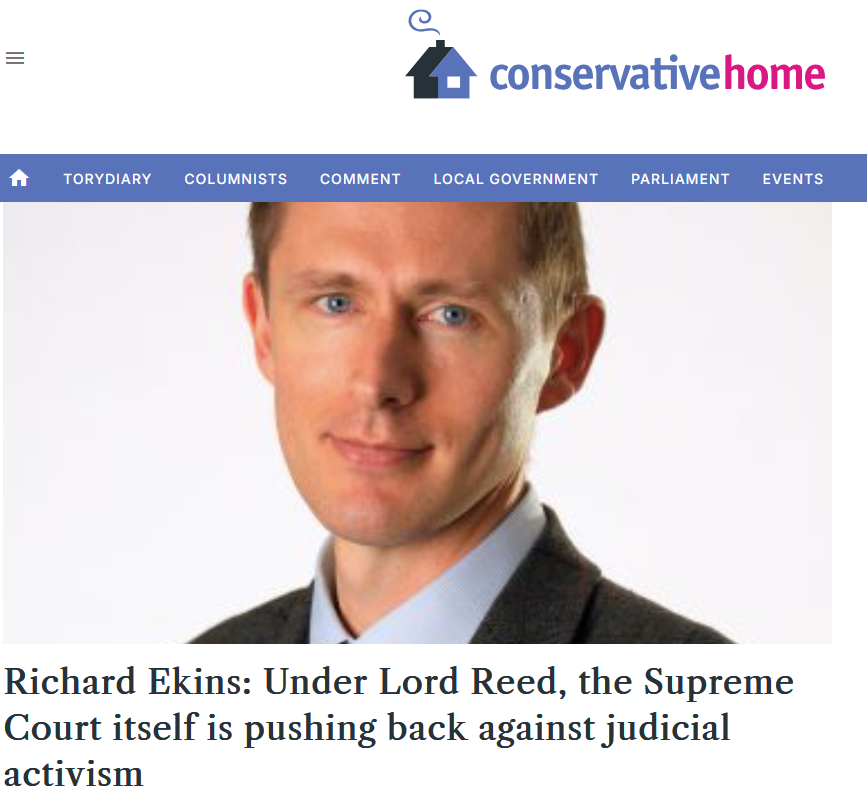
In December 2021 Policy Exchange’s Head of its Judicial Power Project, Oxford University right-wing ideologue Richard Ekins, was in a Conservative Home article praising Lord Reed for judgments moving the law in their direction:
In deciding if a state has breached the ECHR, the Strasbourg Court often recognises a “margin of appreciation” within which the state is free to decide how best to limit rights. Lady Hale and others reasoned that within the margin of appreciation, the UK courts should develop and apply their own understanding of Convention rights.
…In its Wednesday judgment, the Supreme Court disapproves the 2008 judgment that began this line of reasoning, as well as one of the most high-profile subsequent cases. Lord Reed, giving judgment for the court, rather understates the extent to which his colleagues had been willing to go beyond Strasbourg, but his judgment firmly restates the understanding of the 1998 Act for which Policy Exchange’s Judicial Power Project has argued now for many years.
Buckland himself in 2022 also praised the work of his appointed agent:
the current Supreme Court, under Lord Reed’s leadership, has in the last year demonstrated the appropriate degree of restraint. It is essential that this continues and that we remain blessed with sensible judges like Lord Reed.
Again this is exactly the argument in the Palestine Action case, where Lady Carr in the English Court of Appeal ruled that the proscription of Palestine Action was lawful because a “wide margin of appreciation” had to be given to Yvette Cooper in deciding to proscribe Palestine Action.
Court of Appeal judges frequently aim for promotion to the Supreme Court. There is an appointment process open now. Lord Reed has made absolutely plain that one unavoidable criterion to become a member of the Supreme Court is to agree with his doctrine that government ministers must be given “a wide margin of appreciation” in relation to the application of the Human Rights Act.
We therefore have a situation where the English Court of Appeal has ludicrously ruled that, for 85-year-old grannies to be jailed as terrorists for holding a placard, falls within the “wide margin of appreciation” to be given to Yvette Cooper and Shabana Mahmood in judging what is necessary for “national security”.
Well, it would certainly not have been in the Appeal Court judges’ career interest to have decided otherwise.
You can find small areas of specialist commentary where all this has been noted. Here, for example, on The Justice Gap:
Under Lord Reed, the Court has retreated into itself, becoming less confident and more deferential. No longer are decisions of the executive subject to searching scrutiny, but instead there is a focus on the ‘democratic credentials’ of an act, such as whether it was introduced after a ‘manifesto commitment’ or subject to ‘vigorous debate’ in the House of Commons.
The last two weeks alone have seen the Court hand down decisions that approved the cuts to child-tax credit despite their discriminatory consequences on women, and which allowed children to be kept in solitary confinement. In the former decision, Lord Reed even saw fit to condemn charities and campaigning organisations for trying to use the courts, as he sees it, as a way of compensating for their failures in the political arena. Not only does this show a hopeless naivety about how politics is conducted, but it ignores the reality which is that in a modern liberal democracy, there is no bright-line boundary between ‘legality and the political process’.
The consequences of this naivety are all too clear to see. Alongside last week’s troubling decisions, Lord Reed’s presidency has seen the Supreme Court permit the Home Secretary to unilaterally strip British citizens of their nationality without due process; while a decision handed down at the end of last year allowed ministers to sidestep their pledges and international commitments to engage with the threat of climate change. In this latter case, the UK’s Supreme Court seems especially out of step with its brethren across the globe, who are doing much to emphasise the existential threat that climate change poses to human rights, and are also more adroitly balancing the need to respect both democratic decision-making and fundamental rights.
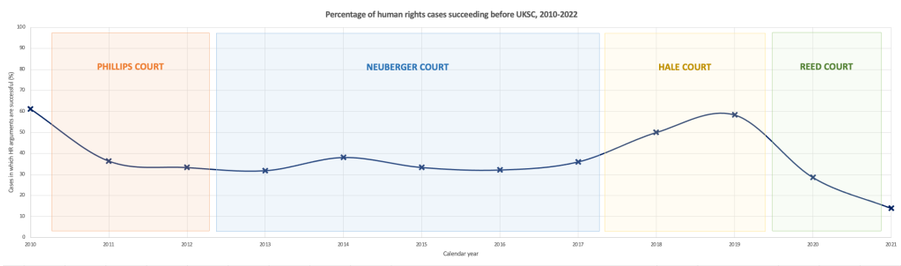
Here is a tremendous graphic, from an article seeking to quantify the change under Reed. It shows the percentage of Human Rights cases which succeed before the Supreme Court. Remember the Court only takes cases which are well-founded with a good prospect of success. Under Reed the percentage of successful human rights appeals has fallen from 60% to 15%.
Reed has done what he was openly put there to do.
The Palestine Action case is being rushed through by the Supreme Court in November, before Lord Reed retires in January having successfully reduced human rights in the UK.
The UK has passed a whole raft of extremely authoritarian legislation recently, including the National Security Act, the Online Safety Act and the National Security (State Threats) Act. To institute extreme authoritarianism, you must have judges prepared to enforce it.
Let me however caveat this. Nobody is totally malign, not even Lord Reed. In the Rwanda case he presided over the unanimous Supreme Court judgment against the government, showing that when the executive do something totally bonkers and argue plainly untrue fact, he has the intellectual self-respect not to endorse it. Or possibly he has the desire to maintain credibility and authority among his fellow judges. Whatever the exact workings, it is not impossible for Lord Reed to find against the government.
On top of that there has been a discernible shift in the position of some Conservatives – precisely the ones that Lord Reed will see in his newspapers of choice. Both Andrew Neil and Daniel Hannan expressed dismay at the latest arrests of protestors outside Westminster Crown Court “for expressing an opinion”, to quote Neil.
Neither of these two had previously any problem with the arrest for expressing an opinion of priests, people in wheelchairs, or ladies in their 80s, but when Sir Jonathon Porritt, knight of the realm and a close personal friend of King Charles, was arrested again, it began to dawn on them that this was not perhaps really terrorism.
We’re losing the plot when it comes to free speech. There are few issues on which Jonathan and I agree, especially on Palestine Action. That’s irrelevant. But for him to be arrested for no more than expressing an opinion? That way lies madness and dictatorship. Free Jonathan… https://t.co/DPZv619Uov
— Andrew Neil (@afneil) July 30, 2026
As it stands the Supreme Court starts with the decision that the Palestine Action proscription was lawful, made by the High Court of England and Wales. We need to seek to counter that with a decision by the Scottish Court of Session that the proscription was unlawful. I am very optimistic that the Scottish court will come to this conclusion.
In the proscription case, the English courts decided that Johnson’s suspension of parliament was lawful whereas the Scottish courts ruled it unlawful. The Supreme Court agreed with the Scottish courts.
The Scottish judicial review has been suspended or “sisted” by Lord Young after a whole series of horribly expensive procedural motions in view of lawfare tactics by the UK government to delay, delay, delay and either time out the Scottish judicial review or make us run out of money to pursue it.
The suspension or “sist” falls now the Supreme Court has decided to hear the appeal. Indeed the sist was designed to end as soon as the Supreme Court decided on whether to allow an appeal, and the sist ended if they decided to allow an appeal or if they decided not to allow an appeal. In which case, there was no possible logical reason for the sist, except to agree to the Government’s attempt to time out the Scottish judicial review.
Rather to my amazement, the UK government has agreed that the sist is now over. There will be a hearing on timetabling we hope next week. At which point, doubtless the UK government will apply for another suspension on the grounds there is no time for a Scottish judicial review before the Supreme Court hearing in mid-November.
That however is simply not true. The Scottish courts do not have a summer break and we have longer than the English judicial review took. I don’t think the court will dare to suspend the Scottish judicial review yet again. I am very optimistic indeed it is going to go ahead and we will win a real victory against this absurd and unprecedented proscription of a non-violent direct action group as “terrorist”.
But I am afraid we do desperately need more funds to get through this. To answer a slur, I do not get a single penny from it, not even my expenses. The money is all for legal fees and nothing else.
Please do not contribute if it causes you difficulty. If you know people who are able to afford to help and likely to be sympathetic, please do contact them and ask their assistance. We are trying to keep a lot of very good people out of prison.
You can donate through the link via Crowd Justice, which goes straight to the lawyers, or through this blog.
https://www.crowdjustice.com/case/scottish-challenge-to-proscription/
Alternatively by bank transfer:
Account name
MURRAY CJ
Account number 3 2 1 5 0 9 6 2
Sort code 6 0 – 4 0 – 0 5
IBAN GB98NWBK60400532150962
BIC NWBKGB2L
Bank address NatWest, PO Box 414, 38 Strand, London, WC2H 5JB
Or crypto:
Bitcoin: bc1q3sdm60rshynxtvfnkhhqjn83vk3e3nyw78cjx9
Ethereum/ERC-20: 0x764a6054783e86C321Cb8208442477d24834861a