Fergie Chambers Extradition
The Trump regime’s extradition case against Fergie Chambers is so thin, that the US Justice Department did not even turn up to try to enforce it. At the Assange extradition hearings there were always a minimum of two Justice Department officials , every day, seated behind the British Home Secretary’s legal team, exchanging notes and whispers.
Extradition requests are processed through the courts by the host country’s prosecuting authorities, but I have never before seen a high profile extradition case there the extraditing country did not bother to turn up. There was nobody from the US Justice Department in court, nobody from the FBI who are requesting the extradition, and not even a lowly Third Secretary from the Embassy to take notes on who was there and what was happening.
In truth there is no case. The allegations – of riot, incitement to riot, and money laundering – are unsupported by any kind of coherent narrative.
The problem is, in some ways that does not matter. Extradition is a technical process, where the justiciary in one country request the justiciary in another to send a suspect for trial. The potentially extraditing country assesses whether the request is technically correct and in proper form, and if so, agrees to extradition.
The process is provided in the extradition agreement between the two states. Here is a crucial point: the extraditing country is not judging innocence or guilt, or even the weight of evidence. It is just checking the request is from the proper state authorities in the proper form. It is a box-checking exercise, and notoriously difficult to stop.
Here is you second crucial point. Courts do not have the final say. The court can stop an extradition as not in the proper form and thus transgressing the rights of an individual. A court can alternatively permit an extradition. But a court cannot order an extradition to happen. Extraditions are a government to government matter, governed by international agreement that stands outside domestic law.
So in the UK, the courts allowed the US extradition request for Gary MacKinnon, but Home Secretary Theresa May did not action it, on human rights and health grounds.
In Spain this final decision rests, should the Court rule extradition legal, not with a single minister but formally with the Council of Ministers. That body already took the decision to allow the extradition to proceed to the courts. Progressive opinion in Spain was outraged and to those of us outside who had viewed Sanchez as one of the islands of pro-Palestinian statesmanship, it came as an alarming lesson in the exercise of American and Israeli power.
So here we were at the Audiencia Nacional, Spain’s High Court, for the extradition hearing.
Madrid is perhaps the most spectacular of old Imperial capitals, with the sheer mass of its governing buildings, the depth and intricacy of its stone carving, the extraordinary effusions of unabashed baroque around every corner, and the glory of its art collections, parks and fountains.
You can see where all that plundered gold went.
You would expect the High Court to be set in one of those magnificent buildings, all looming capitals, dark tropical hardwoods, blackened oil paintings and gilded armorial crests. But it is not. It is set in dystopian future Hell.
You walk past some police check points into an open courtyard, in the middle of which sits a low brick of a building made of steel and armoured glass. This is the entrance to the Audiencia Nacional. It is not connected to anything, it stands alone, looking like a greenhouse designed to ensure the tomatoes survive thermo-nuclear war.
You enter at the narrow end, and are processed through security screening and identity checks. These are very slow. Spain is one of those nations where, as soon as you give someone a police uniform or a jacket with “seguridad” written on the back, they take it as part of their everyday duty to be as hostile as possible to members of the public, with bonus points for intimidation.
Once processed through here, you immediately face a lift which goes down below ground level. You have no option to go up, indeed there is no floor above you. You can only go down into the windowless underground bunker that is Spain’s High Court.
Why Spain’s High Court is a windowless bunker I cannot tell you.
It is not only windowless, it is all white. Everything is white. You wait on white benches in a white corridor, lit with harsh white light. When you enter the courtroom through a white door, the judges are seated behind white desks on a white dais.The lawyers’ white desks are at right angles to the judges, on the same level – prosecution to the judges’ left and defence to the right.
Then on the lower level stretch lines of white desks for the rest of the legal teams, not used on this occasion, still at right angles to the judges. Then you come to the rows of public benches facing the judges. These benches are formed from pressed metal and are completely white. They are also completely comfortless, with a metal ridged seat area and hard metal back.
It is the aesthetic of oppression: clinical, clean, comfortless, and utterly without soul.
In the middle of the front row of benches sat Fergie Chambers, sporting an impressive Freddie Mercury moustache, a solitary interpreter next to him. He was neatly and casually dressed. Behind him two rows were kept entry. Then we had two rows of the public, including me, and a further half row of the public behind, about 18 of the public in total, all of them connected to Chambers’ support and including Barry Pollack, his US lawyer.
At the back were a further two empty rows. We had been told the public gallery would be restricted to 14 people. In the event a few more were allowed, but another couple of dozen could have easily been accommodated. I may have helped boost the number slightly, as the front security check asked me if I was a journalist and I said “no, retired Ambassador”.
I may have said the “retired” rather quietly.
There was a separate room for journalists to watch onscreen. I do not know if any came. There are permanent crews outside the High Court from TV Espana and TV Madrid, but they quite openly told us that they were under instruction not to cover the case.
The unnecessary restriction of the public entering the “public galleries” for cases involving Palestine is a worldwide phenomenon. In the UK Supreme Court, zero public were allowed in that actual courtroom for the Palestine Action hearing. It is of course part of the theatre of “counter-terrorism”, but it is also a small symptom of authoritarian governments increasingly becoming afraid of their own people.
The American extradition request is on the basis of a sealed criminal complaint sworn by a single FBI agent, not a grand-jury indictment. No formal charges have been preferred; the extradition request itself states that an indictment will be sought from a grand jury only if Spain surrenders Chambers.
The complaint alleges three offences: riot, conspiracy to riot and international money laundering.
The riot offences relate to Palestine Action protests against Elbit, the Israeli weapons manufacturer, at their factories in New Hampshire. and Massachussets. Chambers is alleged to have organised and financed the “riot”, to have taken part and to have paid bail for those arrested.
The money laundering concerns approximately $7.2–7.5 million transferred in ten payments from a US bank account to accounts in Tunisia between March 2024 and April 2025, while Chambers was living there. The complaint alleges the funds were intended to provide material support to Hamas or associated organisations.
Spanish prosecutors have supported the extradition request, characterising the alleged conduct as corresponding to offences under Spanish law (including terrorist financing and public disorder).
As always, you need to go to the text of the extradition treaty to understand what is now happening now. Exactly as with the Julian Assange case, the first and obvious point is the bar on political extradition. The Treaty says this:
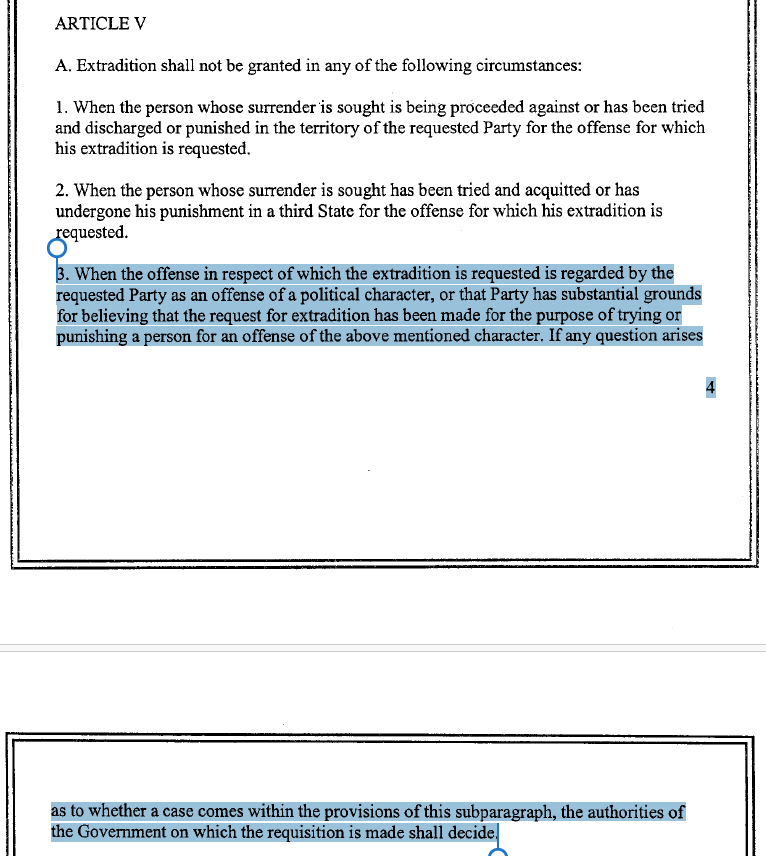
Please note it is for the Spanish authorities – not necessarily judicial authorities – to decide whether the request is political, and this is the point on which it is shocking that Sanchez’ Cabinet allowed it to go ahead.
There is a further key point here. The extradition treaty excludes from political offences , offences involving weapons and states that explosive or incendiary device charges make an offence non-political:
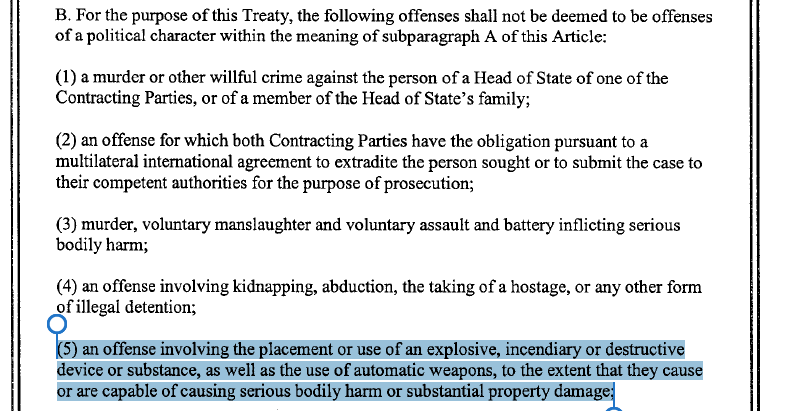
This is the purpose of the specific criminal complaint that Fergie Chambers purchased the smoke bombs for the Elbit protest, which the US and Spanish prosecutors are attempting to characterise as explosive or incendiary devices for the purpose of obviating the political exclusion. We will return to this point in the context of mistranslations.
There is a strong echo here of the UK’s proscription of Palestine Action. One of the three incidents the Home Office cited as having “reached the level of terrorism” was the 2022 action at the Thales factory in Glasgow. The designation rested essentially on the use of smoke bombs, described as pyrotechnics, in the Sheriff’s florid sentencing remarks, thrown near staff and therefore not “non-violent.”
Now I am old and grumpy and there are some features of modern protest that I dislike. One is talentless “samba bands” drumming. Another is smoke flares. But smoke flares are common features of protests and football crowds, yet are now being characterised, on both sides of the Atlantic, as terrorist.
I started this article by explaining that extradition requests are essentially technical. It is here that this one should fail. The extradition treaty could not possibly be clearer that the extradition request must come from a judge or judicial official. As it starts at paragraph X (D):

This condition is simply not met. There is no warrant from a judge or judicial authority. There is a criminal complaint from an FBI agent and a covering letter from the Attorney-General of New Hampshire. There has been no Grand Jury, no judge has ever seen the matter, and there are no charges.
Yet again I must return to the Assange experience. The exercise of power in a state has nothing to do with justice. In the Assange case, the UK Supreme Court in 2012 ruled that in the original Swedish complaint “judicial authority” did not mean “judicial authority” and could in fact include a prosecutor.
They based this decision on preferring – for the only time I ever saw in my diplomatic experience – the French text of the EU arrest warrant treaty to the English text. But the British diplomats who agreed the treaty would have been working from the English text, as would the Ministers who signed up to it and the parliament it was lain before.
The Supreme Court then ruled that “autorite judiciaire” in French does include prosecutors – a very arguable contention.
States are corrupt. Being undeniably right does not always win in court. We will see whether the Spanish judiciary are less corrupt than their English cousins.
However the judges have less wiggle room than was available in the UK, because the Spanish law 4/1985 incorporates the full text of the extradition treaty into Spanish domestic law. The British government argued successfully in the Assange case that the provisions of the UK/US Extradition Treaty had no legal effect in the UK. That argument is not open in Spain. I do not see how they escape the “judicial authority” point.
There are other technical points about the American documentation, which in a tick box exercise fails to tick any of the requisite boxes. There are discrepancies in dates. Key documents are missing, with only their cover sheets provided.
We now come to the mistranslations. The US government produced a Spanish translation of the complaint which consistently exaggerates the alleged criminal behaviour, in a way apparently designed to increase the chances of extradition.
To give examples, “direct action” is translated as “direct violence”. The phrase “multiple direct action events occurred at Elbit facilities” became “multiple direct violence events occurred at Elbit facilities” when rendered in Spanish.
In English “the three [activists] caused significant damage to the building” becomes in Spanish “three fires caused significant damage to the building”. The English original refers to activists for whom Fergie Chambers provided bail. It is not easy to see how the completely unfounded insertion of “fires” occurs accidentally.
I know translation is a difficult art, but remember that arson is one of the activities that negates the political exclusion. Other than this “mistranslation”, there is no allegation there were any fires and there are no reports of fires at Elbit premises in the USA.
In similar vein, in various places “activate” or “set off” smoke bombs is translated into Spanish as “detonate” smoke bombs. To detonate is, neither in English nor Spanish, the word naturally used with a smoke bomb, and the changed meaning is obvious.
As a final example, the English word “trespass” is translated as the Spanish word for “burglary”, a very different level of offence.
The mistranslation saga plays into the final technical requirement for extradition which I will bring to your attention, that the alleged offence must be a crime in both the United States and Spain, punishable by more than one year in jail. The US extradition request in fact fails to cite specific offences, under which law, and what the penalties are. But all these are specific requirements of the Treaty.
Remarkably the Spanish prosecutors have filled the gap by extrapolating from the US request named Spanish equivalent charges – some of which hinge on those mistranslations. The alleged “money laundering” complaint by the USA does not in fact specify transfer to finance terrorist organisations, other than as an avenue of investigation. The Spanish prosecutor has added terrorist financing as a specific charge.
Now that I have outlined the issues at hand, let us return to the court. The proceeding opened with the case for the defence being put by Josep Riba. He spoke authoritatively and at length, and appeared to have the full attention of the judges, who leaned forward diligently and took extensive notes. He was not significantly interrupted, as indeed were none of the lawyers.
Riba spoke in Spanish. I had no access to interpretation and I am not going to pretend to you to have understood everything he said. An important point he made was that the extradition is incompatible with the European Convention on Human Rights, on grounds both of freedom of speech and assembly, and of due process. At the end of his presentation he requested the court to hear evidence from Fergie Chambers. The judge responded that this court was not finding innocence nor guilt, and should not hear evidence of the truth or otherwise of the charges.
Riba replied that Chambers’ testimony went to the question of whether the extradition request was “manifestly ill-founded”, under Article X (D) of the extradition treaty:
The requested Party may refuse the extradition request if an examination of the case in question shows that the warrant is manifestly ill-founded.
It would also go to the question of political motivation. The judge accepted this, and Riba began the cross examination of Chambers, with consecutive translation both ways.
It was good to hear Fergie Chambers speak. His appearance, and perhaps his cultivated image, is against him.
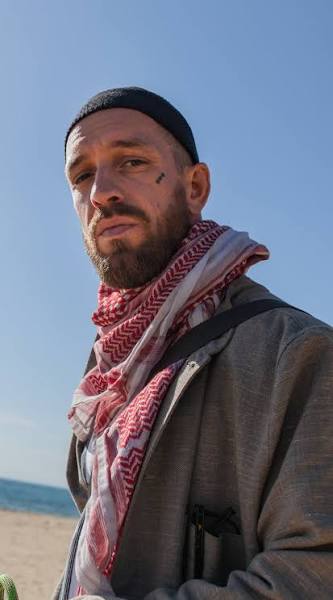
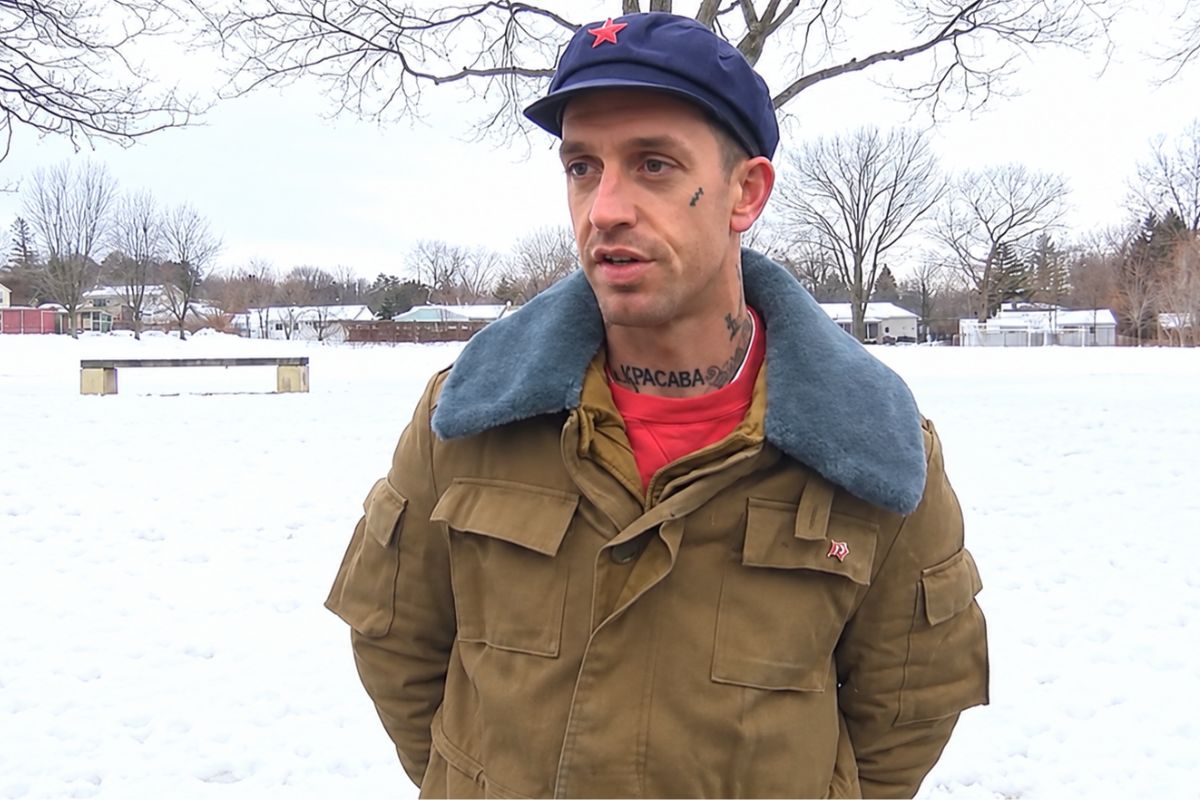
If you google images of him, Fergie Chambers looks like what a right wing reactionary would imagine a domestic terrorist looks like. On top of which he has the toned body and extensive tattooing of an MMA fighter. Of course, if you investigate what Chambers’ tattoos actually say or represent, they reveal something very different. But I wonder whether someone in the Trump regime decided to go after Chambers because of his image, rather than anything he had actually done.
I had never met Fergie Chambers. Indeed until last week, I had hardly heard of him. From seeing him online, I expected him to sound abrasive, even rough.
Instead what came over was a gentle and thoughtful man with a soft, calm voice. He is obviously educated, intellectual, proceeds with thought and care, and has a wide but applied social conscience. He also plainly loves his family, and is vulnerable. You can easily find the video of his interrogation online; but my written distillation of it perhaps captures the essence.
The prosecution was given the first opportunity to question Fergie Chambers but declined to do so. Josep Riba invited Chambers to introduce himself and his background.
Chambers stated that he had been born into the Cox family, which owned a private business enterprise with a turnover of billions of dollars. It had originated in the newspaper business and over time expanded into the automotive and multiple other industries. In 2022 he had sold out his shares in the family business, for a very large sum.
Riba then asked whether he had subsequently devoted himself to human rights and the rights of disadvantaged people, and secondly how long he had been devoted to the cause of Palestine.
Chambers replied that yes, he might be described as a rights activist and a philanthropist, though he was not fond of the word.
On Palestine specifically he had an interest since his teenage years, when he had been introduced to the subject by Jewish friends in Brooklyn.
He had attended some non-violent demonstrations and had donated to organisations devoted to medical aid and prisoner welfare. But his philanthropic activities had absolutely not been limited to Palestine in particular.
Riba then asked how his finance for these causes had been organised.
Chambers replied that until 2023 his donations had been decided and managed personally. But from 2023, after the sale of his company shares, his giving had been managed through a formal foundation, which went by the public name of the Babushki Collective. There were three trustees besides him, and the process of decision making was very collegiate.
Riba asked whether any money had ever been donated to any organisation subject to US sanctions.
Chambers replied no, and this was particularly checked in every case with the Office of Foreign Assets Control of the US Treasury. The foundation could not afford to be at odds with the US government on this, which could affect all of its work.
Riba then asked specifically about donations to Gaza, and whether these had increased.
Chambers replied yes, they had. The focus of giving shifted to the pressing issue of the time – this had across time been race relations in the USA or environmentalism. Then the Genocide in Gaza had changed the focus. They had concentrated on medical aid for children and the provision of food and potable water and transport out of dangerous areas.
He said Gaza was “the prevailing moral issue of our time”.
Riba then asked if he was at, and to what extent he took part in, the Palestine Action event at the Elbit factory.
Chambers said that he would dispute the description of Palestine Action as an organisation. It was more of an idea. The focus was to disrupt Elbit, the largest Israeli weapons producer.
After the 2023 Israeli bombing of a Gaza hospital, in which 250 were killed including many children, there was a protest at the Elbit factory in New Hampshire. He had gone along as it was close to where he was living.
Riba asked what he had done at the protests.
Chambers replied he had been present at two protests. At the first he had chained himself to the door of the factory with a bicycle lock, blocking entry. Another group had been blocking the road to the factory. At the second he had been with a group of about 1,000 people blocking the road to the factory, and had given media interviews.
Riba asked whether, at this time in October and November 2023, there had been any allegation that Palestine Action was a terrorist organisation?
Chambers replied there was none. It had much later been controversially branded a terrorist organisation in the UK, in mid 2025.

Fergie Chambers gives his evidence in court. I am visible as the shock of white hair on the left of the public gallery. Note the half empty gallery though dozens were refused entry.
Riba said that a tweet referred to in the extradition request referenced a further Palestine Action protest. Had he taken part in that protest?
Chambers replied that he had not. At this stage a judge interrupted. It was not interpreted but I am told that he reminded Riba that this hearing was not for the substance of the case. Chambers then answered on the relevant point of the question of “fires”.
Chambers said he had absolutely not caused a fire. Nobody had caused any fire. To the best of his knowledge, there had never been a fire at any Palestine Action protest in the United States. (At this point I suggested to the activist next to me that it was however a good idea. She kicked me in the shins. Police and security forces of the world, please note that this was a joke to relieve the tension).
Riba asked about the allegation Chambers had paid bail for the offenders at the protest.
Chambers replied this was true. Providing bail for protestors who could not afford it was a regular activity of his Foundation, because often protestors could not afford bail and the threat of imprisonment could chill citizens’ rights. Bail had been provided for George Floyd protestors and many others.
Riba then asked why he had left the USA.
Chambers replied his family had decided, on political grounds, they no longer wished to be part of the USA which was complicit in Genocide. There was increasing political repression in the USA. They had gone to Tunisia because he had friends there and was fluent in French. He had family nearby. He also wished to study Islam with non fundamentalist scholars.
Riba said that the extradition request characterised him as leaving the USA on the run. Was he aware of any charges against him in the USA?
Chambers replied there were no legal issues prior to his departure. He had left on his own passport and used his own credit cards in his own name. In Tunisia he had lived next door to the US Ambassador. He had developed a public profile in Tunisia through his football club. He had never been in hiding.
Riba said that 80% of the money he had transferred to Tunisia had gone into the football club and into investment in gyms. Why was this?
Chambers replied that he had made a sponsorship deal with Club Africain which had grown and grown until he was deeply involved in the club. He had provided over US $4 million to the team, which had with its fans a culture of support for Palestine. He was very much interested in sport and with the gyms they had developed sportswear lines.
His involvement with the club had started because he was contacted by a friend who was their former Club President. The football club was deeply in debt and he had been asked to help. They had paid off much of the debt, improved training facilities and coaching, and invested in the women’s team.
Riba then said the US extradition request stated that he had visited the Iranian Embassy.
Chambers replied that this was untrue in essence. At a boat show he had spoken to the Iran stall of his desire to see Iran, and they had told him that, despite his US passport, he might still get a US visa. One day therefore he had stopped by the Iranian Embassy and gone in to ask about visa application. However the Embassy was closed and he only spoke to the local receptionist. That was the entire extent of his contact.
He saw the extradition request stated two visits; that was simply untrue.
Riba said the extradition request stated that immediately after entering the Iranian Embassy he had made a US $20,000 donation to an organisation called the Alliance for Global Justice, was this true?
Chambers replied he could not recall the precise timing, but he had made the donation to the Alliance for Global Justice which was a perfectly legal registered non-profit organisation based in Arizona.
That concluded Chambers questioning.
There was a further defence witness, a forensic accounting expert, who gave evidence that he had investigated all of the international transfers in question and subsequent use of funds, and could find no evidence of any illegal or suspicious transactions.
After this questioning, the prosecution responded.
Juan Hernandez Villalba was not giving an inch. He fully supported the US extradition request, stressing the terrorism angle and stating that the request properly corresponded to the Spanish offences of public disorder and financing of terrorism. He said that such dangerous conduct should not be minimised. He denied the challenges to the technical content of the request and stated that the Attorney General of New Hampshire could be accounted a “judicial authority” for the purposes of the Treaty.
Hernandez Villalba spoke at length, reading very quickly in a monotone. The judges took extensive notes.
This was followed by Aitor Martinez concluding for the defence. You may recall that Aitor represented me in the case against UC Global and David Morales Guillen over spying on Julian Assange (and incidentally on me) in the Ecuador Embassy – a trial stopped by the alleged death of David Morales. Strangely enough, here we were back in the same courtroom where I had given my evidence.
Aitor made a powerful and intellectually muscular presentation, demolishing the extradition request in ten points, on the grounds outlined above.
Below is a video of Aitor’s speech. There is one point that Aitor makes which exactly mirrors what is happening in the UK and it is extremely significant. At 14 minutes and 47 seconds into the video, Aitor makes a point he calls “extremely serious” – that the extradition request details the serious felonies the New Hampshire Elbit protestors were charged with, including riot and criminal damage.
But the extradition request fails to note that they were acquitted of all felonies and only convicted of a misdemeanour of public disorder, attracting a six month jail sentence – which falls below the limit for extradition.
The US and Spanish authorities are using precisely the same trick as the UK authorities in overcharging Palestine Action activists with serious offences in order to portray them as terrorists, then treating those charges as facts of what happened, even though they result in no convictions.
In both the English and Scottish judicial review proceedings this has been done systematically, citing charges particularly of violent disorder and aggravated burglary even though these has been not a single conviction and double digit acquittals. Sir James Eadie KC did this particularly egregiously in the Supreme Court in London last week, referring to carrying of weapons and violent disorder repeatedly, never mentioning the not guilty verdicts.
It is fascinating the exact same tactic is employed across Europe and over the Atlantic. One might posit some form of collaboration.
What the video does not show is the reaction of the judges. At first they looked highly engaged. After about 15 minutes they seemed to be signalling they were affronted, drawing back from Aitor in their seats while increasing their height.
Towards the end, the judge in the centre looked engaged again, the judge to his right appeared to find the whole thing highly amusing, and the judge to his left had made up his mind and was ready for lunch, putting his papers carefully together and tapping them vertically on the desk to level them up, while Aitor still had five minutes to go.
All of which was interesting, but did not really indicate which way they were thinking.
Finally, Fergie Chambers was invited to give a brief closing statement.
Chambers said he could not understand why he had been in prison for four months, for what amounted at most to speaking emotionally and creating a minor public disturbance.
He had never had a history of violence, never advocated violence, or associated with any terrorist organisation.
He was torn from his family, who needed him. He had missed his grandmother’s funeral a week ago. He had a five year old son, and his wife was pregnant. All he was asking for from the court was Justice, Reason and Mercy.
On that emotional note, the court ended, and we left the white court into the white corridor, before heading up in the lift and out of the armoured greenhouse, blinking away our snow blindness and trying to make sense of what we had just seen.
A decision is expected in approximately one week.
—————————————–
Anybody is welcome to republish and reuse my work, including in translation.
My work has no funding at all except for your subscriptions. If you already subscribe, I would be grateful if you could check if your subscription is still active. Over 80% of my subscriptions lapse when debit or credit cards expire: the systems do not warn you.
Because some people wish an alternative to PayPal, I have set up additional new methods of subscription payment including Patreon account and a Substack account, if you wish to subscribe that way. The content will be the same as you get on this blog. Substack has the advantage of overcoming social media suppression by emailing you direct every time I post. You can, if you wish, subscribe free to Substack and use the email notifications as a trigger to come to this blog and read the articles for free.
I am determined to maintain free access for those who cannot afford a subscription.
Choose subscription amount from dropdown box:
PayPal address for one-off donations: [email protected]
Alternatively by bank transfer or standing order:
Account name
MURRAY CJ
Account number 3 2 1 5 0 9 6 2
Sort code 6 0 – 4 0 – 0 5
IBAN GB98NWBK60400532150962
BIC NWBKGB2L
Bank address NatWest, PO Box 414, 38 Strand, London, WC2H 5JB
Bitcoin: bc1q3sdm60rshynxtvfnkhhqjn83vk3e3nyw78cjx9
Ethereum/ERC-20: 0x764a6054783e86C321Cb8208442477d24834861a