Posts


Diallo Must Be Deported

When I get home to Ramsgate next week I have the papers for two new political asylum cases waiting for me to study, one of them a bulky parcel from UPS for a case in the United States. I will peruse them carefully to see if they appear genuine, and if so prepare expert testimony. In most ordinary cases I do this free of any charge. If necessary I will go to the tribunals to give evidence. I have won a large number of cases, and indeed never lost a case at tribunal. I have saved two people from deportation at the last minute, one literally en route to the airport. One would almost certainly have been killed on arrival in Uzbekistan.

It has got harder. The popular outcry against asylum seekers, whipped up by the tabloid media, has resulted in political determination to restrict numbers, and that has filtered down through all aspects of the system. If there is one thing that makes it harder still, it is fraudulent asylum seekers. They do exist, as does benefit fraud. These liars and cheats open the way for the malicious to attack the entire system, and cast unfair doubt on the whole principle of providing help to the genuine needy. It is not nasty conservatives who are the root of the reaction against asylum seekers – they merely feed off it and exploit it to their own vicious ends. Those truly undermining the system are fraudulent asylum seekers.

Nafissato Diallo is a fraudulent asylum seeker, a fraudulent benefit claimant, a fraudulent tax declarer, a fraudulent public housing occupier, an associate of criminals and a probable receiver of proceeds of crime. She lied about being raped on her asylum application (for which she was professionally coached with a tape of her false story), she lied about how many children she had in order to receive more benefits, she lied about her income to receive public housing and to avoid tax, she lied about the receipt of very substantial sums of money into her bank account from known, indeed imprisoned, criminals.

I judge she most probably lied too about being raped by Dominique Strauss Kahn. We will never know for sure, trial or no trial. The Guardian has for the last few months been full of articles telling us that a woman may be a fraudulent asylum seeker, a benefit, tax and housing cheat and a criminal associate, but she can still be a rape victim. That is absolutely true.

But they fail to say the converse. A woman may be a rape victim, but she can still be a fraudulent asylum seeker, a benefit, tax and housing cheat and criminal associate. That is equally true and equally important.

In order to maintain public support for the asylum system, it is essential that it has integrity. If Diallo is not now deported, nobody can believe in that integrity.

Now criminal charges against DSK are being dropped, there is no need for her to remain. She does not need to be ordinarily resident in the US for her money-seeking lawyers to pursue a civil case.

An astonishing ignorance of Africa pervades the comments on this issue throughout most of the web. I have lived in or worked on Africa most of my career. We seldom see any of the postive side of Africa on TV. In fact almost the only time Africa appears on our TV screens is when there is a terrible famine in East Africa, an act of piracy or civil war. But in real life Africa is a huge continent in which, despite relative poverty, the vast majority of its people live happily.

I am not in any sense denying or belittling the problems of poverty and disease, prolonged by an expoitative world economic system. But there is no famine in Guinea Conakry, where Diallo is from. People do not starve there. And she is a Muslim Fulani, and therefore part of a dominant group in Guinea Conakry, most certainly not a persecuted one. Which is why her claim was based on lies about gang rapes. There is no political reason why Diallo would need political asylum.

Of course Guinea Conakry is poorer than the United States. But actually it is not at all an unpleasant place, it really is not. Unless you believe that anyone from a poor country should always be allowed to emigrate to the United States, or that anyone from an undemocratic country should always be allowed to emigrate to the United States, (and you are quite entitled to that view if you hold it), there is no reason Diallo should not be returned. There really is not.

If you think all of Africa is a hell-hole, you are absolutely wrong.

View with comments

Fall of Tripoli

It seems that Gadaffi’s regime has collapsed very quickly at the end. It is difficult to be sure as yet, but it seems there may have been mercifully less further bloodshed than might have been feared. Thank goodness the NATO bombing campaign will now end.

It is plain that there is a great deal of support from ordinary citizens of Tripoli for the rebellion. Whether that translates into specific support for the leadership of the Transitional National Council is quite a different question. Getting rid of a bad government is difficult, but not as difficult as establishing a good one. The next few weeks will be very interesting.

The mainstream news media will move on in a few days, as it has moved on from Egypt. Not all pro-democracy demonstrators arrested under Mubarak have yet been released under the new military government there. However it is good to see anti-Israeli demonstrations are allowed. That is a major advance on the Mubarak years. NATO may yet find it equally difficult to hijack the Libyan people to their agenda.

Now of course NATO are free to move on to oust the despotic, torturing regime of Bahrain. Or not.

View with comments

Thatcher and Blair Caused the Riots

There is a shameless article by Blair in the Observer in which he says the riots were the fault of a very specific group of families, not of society in general. Society in general is jolly good, thanks to one T Blair. In fact, what could possibly be wrong with a society in which Blair has amassed £28 million to date? I love the bit where he says:

I agree totally with the criticisms of excess in pay and bonuses.

This from the man who gets payoffs from corporate America in $100,000 fees for a one hour lecture, then charges corporate executives $400 a pop to be photographed shaking hands with him. Blair agrees so much with criticism of excess pay and bonuses that he did absolutely nothing about it in three terms of office, and presided over the widest ever and still widening gap between rich and poor in this country.

I agree with Blair that we should not excuse individual responsibility for looting and should acknowledge exactly how undesirable and anti-social is the milieu of the rioters, and seek to eliminate that sub-culture. But we have also to understand what generated it, and eliminate those causes.

What caused it was not just poverty. There are plenty of decent poor people. A factor is indeed the deliberate destruction of UK manufacturing capacity on ideological grounds by Thatcher, an ideology carried through by Blair. But it was still more directly the deliberate destruction of social capital by Thatcherism and Blairism, its antipathy to any manifestation or instrument of horizontal social solidarity, and its manifest anti-intellectualism.

Through Thatcher and Blair, education, knowledge and intellectual analysis became valued only if they tended to economic productivity, not as goods in themselves. This attitude still permeates every ministerial statement on education.

The all-pervasive idea that economic productivity was the only good and material consumption the only purpose, relentlessly promoted in media and advertising, left no place for those who could not find a job to produce or funds to consume.

But what these alienated classes could pick up in full from Thatcherism and Blairism was the anti-intellectualism and the desire to consume. Thatcherism and Blairism inevitably produced an entire callous, desocialised and proto-criminal class. It was their inevitable consequence.

These are Thatcher’s and Blair’s riots.

A week ago I published this start on the process of designing a remedy to the social ills that Thatcherism and Blairism have brought:

There is an excellent article by Simon Hughes on response to the looting. He has in many ways the same position as me in seeking radical solutions to the malaise of our hugely unequal society, while in no way sympathising with criminal looters.

The direction of all of Hughes’ proposals is correct, but his proposed action does not go far enough and is not specific enough. In both public and private organisations, the earnings differential between the highest and lowest paid should be limited by law to a factor of four, including the effect of all non-salary perks and benefits. Hughes does not give specifics on his desire to limit this gap, but Will Hutton has been promoting a factor of ten in the public sector – that is far too wide an equality gap.

Similarly Hughes’ pious wish to promote worker partnership and cooperatives needs to be given concrete form by legislation forcing all companies to give truly significant – I am thinking around forty per cent – shareholdings to employees.

If Simon really wants to roll back the excesses of the last thirty years, then natural monopolies like the utilities companies and the railways need to be returned fully to public ownership. PFI should be discontinued and all PFI assets nationalised without compensation.

Housing Association properties should be taken over by local authorities as traditional council housing, and massive new public funded mixed home building programmes should be begun that include the demolition of the ghastly huge sink estates of sub-standard housing. That would help boost the economy out of recession.

Hughes’ diagnosis is correct. But the reversal of the incredible and dangerous expansion of the gulf between rich and poor requires truly radical use of the power of the state with measures along the lines of those above. Anything else is just tinkering.

There is of course much else, of which limiting banking transactions to the actual funding of purchase of property, goods and services, rather than gambling on future values of those things, is perhaps the most important.

But we must repudiate Blair’s assertion that there is little wrong with our society. One very good start would be to send Blair for war crimes trial at The Hague, to demonstrate to all that crime does not pay.

View with comments

Faint Hearts

I hope that some of the sentencing overreactions to the looting will be corrected. But I saw one hilarious overreaction last night as Spurs supporters were herded past our flat here from Tynecastle after their match. There was the kind of massed phalanx of police that I haven’t seen since the miners’ strike, with armoured helmets and horses much in evidence. In the middle of this mass, much outnumbered by police, was a tiny little knot of Tottenham Hotspurs supporters, being herded towards Haymarket station.

Having seen Spurs hammer Hearts 5-0, I suspect the Spurs fans were too ecstatic to be annoyed. But it looked really extraordinary, so on going down to the chippie I asked a policeman why the huge escort – Hearts supporters aren’t known for violence against visitors. He replied very gravely that the looting had started in Tottenham, and they didn’t want that kind of nonsense here. So either the police had no intelligence on how many Spurs fans were expected, or they had decided to escort them three policemen to every fan. Scottish fear of the barbarian English is quite a wry concept.

View with comments

Owning the Parthenon

Ponzi schemes and finance bubbles of all kinds depend on it being in nobody’s short term interest to admit they are worthless – indeed to people having a terrible fear of the consequences once it is discovered the scheme is worthless.

Larry Elliott in the Guardian has an interesting article on how this worked in the great banking bubble. He quotes James Galbraith:

“There was a private vocabulary, well-known in the industry, covering these loans and related financial products: liars’ loans, Ninja loans (the borrowers had no income, no job or assets), neutron loans (loans that would explode, destroying the people but leaving the buildings intact), toxic waste (the residue of the securitisation process). I suggest that this tells you that those who sold these products knew or suspected that their line of work was not 100% honest. Think of the restaurant where the staff refers to the food as scum, sludge and sewage.”

At the moment, everybody knows that Greece will default and cannot effectively reform. But the consequences of admitting this are so disastrous, everybody is pretending not to know. However Northern European politicians are finding that, whatever they agree in cosy EU cabals, their voters are not stupid and are not happy to stump up for massive guarantees sure to be called, and massive loans sure not to be repaid.

Several countries, led by the Austrians, Dutch and Nokialand, now have political leaderships trying desperately to unpick the promises they have made, by demanding solid assets as collateral from the Greek government against any default.

This has caused some puzzlement in the UK Treasury, where a friend of mine is exasperatedly wondering how the Greeks are expected to find up to $100 billion of physical assets to pledge. Greece has a much larger state sector than most other European countries, but any possible assets are slated for privatisation under the vaunted economic reform programme. They can’t both be privatised and pledged for collateral. If Greece had secure reserves it could pledge, it would not be in this mess in the first place, while the tax office building in Thessaloniki or an old coastguard cutter do not carry much genuine market value.

They could, of course, pledge the Parthenon, Mount Olympus etc, I suggest to my friend. She seems to consider it for a moment.

“But think of all the fuss over just the bloody Elgin marbles” she groans.

View with comments

Kabul Attack

I am very sorry to hear of the attack on the British Council office in Kabul. I do hope that, as details of the dead and injured start to come in, the count does not rise higher, whoever they are, and that the British Council staff are safe. I am a great believer in the contribution of cultural diplomacy in international peace and understanding, even if I do not support every detail of the British Council.

But this attack does represent, yet again, the folly of the occupation of Afghanistan. It has reinforced old anti-British sentiment dating back to our first invasion of 1839 and a series since. It will be generations before we might be forgiven our bombings, and I can guarantee you that the British Council will not be able to maintain any effective operation in Kabul after our troops slink away defeated.

The British Council opening there at all is empty bravado that has now cost lives.

View with comments

Exam Results

A piece of paper does not encapsulate a person’s worth. University is one good way of enhancing your understanding and experience of this wonderful world, but there are many other ways.

I was very unhappy with the discipline and structure of school and did very badly – my A Levels were BEE. I lost my place to do law and scraped into Dundee on clearing to study History. In the free atmosphere of university I flourished and ended up with a First, as well as twice being President of the students union (and eventually became Rector of the university). My parents and friends were very upset the day my A Level results came out but I knew, even then, there were much more important things in life. I know it still more now.

Study what you enjoy, not what you think might pay. The economic world is changing so fast there are few safe bets anyway. But you are a wonderful, complex being, not just an economic agent. Experience life wherever it takes you. Everybody deserves love, and with patience you will find some. Nobody’s worth depends on bits of paper of any kind.

View with comments

Sanctuary Management Services Rip-Off

I had a tour round the three year old campus of Queen Margaret’s University yesterday. It was impressive, but extremely compact for a university of 5,500 students. When I first went to Dundee, it had only 3,500 students and the University was vastly more extensive.

The Students Union in particular was completely inadequate – one very small bar and cafe, three pool tables. Students Unions are a vital part of the university experience, but evidently not at QM.

But what especially shocked me was the accommodation. Divided into (mostly) six bedroom flats, they rent out on forty week lets for over £100 per bedroom. But the rooms are absolutely tiny (more expensive premium ones are available). They do have en suite facilities of an extremely clever very very compact modular design like a Japanese pod hotel (and costing in bulk around £1,500 per unit, I would judge). But they are small. There is a shared kitchen, which is pleasant enough.

I paced the total flat area at around 80 square metres. That is an income of £3,000 per month on 80 square metres – absolutely colossal! Our rented flat in West Kensington was about 100 square metres and cost me £1500 per month, and our little house in Ealing was about 150 square metres and cost me £2000 per month. This is £3,000 on 80 square metres? In a field outside Musselburgh?

(The £3,000 comes from six rooms at a little over £100 per week per room. There are of course more than four weeks in the average month. The rooms are not empty outside the 40 weeks, but available for holiday let – at a still higher rate).

I was greatly puzzled by this until I saw stickers for Sanctuary Management Services. Dundee University’s PFI contract with Sanctuary was in part responsible for the major financial crisis at the University when I took over as Rector, which led to the administration forcing through departmental closures. The West Park PFI development contract was so structured that cost overruns (which were legion) fell on the University and not on Sanctuary. Getting information inside the contract from the administration was like drawing teeth, and the cv enhancing businessmen who dominated University Court were much more interested in covering up a blot on their and the University’s reputation than on digging into it. One thing is for sure – Sanctuary Management Services came out of it very well indeed.

Queen Margarets University has PFI written all over it, and doubtless the students will be paying those very high accommodation fees forever. This will bring a great deal of profit to Sanctuary Management Services Ltd. That transfer of money comes of course from the students themselves racking up vast amounts of debt that will blight their young adulthood.

If Sanctuary at Dundee University is anything to go by, the student experience on maintenance and management heavy-handedness will be less than fun, not to mention the private “security” roaming the place.

Sanctuary Management Services always impose excessive security, and the impact of this on the student experience also worries me. Every student room is, 24 hours a day, behind three locked doors. The front door of the block, the corridor or “flat” door, and their own room. That means for example that a first year student cannot access the room of anyone even in their own hall of residence to knock at the door, see if they are in and chat and have a cup of coffee.

This seems to me a completely unnecessary reinforcement of desocialisation. I recall fondly in my student days wandering the halls and dropping in on coffee – often a snowballing group of us, wandering round collecting up friends until settling down somewhere. It was almost impossible to be sat alone and lonesome, and as a depressive myself that was very important. Now the shy and depressed can stew behind those multiple locks with little chance of being rescued. It is, as I said, a desocialisation of the student experience, further exemplified by the near non-existent students union social facilities.

There has not in fact been a vast crime wave of theft and assault from students that makes Musselburgh in 2011 and infinitely more dangerous place than Dundee was in 1982. Those locks are not to protect students – they are to protect the property of Sanctuary Managment Services.

But this is all OK! Sanctuary Management Services Ltd is, after all, a charity, a subsidiary of a Housing Association! It is interesting that being a highly exploitative landlord to students counts as a charitable pursuit. While being a charity presumably means it does not pay a dividend to shareholders, I would nonetheless be fascinated to know more about the salaries, expenses, housing, company cars and other perks of those at the top of Sanctuary Managment Services Ltd and its parent Housing Association.

Interestingly enough, while Sanctuary’s website says it is registered at Companies House, I drew a blank when trying to bring up its company accounts there.

View with comments

Coulson for the Pokey

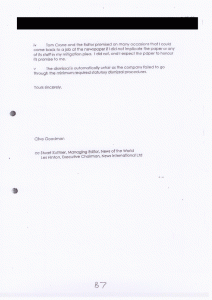
If our criminal justice system works at all, then the slimey Andy Coulson will soon be behind bars for conspiracy to pervert the course of justice. The Guardian has just published a whole raft of evidence released by the select committee, of which this is not the only bit which seems to have Coulson – the “editor” in question – absolutely bang to rights.

Of course, while the justice system can work 24 hours on convicting people who nicked some maltesers, Scotland Yard have still proved completely incapable of identifying any of the policemen who took Murdoch’s bungs, or in locking up Coulson and the other News International executives who are guilty as sin.

Given this letter from Goodman making plain that Coulson instigated a cover-up of the extent of culpability within N.I., it seems that Cameron must resign for having brought a definite criminal into the heart of 10 Downing Street, despite numerous warnings. Cameron is compromised by this beyond repair.

View with comments

Lessons From Ghana

I am off back to work in Ghana for a few weeks next month.

Anyone who believes the crime in England was related to poverty or to race should visit Ghana, where crime is at a low level and society is extremely helpful and supportive. People are much poorer than in the UK yet are not ignorant of the possibilities of western levels of consumption, but they would not dream of seizing them by force, and those few who do have no pro-criminal social milieu in which to shelter.

View with comments

The Times Reviews Medea

Very happy with today’s review of Medea by Libby Purves in The Times. Can’t link to it because it is hidden behind the great firewall of Murdoch. Taking a risk that News International’s lawyers are rather too busy to sue me for copyright, here it is:

Nadira Janikova sprang to attention over her affair and marriage with the whistleblowing British envoy to Uzbekistan, Craig Murray. She told the story in her show The British Ambassador’s Belly Dancer, containing the famous admission that the first time she saw him she thought: “Who is this old foreigner, does he have any money?”
Seven years on, as an actress, she radiates an exile’s determined vigour: a steely, competent, wounded, potentially ruthless brand of feminine strength, which makes her ideal casting for Euripides’ Medea in a sinewy new version by Stella Duffy, directed by Sarah Chew.
Medea after all, though a royal granddaughter of the Sun-god Helios, is the foreign wife of an Establishment man, Jason. Far from her roots and rejected, she becomes the avenging demon who kills her rival and her own two small sons.
Because the horrible story is familiar — Duffy uses the traditional prophetic, worried chorus of women to signpost it — it is mainly a meditation on motive and provocation, with Medea’s pain at its heart. Uninhibited howls of “dark, wild grief” and rage greet us from behind the marbled slabs of the set even before we sit down: when she appears, exotically scarfed, she rages about being foreign, deceived, betrayed and as fierce as any man.
For all the high language and the sinuous, scarf-twisting writhing, Janikova is most real in the more colloquial lines, as she contemplates her dark intent and flirts deceitfully with Jason, who is played by Richard Fry in blokey and exasperated Cockney, like an EastEnders geezer telling his stroppy girlfriend to “leave it off, darling”. That actually works rather well, giving a sense of grounded realpolitik to counterbalance Medea’s primitive rage. As he says soothingly “I don’t blame you, you’re a woman”, her eyes hood with dark intention.
Sarah Berger, powerful as the nurse, relates the revolting details of the bride’s death; two sweet twin boys (the Pleasance director’s, I am told) are seen, although mercifully their throats only get slit offstage. A grim but gripping hour, but worth the ride.
Box office: 0131-623 3030; to Aug 29

View with comments

Revenge and Punishment

The country is in a mood for revenge. The BBC reports that 200,000 people have signed a petition for withdrawal of benefits from those involved in rioting, while housing associations and councils have started to initiate evictions.

This is madness. If you believe – as I do, and David Cameron claims to – that these lootings were nothing more than simple criminality, then surely they should be treated no differently to ordinary criminal procedure. Criminals do not receive benefits while in jail anyway, whatever the Daily Mail may wish its readers to believe. But deprivation beyond that appears to be the aim of politicians now, wiht those not jailed losing their benefits and loss to those jailed extending beyond their sentence.

I support custodial sentences for many of the looters. I have absolutely no time for gangster culture. Many of these criminals have shown that decent people do indeed need protection from them – in the case of murderers, muggers and arsonists, for a long time. But the custodial sentence for the man who pinched two bottles of water was a totally irrational over-reaction.

If we have learnt anything about punishment in modern times, it is that prison purely as punishment and isolation does not work long term. The purpose must be rehabilitation, training and a better understanding of society and its obligations. There is not enough of this in custodial centres already. To add to it the idea that people should be returned to society in a state of enforced homelessness and with no income, is absolutely mad. There is no other word for it. A more certain way of causing future crime could not be found.

View with comments

Broken Britain

Not sure where this came from, was sent to me by email. An excellent cartoon.

Where I differ from so many of my commenters is in seeing all three caricatures as representing a real type of deeply unpleasant person involved in what has gone so wrong in our ultra-materialist society. Most of my commenters view the first two that way and the third as a noble class warrior fulfilling a legitimate desire for material goods (and killing pensioners and burning families out of their homes). Or some such bollocks.

View with comments

The Roots of Conflict

There is an excellent article by Simon Hughes on response to the looting. He has in many ways the same position as me in seeking radical solutions to the malaise of our hugely unequal society, while in no way sympathising with criminal looters.

The direction of all of Hughes’ proposals is correct, but his proposed action does not go far enough and is not specific enough. In both public and private organisations, the earnings differential between the highest and lowest paid should be limited by law to a factor of four, including the effect of all non-salary perks and benefits. Hughes does not give specifics on his desire to limit this gap, but Will Hutton has been promoting a factor of ten in the public sector – that is far too wide an equality gap.

Similarly Hughes’ pious wish to promote worker partnership and cooperatives needs to be given concrete form by legislation forcing all companies to give truly significant – I am thinking around forty per cent – shareholdings to employees.

If Simon really wants to roll back the excesses of the last thirty years, then natural monopolies like the utilities companies and the railways need to be returned fully to public ownership. PFI should be discontinued and all PFI assets nationalised without compensation.

Housing Association properties should be taken over by local authorities as traditional council housing, and massive new public funded mixed home building programmes should be begun that include the demolition of the ghastly huge sink estates of sub-standard housing. That would help boost the economy out of recession.

Hughes’ diagnosis is correct. But the reversal of the incredible and dangerous expansion of the gulf between rich and poor requires truly radical use of the power of the state with measures along the lines of those above. Anything else is just tinkering.

View with comments

The Killing of Mark Duggan

The Guardian has an interesting piece today on Mark Duggan, whose death sparked the initial rioting. I want to try to approach this as objectively as possible.

The Guardian piece focuses, quite rightly, on the fact that the police yet again seem to have encouraged false information to come out in the immediate aftermath of the killing, particularly to the effect that Duggan fired first. This is part of a worrying pattern – the numerous lies about Jean Charles De Menezes, the false claim that demonstrators attacked police trying to resuscitate Ian Tomlinson.

This is extremely serious because it is part of the picture of the Met, like the rest of government, being much more interested in spin than fact when it comes to dealing with the media. This in turn comes back again to that incestuous web of bungs and consultancy contracts that characterises the Met/Murdoch relationship. The Duggan death shows the police instinct to lie and cover up is as fierce as ever.

But, on the death itself, we have to face the fact that Duggan was no Ian Tomlinson or Jean Charles De Menezes. They were both innocent and unarmed. Duggan was neither innocent nor unarmed. He was a hardened gangster carrying a loaded firearm. I understand the police believed he may have been actually on the way to carry out a “hit” and that is why they stooped him in a public street. I have no reason to disbelieve this.

From the Guardian report:

“Duggan’s family and friends have said that if he was carrying a loaded weapon, they did not believe he would have fired at police.”

That is a highly qualified statement. No doubt that he would carry a loaded weapon, or that he might fire it at somebody else.

Thankfully, being an armed gangster is not a capital offence in the UK and the circumstances described above do not give the police the right to carry out an execution. Obviously something went horribly wrong in the incident, and one possibility must be that the officers, or at least one officer, decided on just such an illegal execution.

But that is by no means the only possibility, and we must also note that this went so wrong that the police injured and could have killed one of their own. It seems most likely that the bullet which passed through Duggan’s bicep was the one that ended lodged in a police radio. How somebody came to open fire when one of his own colleagues was in harm’s way is another important question, and on the face of it would seem to indicate confusion.

The police have harmed their case, perhaps irretrievably in public opinion, by their lack of immediate honesty about whether Duggan fired. But that does not mean they have no case. Duggan was not an entirely innocent man. He is absolutely not, in that sense, in the category of De Menezes or Tomlinson.

I for one do actually want the police to arrest criminals carrying loaded firearms, and I realise that will always be a risky business.

Was this an execution, a botch, or a legitimate response to a leveled weapon? We do not know. The problem is, we can be pretty sure that the well-oiled protection mechanisms that always shield the police from genuine investigation, will kick in again.

The problem, of course, with exoneration of the police in appalling crimes like their execution of Jean Charles De Menezes, is that nobody will believe them when they are in fact in the right. There is a strong possibility they were in the right on this one. They have brought general disbelief upon themselves.

View with comments

Edinburgh

My family come from Edinburgh. I used to live and work here. It really is not an especially wet city. It gets hot in summer. But every time we come for the Festival, it is like spending an entire month in an ice cold shower. Emily is developing trench foot.

Reviews continue to be generally very good. This one came out in Three Weeks printed edition yesterday, though it has not gone up on their website yet:

Medea ****

Euripides’ tragic tale of betrayal and alienation is expertly given a modern edge in this production from Fraser Cannon. An adapted script from Stella Duffy sees much of the language transformed to give more of a contemporary feel, whilst still retaining the essence of the original Greek story. Nadira Janikova in her portrayal of Medea manages to brilliantly capture the agony of being ostracised and abandonned for another woman, and her subsequent thirst for revenge that follows, in a performance that is truly absorbing. With a well presented chorus that uses music to help capture the burning torment of the “barbarian”, this is a production that is well worth watching, regardless of one’s interest (or not) in Greek tragedy.

Qualified rapture from Lyn Gardner, theatre critic of the Guardian who tweeted:

Stella Duffy’s version of Medea at Assembly is just terrific, although some of the acting a trifle under-powered

Which of course leaves one rather wanting to know more, and points up the limitations of Twitter as a medium of theatrical criticism (or intelligent human communication full stop).

In the interests of strict honesty I should also reference this bad review from the British Theatre Guide. Mr Fisher is of course absolutely entitled to his view of the production and acting. But I find his claim not to be able to understand the casts’ accents wildly improbable, and it leads me to wonder whether he is (ahem) not entirely in harmony with our multicultural society.

Finally it is a great pleasure to keep meeting so many blog readers after the show. It was good to see John yesterday. I do have a number of things I have to do and people I have to juggle once the show finishes, so I am sorry if I seem preoccupied, but it really does cheer me up more than you can imagine when readers come up and introduce themselves. I am only sorry that Nextus slipped away without me seeing what he (or indeed she) looked like!!

UPDATE

Let me add this shocking video of Edinburgh Riots, which I think Vronsky posted to an earlier comment thread.

View with comments

The Limits of Debate

An organisation called Intelligence Squared recently sent me an email asking me to promote their next debate, on the War on Terror. Speakers are General Musharaff, Colleen Graffny (ex senior Bush diplomat), Jeremy Greenstock and Bernard Kouchner.

But who, I inquired, is on the other side? The rather surprising answer I received is that Musharaff and Graffny are speaking for the War on Terror, and Greenstock and Kouchner against.

Which just about sums up the current lack of political debate in this country. Jeremy Greenstock is the Ambassador who assisted Straw in presenting the lies about Iraqi WMD to the UN. Bernard Kouchner is the intellectual poster-boy of “liberal intervention” and fan of Tony Blair. “Liberal intervention” is the highly fashionable theory that bombing brown people is good for them, as currently on show in Libya and Afghanistan.

Now Jeremy is a good man, but if he was against the “War on Terror” he signally failed to do anything about it when he was UK Ambassador to the UN. He did in fact tell one of his staff morning meetings in New York that one of my telegrams from Tashkent, condemning US support for Karimov and other dictatorships, was just the kind of thinking and reporting we needed. But he received every one of my telegrams condemning the use of torture in the War on Terror, and did not join in to support me on any of them.

Like many in the FCO, Jeremy would not himself have instituted the attack on Iraq or extraordinary rendition, but did nothing serious to try to dissuade ministers from them either.

It is quite extraordinary that an organisation like Intelligence Squared, which is happy to invite along extremist neo-cons like Douglas Murray to participate in debates, cannot contemplate giving a platform to an actually anti-war, and anti-war on terror, speaker (like Ray McGovern, for example). I am of course reminded of the New Statesman’s refusal to allow any whistleblowers on the panel of their “debate” on whistleblowing.

These are small straws in the wind, but as our society becomes increasingly dysfunctional, the scope of “respectable” or “acceptable” thought ever narrows.

View with comments

Peter Oborne

An extremely good article on the riots by Peter Oborne in the Telegraph.

Indeed, I believe that the criminality in our streets cannot be dissociated from the moral disintegration in the highest ranks of modern British society. The last two decades have seen a terrifying decline in standards among the British governing elite. It has become acceptable for our politicians to lie and to cheat. An almost universal culture of selfishness and greed has grown up.

It is not just the feral youth of Tottenham who have forgotten they have duties as well as rights. So have the feral rich of Chelsea and Kensington

I really am quite a fan of Oborne, whose books are well worth reading.

View with comments

The Destruction of Higher Education

In our discussions of the riots, a commenter noted that while I had grown up in comparative material poverty, I had benefited from an environment which was socially and intellectually rich – by contrast with the looters. It was a very good point, and I don’t think I had thought of it that way before. I recall a survey of educational achievement by children which found the most significant of all correlations was to the simple number of books in the parental home.

But nevertheless, my own progress – and that of my siblings – was entirely due to the availability of public funded excellent education. I was not only given higher education free, but given a full maintenance grant I could actually live on. Without that, I would have had little more opportunity than my father, forced to leave school at 13 to work.

To me, it is the greatest betrayal in the modern history of Britain, that my generation, which benefited hugely from free public education, has destroyed it rather than pay for it for the next generation.

A betrayal instigated by one Tony Bliar, public school and Oxford.

Now a survey indicates that with new tuition fees, average graduate debt might soon reach a staggering £53,000. This is in fact already blindingly obvious to those of us who are parents.

The government has effectively withdrawn all public funding from university teaching in England and Wales, the finance for universities solely covering part of research costs. No other major country in the world has done this. It is an act of crass philistinism, from a government of millionaires who never needed public educational provision and whose social circles do not need it now.

It is an act of class war, pure and simple.

That level of existing debt as graduates launch their careers (those who can find one) is also going to contribute to the inevitable major collapse of the housing market. To add to the mountain of lunacy that this policy comprises, it is further evidence of the ludicrous fallacy to which this government is so attached, that it is only public debt which damages the economy.

View with comments