Monthly archives: December 2025


Hunger Strikes and Court Cases 572

Fighting the proscription of Palestine Action has become more urgent as eight brave activists enter the crucial period of their hunger strike.

12 January has finally been set for the court hearing on holding a Scottish judicial review of the proscription of Palestine Action.

I am frankly terrified for the hunger strikers.

  • Qesser Zuhrah
  • Amu Gib
  • Heba Muraisi
  • Jon Cink
  • Teuta Hoxha
  • Kamran Ahmed
  • Muhammad Umer Khalid
  • Lewie Chiaramello (a diabetic so on modified hunger strike or he would die very rapidly).

The Starmer government is quite prepared to let them die: to emphasise devotion to Israel, to show their Zionist donors they are earning their money, and to reinforce the hardline macho image they believe appeals to Reform voters.

Indeed I have no doubt that Starmer, Mahmood, Lammy and Cooper hope for their deaths as a political positive; just as Thatcher thought she would win plaudits for facing down IRA hunger strikers.

It is important to state that none of the hunger striking prisoners has been convicted of anything – all are on remand – and none of them was in any way involved in the incident in which a policewoman was allegedly injured.

The coordinated response from government and other Zionist troll farms and stenographers is that none of the hunger strikers deserve sympathy as “a policewoman was hit by a sledgehammer”.

It remains astonishing to me that this assertion is constantly and stridently made by the state and its myriad acolytes, despite the rules against prejudicing a jury trial. This stance ignores the detailed accounts of the trial itself which paint a far more complex picture.

As well as the real danger to the hunger strikers, there are thousands of entirely peaceful protestors facing terrorism charges simply for speech. These are life-changing, bringing not just jail sentences but loss of employment, debanking and travel restrictions.

All this while the genocide of Palestinians continues, with appalling conditions in Gaza, stringent restrictions on aid (which is still at less than half the required levels), and continued Israeli bombing – despite the “ceasefire”.

The judicial review of Palestine Action in the High Court of England and Wales appears to have been “fixed”. The last-minute change of judges – including the total removal of the original judge from the panel – and the conduct of the review, have left little room for optimism.

My own most striking impression from that judicial review is the difference in how the judges treated the counsel for Huda Ammori and the counsel for the UK government.

Counsel for Huda Ammori, Raza Husain KC, was treated with impatience and at times disdain. That is difficult to quantify, but one thing that could indeed be measured was this:

Every time Raza Husain KC referred the judges to a passage in a past judgment or other quoted authority, they quickly skated over it and moved on, frequently with a phrase like “Yes, we have seen it” or “We are familiar with that”.

Every time James Eadie KC for the government referred the judges to a written authority, they ostentatiously physically found it in their bundle and took time to peruse it, on one occasion taking over a minute to demonstrate they were reading and absorbing at the government’s direction, before Eadie moved on.

The contrast was stark. Not just once, but over and over.

My favourite moment in the English judicial review was when Raza Hussain quoted the Proscription Advisory Committee’s recommendation to Yvette Cooper that Palestine Action should be proscribed because “Palestine Action kept hiring good lawyers” and defendants kept being acquitted as it was difficult to prove guilt to the criminal standard.

Yes, they really did say that. Palestine Action should be proscribed because it was being found by juries not to be criminal.

By proscribing Palestine Action, this makes it a criminal offence of strict liability to support it, whether or not you were doing anything that a jury would have found criminal before the proscription.

Raza Hussain KC described this as “Not the Proscription Advisory Committee’s finest hour”. I thought much more could have been made of it, but a feature of the English judicial review – and I think a mistake – is that there was no playing to the gallery of public opinion.

It was conducted as a legal conversation between the lawyers and the judges, often incomprehensible to the onlooker because it was based on documents to which the public do not have access. Yet there is an extremely concerned public looking on.

The demands of the hunger strikers largely refer to the appalling prison conditions in which they are kept, despite the fact that none of them have been convicted and none of them have previous convictions, or can reasonably be said to present a danger to the public, or be a particular flight risk.

  • Immediate bail/release on bail for the remand prisoners (many held longer than standard limits).
  • The right to a fair trial, including access to all relevant documents and an end to demonization or “terrorist connection” claims.
  • An end to prison censorship/restrictions on communications (e.g., blocking letters, phone calls, and books).
  • De-proscription (lifting the ban) on Palestine Action as a terrorist organization.
  • Shutdown of Elbit Systems’ UK sites (Israel’s largest arms manufacturer, accused of supplying weapons used in Gaza).

On right to a fair trial, it is worth noting that there is huge evidence of outside influence on the prosecutions, and there are communications between the police and prosecutorial authorities on the one hand, and Elbit, the Israeli Embassy, and various Zionist groups on the other, which have either not been released to the defence, or have only been released in very redacted form.

In the day of the Filton trial which I attended, I found the parts the jury was not allowed to know (when they were sent out) particularly interesting. I cannot tell you more than that until the trial is over.

We can help lift the proscription of Palestine Action if we win the judicial review in Scotland. We have finally been given a court date of 12 January at 9:30am in Edinburgh.

This hearing is to decide whether there will be a judicial review. It will look at only two points.

Firstly, whether I as an individual have sufficient connection to Palestine Action, or have my rights particularly infringed by the proscription, in order to have standing in the case.

The UK Government is arguing that I have no connection to Palestine Action. (I wish they would tell their police that!!)

We will however also be relying on the Supreme Court judgment in Walton vs Scottish ministers, which states that it “is sufficient that the applicant has a genuine concern about the legality of the act or decision, and that the issues raised are of general public importance”.

The second ground to be heard is whether there can be a separate judicial review in Scotland when there is already one in the High Court of England and Wales.

Our view is that the principle has already been established in the Joanna Cherry and Gina Miller cases, where judicial reviews in London and Edinburgh came to opposing decisions on the legality of Boris Johnson’s prorogation of parliament.

I am resident in Scotland, where the High Court of England and Wales has no jurisdiction. If my rights are infringed I am entitled, even within the United Kingdom, to the protection of my own courts of my own nation in first instance.

Scots law is different. Its intellectual basis and maxims are different. There is a reason why lawyers legally qualified to plead in courts in England and Wales are not automatically qualified to appear in Scotland; and vice versa. The Court of Session is not inferior to the High Court.

We intend to submit substantive evidence of the oppression of numerous individuals in Scotland as a result of the proscription.

We will need the maximum public support inside and outside the court of session at Parliament House, Edinburgh on 12 January from 9am.

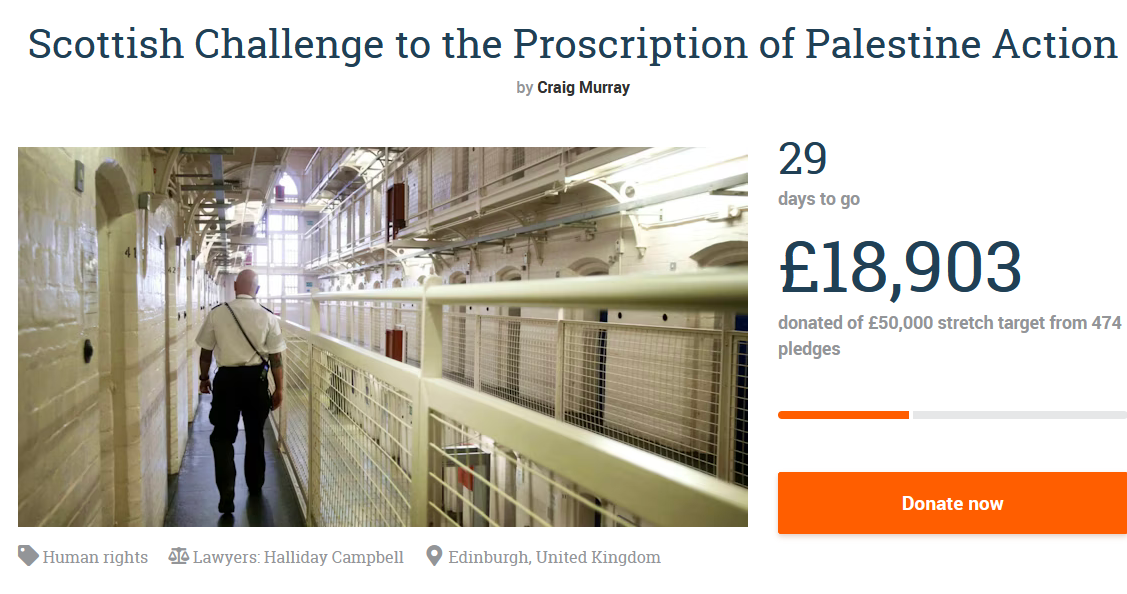
Unfortunately we will not be able to go ahead if we do not raise sufficient funds. The crowdfunder has got us into court, but needs to supercharge to get us further. Please do help:
https://www.crowdjustice.com/case/scottish-challenge-to-proscription/

I know these are the most difficult of times. But that is why we have to keep fighting. The sums needed to mount a successful legal challenge to the power of the state can be eye-watering. But we are the many. Every penny helps, but please do not cause yourself hardship. You can contribute via the crowdfunder above or via these methods:

Alternatively by bank transfer:

Account name: MURRAY CJ
Account number: 32150962
Sort code: 60–40–05
IBAN: GB98NWBK60400532150962
BIC: NWBKGB2L
Bank address: NatWest, PO Box 414, 38 Strand, London, WC2H 5JB

Or crypto:

Bitcoin: bc1q3sdm60rshynxtvfnkhhqjn83vk3e3nyw78cjx9
Ethereum/ERC-20: 0x764a6054783e86C321Cb8208442477d24834861a

View with comments

The Skripal Novichok Hoax 242

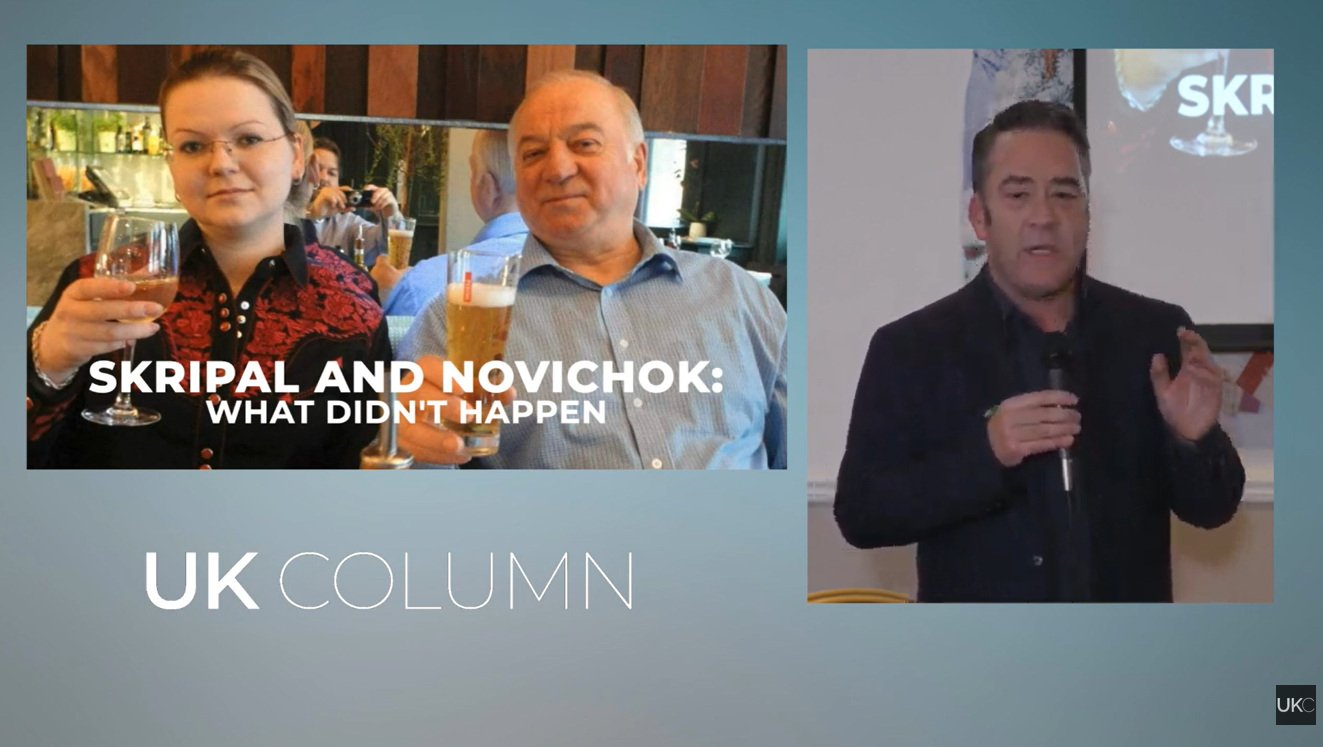
I did not anticipate that an open public meeting in Salisbury itself would be 95% sceptical of the official Novichok hoax – but it was.

Thanks to UK Column for putting this on. I hope you find it enlightening – there is information which goes beyond my previous articles on the subject. In about a week there will also be a film of our tour of the key sites in Salisbury.

The video settings prevent me from embedding it but you can watch it here.
https://youtu.be/3K9jUOYsga0?t=1464

———————————

My reporting and advocacy work has no source of finance at all other than your contributions to keep us going. We get nothing from any state nor any billionaire.

Anybody is welcome to republish and reuse, including in translation.

Because some people wish an alternative to PayPal, I have set up new methods of payment including a Patreon account and a Substack account if you wish to subscribe that way. The content will be the same as you get on this blog. Substack has the advantage of overcoming social media suppression by emailing you direct every time I post. You can if you wish subscribe free to Substack and use the email notifications as a trigger to come for this blog and read the articles for free. I am determined to maintain free access for those who cannot afford a subscription.


Click HERE TO DONATE if you do not see the Donate button above

Subscriptions to keep this blog going are gratefully received.

Choose subscription amount from dropdown box:

Recurring Donations


PayPal address for one-off donations: [email protected]

Alternatively by bank transfer or standing order:

Account name
MURRAY CJ
Account number 3 2 1 5 0 9 6 2
Sort code 6 0 – 4 0 – 0 5
IBAN GB98NWBK60400532150962
BIC NWBKGB2L
Bank address NatWest, PO Box 414, 38 Strand, London, WC2H 5JB

Bitcoin: bc1q3sdm60rshynxtvfnkhhqjn83vk3e3nyw78cjx9
Ethereum/ERC-20: 0x764a6054783e86C321Cb8208442477d24834861a


View with comments

Your Party, and Its Conference 143

It is probably no bad thing that health struggles have delayed my writing up Your Party’s extraordinary Liverpool founding conference. Perspective is definitely helpful to process something unique.

Personally, I could not help but be struck by the number of participants who approached me as regular readers of my blog, certainly well into three figures. I did scores of selfies and even signed several booklets. The very large majority of these – and you may be among them – were very enthusiastic about the experience of the conference.

They loved the feeling of a new beginning, of taking the fight to Blue Labour and Reform, of openly espousing socialist principles and policies. They enjoyed the more heated debates over party structures as evidence of functioning and lively democracy. They were uplifted by the speeches of Jeremy Corbyn and Zarah Sultana, by Shockat Adam and Ayoub Khan, and by the guest speakers from European left parties.

I felt some of this myself. The speeches were indeed uplifting, and the heated arguments were the bit I enjoyed the most, where it felt that the opinion of members mattered.

But all of that was to ignore the undercurrent of extreme factional infighting that had dogged the formation of the party, and resulted in only 45,000 joining out of the 850,000 who had signed up to register their interest.

I am not going to rehearse the history of conflict and infuriating dispute between Zarah Sultana and Jeremy Corbyn that led up to the conference. But the continuation of this into the founding conference itself was a petulant betrayal of the good people who are working to put together a new Left party.

That Sultana and Corbyn could not find it in themselves to just stand side by side on the stage together, smile and wave for five minutes for the photographers is pathetic. The power play on the eve of conference to expel members of the Socialist Workers Party, Counterfire and other socialist groups, in such a way that many did not find out until they were in Liverpool, was extraordinary.

This is what happened. Broadly speaking the organisation of the party has been in the hands of factions broadly aligned to Jeremy Corbyn. The founding draft documents state that the Alliance MPs are the steering committee of the party. There has so far been no democratic input from members in control of the party.

While the conference was to adopt a constitution setting out a new Central Executive Committee and its election, there was no provision for any interim democratic input until that executive is elected – probably five months from Conference. A number of left wing groups were therefore planning to propose that the conference itself should elect a temporary steering committee, to run the party until the executive elections.

The last minute expulsions were a reaction against those who were believed to be leading the plan to elect a temporary committee from the conference. Other measures were also put into effect to stop it – for example it was imposed that no points of order could be made from the floor, that no motions or amendments could be expressed from the floor, and burly security men were brought in to impose this “order” on the hall.

Now I should make plain all of this bothers me. I did not know of any plan, but I would have voted that conference should elect an interim committee. I deeply dislike the way that decisions are being made with nobody knowing who makes them, and on what authority.

The prime example of this is the decision to expel people. Nobody seems able to say who made this decision, and on what authority. To be plain, it was not only members of the SWP affected. Three friends of mine have been expelled, for reasons I simply cannot fathom.

Similarly, it is impossible to know who selected what could be debated by conference. There were indeed heated debates – but the agenda was set and the wording decided by invisible and unnamed people, drawing on divided up “Assemblies” which were always designed to produce no clear democratic outcome.

So, for example, the proposal that MPs should receive a workers’ wage and give the rest of their salary to the party was not chosen for debate, despite being the most popular in the online poll.

The leadership suffered a hefty defeat over dual party membership, with members voting strongly in favour. The one man one vote system of online voting for all members that was used, I strongly support. But the dual party membership debate is a precise example of the abuse of control of the agenda.

The two options were both drafted by the leadership which opposed dual party membership, and you were given two choices. The first choice was no dual party membership. The second choice was dual party membership, but only with a list of parties to be decided by the Central Executive Committee and agreed by Conference.

As there is no such list yet, and indeed no executive committee yet, all those expelled who come from the SWP and other organisations, remain expelled at least until Conference in Autumn 2026. This was against the strong sentiment of the Conference.

So I could not shake off the awareness of all this counter-productive machination and could not enjoy the conference. I find all this distasteful, and highly reminiscent of the worst behaviours of the Labour Party. I have to state I left Liverpool with a lower opinion of both Jeremy Corbyn and Zarah Sultana than I turned up with.

We had one informal and one more formal meeting of the Scottish delegates, and that was indeed more unified and more hopeful. There will be a Scottish Conference in Dundee in February 2026.

There are two central questions for the Scottish conference – will Your Party Scotland be fully autonomous, and will it support Scottish Independence? Just for me personally, those are fundamental questions governing my membership of this new entity. My feeling is they will be resolved in the positive. But they are not by any means the only questions for me.

I will I think be much happier if these issues of power and control get resolved and we finally get to talk about policy. I was never likely to enjoy a conference where sessions are called “constitution” and “standing orders”.

The problems of the party are self-reinforcing. The failure of the mass membership to materialise means that small groups of already dedicated political activists on the left have disproportionate influence within the party at present. I see and understand the problem the leadership is trying to counter – but you can’t suppress democracy because you don’t like the membership.

It is absolutely essential that a party arises to the left of Labour – there is a huge space there – and opposes both neoliberal economics and Imperialist foreign policy, while openly countering racism. I therefore really want Your Party to succeed. I also want it to support the dismantlement of the irredeemably imperialist UK state.

I think there is still hope Your Party will fulfil these roles. I shall continue to work for that. There are a great many good people in Your Party. In a time of dizzying change and fragmentation in British politics, we have to do what seems right at this moment.


———————————

My reporting and advocacy work has no source of finance at all other than your contributions to keep us going. We get nothing from any state nor any billionaire.

Anybody is welcome to republish and reuse, including in translation.

Because some people wish an alternative to PayPal, I have set up new methods of payment including a Patreon account and a Substack account if you wish to subscribe that way. The content will be the same as you get on this blog. Substack has the advantage of overcoming social media suppression by emailing you direct every time I post. You can if you wish subscribe free to Substack and use the email notifications as a trigger to come for this blog and read the articles for free. I am determined to maintain free access for those who cannot afford a subscription.


Click HERE TO DONATE if you do not see the Donate button above

Subscriptions to keep this blog going are gratefully received.

Choose subscription amount from dropdown box:

Recurring Donations


PayPal address for one-off donations: [email protected]

Alternatively by bank transfer or standing order:

Account name
MURRAY CJ
Account number 3 2 1 5 0 9 6 2
Sort code 6 0 – 4 0 – 0 5
IBAN GB98NWBK60400532150962
BIC NWBKGB2L
Bank address NatWest, PO Box 414, 38 Strand, London, WC2H 5JB

Bitcoin: bc1q3sdm60rshynxtvfnkhhqjn83vk3e3nyw78cjx9
Ethereum/ERC-20: 0x764a6054783e86C321Cb8208442477d24834861a


View with comments

The Filton Trial 65

“The policewoman attacked by a sledgehammer” has been the constant refrain of the government against Palestine Action. A couple of days before the judicial review of the proscription in England, and despite fierce reporting restrictions on the trial, the prosecution released to the media highly edited video footage from the current trial in Woolwich Crown Court of six activists accused of the attack inside Elbit Systems’ Filton factory on August 6 2024.

While that video has fuelled tens of thousands of Zionist troll posts on social media, the remarkable thing is that it is almost impossible to establish what it shows.

In fact, had it been put out without the prosecution narrative, nobody would have discerned that is what they were looking at. It shows chaotic fast-moving footage from bodycams.

The first sledgehammer seen is plainly in the hands of a security guard – as testimony in the trial, ignored by the MSM, has explained.

Here are some key facts:

  • Every single prosecution witness who gave evidence about the melee was obliged to change their statement when confronted by the defence with video evidence which contradicted it. This included much more video than was released by the prosecution.
  • The prosecution produced a misleading account of the number and location of CCTV cameras in the factory. They were obliged to present a new map showing more cameras.
  • The video evidence was left in or given into the hands of Elbit. A search of Elbit’s premises in November 2025 found the USB sticks of video in their Metropolitan Police evidence bags in Elbit’s safe.

The last fact is simply astonishing. The evidence collected and apparently correctly bagged by the police had simply been handed over to Elbit, apparently for over a year. This is only a part of a much wider collusion between Elbit and the UK state, including the police.

One of the key demands of the Palestine Action hunger strikers in other cases – of whom I will write further shortly – is the full release of correspondence between Elbit and UK authorities including the counter-terrorism police, which has been partially released and in very heavily redacted format.

Judge Johnson has directed the jury that the events in the Filton trial predated the proscription of Palestine Action as a terrorist action and they must not allow that subsequent development to influence them in any way.

There are six defendants in the current Woolwich trial, allegedly members of the “overt group” or “red group” who entered inside the facility to do damage, while a second “black” or “covert group” allegedly carried out a noisy distractive action.

Charlotte Head, Samuel Corner, Leona Kamio, Fatema Zainab Rajwani, Zoe Rogers and Jordan Devlin are charged with aggravated burglary, criminal damage and violent disorder.

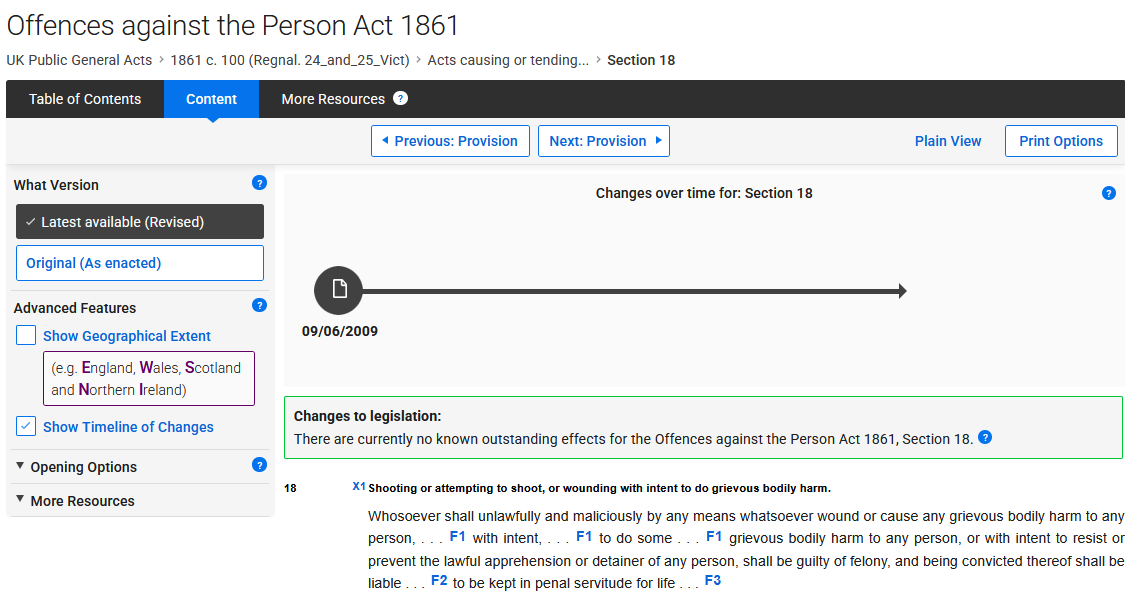
In addition Samuel Corner is charged with grievous bodily harm with intent, an offence potentially resulting in life imprisonment.

I must at this stage congratulate Real Media, who have been doing a wonderful job of reporting the key events in the trial. As is to be expected, the mainstream media has published nothing except what has been served up to them on behalf of the prosecution and the state.

I am going to publish some key extracts that give you an idea of what has been going on:

Extract from the cross examination of Elbit security guard Mr Shaw:

After a break for lunch, it was time for Mr. Shaw to be cross-examined by defence barristers, beginning with Mr. Menon, who first asked him whether he knew at the time of the incident that “Elbit Systems is Israel’s largest weapons manufacturer”. The prosecution immediately objected, and Judge Johnson told Menon that if he wanted to ask questions like this they would need to have a discussion about it later. Mr. Menon requested an answer from Mr. Shaw, but the judge insisted he move on. The context appeared to be that Menon went on to ask whether the guard was aware of Palestine Action’s protests and actions against the company, and whether he’d been given specific training in relation to protest. Shaw said he’d received verbal instruction to call police and to intervene if it was safe to do so.

Menon then went on to the first interaction, after the van had been seen and heard hitting the shutters. There was then a very confused exchange in which Shaw was adamant he had had a struggle with an Arabic-looking man wielding an axe, prior to the point at which he is seen in footage running at someone and hitting them several times with an umbrella and bringing them to the ground. His recollection didn’t seem to be backed up by evidence, and Menon reminded him he’d told the jury earlier about a man with an axe, but he maintained that in his mind that was a separate incident before what we saw on video. He was asked whether any injuries he received had occurred inside the factory, and he affirmed they had all happened before he went in, that is, he didn’t receive any contact from anyone in the ‘red team’.

Barrister Mr Wainwright, acting for Samuel Corner, picked up on the answers just given. In Shaw’s witness statement (given later in the day after the event) he had referred to just one incident outside the building, but now seemed confused as to whether there were two. He agreed there didn’t seem to be any evidence of two incidents.

Moving on, once he was in the building, we’d seen Shaw running towards people wielding his umbrella. His evidence had suggested he was threatened and attacked – he also said the group had tried to get him to open a door to give them access to offices. On reviewing the footage and under cross-examination he conceded they were telling him to leave, to ‘fuck off’, and not to give them access. He was also shown footage of Samuel Corner leading the way and showing him how he could go out via the shutter – a female, thought to be Kamio, also asks him if he’s OK and tells him he needs to go because he is bleeding. Mr. Shaw concedes what is being evidenced, and also that he then followed Mr Corner who had begun smashing a toilet area, and tried to trap him in there by holding the door for a while before deciding to go outside. Shaw agreed that no-one in the building had struck him.

Extract from cross-examination of security guard Mr Volante

In evidence yesterday, Volante had claimed that Kamio approached him with an angle grinder. He was shown footage in which she actually appeared to be holding a sledgehammer, while it was Volante himself who appeared to hold an angle grinder in one hand and a small hammer in the other, and was swinging them. Ms Hammad accused Volante of being very angry, causing one of the activists, Mr. Devlin, to tell him to ‘calm down’. The guard said he was ‘animated’ rather than angry, wasn’t using the tools as weapons, and was attempting to disarm the intruders. It can be seen that that Mr. Devlin is actually unarmed. Kamio is seen moving around with a sledgehammer, and then using it to smash up some computer equipment. Volante agrees that at no point is she seen with an angle grinder, let alone threatening him with it.

Barrister for Zoe Rogers, Ms Mogan shows footage of Volante in the corridor with a whip in his hand screaming at Ms Rogers and others that they were “being recorded”. Mogan reminded him that he was aware of previous Palestine Action protests aimed at damaging Elbit equipment, and that yesterday he had said he had grabbed a sledgehammer off Mr Devlin. Playing footage, it seemed to show him actually seizing the sledgehammer off Zoe, and she gets flung towards a wall. It also looks like he is then holding the sledgehammer with its head out in front of him, and Zoe picks up another sledgehammer from the floor, struggling with its weight and turning through 360 degrees as he approaches her with his hammer in front of him.

Yesterday Volante told the court that her hammer made contact with him, but now he accepts that that wasn’t in his statement to the police, and that it may not have done. Ms Mogan suggested he had swung his sledgehammer at Zoe, showing some more footage, in which the shadow of the hammer appeared as though raised, and Zoe covering her face in response. He had already accepted that he had kicked Mr Devlin, and he now acceded that Zoe might have “thought” that the hammer would hit her, but maintained he hadn’t swung it at her. Volante also agreed that, although his BWV was no longer recording at that time, it was “possible” that Ms Rogers ended up on the ground.

Mr Morris, barrister for Jordan Devlin, then asked Mr Volante to acknowledge that police officers had shown him unedited footage from his own BWV a few days before trial, and asked whether he noticed anything additional to what he’d described in his original statement at the time, especially that when he entered the building he clearly had one of the whips in his hand. Volante said he hadn’t noticed that. Mr. Morris suggested that Volante had run down the corridor with whip in hand, screaming at Mr. Devlin who was unarmed, and inquired whether Volante had used any de-escalation training, rather than engaging in force on first contact with Devlin and Rogers. Morris asked whether he was registered with the Security Industries Association (SIA) and whether their training included hitting someone in the face with the handle of a sledgehammer. Volante said that any such contact was unintentional and that that was why he also hadn’t mentioned it in his police statement.

Mr. Morris showed the court a screenshot from footage, that appeared to show contact described, and then handed out several photos of injuries that Mr. Devlin had sustained. One shows a round red mark that Mr. Morris suggests is the shape of a sledgehammer head. Volante is also asked about any conversation they had in the struggle, and whether when they were face-to-face, he had tried to bite Mr. Devlin on the neck. He said Mr. Devlin had likened the struggle to Star Wars and that he was a rebel or Jedi to Mr. Volante’s empire, but that no bite had occurred.

After the struggle in the alcove, the next time Devlin and Volante engaged was when the police had arrived. Volante denies he hit Devlin in the face with the edge of the hammer, but admits he then put him in a choke hold, which under further questioning he reveals he learnt from martial arts training which he’d done when younger, reaching a blue belt in JuJitsu but only a white belt in TaeKwondo. Volante described the manoeuvre as a ‘rear naked choke hold’, which could be dangerous if not administered properly. He is shown a further photograph of marks to Devlin’s neck, but says he hadn’t caused those. A police BWV video sequence is shown where Mr. Devlin attempts to stand up, and Volante uses the handle of the sledgehammer against his neck to force him back down. A disagreement ensues, in which Volante claims he was defending himself and trying to prevent Devlin from grabbing the sledgehammer, while Morris argues that Devlin poses no threat at the time and Volante was performing an aggressive and dangerous act. Another photo showed Devlin’s bruised face and black eye, corresponding to the side of his face that Volante was accused of hitting. Volante admits that he struck him and that he fell back.

Footage shows Devlin telling the police Volante had assaulted him and pointing at his face. Mr. Morris also notes to the court, that although referred to throughout as Scottish, Mr. Devlin’s accent is actually Northern Irish.

Now we have extracts from the cross-examination of a third security guard. Mr Luke:

After a short break, Mr Menon cross-examines Mr. Luke and takes him through the footage once more. He agrees that the first woman is holding a whip and he seizes it off her – and although he claims she used it against him there doesn’t appear to be video of that. While he’s grappling with the woman who originally held a sledgehammer, the other woman hands her hammer to the male and runs off somewhere. After a bit more confusion, Mr. Luke agrees that the next time he sees the two women, it is after what Menon describes as Mr. Volante’s ‘Incredible Hulk’ moment, and that they remain on the ground compliant until they are arrested by police.

Samuel Corner’s barrister, Mr. Wainright, then speaks to Mr. Luke pointing out that several of his assertions have turned out to be wrong. He was wrong about the sequence of events, he was wrong that a female passed a sledgehammer to a male who tried to use it against him. In his police statement Mr. Luke said he disarmed two women of a sledgehammer and an angle grinder, but later accepted this was wrong too. Mr. Wainwright took Luke through footage once more and showed that he had mixed which of the two males had the sledgehammer, which direction they had come from, and indeed whether anyone had actually tried to hit him.

Ms Hammad (for Leona Kamio) tried to clear up confusion of the order of events, and particularly at what point Mr. Luke had actually switched his camera on. He had said he started recording after hitting the panic button in the control room, but Ms Hammad showed footage that appeared to show him entering the warehouse from the loading bay area before that. She suggested that he had had some sort of tussle with one of the females at that point (before switching on his BWV) and then he went to the control room. Mr. Luke was adamant this was not the case. Ms Hammad finished her questioning by asking him whether he had been hit by the woman with the sledgehammer – he said he thought it had grazed him, but accepted it hadn’t hit him. Ms Hammad suggested he had merely grabbed it.

Next, Ms Oborne asked some questions about the allegation that Fatema Rajwani had a bag of fireworks and was intending to throw one at him. Taking him through his BWV footage once more, he acceded there didn’t appear to be any bag, or possibly any fireworks, and that in fact Ms Rajwani had taken a simple flare out of her pocket.

Now we have an extract from the evidence of a policeman, PC Buxton, under cross-examination:

The barrister reminds Buxton that when he entered the building there was loud noise and a horrible smell, and then shows the officer some video of the confrontation between the security guard and the intruder. The guard (Volante) is seen pushing the handle of the sledgehammer against the brown-haired male’s neck, and Buxton is asked if he remembered seeing that – he said he didn’t remember it. Wainright (who acts for Mr. Corner, the blonde man) shows footage showing Corner swing his hammer in order to hit the hammer held by the guard, and Buxton accedes that is what it looks like.

Next, Buxton is seen in the footage using his spray, and he agrees that Corner is not wearing any eye protection at that moment. Wainright asks him about the struggle with the brown-haired male on the floor, and about the moment that Corner returns. Buxton had given a video statement a couple of days after the incident, in which he describes Corner swinging the sledgehammer, and saying that although he wasn’t absolutely sure if it had hit him, he thought it probably had, because he remembered feeling pain, and because a bruise appeared a few days later. Mr. Wainright remarks that the officer also hadn’t mentioned damage to the radio in any earlier evidence, and Buxton agreed that it could have been away from his body on the floor somewhere.

Mr. Wainright also asked the jury to note that in Buxton’s evidence he said “I remember a horrible scream” which referred to the point at which one of the women was tazered.

Mr. Morris (acting for brown-haired Jordan Devlin) then takes over cross-examination, and asks Buxton to look once more at the footage, this time slowed down. When the video first shows the three people in red, Mr. Morris asks the officer whether he had noticed the security guard on his right holding a sledgehammer. He replies that he can’t remember. He was also asked when he’d first seen the footage and whether it was before writing his first statement. After challenging Mr. Morris as to whether it was a strike or whether it was a push that the guard administered with the sledgehammer on Devlin’s neck, Buxton does agree that his statement claimed the sledgehammer was in Devlin’s hands, but now realises that it was the guard who was actually holding it. The barrister asked the officer whether he knew why the guard had a sledgehammer, and he answered that he didn’t.
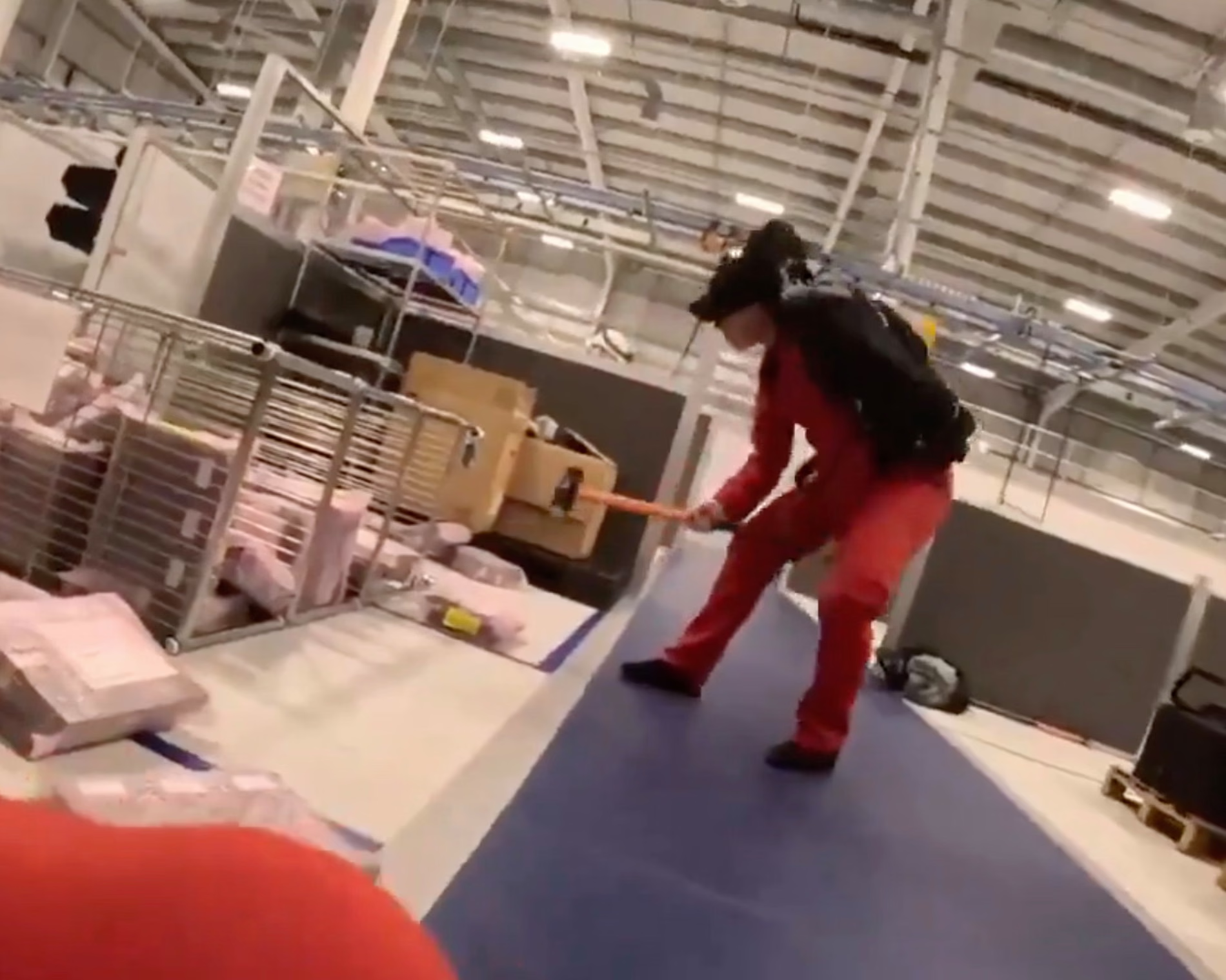
Now, it is not in dispute that the Palestine Action team entered the factory with sledgehammers and other equipment, intending to damage machinery and weapons in order to disrupt Israeli arms supply. It is also not in dispute that a policewoman, Sergeant Evans, was injured. But how she got injured, how the melee developed and who hit who is a key question.

What is evident from these exchanges is that the security guards and police are unreliable witnesses.

It is not merely that their evidence differs from what is shown by the video cameras.

It is that, consistently, their sworn evidence is untrue in a way that always makes the Palestine Action activists more aggressive, and themselves more passive, than in fact was the case.

Whether this is malicious, or merely the natural tendency of the human brain in a chaotic and scary situation to see things in the way it wishes, is not immediately evident. The answer to that will become plain when the defendants give evidence, and we start to see whether they too gave accounts inconsistent with the video evidence.

There is also the question of major gaps in video recordings and of the cameras in the “alcove” where much of the action took place apparently producing no footage, as so often happens when convenient to the authorities.

The cross-examination about the police handling of the video evidence is also highly revealing, here with PC Grant:

Menon asked her to confirm that Elbit had sole control of the footage and the system for two days – she agreed, but said the recordings on the system would have been the same and there was no evidence they had edited anything. She confirmed that she had not asked Elbit about the footage from cameras 22-25 until “much later” and that they were “quite shocked when I pointed it out”.

The name of her contact at Elbit Systems has been withheld from the defence barristers and he is known as Witness A. Grant was asked about her contact with him and referred her to email correspondence between them. On 11th Aug she’d sent an email headed ‘CCTV update Saturday’ stating that the police hadn’t checked the frame rate of all the cameras, just dipping in to get an interview, but she was concerned that “ There’s a huge opportunity for the defence counsel to use the gaps and jumps to their advantage”.

It is hard to imagine a plainer admission that a serving British police officer saw her primary duty as helping Israel’s largest arms manufacturer to secure convictions, rather than establishing the truth.

Menon asked why on earth the police were chatting with Israel’s largest arms manufacturer about what the defence counsel might do. She replied it was just her experience there was potential for that and that the system was so bad she was concerned about possible future incidents.

One of the other defence barristers picked up the baton, asking about the supposed independence of the police, and about the integrity of independent investigation and storage of exhibits. They referred to a police search of a safe at Filton carried out on 22nd November just before the trial, which found a number of USB sticks in Metropolitan Police evidence bags. Ms Grant said she was not aware of that. But one of the bags had written on it “provided to Elbit Systems by PC Grant.” The officer said the only stuff they’d given back was the material offloaded to create space. She said she couldn’t recall the labelling of the bag, that it wasn’t normal practice and couldn’t understand it at all.

….Mr Wainwright asked PC Grant whether she’d been made aware that the security guard Mr. Volante had run into the factory towards one of the defendants with a whip in his hand, and there was another incident in which a security guard used a sledgehammer. He asked her whether she’d searched for footage of that. She said she’d been told about it when she was there, but didn’t look for it specifically as she had downloaded everything that happened in that hour and a half between 3 and 4.30am. She couldn’t remember seeing a security guard with a whip.

Mr. Wainwright showed an image of the view from C24, asking if she’d looked at that footage and whether she’d seen Volante running with a whip in his hand and screaming. Ms Grant said that if the camera had been operating properly regarding the frame rate, she’d have seen it, but had made no notes of frame rates etc. Asked about C28, and the security guard running into the alcove, she was asked whether she’d seen that or made any notes on it. She said she couldn’t remember. Effectively it wasn’t her job, and she handed all the footage over to her Sergeant, Ken Crawley.

And this from the cross-examination of Detective Constable Hammersley from the Counter Terrorism Police:

Mr. Morris noted that Hammersley had made several statements over the past year, but only the latest, served during this trial, mentioned that he was a ‘viewing manager’. He said that he hadn’t thought it relevant. Mr. Morris then showed the unedited clip of Mr. Volante running in with the whip in his hand and asked Hammersley why he hadn’t put this in the compilation. The response was that the technician Sarah Bentley had a degree of autonomy in what went in. Asked whether the edit was deliberate Mr. Hammersley said no.

After a busy week of traveling I had intended to attend the start of the defence case on Wednesday, but the trial was suspended due to a juror suffering a bereavement. I therefore only managed to attend the trial in person on Thursday morning, with the evidence of the first defendant, Charlotte Head.

Again, Real Media have done a superb job of covering Charlotte’s testimony. I would add only a few atmospherics.

This was my first time back in Woolwich Crown Court, attached to Belmarsh jail, since it hosted the first week of Julian Assange’s extradition proceedings six years ago.

The area is still as bleak, the weather still cold, wet and windy, and the court as unremittingly gulag worthy, as six years ago.

I was slightly worried on arrival that I did not have a passport on me, but as in proceedings at the High Court it was not required for entry. When I had attended the Assange hearings here they had insisted on passports and entered everyone’s details. They had also attempted to confiscate notebooks and pens in the public gallery. This Filton trial however was much more normal.

The courtroom is a mirror image of that used for the Assange case. The six accused were seated in a glass box at the back, spaced out evenly perhaps two metres apart from each other. The public gallery is raised at a mezzanine level, running down the left-hand side of the court, but completely sealed off with security glass. The courtroom sound is piped in to the public gallery through loudspeakers.

We could not see the jury, who are directly below the public gallery. Judge James Johnson, in his long wig and scarlet gown, presided from a dais. There was plainly great tension between the judge and the various defence counsel (each defendant having a team). I have never seen a judge spoken to with such obvious intonation of disrespect. Johnson’s face repeatedly flushed as crimson as his robe.

Some of the highest drama in this trial consists in the discussions on admissibility of evidence when the jury is sent out. This was again the case on Thursday when I was there. Unfortunately reporting restrictions prevent me from telling you what this is about, until the trial is over, when I shall have much to say.

Charlotte Head was plainly extremely nervous. Before moving from the glass case to the witness box, she vigorously shook out her arms and particularly her hands to relieve the tension, and did so as though unaware she could be observed. At several points she was visibly struggling to collect herself.

She did however come over as intelligent, competent and concerned. How far the jury can connect with people coming from an activist background and sensibility will be a key factor in the outcome.

The key point of Head’s very full evidence is that absolutely at no point was violence against people planned or envisaged. As at similar actions the expectation was that the security guards would not physically intervene and that they would have 20 minutes or so to cause property damage before the police arrived.

In the event it had all instead escalated extremely quickly.

This trial is a real ordeal for the female prisoners. Their journey in the extremely uncomfortable prison van from Bronzefield Prison takes between three and five hours each way, every day. On a typical day they are awoken at 5:30am and do not get back into their individual cells until 10:30pm, with only the limited lunch at Woolwich Crown Court as hot food; this five days a week.

It is also important to highlight the injuries Jordan Devlin suffered from the security guards. This from Charlotte Head:

Andrew Morris (representing Jordan Devlin) asks Ms Head to look at the photograph of Devlin’s right arm, and asks her whether when she attended court on 13th August had she seen his injury. She said he had a pure black bruise all over one side, “like nothing she’d seen before”, over mostly his ribs and underarm. He also had a bad black eye. Shown another picture of his face, she confirmed that’s what it looked like, but said she was so shocked about the body bruising that she hardly remembered the eye.

These are noted in this description of the agreed facts of the case between prosecution and defence:

Mr Devlin’s numerous injuries were recorded and on the following evening the custody officer authorised his escorted transfer to hospital, noting that large bruises were forming which Devlin said were caused by a sledgehammer.

The defendants were moved to Hammersmith Police Station the next day, and a list of Devlin’s injuries were recorded there, which included hight shoulder tricep area was swollen, injuries to both wrists and his right cheek, a bump on his head, black right eye, bruised shins, thighs, and left arm, a bruised right elbow, and his left pectoral.

You will recall the police did not think Mr Devlin’s injuries worth noting in their statements. In addition to which one female activist, Leona Kamio, was twice tasered, the second time “by accident” while prone and restrained.

Remember this is a case in which the prosecution narrative has been put forward as fact by both the Home Secretary and the Metropolitan Police Commissioner. Where there has been so much said by senior figures to the defendants’ detriment, the running sore of the matters to be kept from the jury become still more problematic.

It is also simply remarkable that the prosecution’s highly selective and edited video evidence has been put into the public domain and has notably affected the public narrative, but that the defence video evidence may not be made public.

But then I gave up on expecting justice from the system long ago. Happily juries often represent the last defence of a true spirit of fairness.

The trial continues. Do follow on Real Media – the state and corporate media will never give you the truth of it.


———————————

My reporting and advocacy work has no source of finance at all other than your contributions to keep us going. We get nothing from any state nor any billionaire.

Anybody is welcome to republish and reuse, including in translation.

Because some people wish an alternative to PayPal, I have set up new methods of payment including a Patreon account and a Substack account if you wish to subscribe that way. The content will be the same as you get on this blog. Substack has the advantage of overcoming social media suppression by emailing you direct every time I post. You can if you wish subscribe free to Substack and use the email notifications as a trigger to come for this blog and read the articles for free. I am determined to maintain free access for those who cannot afford a subscription.


Click HERE TO DONATE if you do not see the Donate button above

Subscriptions to keep this blog going are gratefully received.

Choose subscription amount from dropdown box:

Recurring Donations


PayPal address for one-off donations: [email protected]

Alternatively by bank transfer or standing order:

Account name
MURRAY CJ
Account number 3 2 1 5 0 9 6 2
Sort code 6 0 – 4 0 – 0 5
IBAN GB98NWBK60400532150962
BIC NWBKGB2L
Bank address NatWest, PO Box 414, 38 Strand, London, WC2H 5JB

Bitcoin: bc1q3sdm60rshynxtvfnkhhqjn83vk3e3nyw78cjx9
Ethereum/ERC-20: 0x764a6054783e86C321Cb8208442477d24834861a

View with comments

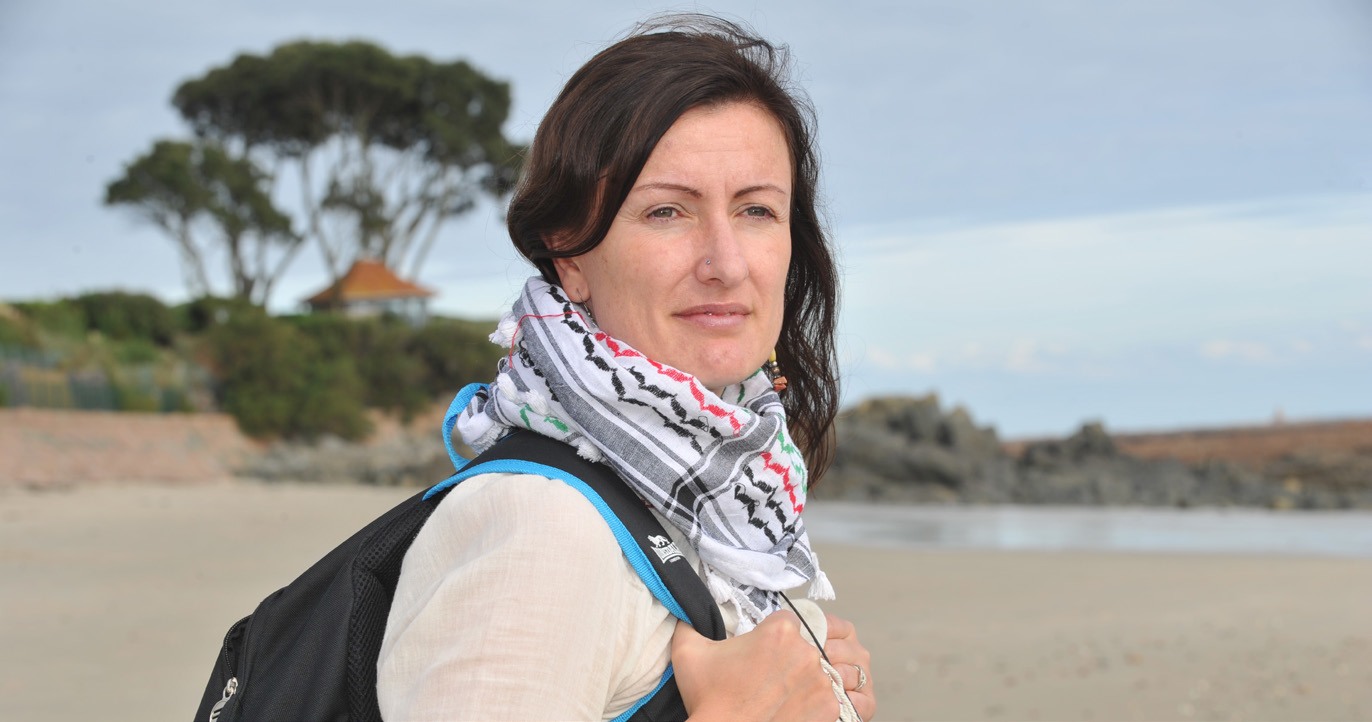
The Terrifying Case of Natalie Strecker 295

I am confident that over 2 million people in the UK have shared thoughts on the Genocide in Gaza that are stronger than anything Natalie Strecker has expressed.

I am quite certain that I am one of those 2 million.

Yet Natalie Strecker, an avowed pacifist, today faces up to ten years in prison under the Terrorism Act when the verdict in her case comes in.

Strecker is charged with eliciting support for Hamas and Hezbollah, based on 8 tweets, cherry-picked by police and prosecutors from an astounding 51,000 tweets she sent, mainly from the Jersey Palestine Solidarity Committee account.

The tweets were rather rattled off in court and referred to occasionally again in whole and in part. There may be minor inaccuracies not affecting sense, but this is the best reconstruction of those tweets that I can make (they were not displayed to the public):

“People will be individually resisting: otherwise we would be asking them to submit to genocide on their knees”

“Solidarity with the people of Lebanon and Hezbollah has the right to resist in international law, I remind you the occupier does not, and are legally obligated to try to prevent Genocide.”

“Solidarity with the resistance. In the same way that the resistance fought the Nazis in Europe, we must support the fight against the Nazis of our generation”.

“Resistance is their legal right under moral and international law. If you don’t want resistance, then don’t create the circumstances which require it. Solidarity with the Resistance.”

“This nonsense our nation has descended into, where one side is committing genocide, and the other is proscribed for fighting it. I believe Hezbollah may be Palestine’s last hope”.

“Hamas the resistance did not break out of their concentration camp to attack Jews as Jews. We can debate whether armed resistance is legitimate. Of course there should be no attacks on civilians.”

“I am sick of the MSM propaganda about “Hamas-run health ministry figures”. Hamas is the government in Gaza. Every health ministry in the world is run by its government.”

“Are you awake? So it is down to ordinary people like you an me to end it. We must take our power back. Join me in solidarity with the people of Lebanon and Palestine. Solidarity with the Resistance.”

That is it. The prosecution case is that these tweets, both collectively and individually, amount to an invitation of support for Hamas and Hezbollah resulting in up to ten years in jail in Jersey, or 14 years in jail on the UK mainland.

The prosecution explicitly stated, and the judge notably intervened to make sure that everybody understood, that it is the offence of supporting terrorism to state that the Palestinians have the right to armed resistance in international law.

Judge John Saunders interrupted the prosecution to ask whether they were saying that he would be guilty of support for terrorism if, in a lecture, he told an international law class that Palestinians have the right to armed resistance in international law.

After some kerfuffle when faced with such an awkward question, the prosecution replied that yes, it could be the offence to tell law students that.

I should point out, at risk of dying in jail, that the Palestinians are beyond doubt an occupied people in international law, and equally beyond doubt an occupied people have the right of armed resistance.

To state that the Palestinians have the right of armed resistance in international law is not in the least controversial as a statement of law. A few Zionist nutters would try to differ, but 95% of international lawyers on this planet would agree.

I assume by perfectly logical extension that this means the prosecution must believe it is a terrorist crime in UK law, for example, to quote UN General Assembly Resolution 37/43, which:

2. Reaffirms the legitimacy of the struggle of peoples for independence, territorial integrity, national unity and liberation from colonial and foreign domination and foreign occupation by all available means, including armed struggle;

3. Reaffirms the inalienable right of the Namibian people, the Palestinian people and all peoples under foreign and colonial domination to self-determination, national independence, territorial integrity, national unity and sovereignty without outside interference;

It is also worth stating that on Friday the prosecution stated, in these precise words, that “Resistance is synonymous with Hamas and Hezbollah” and that any support for, or justification of, Palestinian resistance is support for a proscribed organisation.

To repeat, there are millions of people in the UK who have stated stronger things than the tweets above. Including me. And, as the defence pointed out repeatedly, just eight tweets had been found after hundreds of hours of police time, and found amidst tens of thousands of other tweets on the Middle East, hundreds of which specifically urge non-violence.

So why are the police doing this to Natalie? Why did six armed police storm her apartment and rouse her at 7am a year ago, seizing all her electronics and papers, arresting her and not allowing her to have a pee without leaving the bathroom door open so she could be observed?

This is where the story gets very dark indeed.

This is not a local Jersey initiative.

The prosecution is directed from London and Alison Morgan KC, senior Treasury counsel (UK government lawyer) is seated beside the local prosecuting counsel, openly puppeteering him every step of the way.

So why has the UK government chosen Jersey to prosecute a local pacifist whose statements provide possibly the weakest case of support for terrorism that has ever been heard in any court in the Western world?

The answer is that here in Jersey there is no jury.

Facing this charge on the UK mainland Natalie would have a jury, and there is not a jury in the UK that would not throw this self-evidently vindictive nonsense out in 5 minutes.

Why is it worth the time and expense for Whitehall to send Alison Morgan KC here to direct a weak case against somebody who is obviously not a terrorist?

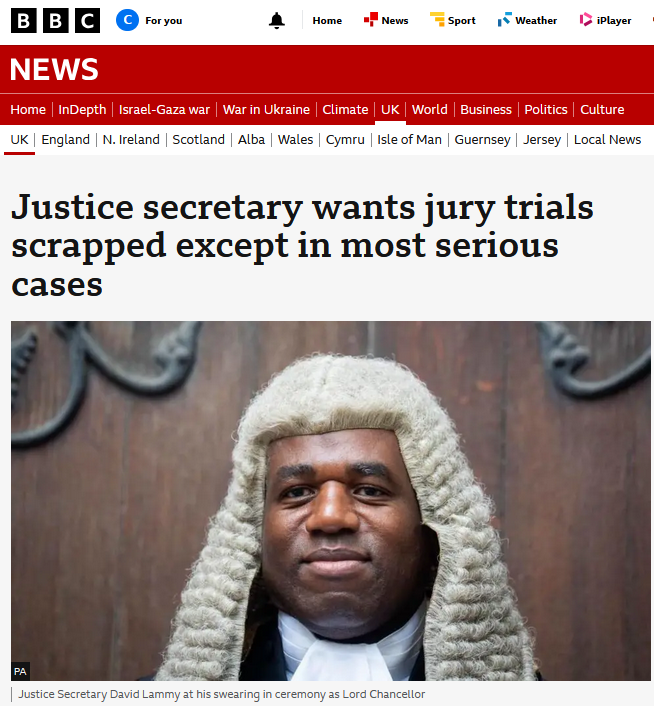
The plain answer is that this is a pilot for what they can get away with on the mainland when they abolish juries in such trials, as “Justice Secretary” David Lammy has announced that they will indeed do.

In Jersey the system is inherited from the Normans. The judge sits with two “jurats” or lay magistrates. They determine innocence or guilt. These come from a pool of 12 permanent jurats. In practice these are retired professionals and frequently have strong connections to the financial services industry.

What the jurats emphatically are not is Natalie Strecker’s working class peers of a kind who would be represented on a jury. I strongly recommend this brief article on the corruption of Jersey society by a man who was for 11 years the Government of Jersey’s economic adviser.

The judge, Sir John Saunders, seems a decent old stick in a headmasterly sort of way. He has told the court that “Mrs Strecker’s good character is not in doubt”. On Friday he stated that this was “A very difficult and in many ways a very sad case for the court to deal with. But I have to construe it according to strict legal principles”.

In the Palestine Action proscription case, as I reported, counsel for the UK government openly stated “We do not deny that the law is draconian. It is supposed to be”. In the mass arrests of decent people over Palestine Action, people have understood what a dreadfully authoritarian law the proscription regime is.

An intelligent observer cannot sit in Judge Saunders’ courtroom without realising that he thinks this is a dreadful law, but accepts that it is his job to enforce it. He reminds me of the caricature of the lugubrious headmaster stating “This is going to hurt me more than it is going to hurt you”.

In effect, Alison Morgan and the UK government are attempting through this prosecution to make even the most basic expression of support for Palestine a serious criminal offence. Remember that a terrorism conviction destroys your life – it almost certainly brings loss of employment, debanking and severe travel restrictions.

The International Court of Justice has decided that Israel has a real case to answer on Genocide, and most experts believe that Israel is committing Genocide. In Natalie’s correct image, the UK government is trying to make it a terrorist offence to say anything other than that the Palestinians should quietly submit to Genocide on their knees.

The danger is that the hubris of lay magistrates will lead the jurats to try cleverly to construe Natalie’s comments as support for terrorism in line with the government’s wishes. Natalie has, however, one defence in Jersey not available in mainland UK: here in Jersey the prosecution has to show intent – that she intended to cause support for terrorist organisations.

The prosecution has also relied on the extremely wide definition of support adopted in UK terrorist cases, that “support of” merely means “expression of agreement with”.

In defending the tweet about Hamas-run health ministry figures, Natalie Strecker’s counsel Mark Boothman countered this rather well when he said: “there is no offence of causing people to think less badly of Hamas”

I confess however I am slightly puzzled that I have not heard the defence argue that the prosecution positions are grossly disproportionate violations of freedom of expression in terms of Article X of the European Convention of Human Rights.

I would have thought, for example, that was the natural thing to say in response to the prosecution’s contention that it would be a crime for a law lecturer to tell his class that the Palestinian people had the right of armed resistance in international law.

The verdict was decided yesterday afternoon between the judge and jurats. It will be presented in full written judgment in an hour’s time.

This is a truly horrifying case for Natalie, who cannot afford to lose her job with a Jersey government agency and most certainly does not wish to be jailed. I pinch myself to be sure that this is all really happening.

It is a truly horrifying case in terms of what the Starmer government intends to do on the mainland in further criminalising support for Palestine.

I do not support Hamas nor Hezbollah, being opposed to theocracy. But for it to be illegal to discuss the Genocide in Gaza and the role of these two organisations, unless you do it absolutely without either context or nuance, is Orwellian.

Western dissent is also a victim of the Zionist Genocide.


———————————

My reporting and advocacy work has no source of finance at all other than your contributions to keep us going. We get nothing from any state nor any billionaire.

Anybody is welcome to republish and reuse, including in translation.

Because some people wish an alternative to PayPal, I have set up new methods of payment including a Patreon account and a Substack account if you wish to subscribe that way. The content will be the same as you get on this blog. Substack has the advantage of overcoming social media suppression by emailing you direct every time I post. You can if you wish subscribe free to Substack and use the email notifications as a trigger to come for this blog and read the articles for free. I am determined to maintain free access for those who cannot afford a subscription.


Click HERE TO DONATE if you do not see the Donate button above

Subscriptions to keep this blog going are gratefully received.

Choose subscription amount from dropdown box:

Recurring Donations


PayPal address for one-off donations: [email protected]

Alternatively by bank transfer or standing order:

Account name
MURRAY CJ
Account number 3 2 1 5 0 9 6 2
Sort code 6 0 – 4 0 – 0 5
IBAN GB98NWBK60400532150962
BIC NWBKGB2L
Bank address NatWest, PO Box 414, 38 Strand, London, WC2H 5JB

Bitcoin: bc1q3sdm60rshynxtvfnkhhqjn83vk3e3nyw78cjx9
Ethereum/ERC-20: 0x764a6054783e86C321Cb8208442477d24834861a
View with comments