Unlike the USA, where it is obsessively watched, the UK has no political culture of scrutinising the political composition of its Supreme Court. This is a big mistake.
The UK Supreme Court has been deliberately and openly, even ostentatiously, packed with hard-right judges selected on the specific criterion that they will not oppose the will of the government.
This is neither a crank theory nor a secret. It is much discussed in the most respectable of specialist law journals, though couched in the jargon of jurisprudence. It has not reached a wider audience because the Establishment is entirely in favour. Just like all recent authoritarian legislation, it is supported by New Labour, Reform, Conservative and Liberal Democrat branches of the Uniparty and favoured by the entire mainstream media – indeed it is openly framed as responding to the mainstream media, of which more follows.
In 2019 the Supreme Court ruled that the suspension (prorogation) of Parliament by Boris Johnson to get Brexit through was illegal. This outraged conservatives.
Lord Reed of Allermuir, President of the Supreme Court, was appointed by Tory Lord Chancellor Robert Buckland specifically to push back against the notion that the court should be a limitation on the power of the Executive. As Reed stated in evidence to the House of Lords Constitution Committee:
The challenges really came in the earlier part of my presidency… One was the aftermath of the prorogation judgment. I became President a matter of a few months after that judgment was given. It would be fair to say that the judgment had been regarded by the Government and many people in Parliament as an example of judicial activism. I think it was, if you like, the straw that broke the camel’s back. It and other cases no doubt prompted initiatives to push back against judicial review, the Human Rights Act and specifically the Supreme Court, with some briefings suggesting that the court would be abolished.
The challenge was to rebuild trust and build a relationship with the Government and Parliament in which our role was understood.
Reed thus began a crusade against what he called “judicial activism” – a crusade which included blocking, as Chair of the Judicial Appointments Committee, any judge from promotion who believed the Courts and the Human Rights Act should be used to constrain the actions of Government. As he said to the same Lords Committee meeting:
“we ask the shortlisted candidates to give us a presentation and we have very often chosen one on that very topic. I can remember asking something along the lines of, “Do you think that the relationship between the courts and Parliament has been damaged by an overenthusiastic interpretation of the Human Rights Act?”. If the candidate says, “No, there’s no problem. We had a wonderful relationship with Parliament, and the Human Rights Act had no impact on that whatever”, you wonder, “What planet has this person been on?”.
…So long as I am chairing the selection commission, I would be looking for people with a better awareness of constitutional realities.”
So here Lord Reed states openly that any judge who believes the executive is constrained by the provisions of the Human Rights Act will not get on to the Supreme Court.
The vital point to note here is that the appeal to the Supreme Court which has been granted to Huda Ammori on the Palestine Action proscription is on exactly this point. It is on, and indeed limited by the Supreme Court precisely to, whether the actions of the government in proscribing Palestine Action are a disproportionate limitation of ECHR rights enshrined in the Human Rights Act.
So Huda Ammori in the Palestine Action case has been granted leave to appeal to a court which specifically and openly disbars from membership any judge who might find in her favour.
In case you think I am selectively quoting or am twisting Lord Reed’s meaning, here he is delivering the Peter Taylor Memorial lecture, in which he mentions issues for which the courts face public criticism:
The first is judicial overreach or activism: that judges do not know their place in the constitution, and interfere unwarrantably in the democratic process. As it was put in an editorial in the Daily Telegraph earlier this year, under the headline “Judicial reform is long overdue”: “Roughly 29 million people cast their votes, elect their representatives to Parliament, those representatives pass laws, and, at the end of this process, a group of judges appear to then decide what the law should actually be instead”. This is not a new criticism. In 2006 an editorial in the Daily Express stated: “Britain’s out-of-touch judges are increasingly using the Human Rights Act as a means of asserting their will over our elected representatives”.
As I will explain, a concern that judges do not understand their constitutional role is not confined to a section of the press, but is also felt by some members of Parliament.
The second concern is that judicial decisions are based on the application of values which are not shared by Parliament or the general public. The same editorial in the Daily Telegraph cited tribunal decisions in asylum and immigration cases as demonstrating “the extent to which the values held by this country’s judiciary have diverged from both those held by the general population, and those held by the legitimate legislature in Parliament”. This too is not a new criticism. A Daily Mail editorial in 2003 asserted that “Britain’s unaccountable and unelected judges are openly, and with increasing arrogance and perversity, usurping the role of Parliament, setting the wishes of the people at nought and pursuing a liberal, politically correct agenda of their own…”
While Reed frames these as merely noting outside criticism of the courts, and “balances” them with a single unreferenced claim of left-wing criticism of the court over trans rights, the whole lecture makes entirely clear that Reed sympathises with these right-wing criticisms. He repeatedly quotes the viewpoint of the Telegraph, Express and Mail but shows very little awareness of other viewpoints. He nowhere – not just in this article, nowhere – indicates that he thinks liberal criticism need be similarly heeded.
He carries on in this lecture:
…we should not deceive
ourselves into thinking that the reasons for the distrust have nothing to do with the courts. Cases in which, for example, judges have said that they might disapply an Act of Parliament which they regarded as contrary to the rule of law, or in which they have interpreted ouster clauses so narrowly as to render them ineffective, have left a legacy. The courts’ approach in recent years has been more attentive to the separation of powers; but the more ambitious decisions and dicta of the past have not been forgotten.If it is desirable for politicians to understand the judiciary better, it is also desirable for the judiciary to understand politicians better. It is important that a sense of proportion is maintained and that we do not cry “wolf” in response to every proposed statutory intervention in the work of the courts. It needs to be recognised that not all proposals for the modification of judicial review, or sentencing policy, or the protection of human rights, are constitutionally improper.
That is not the easiest paragraph to parse, but he is stating that proposals for the modification of judicial review or the modification of human rights are not constitutionally improper. He is asserting the government’s right to limit judicial review and human rights. Which rather puts a shade on the Palestine Action proscription judicial review on the grounds of human rights.
The ultra-conservative think tank Policy Exchange was extremely influential during the Conservative administration which appointed Reed. It published in 2019 a series of papers arguing that judges must be prevented from overruling the executive, particularly on human rights grounds.
The same year, Conservative Lord Chancellor Buckland appointed Reed to carry out this project.
In December 2021 Policy Exchange’s Head of its Judicial Power Project, Oxford University right-wing ideologue Richard Ekins, was in a Conservative Home article praising Lord Reed for judgments moving the law in their direction:
In deciding if a state has breached the ECHR, the Strasbourg Court often recognises a “margin of appreciation” within which the state is free to decide how best to limit rights. Lady Hale and others reasoned that within the margin of appreciation, the UK courts should develop and apply their own understanding of Convention rights.
…In its Wednesday judgment, the Supreme Court disapproves the 2008 judgment that began this line of reasoning, as well as one of the most high-profile subsequent cases. Lord Reed, giving judgment for the court, rather understates the extent to which his colleagues had been willing to go beyond Strasbourg, but his judgment firmly restates the understanding of the 1998 Act for which Policy Exchange’s Judicial Power Project has argued now for many years.
Buckland himself in 2022 also praised the work of his appointed agent:
the current Supreme Court, under Lord Reed’s leadership, has in the last year demonstrated the appropriate degree of restraint. It is essential that this continues and that we remain blessed with sensible judges like Lord Reed.
Again this is exactly the argument in the Palestine Action case, where Lady Carr in the English Court of Appeal ruled that the proscription of Palestine Action was lawful because a “wide margin of appreciation” had to be given to Yvette Cooper in deciding to proscribe Palestine Action.
Court of Appeal judges frequently aim for promotion to the Supreme Court. There is an appointment process open now. Lord Reed has made absolutely plain that one unavoidable criterion to become a member of the Supreme Court is to agree with his doctrine that government ministers must be given “a wide margin of appreciation” in relation to the application of the Human Rights Act.
We therefore have a situation where the English Court of Appeal has ludicrously ruled that, for 85-year-old grannies to be jailed as terrorists for holding a placard, falls within the “wide margin of appreciation” to be given to Yvette Cooper and Shabana Mahmood in judging what is necessary for “national security”.
Well, it would certainly not have been in the Appeal Court judges’ career interest to have decided otherwise.
You can find small areas of specialist commentary where all this has been noted. Here, for example, on The Justice Gap:
Under Lord Reed, the Court has retreated into itself, becoming less confident and more deferential. No longer are decisions of the executive subject to searching scrutiny, but instead there is a focus on the ‘democratic credentials’ of an act, such as whether it was introduced after a ‘manifesto commitment’ or subject to ‘vigorous debate’ in the House of Commons.
The last two weeks alone have seen the Court hand down decisions that approved the cuts to child-tax credit despite their discriminatory consequences on women, and which allowed children to be kept in solitary confinement. In the former decision, Lord Reed even saw fit to condemn charities and campaigning organisations for trying to use the courts, as he sees it, as a way of compensating for their failures in the political arena. Not only does this show a hopeless naivety about how politics is conducted, but it ignores the reality which is that in a modern liberal democracy, there is no bright-line boundary between ‘legality and the political process’.
The consequences of this naivety are all too clear to see. Alongside last week’s troubling decisions, Lord Reed’s presidency has seen the Supreme Court permit the Home Secretary to unilaterally strip British citizens of their nationality without due process; while a decision handed down at the end of last year allowed ministers to sidestep their pledges and international commitments to engage with the threat of climate change. In this latter case, the UK’s Supreme Court seems especially out of step with its brethren across the globe, who are doing much to emphasise the existential threat that climate change poses to human rights, and are also more adroitly balancing the need to respect both democratic decision-making and fundamental rights.
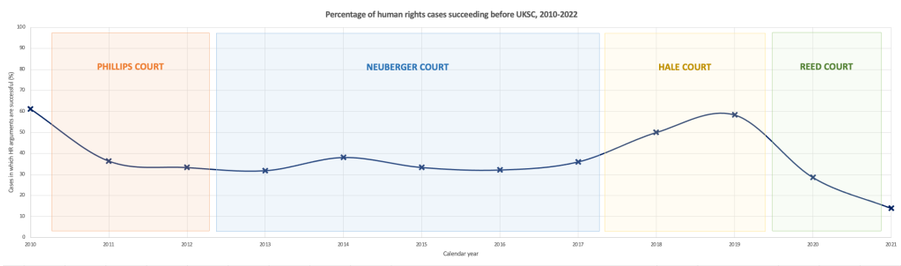
Here is a tremendous graphic, from an article seeking to quantify the change under Reed. It shows the percentage of Human Rights cases which succeed before the Supreme Court. Remember the Court only takes cases which are well-founded with a good prospect of success. Under Reed the percentage of successful human rights appeals has fallen from 60% to 15%.
Reed has done what he was openly put there to do.
The Palestine Action case is being rushed through by the Supreme Court in November, before Lord Reed retires in January having successfully reduced human rights in the UK.
The UK has passed a whole raft of extremely authoritarian legislation recently, including the National Security Act, the Online Safety Act and the National Security (State Threats) Act. To institute extreme authoritarianism, you must have judges prepared to enforce it.
Let me however caveat this. Nobody is totally malign, not even Lord Reed. In the Rwanda case he presided over the unanimous Supreme Court judgment against the government, showing that when the executive do something totally bonkers and argue plainly untrue fact, he has the intellectual self-respect not to endorse it. Or possibly he has the desire to maintain credibility and authority among his fellow judges. Whatever the exact workings, it is not impossible for Lord Reed to find against the government.
On top of that there has been a discernible shift in the position of some Conservatives – precisely the ones that Lord Reed will see in his newspapers of choice. Both Andrew Neil and Daniel Hannan expressed dismay at the latest arrests of protestors outside Westminster Crown Court “for expressing an opinion”, to quote Neil.
Neither of these two had previously any problem with the arrest for expressing an opinion of priests, people in wheelchairs, or ladies in their 80s, but when Sir Jonathon Porritt, knight of the realm and a close personal friend of King Charles, was arrested again, it began to dawn on them that this was not perhaps really terrorism.
We’re losing the plot when it comes to free speech. There are few issues on which Jonathan and I agree, especially on Palestine Action. That’s irrelevant. But for him to be arrested for no more than expressing an opinion? That way lies madness and dictatorship. Free Jonathan… https://t.co/DPZv619Uov
— Andrew Neil (@afneil) July 30, 2026
As it stands the Supreme Court starts with the decision that the Palestine Action proscription was lawful, made by the High Court of England and Wales. We need to seek to counter that with a decision by the Scottish Court of Session that the proscription was unlawful. I am very optimistic that the Scottish court will come to this conclusion.
In the proscription case, the English courts decided that Johnson’s suspension of parliament was lawful whereas the Scottish courts ruled it unlawful. The Supreme Court agreed with the Scottish courts.
The Scottish judicial review has been suspended or “sisted” by Lord Young after a whole series of horribly expensive procedural motions in view of lawfare tactics by the UK government to delay, delay, delay and either time out the Scottish judicial review or make us run out of money to pursue it.
The suspension or “sist” falls now the Supreme Court has decided to hear the appeal. Indeed the sist was designed to end as soon as the Supreme Court decided on whether to allow an appeal, and the sist ended if they decided to allow an appeal or if they decided not to allow an appeal. In which case, there was no possible logical reason for the sist, except to agree to the Government’s attempt to time out the Scottish judicial review.
Rather to my amazement, the UK government has agreed that the sist is now over. There will be a hearing on timetabling we hope next week. At which point, doubtless the UK government will apply for another suspension on the grounds there is no time for a Scottish judicial review before the Supreme Court hearing in mid-November.
That however is simply not true. The Scottish courts do not have a summer break and we have longer than the English judicial review took. I don’t think the court will dare to suspend the Scottish judicial review yet again. I am very optimistic indeed it is going to go ahead and we will win a real victory against this absurd and unprecedented proscription of a non-violent direct action group as “terrorist”.
But I am afraid we do desperately need more funds to get through this. To answer a slur, I do not get a single penny from it, not even my expenses. The money is all for legal fees and nothing else.
Please do not contribute if it causes you difficulty. If you know people who are able to afford to help and likely to be sympathetic, please do contact them and ask their assistance. We are trying to keep a lot of very good people out of prison.
You can donate through the link via Crowd Justice, which goes straight to the lawyers, or through this blog.
https://www.crowdjustice.com/case/scottish-challenge-to-proscription/
Alternatively by bank transfer:
Account name
MURRAY CJ
Account number 3 2 1 5 0 9 6 2
Sort code 6 0 – 4 0 – 0 5
IBAN GB98NWBK60400532150962
BIC NWBKGB2L
Bank address NatWest, PO Box 414, 38 Strand, London, WC2H 5JB
Or crypto:
Bitcoin: bc1q3sdm60rshynxtvfnkhhqjn83vk3e3nyw78cjx9
Ethereum/ERC-20: 0x764a6054783e86C321Cb8208442477d24834861a
Another wee donation on its wait
Thank you. Have made small conttibution to your General Expenses.
When I heard of Huda being allowed to bring this vitally important issue of terrorising an organisation that has done nothing wrong but to support international ICJ tractats and reports on the genocide in the occupied Palestinian state,
I thought this will be a money draining exercise and a timewaster to boot.
They have made their positions clear before, remember Julian Assange.
Hi
I see Craig is getting Hassle on Fbook ..I’m there Fighing them …Fkn Cowards
Jonathan Porritt…there’s a blast from the past! The kids have Zach P or Gary Stevenson these days I suppose.
Huge respect for this man. How many other public figures have been brave and principled enough to state the shocking truth about Britain’s participation in the Gaza Genocide and the insane efforts to suppress public awareness of it at home?
Compare Porritt with Labour’s political ‘opponents’ (barring Polanski, Corbyn, Sultana), with the press and BBC or the mouse he once advised.
As police led him to a transport vehicle, King Charles’ advisor of 30 years addressed bystanders and journalists directly on the street.
‘I am a supporter of Palestine Action. Trying to save lives is not terrorism. Exposing this Government’s complicity in genocide is not terrorism’.
Fully agree.
On a positive note, “A German court ruled that comparing Israel to the Nazi regime is not a criminal offense” – from: https://www.aa.com.tr/en/europe/comparing-israel-to-nazi-regime-is-not-a-criminal-offense-german-court-rules/4016284
+1
Came across this last night on youtube (posted two days ago), which is well worth checking out:
“AN ARMS FIRM IS SECRETLY DICTATING BRITISH LAW”: Palestine Action Co-Founder Exposes The Plot
As 5 more Palestine Action activists face the prospect of years in prison and lifetime terrorism restrictions for spraying red paint on a Barclays Bank, the UK state is escalating an unprecedented judicial crackdown.
In this episode of Double Down NewsWatch, host Richard Sanders speaks with Palestine Action Co-Founder Huda Ammori about the “secret legal ambush” taking place in British courtrooms, corporate lobbying by Israel’s largest arms manufacturer Elbit Systems, and the targeting of defence barristers for upholding jury independence.
https://www.youtube.com/watch?v=i2DJgmnk-sI&t=1184s (24 minutes)
And I came across the following this evening (posted a couple of days ago), and let’s hope to gawd it comes to pass:
Burnham hints at dumping jury trial curbs
New prime minister Andy Burnham has indicated that he is poised to scrap former lord chancellor David Lammy’s jury trial curbs.
Speaking at an event in Sheffield today, Burnham said he wanted to ‘look in detail’ at the proposals but that his instincts were ‘not to reduce access to jury trial’…..
https://www.lawgazette.co.uk/news/burnham-hints-at-dumping-jury-trial-curbs/5127562.article
Burnham is Trump in a tee-shirt. Who cares what this guy’s “instincts” are? Sadly this means this total joker could last in office for a few years. Perhaps the “royal navy” will even do an “ICE” dance against immigration in the Channel.
Has he thought of a theme for countrywide “reindustrialisation” yet? I mean jobs doing what exactly? Fighting Mother Nature’s climate change? Or will it be installing AI in every street? What a plonker/
And? If he cancels the Lammy’s fascist intention to abolish juries for all but the most serious crimes, then that’s infinitely better than NOT cancelling the legislation. Funny thing is that I came straight on here from watching the rest of a vid with Matt Kennard that I came across over two weeks ago entitled… Wait for it:
EXPOSED: What Andy Burnham Really Thinks About Palestine | Matt Kennard
https://www.youtube.com/watch?v=qeA1qkuZ6VA (Palestine Deep Dive 37 minutes, posted 3 weeks ago)
And it’s not just about Palestine of course. So anyway, I take it you’d prefer juries to be curbed, Yes?
Afterthought: Just because I post about Andy Burnham’s apparent intention to dump Starmer and Lammy’s curb on jury trials, doesn’t mean that I have somehow been duped by him – as Stevie B (further down the page) thinks some people have – it’s because for me curbing jury trials was one of the most serious domestic things these cnuts were doing. And even though he said as much a month or two ago before taking over as PM, I was delighted to learn that he repeated as much recently. I mean once it’s gone, the whole structure, we’d never get it back again.
But you obviously don’t seem to give a shit about it, or so it appears from what you said. But then again, I’m sure you do really.
UK citizens and residents have no rights whatsoever.
The party which has a commanding majority in Parliament can do whatever it likes. If it want to do some something prohibited by law, it can change the law, then go ahead and do it. It can punish any resident without a criminal charge and without a trial – and has done so on more than one occasion.
The USA, for all its faults, does have a Constitution which limits what the politicians can do. Their Constitution contains a “Bill of Rights” which limits what Congress may do.
Of course it’s not perfect. The politicians keep trying to chip away at it. But it’s better than nothing.
We’ve got nothing.
The police in this country can’t shoot people in the streets and get away with it, as ICE has done. As for corruption and attempts to get round the Constitution, including rigging elections – just watch a few Youtube videos of Robert Reich or Frank Schaeffer about the Trump regime. Don’t be too surprised if Sinclair Lewis’ novel It can’t happen here proves to be prescient.
Constitutions only work as well as the people who operate them. They are not a cure-all. We need good politicians more than we need codified legal constraints on them.
As it is, I think we have one of the best working unwritten Constitutions in the world. However, if we must have a written one, let it be brief, so as not to prevent politicians being able to act flexibly when necessary. A rotating citizen’s forum within the Lords, a sort of influential democratic advisory body, with the current Peers as resident expert helpers, might help with difficult issues.
“The police in this country can’t shoot people in the streets and get away with it”. WTF ! where have you been ?
There are multiple cases of the UK Regime doing just that – shooting people and getting away with it. We may not be as bad as USrael, but we have form.
In the UK, the IOPC investigates fatal police incidents. What specific modern cases are you talking about where the state ‘got away with it’ without an independent investigation, public inquest, or judicial review? Let me anticipate three possible examples.
1. The Troubles (of N. Ireland): These led to massive, multi-million-pound public inquiries (like the Saville Inquiry) and official state apologies—the exact opposite of a “regime getting away with it.”
2. Jean Charles de Menezes (2005): A tragic case of mistaken identity during a terrorist manhunt. This resulted in a massive Metropolitan Police trial under health and safety laws, a payout to the family, and a total overhaul of police firearms tactics.
3. Mark Duggan (2011): The shooting that sparked the London riots. This was subject to an exhaustive 3-and-a-half-month public inquest with an independent jury that thoroughly examined the evidence and ruled the killing lawful, because under UK criminal law, if an armed officer has an “honest and genuine belief” that a suspect is holding a weapon and is about to use it, they are legally acting in self-defence.
Let me also mention major judicial processes like the Saville Inquiry (Bloody Sunday) or the Hillsborough inquests. They prove that even when the state fails, the UK system allows for decades of legal pressure to eventually force accountability and official apologies.
All those dead people will be applauding your logic, NOT.
Maybe list some of the officers associated with those cases that were ‘banged up’, ie. didn’t get away with it ?
“the UK system allows for decades of legal pressure to eventually force accountability”. Do you actually understand what you write ? For example, the Hillsborough families might think differently. “Justice delayed is justice denied”.
2. Jean Charles de Menezes (2005): A tragic case of mistaken identity during a terrorist manhunt. This resulted in a massive Metropolitan Police trial under health and safety laws, a payout to the family, and a total overhaul of police firearms tactics.
It resulted in a massive police cover up, lies, attempts to smear de Menezes and a fixed inquest which delivered an ‘open’ verdict rather than ‘unlawful killing’, which it clearly was, meaning the trigger happy uniformed thugs responsible never got to face trail. The utterly incompetent ‘Gold Commander’ on the day was awarded a gong and eventually became Chief Commissioner and a Dame.
Then there was the murder of Ian Tomlinson, pushed to the ground from behind by an officer which was the subject of a further cover-up until footage of the incident taken by an American tourist surfaced.
Sadly stories of British police, especially the Met, abusing their powers to bully members of the public are commonplace.
“Jean Charles de Menezes (2005): A tragic case of mistaken identity during a terrorist manhunt.”
Stevie Boy, on the above I nearly fell off my chair laughing at that above BS excuse for intentional murder.
@M.J. in what country? Police seem to get away with shooting people as standard in the UK.
Whose unwritten constitution is the British better than? Israel’s? There aren’t many to choose from. That would-be President-for-Life Trump struggles continually with USAmerican courts enforcing the Constitution and had to blatantly pack the Supreme Court with rightwing loons indicates that their Constitution is a formidable (if flawed) obstacle to Kingship.
I see you’re a fan of the rightwing Great Man (Occasionally Woman) View of History, the ‘Good Chaps’ theory of British politics. Funny how the relation of British imperial rule in practice to theoretical investment in rule of law is so mythologised. Oh, the shenanigans revealed in Elizabeth Kolsky’s Colonial Justice in British India: White Violence and the Rule of Law (2010).
I’m referring to the World in 2026, be their Constitutions written or unwritten. I think those systems which excel ours are in a very small minority. Israel is too low a bar for comparison, as Trump’s America. I won’t defend the injustices of British India e.g. the Amritsar massacre (which I believe Churchill gravely disapproved of), and the Bengal famine (though profiteering may have been part of the problem, and I’m sure being in the middle of fighting WW2 didn’t help).
However, Churchill, the zionist funded drunk, did approve of the killing of over 1,000 people on the Lusitania just to get the americans into WW1.
@M.J. if
then that is surely because there is no codified constitution, and these tensions and contrary unresolvable opinions and breakdowns of convention will feed increasing instability and political unrest.
Meanwhile governing by Royal prerogative, where large areas of public policy are off-limits to public and even parliamentary influence, where no senior official is held accountable in law, no Crown service can face prosecution in Crown courts, will create crisis after crisis.
For whom is this constitutional arrangement working well?
Tell that to Jean Charles De Menezes
@MJ
“As it is, I think we have one of the best working unwritten Constitutions in the world.”
1. Leaving aside the point that an “unwritten constitution” is a contradiction in terms, extremely few countries don’t have written (i.e. actual) constitutions. Even Saudi Arabia has got one – the Koran. San Marino has got one too. Dunno which regimes you’d put on the list other than New Zealand and the Jewish state in Palestine.
2. One is reminded of the poll tax that the British regime introduced in 1989 and 1990. It was said at the time (I don’t know whether this was true) that only one other country had recently tried to introduce one – namely Upper Volta, where it was found unworkable.
3. These islands did have a constitution once. It was introduced under Oliver Cromwell. The royalists (still with us) tore it up as soon as they came back in 1660.
“unwritten constitution” , pure Monty Python.
” I had transgressed the unwritten law.” Piranha Bothers.
Surely raw power trumps whatever ‘constitution’ is written down? Bitter experience also shows everywhere (e.g. the ‘COVID’ con) that evil people triumph if good people do (next to) nothing. The years 2020-22 did feature a slightly less tyrannical approach in England than Germany/Austria/Italy/France; this made me extremely glad I didn’t live there.
Various people have researched the (English) constitution and believe that various bits of Magna Carta, after 1215, also form part of it. There’s the 1688 Bill of Rights too. It definitely forms part of it, although the anti-Catholic parts ever so slightly reduce its usefulness in 2026…
The English Bill of Rights also informed the writers of the US Constitution. NB As I live in England, I know next to nothing about Scots law. In some respect’s, it’s very different from the approach in England and Wales.
The British state manipulates health and safety law to excuse the shooting of people who are dangerous to the porkies, the people who volunteer for the job, know the risks and get paid bundles. One of them even shot a Jewish bloke recently and got away with it.
“As it is, I think we have one of the best working unwritten Constitutions in the world.” Considering that the other one is Israel, I’m not sure we’re racing ahead of a large field.
“We’ve got nothing”, and we’re happy !
@Townsman – You are absolutely right that Britain has no constitution. A constitution must be a written document with a finite number of known sentences on it, for starters. Seriously one would have thought this was obvious, but in Britain’s ultra-cowardly political class who think Britain equals the monarchist regime known as the “UK”, it is anything but.
Does the cowardly BS “doesn’t the emperor look nice in his fine clothes” feature of Britain, which is so much part of the national culture everywhere you look, surpass the level it was at even in, say, Stalin’s USSR?
Thank you for your persistence and integrity, I suspect you still have faith, I however no longer recognise any rule of law concerning the English state. English lawmaker’s care nothing for us unless it impacts their ability to maintain their deluded mandate. We will find alternatives.
On the general topic of parliament versus the courts, see
Safety of Rwanda (Asylum and Immigration) Act 2024
https://www.legislation.gov.uk/ukpga/2024/8/contents/enacted
2 Safety of the Republic of Rwanda
(1)Every decision-maker must conclusively treat the Republic of Rwanda
as a safe country.
(2)A decision-maker means—
(b)a court or tribunal …
This is totally insane. An attitude to the contrary will naturally generate push-back by judges
Yes. In a way it’s very fitting though, because these mostly Oxford and Cambridge-“educated” tw*ts are essentially admitting they’ve got no argument in their favour. They are like a parent responding to a child who has asked “Why does …?” by declaring “Because I say so.” If you have to pass a law saying “X must always be treated as safe”, then you’re basically admitting you don’t give a toss whether X is safe or not, because that’s precisely the question you’re saying has already been answered and mustn’t be asked. It’s akin to sticking your fingers in your ears and going “laaaa” whenever someone says “I want to tell you three reasons why … ”
It’s removing the right to be heard.
Incidentally the inclusion of the word “conclusively” in that statute shrieks “poor effort by a 15 year old in a GCSE essay”.
Excellent article. If it’s true that the Britain-linked part of the ruling elite has been so divided in recent times, one question to test the hypothesis is whether the prorogation judgment was a case of (a wobbly) two fingers up to MAGA mobsters at the US embassy and the CIA’s London Station – which it may well have been. (But that was then.)
Meanwhile, let’s all dig the way judge-face Robert Reed uses the phrase “democratic process” to mean the authority of the executive.
To the list of envelope-shifting authoritarian legislation should be added the Children’s Wellbeing and Schools Act 2026, which imposes a registration requirement on home educators without even bothering to amend section 7 of the Education Act 1996, which gives PARENTS the duty to ensure the education of their children “either by regular attendance at school or otherwise”. The latter doesn’t say you can only choose “otherwise” if you tell the local council.
When a regime gets to this level of taking the piss, it’s time to leave…
If you google for Jonathon Porritt, remember he’s “Jonathon” not “Jonathan”.
Another honest, honourable citizen arrested for opposition to genocide.
A long time ago, someone described the British military as “Lions led by donkeys”
What is the whole country now?
“Sheep led by jackals”?
Suggestions on a postcard …
“Lions led by donkeys” is an older phrase than Sir Jonathon Porritt, Commander of the British Empire. If he gives his medal back, or tells the “king” where to shove it, or chucks it in the river, I might have a bit more respect for him. What’s next in his story? Will he realise monarchism and green politics are cack by the time he reaches 100?
The phrase was used a lot after WW1 in Britain to express the idea that whereas in the British armed forces the “men” were on the whole upstanding people deserving of respect and the officers were a bunch of idiotic raised-to-be-stupid “Ruperts” – more at home in posho boarding schools and on the polo field than in real life, but who were unaware of the difference – in the German armed forces the officers were relatively competent.
https://en.wikipedia.org/wiki/Lions_led_by_donkeys
Incidentally officers such as field marshal Bernard Montgomery and group captain Douglas Bader were widely viewed as c***s among the men and women of the British armed forces – and by anyone else who came into contact with them other than their own types.
“So here Lord Reed states openly that any judge who believes the executive is constrained by the provisions of the Human Rights Act will not get on to the Supreme Court.”
But the Human Rights Act was voted in by Parliament so if the executive is not so constrained where is the rule of the sovereign parliament?
“Lord Reed’s presidency has seen the Supreme Court permit the Home Secretary to unilaterally strip British citizens of their nationality without due process;”
Did parliament vote to give the Home Secretary this power? A revokable citizenship is a contradiction in terms and amounts to a residence permit. In theory the Home Secretary could revoke the citizenship of everyone in Britain including the monarch, all the MPs and the Home Secretary themself.
This supreme court is to over rule the will of parliament and impose the rule of the Westminster managerial class and their patrons.
The best analysis, of which I am aware, of the phenomenon being discussed by Craig, is to be found in the book ‘ The politics of the Judiciary’ by Professor JAG Griffith.
Indeed, there is a myth of judicial independence.
“A court which refuses to shield the citizen against an authoritarian government, is not an instrument of justice.
It is a mere instrument of power.”
Well, quite. Once again this is something I’ve been banging on about for over twenty years. But there’s obviously something wrong with me because nobody pays a blind bit of notice.
I’ll try again.
The reason the courts will not shield the subject against the authoritarian government is because of your defective Human Rights Act of 1998. Take a look at that act. You will find it incorporates the European Convention on Human Rights into UK law. With two exceptions. One exception is trivial, but the more important of the two renders the law completely useless. Article 13 of the European Convention is excluded from UK law. It is simply not referenced at all.
“ARTICLE 13
Right to an effective remedy
Everyone whose rights and freedoms as set forth in this Convention
are violated shall have an effective remedy before a national
authority notwithstanding that the violation has been committed
by persons acting in an official capacity.”
I hope there is at least one person on this site that can recognise the significance of what is going on here.
And this is a very common practice within the “British Establishment”. I don’t know whether any of you bothered to download the material I offered a week ago, but if you did you will see that the Peat Report adopted the same strategy in 2003. Having confirmed to myself that the issue of who decided to prosecute Paul Burrell was indeed pertinent, when the report came out there was nothing. And then within a few days we decided to invade Iraq and everybody lost interest in the Peat Report. It’s all there, for the record.
As I understand, Parliament excluded Article 13 because the creation of the Human Rights Act 1998 itself was designed to fulfill the UK’s international obligation to provide an effective domestic remedy.
The HRA explicitly grants UK courts the power to provide “just and appropriate” remedies under Section 8, including the awarding of damages for human rights breaches by public authorities.
Section 3 requires UK courts to interpret all legislation, as far as possible, in a way that is compatible with Convention rights.
If an Act of Parliament cannot be interpreted compatibly, Section 4 allows higher courts to issue a formal Declaration of Incompatibility, forcing Parliament to review the law. Section 2 forces UK courts to “take into account” all judgments and opinions from the European Court of Human Rights (ECtHR), where Article 13 jurisprudence continues to heavily guide UK judicial reasoning.
OTOH it is true that a Declaration of Incompatibility under Section 4 does not invalidate a law or provide an immediate remedy to the victim; it relies entirely on political will to change the law.
“Parliament excluded Article 13 because the creation of the Human Rights Act 1998 itself was designed to fulfill the UK’s international obligation to provide an effective domestic remedy.”
This makes no sense. It sounds good, but it has no meaning. Please explain it to a simple person like myself.
So if there is an effective remedy why are we daily confronted with the absence of same? Why the lament from Craig “it is a mere instrument of power”? Why do foreigners need Article 13 (designed by British lawyers, no less) whereas the British do not? Really. This is intellectual hogwash.
I’ll tell you why there is no Article 13.
There is no Article 13 because it conflicts directly with the Treason Felony Act. You cannot have an effective remedy when the law says you cannot “put any force or constraint upon her”. The two clash directly, and the last thing the Establishment wants is a public discussion of the Treason Felony Act.
A slightly different topic, though rooted in the same corrupt soil.
I sent in a response to the competition and Markets Authority which they have formally acknowledged. It’s pretty short and reads
“I first joined ITV some thirty-seven years ago in the summer of 1989. At that time Margaret Thatcher was in Downing Street and ITV was still a regional operation, divided up into fifteen geographic areas. The following year the Broadcasting Act radically revised the rules for independent television and led to a significant deregulation of the model and the entry of new competitors into the industry.
It is a proven fact, if not yet a recognised fact, that this deregulation allowed criminal elements to enter into the industry. This became manifest four years later when Anglia Television was acquired by MAI plc.
The crimes committed by MAI and its board of directors are still extant today, more than thirty years later. The mere passage of time does not grant absolution. Instead the chain of acquirers becomes tainted with the same criminality. Just ask Lord Charles Allen.
My main point is quite simple. ITV are a corrupt and criminal organisation. Any outside entity that merges with ITV will itself become corrupted. That is the fate which awaits Sky UK Limited, its owners and its directors. And I am sure you will agree that corrupt practices do nothing to promote healthy competition.
Because time is short I will rely on four documents authored by myself in the past few weeks. These are:
1) Something wicked this way comes/John Smith
2) Fighting Monsters
3) William: A Clean Pair of Hands
4) The Silent Destroyers
I believe each of these is self explanatory, and relates to separate aspects of the crimes at ITV. If this is not clear to you you are welcome to contact me for clarification. I have a great deal more information that I would be delighted to share with you. All you have to do is to ask. In the meantime I will also be sending this material to Mr Brian L Roberts and Mr Mike Cavanagh, both of Comcast Corp, to ensure they are fully aware of what they will be taking on.
John Cleary”
It also went to a cross-section of 160 separate Members of Parliament.
Leaving out Article 13 was a move to protect British democracy. If Parliament had included Article 13, it would have handed unelected judges a blank cheque. In our system, the elected Parliament makes the laws, not judges. Besides, Sections 7 and 8 of the Human Rights Act already give people the explicit right to sue the government and get compensated. Excluding Article 13 just stopped judges from overstepping their bounds and overriding the voters.
It says nothing about handing judges powers. It says there must be an effective remedy before a national authority. If we had such an effective remedy available some of these abuses would go away.
“In our system, the elected Parliament makes the laws, not judges.” You seem not to be aware that our elected parliametarians swear an oath of allegiance to the entire Windsor family, not to the people who elected them.
I don’t know who you are but you appear to be of the opinion that all is sweetness and light in the UK and no changes are required. I have personal experiences that show you to be wrong. Thirty two years of personal experiences to put against your fantasyland.
@John Cleary August 3, 2026 at 20:12
A ‘national authority’ doesn’t have to mean a court or a judge. In our current constitutional setup, however, the courts are usually the mechanism relied upon to enforce those remedies because they operate independently of the political government. Even then, judges cannot strike down laws passed by Parliament—the elected Parliament always retains the final say. The parliamentary oath of allegiance treats the Crown as the symbol of the state, while the practical, day-to-day job of an MP is to serve their voters. I don’t discount your 32 years of personal experience of failures of the system, though you have given no details. My goal isn’t to argue that the status quo is perfect, but rather to look at the current design, even when it can fall short in practice. The goal of activism is reform, and it is right that we make the case, and keep our MPs informed, even if no-one has a magic wand, and even desirable changes may take time.
“The parliamentary oath of allegiance treats the Crown as the symbol of the state, while the practical, day-to-day job of an MP is to serve their voters.”
Are you having a laugh M.J.?
Here is the oath as spoken:
“I, [full name], do swear that I will be faithful and bear true allegiance to His Majesty King Charles, his heirs and successors, according to law. So help me God.”
A few points. There is nothing there about the Crown. There is nothing there about voters.
It is all about King Charles, his heirs and successors. Parliament (collectively) swears an oath of allegiance to Charles, Andy, William, Henry, George, Charlotte, Louis, Anne, and Edward. They swear they will be faithful and bear true allegiance to that motley crew.
Where do you get what you wrote from? Is it a wish list? You seem comfortable bandying about legal concepts, so let me ask you. What is the usual fate of those who proceed with a contract on the basis of what they wished that contract said, rather than what it actually said?
And further on you said
“I don’t discount your 32 years of personal experience of failures of the system, though you have given no details.”
Au contraire, I gave fulsome details.
But for the avoidance of doubt let me do so once again.
https://drive.proton.me/urls/0J0FYKBG24#F9ZfxS0qYcr6
There is a great deal there, so just have a look at John Smith/Something Wicked.
1994. The genesis.
Then go ahead and discount it.
“In our system, the elected Parliament makes the laws, not judges.”
Common law, the body of customary law, based upon judicial decisions and embodied in reports of decided cases, that has been administered by the common-law courts of England since the Middle Ages.
https://www.britannica.com/topic/common-law
The common law is the system of judge-made law that originates in the King’s courts of medieval England and which has since been received to the former colonies of the British Empire.
https://en.wikipedia.org/wiki/Common_law
Common law forms a vital part of the legal system in various countries, including the United States, where it evolved from longstanding British traditions. This body of unwritten laws is built upon legal precedents set by courts, serving as a critical guide in cases where answers aren’t readily found in existing statutes or written regulations. Countries such as Australia, Canada, India, and the UK also rely on common law to navigate unique legal scenarios that demand precedent-based justice.
https://www.investopedia.com/terms/c/common-law.asp
Primary source of law are
Legislation (Acts of Parliament or statutes, statutory instruments, Orders in Council etc)
Case law (decisions of the higher courts, or “courts of record”, which are binding on and must be followed and applied by less senior courts).
https://www.iclr.co.uk/knowledge/topics/the-english-legal-system/
Hi John. I did have a look at all the things you linked, though I confess not in great depth. TBH I was just curious about what the cases were you were referring to. My impression was that they were subjects which whilst interesting, indeed, important and relevant to events occurring now, were not things I had the inclination to devote the time to exploring to the degree necessary to get a real understanding of them, and of what it is you are hoping might come of them.
I’m obliged to be fairly selective with how I use my time and energy : we never know how much of each we have left. I’m constantly a bit * uneasy * about how much time I spend on sites like this and Social Media in general; at times feeling that I spend too much time on them, at others that it’s kinda necessary to follow sites like Craig’s as a antidote to the incessant mind-numbing white noise of legacy media — particularly in the areas of Politics and Global Affairs. I also like Craig and enjoy his writing, and the comments BTL. As ever it’s the pursuit of that elusive ideal – Balance.
It’s obviously something you care a great deal about and have devoted at lot of YOUR time to. I hope you consider that time and energy well spent and that you get some degrees of resolution and ( CLICHE ALERT!!! ) closure, eventually.
Thank you for those sentiments Robert.
I see more and more people commenting online that there is something very dark at the heart of the British State, but they have no idea what that darkness is. It is for that reason that I have put so much energy into this matter. Those instincts are entirely correct and it is my goal to reveal the essence of that darkness before it destroys all of us.
John, just want to quickly say that I totally agree with your aspirations, but how are you planning to reach the tens of millions (in Britain alone) who have been endlessly duped and deceived and manipulated by the dark forces, which now includes just about the WHOLE of the MSM?
Allan you are correct that I cannot reach the ordinary folk on my own and without any help. This is a spiritual war, and it is important to at least try to make things better.
There are other ways of fighting back which do not involve the ordinary folk. I’ll give you one example out of many.
The core Windsor strategy is that of plausible deniability. They just claim they knew nothing and move on. The courts then endorse this fiction and that’s the end of it. They even do it in judicial inquiries. For example Lord Bingham pronounced the Establishment innocent in the BCCI affair and that the Bank of England had made a simple mistake in failing to regulate. Then an internal memo came out that demonstrated that Peter Cooke, Head of Regulation, had indeed considered this matter and the failure to regulate had been a conscious decision. That is, Bingham lied.
Another example of stripping plausible deniability can be followed in my paper about William (A Clean Pair of Hands?). Earlier this year the Windsors were quite clearly positioning the Prince of Wales as the saviour of the Windsor Dynasty, completely untainted by the many scandals, one who never knew about any of the Firm’s operations. Now, I don’t think he is in any position to claim he knew nothing.
There’s more than one way to skin a cat.
Good * luck *, John and thank you for what you’re trying to do. Please don’t make yourself ill – in any sense – in the effort
Thank you Robert.
You are hinting about mental health. I’m afraid it’s much too late to worry about that.
When the police first came for me way back in January 1995 they told my then wife that they, and two other police forces were looking for me [that would be Norfolk, the Met and Staffordshire who spoke to her]. They did not tell her that I was to be arrested, or that any charges were to be laid. They told her I was mentally ill.
When I wrote about “A British Reich that will last a thousand years” to Janet Reno there is no hyperbole whatsoever involved.
Good piece, except isn’t this crucial bit incorrect?
“The vital point to note here is that the appeal to the Supreme Court which has been granted to Huda Ammori on the Palestine Action proscription is on exactly this point. It is on, and indeed limited by the Supreme Court precisely to, whether the actions of the government in proscribing Palestine Action are a disproportionate limitation of ECHR rights enshrined in the Human Rights Act.”
However, the court record states that:
“The Court of Appeal disagreed and allowed the Home Secretary’s appeal. It concluded that the Proscription Decision was lawful because: (i) the Home Secretary had correctly applied her Policy; and (ii) proscription amounted to a proportionate interference with articles 10 and 11 ECHR.”
And it goes on to say that the permission to Appeal is
“Granted in part: Permission to Appeal is granted in relation to Ground 1 only (and is refused in relation to Ground 2)”
Yes that is apparently an error, which was then repeated in the media. I have been informed by Huda that in fact it is the other way round and the appeal is granted on the grounds of conflict with the Human Rights Act Arts X and XI
Is that right? If so that’s a really crucial point.
The court records state as I’ve described so the error would be right at the source which is very hard to believe. I’m not saying you’re wrong I’d just really appreciate this being clarified.
https://www.supremecourt.uk/cases/uksc-2026-0099
I see that (in contrast to the Supreme Court website which states the appeal is granted only on the grounds of whether the Home Sec followed her policy) the Guardian mistakenly said:
“The supreme court said it was arguable that the ban represented a disproportionate interference with articles 10 and 11 of the European convention on human rights, which protect the rights of freedom of speech and protest respectively.”
https://www.theguardian.com/uk-news/2026/jul/30/supreme-court-says-palestine-action-co-founder-can-challenge-ban-on-group
I see that the Guardian mistakenly said:
“The supreme court said it was arguable that the ban represented a disproportionate interference with articles 10 and 11 of the European convention on human rights, which protect the rights of freedom of speech and protest respectively.”
https://www.theguardian.com/uk-news/2026/jul/30/supreme-court-says-palestine-action-co-founder-can-challenge-ban-on-group
Never mind, Burn’em is ensuring british justice is in good hands:
“the ministerial re-appointment of Sarah Sackman, Keir Starmer’s ex-solicitor general and a key supporter of Lammy’s jury proposals. Sackman has previously worked as a foreign law clerk at the Israeli Supreme Court, and her grandfather once served as an ambassador for the settler state. Last week, Burnham extended her role in government with a re-appointment at the Ministry of Justice.
Sackman’s re-appointment sends a loud signal to those who thought Burnham might change course.”
https://www.thecanary.co/uk/analysis/2026/08/03/burnham-sackman-justice-minister/
Perhaps the courts might remember that about 750 Britons were killed in 1948 by Jewish terrorists – does this mean that Britons who support Israel find those killings were acceptable to them. If so, I imagine that they might be traitors. They should be asked.
Also, would holding up, in public, Einstein’s letter to the New York Times, constitute a ‘terrorist’ act?
People holding up blank sheets of paper have been hassled and threatened by police in Britain already.
Ditto in Russia, mainland China, and Hong Kong.
Those who control and run the state don’t like it up ’em.
A form of struggle that originated in Hong Kong IIANM.
Hong Kong has always been Chinese. Britain had a 99 year lease that was obtained by force, that lease expired and Hong Kong returned to its rightful owners, the Chinese. The western funded dissidents only struggles were with reality and bares no comparison with genuine struggles.
That’s not quite correct; Hong Kong itself was ceded to Britain in perpetuity, the 99-year lease applied to the “New Territories”. On a street map of HK you can find a street called “Boundary Road” which ran along the boundary between the two.
Of course, as you wrote, the whole thing was settled by force and had no moral validity whatever the details.
Yes, and is it terrorism to plant a bomb in a Monaco hotel, and to bomb a Russian restaurant and to attack and kill men, woman and children on a beach on a summer day ? Apparently not, because Westminster explicitly supports and aids these attacks. And what benefits are there to the UK and it’s people in supporting a nazi regime ?
Genocide okay, opposing it terrorism.
I see Scottish Nationalists as the winners in the coming months, and political protestors as losers, as a result of Craig’s case. Let me explain. I see the following happening:
1. Craig wins in the Court of Sessions. Palestine supporters and Human Rights advocates get to celebrate for just a little while.
2. The government immediately makes a fast-track appeal to the UKSC.
3. Following precedent, the UKSC defers to the Home Secretary, bowing to the mantra “National Security”, and the incantation works – on the English judges. The majority find for HMG.
4. The two mandatory Scottish judges however dissent and write powerful opinions.
5. The PA protestors are duly jailed and possibly de-banked as well, unless MPs have the sense to think of something, and I sincerely hope they do.
6. In any case, however the case for Scottish independence is strengthened, including many of the arguments about colonialism, not a real union etc.
I don’t rejoice at the thought, but that’s what I see as a real possibility.
All because some politicians over-reacted to a direct action group as a sop to the apartheid state, when we already have laws for such things as criminal damage, and rights on freedom of speech and jury protections are there for good reasons.
It seems that at major positive turning points in history, some outrageous decisions are taken.
Thomas Aikenhead, a 20 year old student, was hanged in Edinburgh on a charge of blasphemy in 1697, just as the enlightenment was learning to walk. It is a dark and tragic story that you can easily find out the details of. I see it rhyming with a lot of the history being recorded today.
But as any rational person will tell you, there is no such thing as a safe space. However it does make me wonder what is around the next corner.
This looks like a fascinating as well as tragic story. A wiki article contains details of historical resources as well as adaptations of the story in fiction and drama.
I decided to ask Google AI to explain how judges are appointed in the UK, the US and Australia and this is the answer I was given:
Comparison Overview
Primary Selector: Independent Selection Commissions (UK), Federal Cabinet (Australia), the President (US)
Legislative Role: none (UK, Australia), the Senate (US)
Process Style: Independent, job-like application (UK), Federal Cabinet consultation & discretion (Australia), High-profile political scrutiny (US)
Formal Appointer: Monarch, on ministerial advice (UK), Governor General (Australia), the President (US)
Tenure: Mandatory retirement at age 75 (UK), Mandatory retirement at age 70 (Australia), lifetime appointment (US)
The following YouTube sources were relied upon: The Judiciary | English Legal System, and Agony Anth 4: How are High Court Judges appointed?
It would seem that the process of selecting and evaluating UK Supreme Court judges, relatively closed and opaque compared to the Australian and American processes, is the issue. Who determines how the independent selection panels are chosen, who is included on them and who is not, and what selection criteria do these panels use (or are compelled to use) to decide for or against candidates – that is one problem.
I asked AI about the eligibility and qualification criteria required to apply as a lay or professional commissioner. It responded as follow, but note in particular the second criterion for disqualification at the end:
To apply as either a lay commissioner or a professional commissioner, candidates must meet precise statutory definitions alongside strict merit-based competence criteria.
1. Lay Commissioners (Includes the Chair)
The CRA 2005 explicitly designs lay roles to ensure the judiciary is not solely self-selecting and that public interest remains central. There are 5 Lay Commissioners and 1 Lay Chair.
Statutory Eligibility
To be legally eligible to apply as a Lay Commissioner, you must meet a strict negative definition:
* No Legal Practice: You must have never practiced or been employed as a lawyer (e.g., solicitor, barrister, or CILEX fellow).
* No Judicial Office: You must have never held a listed judicial office in any UK court or tribunal.
* Residency: You must be a resident of England or Wales.
* Right to Work: You must possess the right to live and work in the UK.
Experience & Core Competencies
When vacancies arise, the Ministry of Justice’s Public Appointments Portal evaluates applicants against the following criteria:
Merit-Based Assessment Experience: Practical experience sitting on boards, committees, or panels to make collective recruitment or promotion decisions.
Interviewing Proficiency: Demonstrable skill in conducting high-stakes interviews, using structured assessment frameworks, and asking probing questions.
Analytical Ability: The ability to rapidly process massive amounts of complex information and condense it into balanced, clear, evidence-based reports.
Political Impartiality: Absolute freedom from active party-political ties, ensuring decision-making is independent of government influence.
2. Professional Commissioners
There are exactly 2 Professional Commissioners on the JAC. Their main purpose is to bring direct, practical experience from the legal sector to the selection process.
Statutory Eligibility
To apply as a Professional Commissioner, candidates must satisfy the legal definition under paragraph 6 of Schedule 12:
Practising Qualification: You must be a practising barrister, solicitor, or a CILEX fellow in England and Wales.
The “Different Qualification” Rule: Crucially, the two professional commissioners cannot hold the same qualification as each other. If one commissioner is a practising barrister, the other must be a practising solicitor or CILEX fellow.
No Judicial Elevation: You must be actively practising or employed to give legal advice, and you cannot be a full-time holder of a listed judicial office.
Experience & Core Competencies
Professional applicants undergo a similarly competitive public process and must demonstrate:
Standing and Credibility: A high level of personal authority and professional achievement within their legal discipline to command the confidence of the legal sector.
Understanding of Judicial Demands: Deep insight into the modern skills required to be an effective judge, such as courtroom management, dealing with litigants in person, and legal interpretation.
Commitment to Diversity: A track record of understanding and tackling barriers to entry within the legal profession to help the JAC fulfill its statutory duty to encourage a more diverse pool of judicial applicants.
🛑 General Disqualifications (Both Roles)
Even if an applicant meets the specific lay or professional criteria above, they are automatically barred from being considered a commissioner if they:
Are currently disqualified from acting as a company director.
Have an active conflict of interest that cannot be mitigated (e.g., holding a political office or a position in government that compromises the commission’s strict neutrality).
The case for judge-napping builds…
I think it’s over-optimistic to discern a meaningful crack in the hard-right zionism of the British ruling class; certainly judging by those selected to be its media mouthpieces. Look at the uniform grief among the commentariat yesterday at the death of Genocide denier Rod Liddle. This is the grouplet who are meticulously chosen to lead and monopolise the public conversation in Britain. They are hardcore.
The conversation in an episode of “Yes, Minister” went something like this:
Minister: “Couldn’t we put pressure on the judge?”
Sir Humphrey (outraged): “Minister, you can’t put pressure on a judge!”
Minister: “Well, what are we going to do then?”
Sir Humphrey (no longer outraged): “Well, you pick a judge who doesn’t need any pressure putting on him.”
Rule BY law rather than rule OF law.
Surely the decision to sentence people for crimes they were not convicted of amounts to judicial terrorism?
England was one of the first countries to establish the principle that a Government should be bound by its own laws. It did this so a King would not steal from the aristocracy, (Magna Carta). The people were not considered.
In creating this principle it obviously placed the higher courts in some level of contest with Government and today with elected representatives i.e. Parliament. Our elected representatives do not have to demonstrate an understanding of statute and common laws nor do they have to understand the difference. Consequently it is essential that courts should be able to decide, advise and even suspend Parliamentary actions which are unlawful.
Parliament also has a responsibility to monitor and intervene when the Judiciary acts inappropriately.
Democracy depends upon this contest of authorities. Democracy fails when one or both choose to collude. Especially when that collusion is clearly in contrast to the will of the people.
However Britain as a democracy is a failure. Not because of change but because it never was one. The image of Britain as a beacon of freedom and human rights was simply propaganda. You were never better than the USA is today. Taking war to the world to enrich yourselves. Now the world is prepared to fight back. So you get poorer and war at home. It’s all you deserve.
“It is over thirty years since I settled in the United Kingdom. Life has been good to me. I enjoy freedom and democracy, I enjoy openness and debate. I would like the same privileges and opportunities to be more widely available in the world.”
Oleg Gordievsky, Next Stop Execution (ISBN 1839014903).
Also recommended: Ben McIntyre, The Spy and the Traitor (ISBN 0241972132).
“In 1995, Gordievsky published an autobiography, Next Stop Execution…”
https://www.the-tls.com/lives/biography/minus-advantage
I think things have changed a lot in the UK in 31 years, pal.
In Russia, too. In fact I would far rather live in Russia than in the UK now.
Further back you made the erroneous statement:
“In our system, the elected Parliament makes the laws, not judges.”
You have evidently never heard of Common Law. Refer back for a brief lesson.
“I would far rather live in Russia than in the UK now.”
Who’s stopping you? Go and join George Galloway, if you really think Russia is so great, if you are not grateful to live in the UK – which many in this world would risk their lives to do, you see them regularly crossing the Channel illegally for that purpose.
Maybe some people don’t think it’s so great to live in a country where hundreds of thousands of criminals are welcomed with no consequences, whereas thousands of legal citizens are locked up as terrorists for opposing genocide. Two tier justice ?
I do not and would not consider living in the UK. Why do you think I do?
I would live in Russia if I didn’t have residence rights in China where I have lived since 2020.
Try this, you might learn learn something.
https://waltking.substack.com/p/living-in-china
I think more people are leaving the UK than are arriving now.
Many YouTube videos on the subject.
British Democracy.
An unelected head of state.
An unelected Prime Minister.
Until recently a Foreign Secretary who wasn’t even an MP (Lord Cameron, 2023 to 2024).
General Election 2024
“Labour secured 411 seats and a 172-seat majority… The party’s vote share was 33.7%, the lowest of any governing party on record, making this the least proportional general election in British history.”
https://en.wikipedia.org/wiki/2024_United_Kingdom_general_election#cite_note-10
With a turnout of 59.7%, this means that Labour achieved their landslide with the vote of one in five of the electorate. And Starmer put the ten election campaign vows for a better Britain in the bin.
And people are told that China is undemocratic.
I forgot the unelected Upper Chamber. Sorry.
The British media strives for these grotesquely anti-democratic outcomes. They destroyed a genuinely democratic prospect in the Corbyn movement by the most unscrupulous means. Subsequently they covered up Starmer’s broken vows, erased his participation in Genocide/ the criminal attack on Iran, his branding of anti-Genocide protest as terrorism/ antisemitism, his effort to end jury trials and so on. Absolutely insisted in the face of everything that he is a thoroughly decent man.
Most who parrot this line on Starmer’s fundamental decency are unaware of his degeneracy and criminality. M.J.’s different because he is completely aware of all of it through Craig’s articles.
Make of that what you will.
A person can be aware of things and disagree with them. Our king is mainly a symbolic head of state. Our PM did not elect himself; he was elected by others, mainly MPs, and every one needed a mandate from their constituents.
Most importantly, we have means for the peaceful transfer of power. That distinguishes democracies, the fortunate countries, from every tinpot dictatorship under the sun.
In the UK Parliament is supreme even over judges, and statute law always over-rides common law. So we are a Parliamentary Democracy, a Constitutional Monarch, and we are Fortunate!
Please remind me, who was standing against Burnham?
corr ‘we are’ -> ‘we have’ in the last line but one
Truly breathtaking, laughable naïveté bordering on stupidity. Or maybe I’ve got you all wrong and it’s really good self-parody. I’ll assume it’s the first of these scenarios.
The UK is not a “constitutional monarchy” – that term could serve as the definition of an oxymoron. We don’t have a constitution, and don’t say it’s an unwritten constitution, there’s no such thing.
To paraphrase Sam Goldwyn, “an unwritten constitution ain’t worth the paper it’s not written on” because unless it is formally written down in a specific document with a specific number of articles (which, of course, are subject to amendment under certain specific conditions) which define the powers of the executive, legislature and judiciary, then whatever your unwritten constitution is based on can then, Humpty-Dumpty style, “mean just what I choose it to mean – neither more nor less”.
Even if we did have a written constitution, it still wouldn’t be worth the paper it WAS written on because there are no constraints on the power of the executive in our parliament (because the executive derives its power from your sainted Charles Philip Arthur George Battenberg-Saxe-Coburg-Gotha) and no parliament can be bound by any of its predecessors. So if a proper constitution was agreed and passed through parliament, it could be scrapped by a future parliament.
If that’s a democracy then, as they say on every BTL comment section, I have a bridge to sell you.
If you want convincing of how fortunate you are, look at reports and films of people trying to come into the country illegally on boats across the Channel.
Also read about Prince Charles’ comments at the UK’s first citizenship ceremony.
“illegally on boats across the Channel.” FFS. By your own words you’re condoning criminal activity. That doesn’t make most people feel privileged or comfortable with that situation. That is not good PR for ‘democratic’ Britain. How about applying the laws we already have to everyone fairly ?
Hi Frank. Just looking for a bit more info on that bridge you’re selling…..
What are it’s dimensions, in addition to the usual boring three; does it have the capacity to stretch to, eg 4, 5 or even 10 dimensions?
What material is it mainly constructed from: polystyrene, wooden pallets, lego or just hopes n wishes?
Cantilever or Candelabra. Suspension or Disbelief of same?
Would it possible to buy/pay by instalments, like, say 5euros a week for eternity?
As you probably guessed, it’s not for me, ” asking for a friend ” ( well, a friend of an enemy’s friend’s teenage daughter- a Ms Kallas )
I have wondered about that too.
Should we take him seriously, I wonder?
“… Should we take him seriously, I wonder?”
If he doesn’t take himself seriously – look at all the effort he invests in making himself look stupid – then there’s no need for us to do so either.
Still waiting to hear who was standing in the election against Burnham.
Walt,
I took the time to read your Substack article on China that you linked to above in the thread – very informative and interesting.
Some of the dinosaurs who post on here would benefit from reading it from start to finish but there’s more chance of stepping in rocking-horse shit than expecting any of them to read it with an open mind.
One part of it made me nostalgic for better times (which used to exist) in this country:
“Yet in the UK, at least they can change the party, you will say? Well, welcome to the new boss, same as the old boss. You are just evicting one set of snouts from the trough and letting in another, as Paul Foot once remarked.”
Paul Foot – a fearless investigative journalist, a real journalist of a type that no longer exists in “the free world”. He had some equally good contemporaries as well, e.g. James Cameron, John Pilger, Robert Fisk. None of today’s bought and paid for presstitutes and government stenographers who have the effrontery to style themselves ‘journalist’ could hold a candle to Mr Foot and his ilk.
And that’s one of the reasons why the “United Kingdom” (what a sick joke of a name) is in its present parlous state. Because there are no more Paul Foots and John Pilgers keeping a wary eye on them, the people who really run this country know they can do whatever they want without reproach.
“Fourth Estate” – my arse.
>It’s all you deserve.
Has nothing to do with me! Or are you framing the government’s past actions as original sin on the part of the citizenry? The majority of people in the UK said they wouldn’t fight for this country even if it was invaded. The problem is that too many British – or maybe it’s mostly the English – hate their own people and, perhaps, humanity generally.
On top of the what’s happening to the British regime’s supreme court, British academia is also getting sorted out in a hard-right direction. See the Jason Arday case. See also the “21 Group”: https://21percent.org/
There is a petition in support of Jason Arday here:
https://goodlawproject.org/petition/stand-in-solidarity-with-jason-arday/
This case is likely to become much bigger, and probably internationally, because it is heaven for the hard right.
How can anyone support a compulsive liar ?
Have you seen/heard about his resignation letter? bahahahaha: it could easily be interpreted as a parody of preposterous, narcissistic bogus-victimhood pleading: but it isn’t parody; this is ” his truth “. Even in exposure, his self-imagined God-like brilliance and prolonged martyrdom is undimmed.
Bet the SNP and/or ScotGreens would LOVE to welcome him into their hyper-*progressive * fold. In fact,why not make him leader of both parties?
The guy is clearly a genius
Yes – I read the resignation letter.
Many Cambridge dons write far more self-regardingly than that. See Robert Tombs writing about the case in the Telegraph for example:
https://www.telegraph.co.uk/news/2026/08/07/cambridge-failed-every-turn-over-jason-arday/
You can feel his sneering arrogance from the very start of his piece.
The big problem with Jason Arday’s resignation letter is what he DOESN’T address, namely the allegations of plagiarism and other dishonesty. It seems pretty clear he was guilty of plagiarism in a big way. I don’t defend plagiarism at all.
But this is about far more than one guy’s plagiarism.
1. See Nathan Cofnas, the white supremacist who is also involved in this. He’s the ex-Cambridge don who said that if ethnicity were to be ignored when hiring, the percentage of black people occupying positions such as Harvard professorships would approach zero.
2. Look at how Arday is being piled in on. In particular, a photo is circulating showing him supposedly at the top of Mount Everest standing next to someone wearing a Palestinian keffiyeh.
3. There is a lot of hard-right money at Cambridge, and therefore levers that can be pulled. It wouldn’t surprise me if the hiring of Arday as a main man speaking for the cause of better educational opportunities for the disadvantaged (but who for some reason thinks it an “honour” and a “privilege” to be hired by Cambridge – so he can’t actually be very bright) was a set-up from the very beginning.
4. Dominic Cummings, YESTERDAY, approvingly cited T S Eliot’s statement that “There is no doubt that in our headlong rush to educate everybody, we are lowering our standards and more and more abandoning the study of those subjects by which the essentials of our culture … are transmitted; destroying our ancient edifices to make ready the ground upon which the barbarian nomads of the future will encamp in their mechanised caravans.”
(That Cummings can pretend to be against “Oxbridge” when he agrees with such statements is ridiculous.)
5. Cummings seems to quite like the Burnham government, relatively speaking. I am not joking. “The chances that Burnham changes Whitehall much in the right direction seems very low probability, yet still higher than the probability that the farce of ‘Kemi’ and her crew of LGBTQH++ dregs, losers and charlatans would do anything other than implode fast in shameful chaos.”
(“H” in the acronym he uses means “Hamas”, for those who didn’t already know.)
6. (Very much on-topic for this thread) – The plan to tell primary school bosses in England to identify five-year-olds who are supposedly headed for future unemployment:
https://www.theguardian.com/society/2026/aug/07/english-primary-schools-to-be-told-to-identify-children-at-risk-of-future-unemployment
Would Cofnas approve? Of course he would!
^ This kind of thing is very much in the air.
We have Burnham-Cummings-Cofnas-Cambridge-MSM all doing their bit…
Michael Segalov’s piece in the Guardian:
https://www.theguardian.com/world/2026/aug/07/friday-briefing-what-the-jason-arday-row-reveals-about-equality-in-modern-britain
Unfortunately his article doesn’t live up to its title, but I doubt this will surprise many people here.
He quotes Nesrine Malik who majorly doesn’t get it: “Really, it’s a story about the white liberals, and the world they create in which Black people thrive or not.”
WTAF? Cambridge University, the MSM, the Burnham administration, British society generally – none of these are run by liberals FFS, white or otherwise. Very little actually is. Malik should try to get out of the house some more and maybe think about how she might like to find a viewpoint that’s different from Social Darwinism and is actually based on some clue. This “world” as she calls it is neither run, nor was it “created”, by liberals.
Hmmm yes, sure, this case is being leapt-on by the usual suspects, but from what I can make out – amid the online gloating ” Anti-Woke * feeding frenzy- is that yr man has made some pretty er……colourful ( ludicrous ) claims; and the examples of his – alleged – plagiarism pretty damning: if accurate.
Jason Arday is guilty of plagiarism but that isn’t the central issue. I suspect Cambridge’s “ignoring” of the evidence wasn’t what it seems, either, namely the Rotherham in the Cloisters that the hard right are making it out to be.
Also be careful with the “usual suspects” idea. See the “identifying of five-year-olds who are at risk of unemployment”. That’s just Dominic Cummings – TS Eliot – Nathan Cofnas – Charles Murray etc, this time waving Labour colours and a tee-shirt and speaking in a Manchester accent. It’s becoming mainstream and it’s pushing to become the consensus, i.e. any opposition pushed out to the far margins.
Dunno, Brian; to me it’s not that big a deal either way; and I thought by ” usual suspects ” you would know I was referring to the hyenas of the Right Wing MSM and online Commentariat ( is there really any other kind of MSM these days? ). I’m fully aware how this situation is being exploited – and said as much in my initial comment on the subject.
That doesn’t mean there isn’t a whole world of total shite under the catch-all misnomer of * Woke *. We won’t get anywhere if we can’t call-out that bullshit when we see examples of it.
And it’s not * just * the plagiarism, it’s the whole fictional persona and * fabulous * back-story he’s foisted onto the public and which has brought him significant earnings and social cache. I’m more-than-a-little surprised you appear to defending this nonsense. Bullshit = Bullshit whoever/whenever/wherever it’s being manifested.
Jason Arday is a leading figure in the discipline known as the sociology of education, which in its current form is a target for the white supremacist hard right who would like to remove it from meaningful existence.
The white supremacist hard right position is that talking about inequality in education as if it’s something that should be eroded or reduced (rather than accepted and celebrated) is equivalent to calling mathematics racist. They love to drag out quotes from their most stupid opponents to support this association.
Meanwhile in Britain the amount of resources that go into “educating” a pupil at a top private school in a given year bears about the same relationship to the amount that goes to “educating” a pupil at an average state school as existed between the amounts that went respectively to white and black school students in white supremacist South Africa.
White supremacist hard rightists hate “liberals”, but liberalism is not anything like the best way to fight them…
An increasingly rare glimpse of blue sky amidst the prevailing gloom.
David MIller wins his case – for the second time
Can we hope this decision by the EAT might put pressure on the Scottish Judiciary to find in favour of ” Craig’s ” case?
Either way it’s a skelp in the coupon for the Zionist Freedom-Crushing Machine – in it’s Academic Inquisition Dept anyway. Every loss for them is a win for Humanity
https://dearscotland.substack.com/p/professor-david-miller-wins-legal
Interesting. The Zionazi “Campaign Against Antisemitism” isn’t known for backing down. Gotta wonder whether they will take their persecution of David Miller any further.
The timing is interesting too – simultaneous with developments in the Jason Arday case.
They may not be too concerned about this outcome – as long as they have the Upper Echelons of UK Legal System/Establishment in their pocket.
Robert Hughes August 6, 2026 at 18:53
+1 (First line and the link)
Not sure your meaning here, MJ
Seems clear enough to me, Robert.
nope, still not getting it; care to explain?
Robert Hughes August 6, 2026 at 20:09
Thumbs up to both your first line and the link.
(On the rest, no comment).
Ah! ok, cheers M.J. I wondered if you were referring to this part… ” increasingly rare ” : if it was a grammatical faux-pas. Concluded it might be, ie if something is increasing, how can it be rare? Further concluded it didn’t matter if it was 🙂
I was focussing on the “blue sky”, Robert and didn’t much notice the “increasingly rare” bit. I guess I focussed on the silver lining rather than the cloud!
The rest of what you said was fair comment. I had to look up ‘skelp in the coupon’. I don’t remember seeing that in Oor Wullie (too long ago).
” skelp ( hit/slap ) in the coupon ( face ) ” very much a Glaswegianism, MJ. I like to get one in now and again 😉
Enthusiasts for the Scots language might enjoy the article The Oor Wulliefication o Scots. It’s bilingual in Scots and English, so no need for anyone to get mystified – though I should say that the Scots is actually mainly intelligible with a bit of goodwill or concentration, making it clear that Scots and English are sister languages.
The division of powers is a myth, it’s a division of the spoils.
Britain now = Germany 1938.
For a Democracy to exist, the judiciary can not allow itself to be dictated to by the executive – nor the legislature. Otherwise you have no Rule of Law, only Rule by Law.
Judges need courage and integrity.
And that’s all I have to say about THAT.