I was surprised a few weeks ago to get an invitation from Yana Lantratova, Russian Federal Commissioner for Human Rights, to deliver a speech on human rights to the International Youth Festival in Ekaterinburg. It is approaching 20 years since I was last in Russia, and I tend to avoid invitations from governments. But on reflection, I decided that the current official Russophobia of the West and the constant state of propaganda for war with Russia to which we are subjected make an overwhelming reason to go and take a look at the state of the country.
For the record, my travel and accommodation were paid for by the Russian state. I am long enough in the tooth that I do not think that in any way influenced what I said while I was there, nor what I write about it now. It undoubtedly influenced what I did while I was there because the Russian state organised my programme, though taking into account my requests. That is all information that you might wish to hold in your mind as you read this.
It would not be quite accurate to say that I went straight from a hospital bed to the aircraft, though there were only hours in between, my having been struck down with a particularly unpleasant bronchitis and a number of complications. I just had time to shower, pack, and hunt down the proliferation of electrodes and gauze and strip dressings in the shower, before leaving Edinburgh on the 22.00 Saturday night flight for Dubai, still coughing rather spectacularly.
I had been asked whether I wanted a hotel room in Dubai airport for a ten-hour stopover, before the flight to Ekaterinburg, and I had declined, not wanting to cause extra expense. This turned out to be a mistake. I had arrived on Emirates, but it turned out the next leg was a codeshare with FlyDubai, a kind of UAE version of Ryanair. I was therefore not allowed to hang around the materialist wonders of Dubai Airport, but consigned to Terminal 2.
This involved walking a considerable distance to find one particular lift, which I then took down three floors. Wandering around some kind of gloomy basement area devoid of signage, I then had to find my way around several corners to another lift, which I had to take up again one floor, arriving in one of those tarmac-adjacent steel and glass corridors equipped with hard steel benches, of the kind familiar to budget airline travellers around the world.
There I had to wait for 25 minutes for a bus, which took me and a few dozen other strap-hanging passengers to Terminal 2. The journey was of several miles and took a full half hour, on a vehicle which I am pretty sure had less suspension than the baggage carts which kept passing us. We passed through the entrails of the airport, its engineering, baggage, fuel, chartering, civil aviation administration and other areas, frequently stopping and lurching off again. I should not have been surprised if we had driven through the kitchens.
Eventually we were dumped out at the long, low bleak hall that is Terminal 2. Dubai as a whole is the most soulless place on earth, a thoughtless piling up of all the material things beloved of the most empty-headed worshipper of wealth. It runs on the tears of a vast exploited underclass. There is nowhere on Earth better at ruthlessly putting the socially inferior in their place. Having transited between terminals in scores of airports all round the globe, I have never encountered anything like Dubai in its complete refusal to pretend to make the experience pleasant or customer friendly. You know you are in the cheap seats.
It was at 2am the next morning that a pretty dazed Craig finally arrived in Ekaterinburg. What struck me most about the flight was realising just how far East we were as we transited the Aral Sea, about 90 minutes from landing.
Things looked up as I was met at the airport door and taken down to an official car on the tarmac. This whisked me to the VIP lounge, a separate building on the airport complex. Entering there, I had the first encounter of a kind that had been worrying me about the trip, as I explained in bad Russian that I have a pacemaker and could not go through the metal detector. In fact, this was greeted with immediate understanding and ropes were moved without fuss, so I could walk round the machine. This was to be my constant experience.
My programme stated that my arrival was organised by the Deputy Minister of Foreign Economic Relations of Sverdlovsk Region, Mr Ilya Skidin. I did not expect that to mean that he would be there shaking my hand at 2am, but there he was, and we sat down in capacious soft leather armchairs while waiting for my luggage to be retrieved. Ilya spoke excellent English and was wryly welcoming. He introduced me to Margarita and Irina, who were to be respectively my interpreter and my fixer, throughout the visit.
Margarita spoke English with no hint of any accent, and proved to have the best command of nuance and timbre of any interpreter I have ever known. She is freelance and had been hired by the Human Rights Commission for the occasion: most of her work is for private sector firms and for international institutions, particularly the IMF. Irina understood English pretty well but was reticent to speak it – rather my position with Russian. Once the baggage had been acquired, I met with the final member of what was to be our team, Ulugbek, a cheerful driver from Kyrgyzstan.
In my room at the Congress Hotel was waiting for me something I had requested in advance – a laptop and a phone. I have already had the experience of being detained at a UK airport under Section 7 of the Terrorism Act. This allows the police to confiscate your electronics without a warrant – which has happened precisely to me – and gives them powers to demand all PINs and passwords. You also have no right to remain silent when questioned. These powers have been used against so many people I know – George Galloway, Richard Medhurst, John Laughland, Kit Klarenberg, Johanna Ross to name but a few – that I had little doubt my electronics would be confiscated again on return to the UK. So I decided to travel without any.
I assumed, whether rightly or wrongly, that the Russian state would be monitoring every action on the laptop or phone. But as the British state at home, and indeed multiple western states, have had surveillance on me for years, this was hardly a new feeling or problem. I was in any event too tired to use either that morning, and my alarm seemed to wake me for breakfast seconds after I set it and closed my eyes.
We now headed to the Governor’s Office for my first meeting, with the leadership of the law faculties of the Boris Yeltsin Urals Federal University, the Yakovlev Urals State University of Law and the Alekseev private law research centre. This was chaired by the Deputy Governor of Sverdlovsk, Vasily Kozlov, who spoke good English and was very affable.
I gave a very brief discursion on the current crisis in international law: the inability of the international community to restrain the Genocide in Gaza, the blockades of Venezuela and Cuba, the attack on Iran and US insouciance on the closure of Hormuz, the denial of the Dover Strait to Russian shipping. I also spoke of increasing authoritarianism in western countries, particularly the reduction of protections for freedom of speech. I also raised the question of access to justice for poor people in terms of legal aid, for both criminal and administrative cases.
This was a rather scattergun approach, but on this first morning I wasn’t quite sure what to say to this particular gathering that would attract their interest. But in fact I received some clear and stimulating replies. One professor said he did not accept that international law was in crisis, and that people had been writing of the crisis in international law for at least seven centuries. The institutions and legal instruments were sound and temporary noise need not be over-analysed.
Representatives of all these institutions said that they had previously had good working ties with European and British universities and institutions, but that these had been cut by the European side. There were also now almost no European students. This led to a female professor at one of the universities setting out very plainly that the curriculum had consequently changed. They used to teach international and comparative law very much based on the western liberal tradition of jurisprudence.
This had now changed and they looked more in comparative law at other, more successful models of the relationship between the state and individual, such as the Chinese model. This represented a different way of thinking at the most fundamental level, and posited an entirely different balance between the interests of the individual and those of the collective.
This was quietly and dispassionately spoken, but here on day one you could not have had a more eloquent and relevant example of how Western hostility, sanctions and withdrawal was turning Russia away from Europe and into the very thing the West claimed to fear.
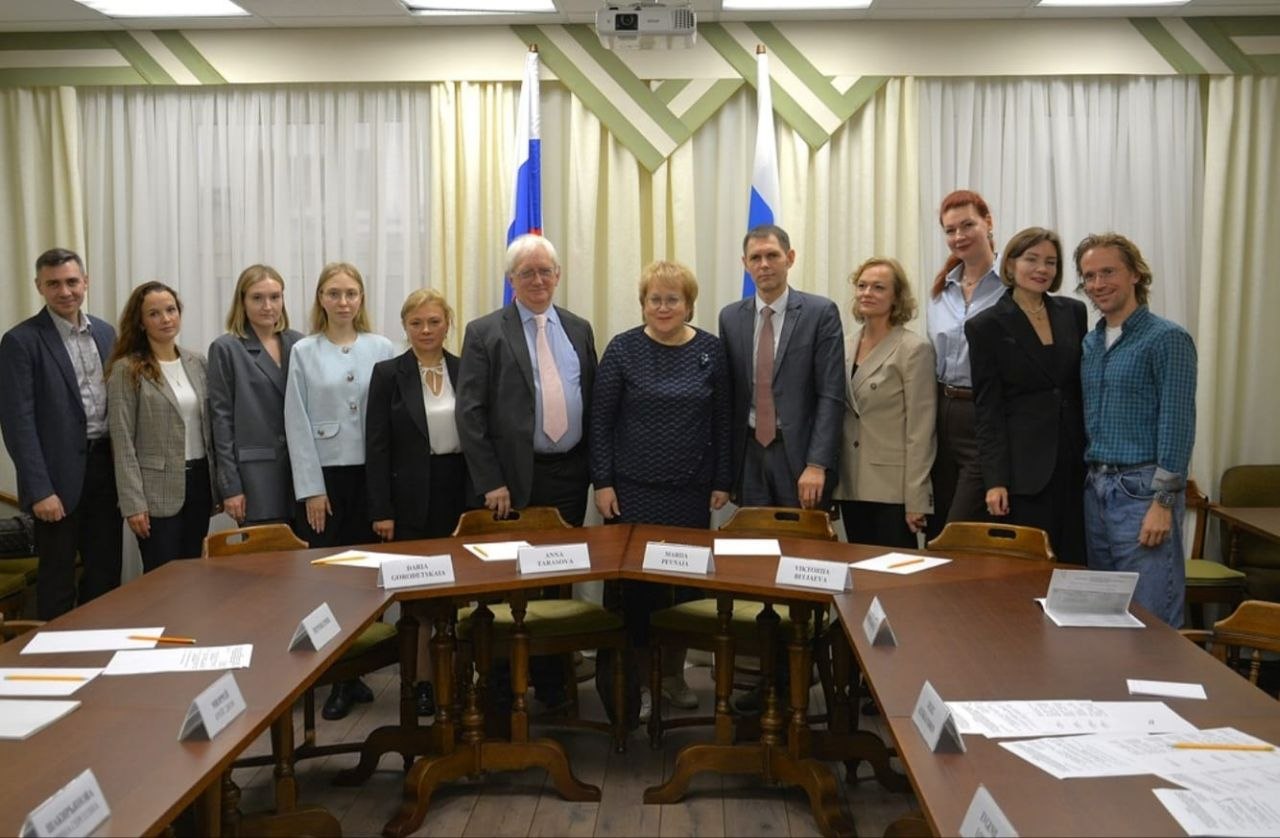
I was to give a lecture later in the programme to their assembled international law students, and everyone seemed genuinely enthused about that, including me. We finished with a group photo. The lady in the centre next to me is Tatyana Merzlyakova, the Sverdlovsk regional commissioner for human rights, of whom much more later, and next to her the Deputy Governor.
After the meeting we walked through a large web of corridors until we emerged in part of the building which is the Governor’s official residence, in the beautiful Sevastyanov Palace. We passed through a splendid ballroom with gilded columns and balconies and spectacular crystal chandeliers, before arriving in an elegant circular dining room which I suspect was within the rotunda in this stock photo.
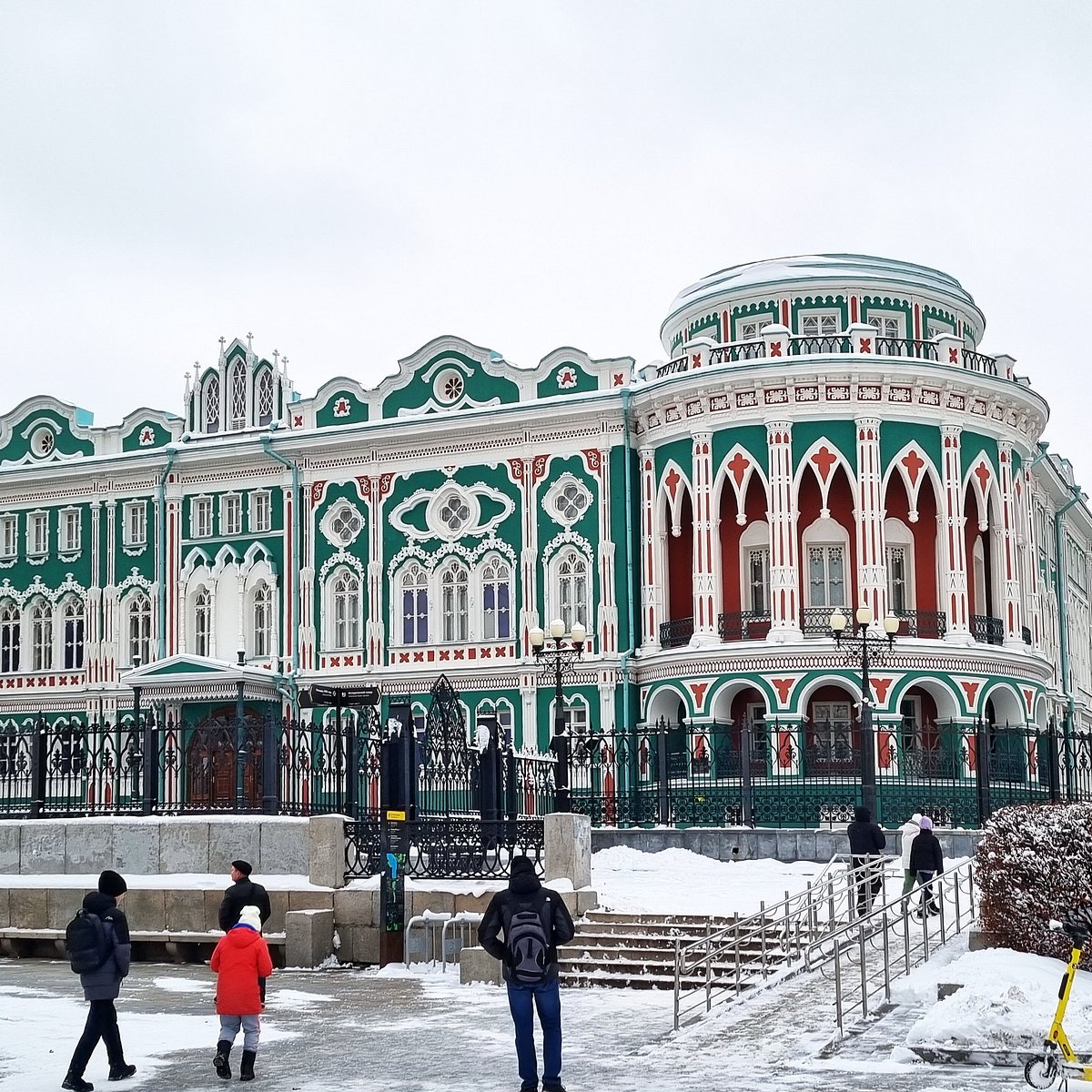
Deputy Governor Kozlov was a genial host, and much of the time was spent discussing the rather spectacular repast of multiple local dishes – just the starters they gave me would feed me for a week. The meal was served without alcohol, which is a very definite change in Russian official culture over the last 20 years. I learnt that Sverdlovsk Region has a slightly smaller population than Scotland, but distributed over three times the area. It is extremely rich in minerals, timber, water and other environmental resources and a major agricultural producer.
Ekaterinburg was founded by Peter the Great specifically as a steel production centre in an effort to rival the industrial power of Sweden. More recently the bulk of Russian military production was famously relocated there during WW2, beyond the reach of German invasion, and it remains an important centre of the defence industry. Ekaterinburg marks what was the traditional border between European Russia and Asian Russia – somewhat confusingly as it lies 2,000 miles East of the Bosphorus. Ekaterinburg is just on the Asian side of the Urals watershed, and the waters of its river, the Iset, joining up with other great rivers, eventually flow into the Arctic.
Modern geology regards the division as irrelevant as there are no separate plates, and regards the whole as Eurasia.
The previous day the First Ministers of Scotland, Wales and Northern Ireland had held a summit to determine the right of their peoples to self-determination, and this had been featured with striking prominence in Russian media. The main Channel 1 television news had it as a lead story with a detailed explanatory piece of several minutes, and this appeared equally true across all channels.
The news also covered a meeting between Foreign Minister Lavrov and the Ambassadors of several states. In this meeting Lavrov told the Ambassadors that Russia viewed the question of the Independence of Scotland in the light of the UN Charter principle of self-determination. It is very significant both that Lavrov chose to raise this with the Ambassadors, and that Russia’s main media then highlighted it as a major point of the meeting.
Kozlov asked me about Scottish Independence and I told him that, while I could not give a precise date or method, I had no doubt it was inevitably coming. I quoted the consistent majority support for Independence in the polls and the complete dominance of pro-Independence sentiment among younger people. I also said that the United Kingdom had always been an imperialist construct and was still at the centre of much neo-imperialist mischief in the world today. But as the British Empire had crumbled away, so eventually would the metropolitan. Scotland, Wales and Ireland were the first colonies and would recover their freedom.
Deputy Governor Kozlov assured me of his longstanding personal support for Scottish Independence and said that it was a cause well understood by the Russian people.
Tatyana Merzlyakova, the Sverdlovsk state commissioner for human rights, had been with us throughout these meetings and appeared to be deferred to by all. Kozlov assured me that the organs of government in the region all listened to her very carefully and almost always took her advice, as he did himself. I was to see much more of Tatyana over the next few days.
After lunch we drove to the Museum of Civil and Military Equipment. This housed a remarkable collection of vehicles, in particular some massive mining dump trucks which are the largest in the world, and one of which held the world record for transporting 560 tonnes of material in one lift. Moving indoors there was a really remarkable collection of automobiles from all round the world, from the earliest days of the internal combustion engine right up to modern times.
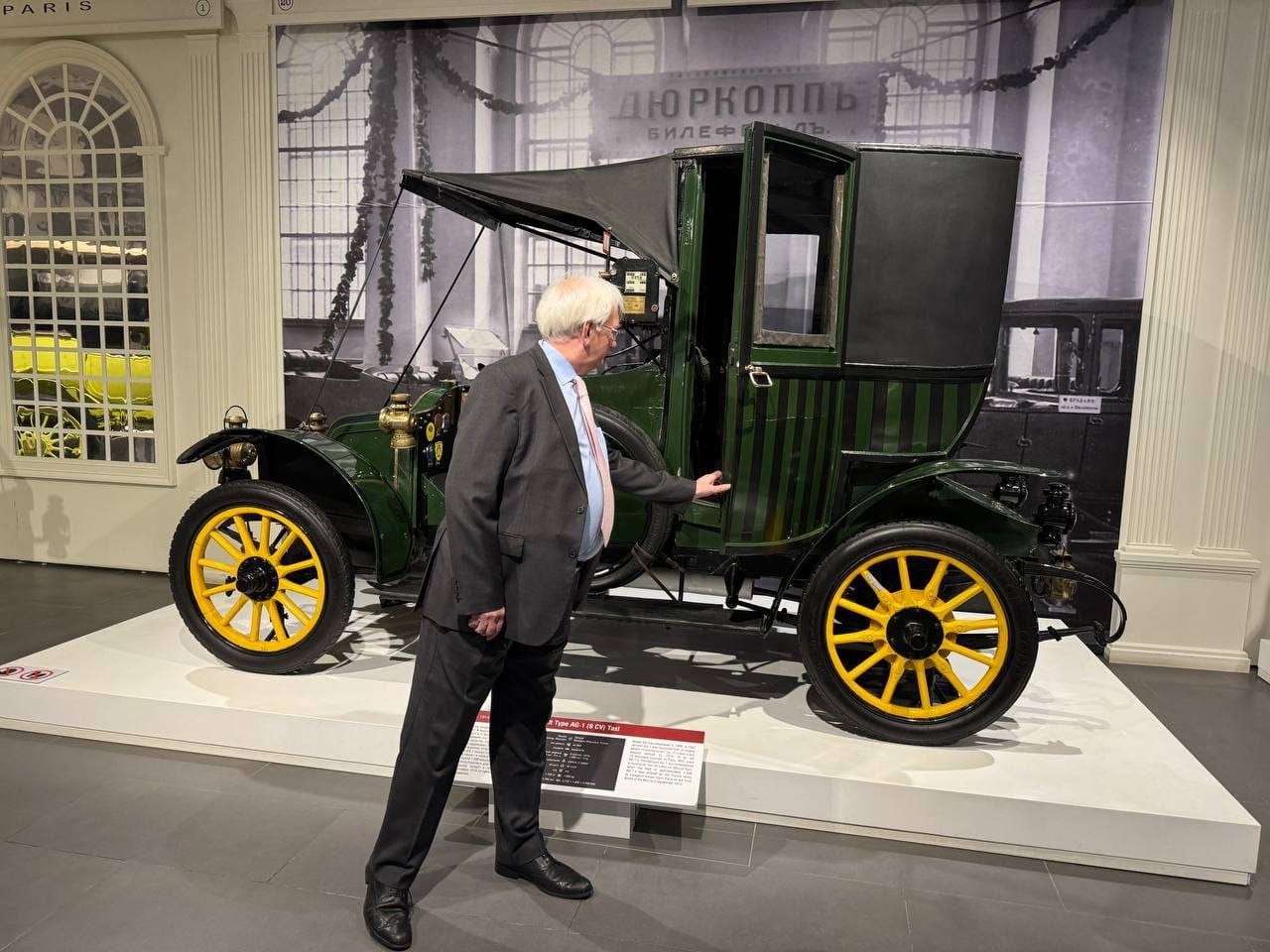
I skipped the collection of armoured vehicles and howitzers and (with some regret) steam locomotives, and breezed past the extraordinary assemblage of military aircraft in the yard. The museum director was so kind and enthusiastic I felt compelled to show rather more interest than I felt. We spent a long time looking at the Buran, the old Russian version of the space shuttle, and I recalled that the West had for many years been highly dependent on Russia’s International Space Station and launch vehicles for space exploration, a cooperation the West was not looking to reciprocate now it was again taking the technological lead.
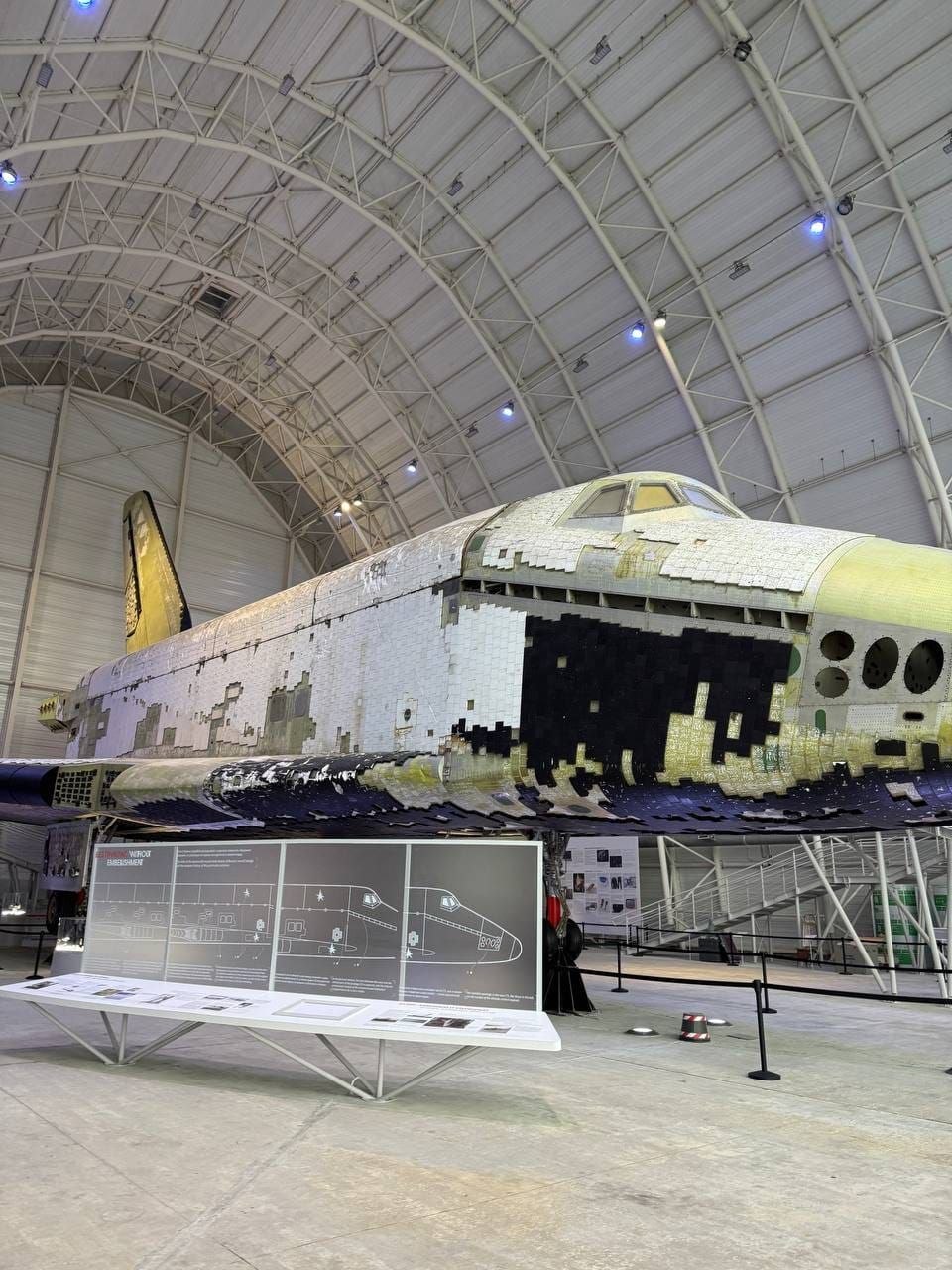
I saw only a tiny percentage of this remarkable collection, which extraordinarily has been built up by a local private metals and mining conglomerate. The motivation for taking me there seemed to be a genuine keenness to give me experiences I might enjoy and to show off Ekaterinburg. We then swept off to the next destination, about 20 minutes’ drive through woods.
When the Romanov Royal Family were murdered in Ekaterinburg, the Bolshevik perpetrators had removed the bodies to a local mine. There they had been butchered, covered in sulphuric acid, burnt and thrown down a mineshaft (though some of the remains were taken on to a further site for disposal). That shaft in Ganina Yama was our next destination, and a monastery of seven churches was built on the surrounding site in 2016.
The Royal Family has been canonised by the Russian Orthodox Church and are viewed as saints. It was somewhat difficult to pin down as the reason for their canonisation was the pain and suffering of their martyrdom, and the precise distinction between saint and martyr is perhaps not exactly the same in Orthodox tradition as it is in Western Catholic tradition. But they are effectively saints. There is a tradition in Russian Orthodoxy of canonising national leaders – I was rather surprised to find that the distinctly earthbound warrior Alexander Nevsky, for example, is also a saint.
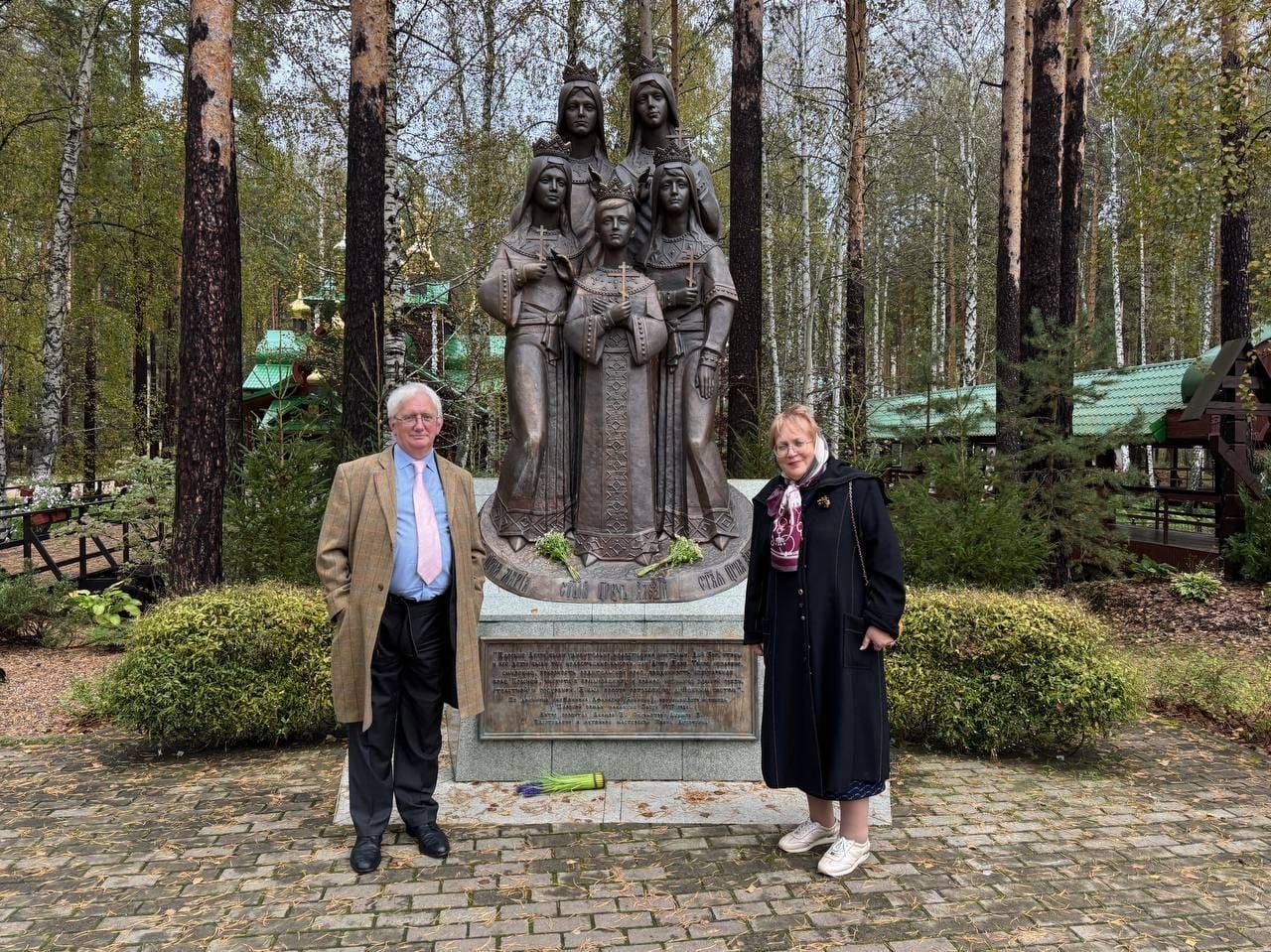
Tatyana accompanied me and it was plain that the religion and the slain Royals meant a great deal to her, as they appeared to do to most of those visiting. It was a very solemn place. I therefore listened with respect to our earnest young guide, and it did not require fakery to feel affected at the site where the children were dismembered. Only in the car after we left did I venture that perhaps it is much easier to feel warmth towards a Royal Family once they are gone. In the UK we do not have that luxury.
We next drove back to central Ekaterinburg to a restaurant for dinner which very much specialised in local food, and the table groaned with multiple examples of pickles and raw, lightly smoked or frozen fish of many varieties. Eating frozen flakes of raw fish is very much a Urals thing. I was very pleased we were joined again by Deputy Minister Ilya Skidin, genuinely because he is very good company and also because it gave me somebody I could drink vodka with, without which I find this particular kind of Russian diet somewhat difficult to tackle. Margarita and Irina had been with me the whole day. Tatyana was still going strong and we were swapping stories of human rights cases, and Ilya and I put the world economy to rights.
So ended a very pleasant first day in the hands of the Sverdlovsk Governorate.
I have not mentioned that the weather had been cool and wet throughout day one and my cough was not improving. I rather struggled out of bed the next morning, managed to get locked out of my room following breakfast and reported to Irina and Margarita fifteen minutes late. We now drove on some forty kilometres to the International Youth Gathering.
This took place in an enormous exhibition centre outside Ekaterinburg. There were reportedly 10,000 participants from 190 countries, and there were some national delegations milling around in flags and costumes, although the majority of the young people I spoke to were already resident in Russia, mostly as students. The exhibition was “international” in the sense of its congregation, not of the exhibits – while I probably eventually saw only about half the stalls, all I saw were Russian and designed to showcase Russia to the World.
My programme had me touring the exhibition from 10.30 to 12, and I genuinely enjoyed this. I spent most of this time in the technology section, where there were both exhibits and genuine experts willing to discuss matters such as nuclear fusion and plasma drives (though I left a ten-minute chat about the latter painfully aware I had not understood a word of it). I had a more useful chat on the difficulties of transporting and storing the hydrogen for fuel cell vehicles.
As in Venezuela, I was struck at a number of stalls by the way that western sanctions had caused an explosion of technological development in payment systems, though I found everybody appeared blithely unaware of the civil liberties issues around fully digital and identity-linked currencies. I was however able to get a very useful explanation of the current state of BRICS international clearing operations.
A large rather scared-looking rabbit attracted my attention, and he turned out to be central to an exhibition on tissue regeneration. The technology has been developed by Rosatom to generate organs from tissue, is dependent in some way on DNA imprinting, and is said to be fundamentally different from stem cell technology. The rabbit was apparently the chief living recipient, was much older than you would expect him to be, and had homegrown replacement parts. He was a very famous rabbit and President Putin had met him twice.
The young lady explaining all this to me said that the technology might currently enable humans to live until 122 years old. I asked her why on earth anybody would want humans to live to 122 years old? Was the planet not fully burdened with humans already? There would be a massive explosion in numbers. Where would you put them all?
She looked rather nonplussed by this, as though nobody had put this to her before (which hardly seems likely). She replied that she herself would love to live to know her great-grandchildren. I suggested she might feel differently when she reaches my age. She presented me with a pair of replacement rats’ veins she had grown personally from the cells of a living rat. I reflected that I had not anticipated that my life would ever include being given rats’ veins by a beautiful young lady, and decided to move on.
At noon I was taken back to the entrance to meet with Yana Lantratova, the Federal Commissioner for Human Rights. The programme had us meeting together for half an hour, then visiting the stand of the Russian Federal Commission for Human Rights where the process for individuals to launch a case or an appeal would be shown.
Yana arrived, a very glamorous young woman in a designer outfit that bore its large label on the outside. She appeared warm and friendly as she shook my hand with an open smile, then disappeared into a huddle with a cloud of advisers. After I hung around a few minutes, Irina and Margarita explained to me that Yana had not previously known she was to give a talk alongside me, she had only expected to be introducing me, therefore she needed to prepare. I was to go to the speakers’ lounge and wait.
So we wandered up to the speakers’ lounge, where I sat for an hour or so drinking tea and doing nothing in particular, which suits my talents. Then suddenly I was hustled very quickly down to the exhibition hall, where I was wanted to hear Yana give a tour of an exhibition on Ukrainian atrocities against civilians in the Donbass.
Her tour was well underway when I arrived, and much of it was harrowing. She spoke of attacks on citizens of Donbass from 2014 onwards, and of a Ukrainian attack on an educational institute in Starobilsk in May 2026 in which 25 teenagers had been killed in multiple waves of drone strikes. She also spoke of glorification of Nazism in official commemorations and literature in the Ukraine, and had exhibits to illustrate all of these points.
I know the points she was making to be true, and while it is one side of a story, it is the side which is never heard in Western media, while the reverse story is relentlessly pushed. But I found myself personally in a strange position. I had been rushed in and physically pushed through the press of cameramen to be with her in shot as she spoke at the exhibits she had reached when I had arrived, but she did not acknowledge me in any way and when she moved on to the next exhibition I was faced with the prospect of physically jostling to remain in the limelight, which I declined. I watched the rest of the tour of exhibits with the small crowd of public following.
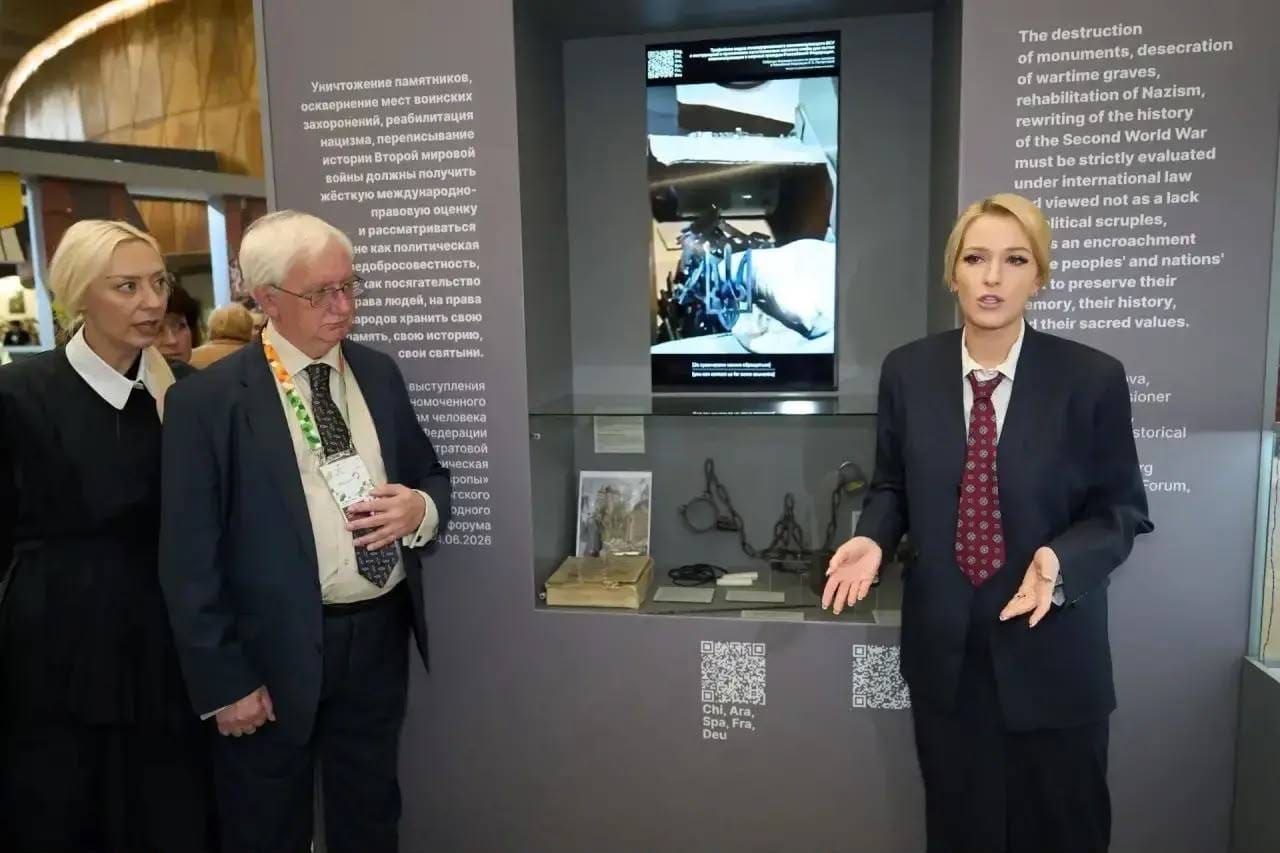
After this tour, we proceeded to the lecture theatre where we were to speak, in a discussion hosted by Evgeny Popov, a Russian federal MP. The talk was billed as a “discussion” between Yana and me on the subject of “The current state of human rights in the world”. I had been told we would open with 20 minutes each, and then take questions and respond to each other. I never write a prepared speech. I had however been given by the organisers a list of proposed speaking points – which related entirely to the Ukraine.
I did not object to any of them as they all appeared to be gleaned from my writings, but they seemed rather over-detailed for a general talk on human rights in the world. I sat down and, as is my usual technique, mapped out a few guiding words to carry me through a 20-minute talk.
These are the notes I wrote:
HAGUE GENOCIDE
LOST CONTROL NARRATIVE
REPRESSION THROUGHOUT WESTERN WORLD
TERRORISM CHARGES
MACKLEMORE
NON-FUNCTIONING OF WESTERN DEMOCRACY
UKRAINE
BANNING OF PARTIES – CHURCH – CULTURE
BALTIC STATES
MOLDOVA
DRUMS
CUI BONO
Drums being a reference to the Western beat for war with Russia, and cui bono of course who benefits from the warmongering?
Yana had still not said a word to me since the brief introduction, and something felt off even as we entered into the hall. The format was very much a modern Davos-style arrangement, with white leather chairs on a dais for the speakers, and simultaneous interpretation. Yana was introduced and rather overran her 20 minutes. She spoke exclusively of Ukraine, of the origins of the conflict, of the repression of the rights of Russians in the cultural, political, religious, educational and economic fields, of the attacks on the Donbass, of the genuflection to Ukrainian Nazism and of the extraordinary warmongering of the European Union and its politicians.
She spoke elegantly and well and said almost nothing with which I had any disagreement.
I then spoke and started by saying I had been considering what a young international audience could possibly find interesting in hearing an old man from Edinburgh address them. I then recounted my being in the Hague for the opening days of the South Africa vs Israel genocide case, gave some of the key facts, and moved on to my experiences of being in Southern Lebanon, and having been present when a twelve-year-old child was shot (but thankfully not killed) at Kfar Kila on the front line.
I spoke of how the access to true information by young people on Gaza from their mobile phones had broken the hold of state propaganda and placed populations at odds with a Zionist billionaire-controlled political class that they could not influence. The western political elites had therefore responded with a wave of repressive legislation and arrests that had given the lie to the myth of western democracies. I spoke of the 3,500 arrests of peaceful people in the UK under terrorism legislation for support of Palestine Action.
As I spoke, I was aware of Popov, the chairman, becoming visibly agitated. He was shifting uncomfortably on his seat and several times held up his microphone as if he wished to interrupt. I was determined not to allow him to, and was careful not to pause between thoughts and sentences. I referred to western lies about Ukraine and western claims of Russian genocide in Ukraine which are plainly untrue.
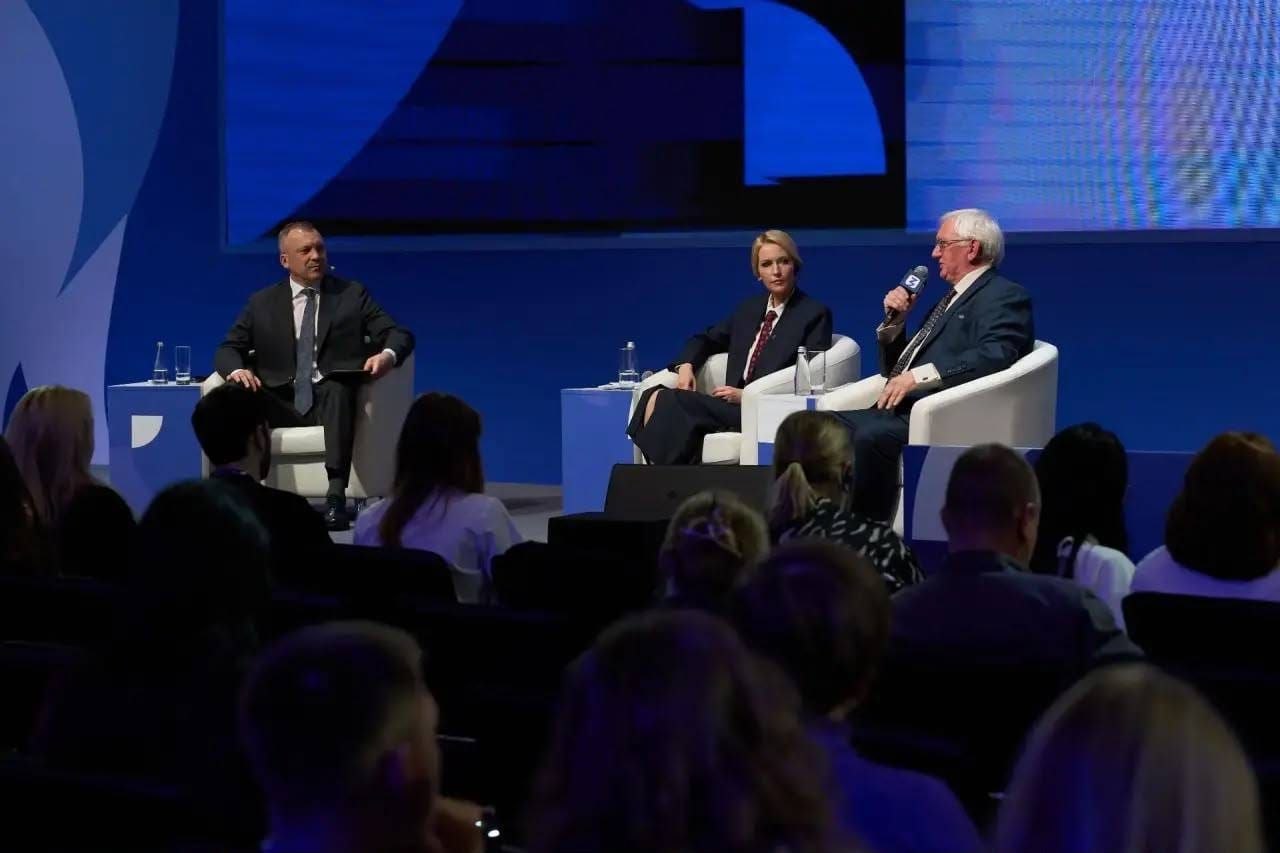
I said that in the fog of war it was difficult to get a true picture of casualty figures in Ukraine, but total deaths on all sides were around 400,000. Deaths of children on all sides were around 800 children. These precise figures might be disputed by either side but were certainly not out by orders of magnitude.
Any child’s death was terrible and there may well be individual instances of war crimes, but about 0.2 per cent of the dead as children was not abnormal in war.
Compare this to Gaza, where approximately 36% of the dead are children. This too could be disputed in precise numbers – and many bodies still lie unrecovered – but was not order of magnitude wrong.
The gap between 0.2% and 36% cannot be closed by any amount of marginal adjustment of the figures, whether from Ukraine of Gaza. Nobody could seriously dispute the fundamental difference. That massive killing of children is the difference between a war and a genocide.
Popov looked extremely anxious as I said this, presumably because this is not the Russian line on casualty figures, but he did not interrupt me until a few moments later when I said no nation has a perfect human rights record, including Russia, and the need for Yana Lantratova’s office as Commissioner for Human Rights was evidence of that. At this stage Popov outright interrupted and said that Russia strove for perfection in human rights, but we were out of time.
I had been given a substantial list of questions to be asked after the talk, which were evidently now not going to happen. But Popov said there was just time for one quick question, and the choice is very instructive. He asked for my opinion on Scottish Independence.
I said that as a Scot, I naturally wanted the freedom of my native land, and that the UK was the centre of much western Imperialism and a main source of NATO warmongering. This drew the first heartfelt applause of the day from the audience. We then left the stage and Popov and Lantratova went off, again not saying a word to me.
I recovered the phone I had left with Irina, and she said it had been buzzing non-stop. There was a long stream of messages that had arrived as I was speaking. Do not mention Palestine! Lay off Palestine! Stop speaking about Palestine! Ukraine! If you need another example use Western Sahara! Talk about Ukraine!
Obviously my talk had caused some panic. It is worth noting that nobody had said to me not to mention Palestine before I stood up (or I would have refused the invitation).
I did not feel good about causing problems for the hosts who had been so very kind to me. I was left with the local team, who stoutly said that I had done nothing wrong, and Tatyana said she had told “them” that I had every right to say whatever I want.
I cannot pretend I know the reason for the extreme sensitivity on Palestine, but it is worth noting that in two days in the exhibition halls I did not see, among hundreds of socially aware international youth delegates, a single keffiyeh, which is improbable in any youth gathering in 2026.
We went on to give an interview to a local youth radio station, which went extremely well. They were very well informed on my history and views, had no worries about discussing Palestine or anything else, and it was a refreshing and enjoyable relief of the tension.
We then went on to the Russian History museum, where I toured an exhibition of the birth of the Russian nation in the fusion of Viking and Slavic cultures in Novgorod and Staraya Ladoga from the time of Rurik. The exhibition absolutely fascinated me, consisting of finds from recent very extensive archaeological digs. There is something deeply fascinating in the physical confirmation through finds of written chronicles and oral traditions, and some of the exhibits were extremely well preserved. The professor who escorted me was deeply knowledgeable and I think surprised I was so genuinely interested.
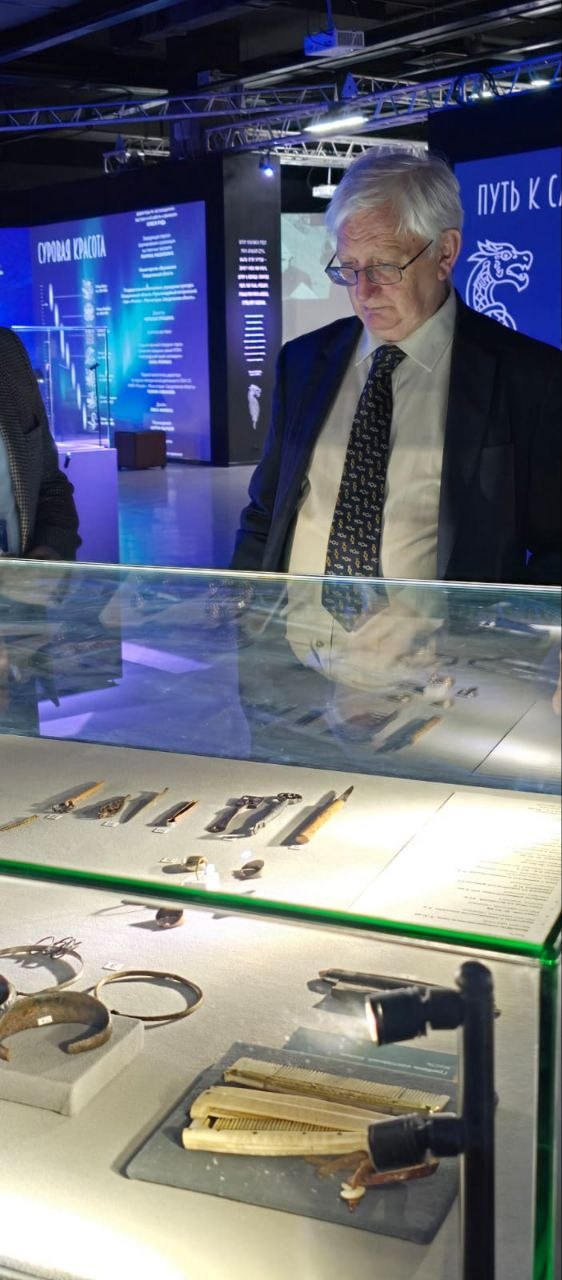
The Minister of Education of Sverdlovsk Region had joined us for this occasion, and the museum tour was to be followed by an event in the same venue, which had been advertised as a meeting with civil society, but heavily tilted towards veterans, families and refugees from the Ukraine war and their representatives. Yana Lantratova and I were both slated to address them and, as this was specifically a Ukraine-related event, it has always been my intention to discuss only Ukraine on this occasion.
Yana gave a very similar talk to the one I had heard twice before that day, with added references to the heroism of those defending Russia. I spoke of the war not having started in 2022, but the conflict dating back to 2014 and beyond. I spoke about the use of Ukraine by NATO to bleed Russia and facilitate its Western expansion, while Ukrainians died to no good purpose. I spoke of the madness of risking nuclear war over the precise boundaries of a state that had never had a historical existence until 35 years ago. I added that by the same token it should not be for Russia to insist on precise boundaries of the Donbass as a precondition of peace.
Peace itself was what the World now desperately needed. It was deeply painful to me to see Russia’s place at the heart of European culture denigrated and denied. It was painful that I came from a country which was pouring money and missiles into Ukraine with the express intention of facilitating attacks on civilian targets deep inside Russia. I spoke again of the devastating effect of authoritarianism and militarism on western societies. I spoke of the farce of pretending this was a war for democracy when Ukraine had abolished all opposition political parties and groups.
I explained that I had needed to travel without electronics due to my fear of arrest at the airport on return, and outlined the National Security (State Threats) Act 2026 under which I could be jailed for up to twelve years for publishing any information given me by a Russian government source, even if – and perhaps especially if – it were true. Information itself is specifically defined as a “material benefit” in terms of the Act.
There was an interesting discussion afterwards which included several civil society groups praising the work of the Commission for Human Rights, and particularly Tatyana, in projects such as obtaining better access for the disabled to rural healthcare facilities, and providing various aids to the blind. Several veterans thanked me very much for coming, and being prepared to face the Russian people and talk so candidly.
One lady who spoke was from Central Asia and wearing traditional dress, including a hijab. She represented an NGO which works for the rights of national minorities in Sverdlovsk Region. She said they worked for many years with the assistance of British NGOs, but that all help, cooperation and even contact had now been withdrawn, which she very much regretted and which hampered their work on education, health and migrant workers. She asked why this should be. I replied it was obviously extremely disappointing. It was in part a measure of Russophobia in the UK, and of fear of official sanction. It also perhaps reflected the fact that a great deal of the NGO sector in the UK is misnamed and in fact heavily reliant on government finance.
After this meeting concluded, Yana Lantratova presented me with a number of gifts, which she did with grace and humour; a painting, a scarf and some vodka.
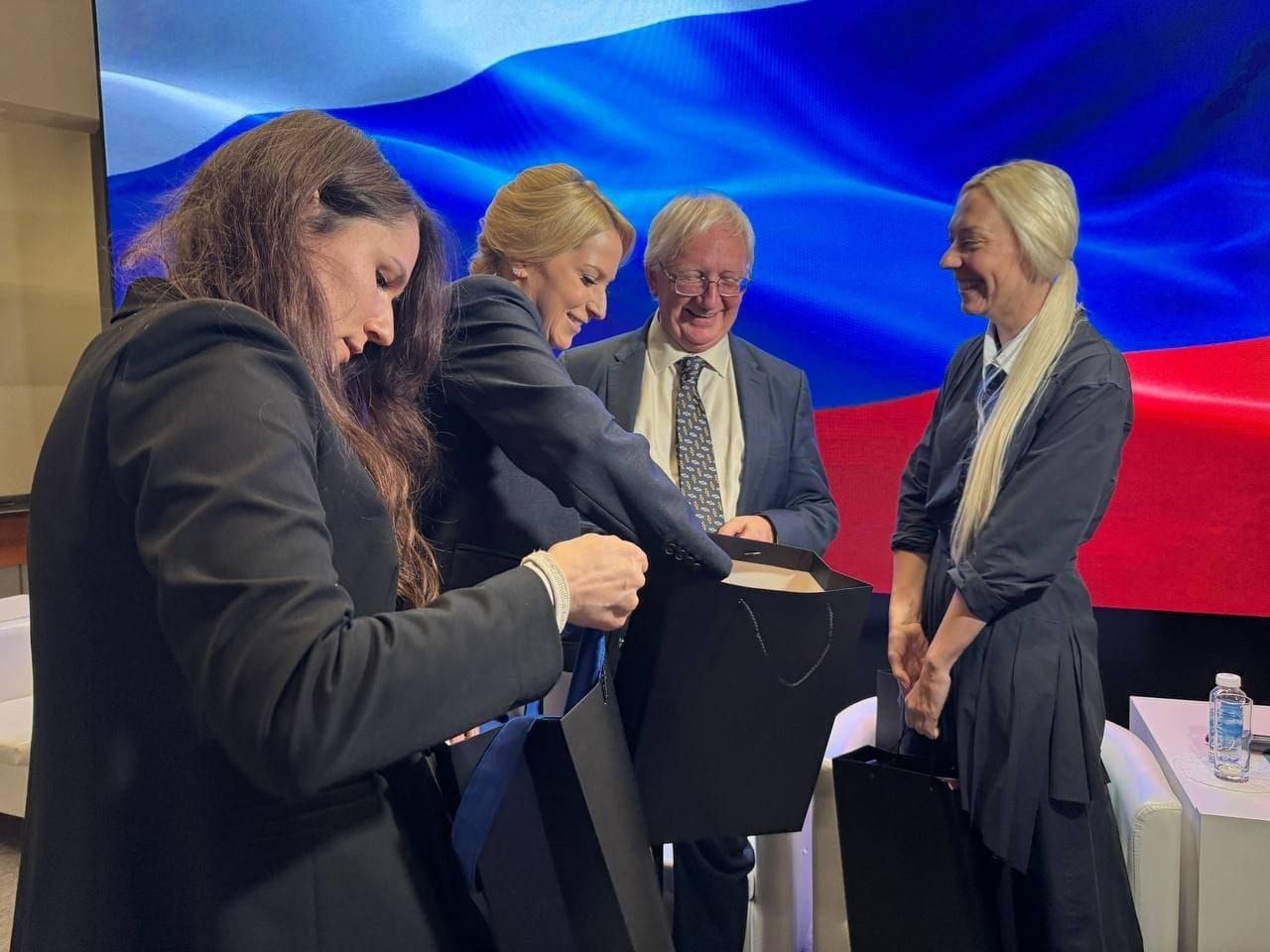
She was then hustled out again. My programme said I would be having dinner with her, but after arriving at the restaurant we were told that she would not be joining us. The dinner consisted of Tatyana, Ilya, Irina, Margarita and me and a couple of others from Tatyana’s office, notably Evgeny Batukhin, who had very much become a member of the core team. The dinner was in a delightful restaurant featuring Caucasus dishes, and we had a jolly evening. The topic of what had gone wrong was not taboo, and the general consensus was that Yana was surrounded by a team inclined to panic and be over-protective towards her.
The next morning I woke feeling rather less ill, and looking forward to the day. It started with a visit to the Regional Human Rights Commission offices of Tatyana and her team.
To be honest, I started from a deep scepticism about the genuine independence and commitment to human rights of the Federal or Regional commission. My scepticism was informed by experience of the parallel institution in Uzbekistan, where it was simply window dressing for a deeply authoritarian system. A morning with Tatyana and her team persuaded me I was wrong to be sceptical of them.
If I can give you a single proof of this, it is that one of Tatyana’s team is a highly impressive international human rights lawyer who had four times been to the European Court of Human Rights on behalf of clients claiming abuse by the Russian state, and had four times won. Russia’s suspension from the Council of Europe had closed that particular avenue for now, but here she was, still employed in human rights work by the Russian state. That is not the kind of thing you are told in the West about how the Russian state truly functions.
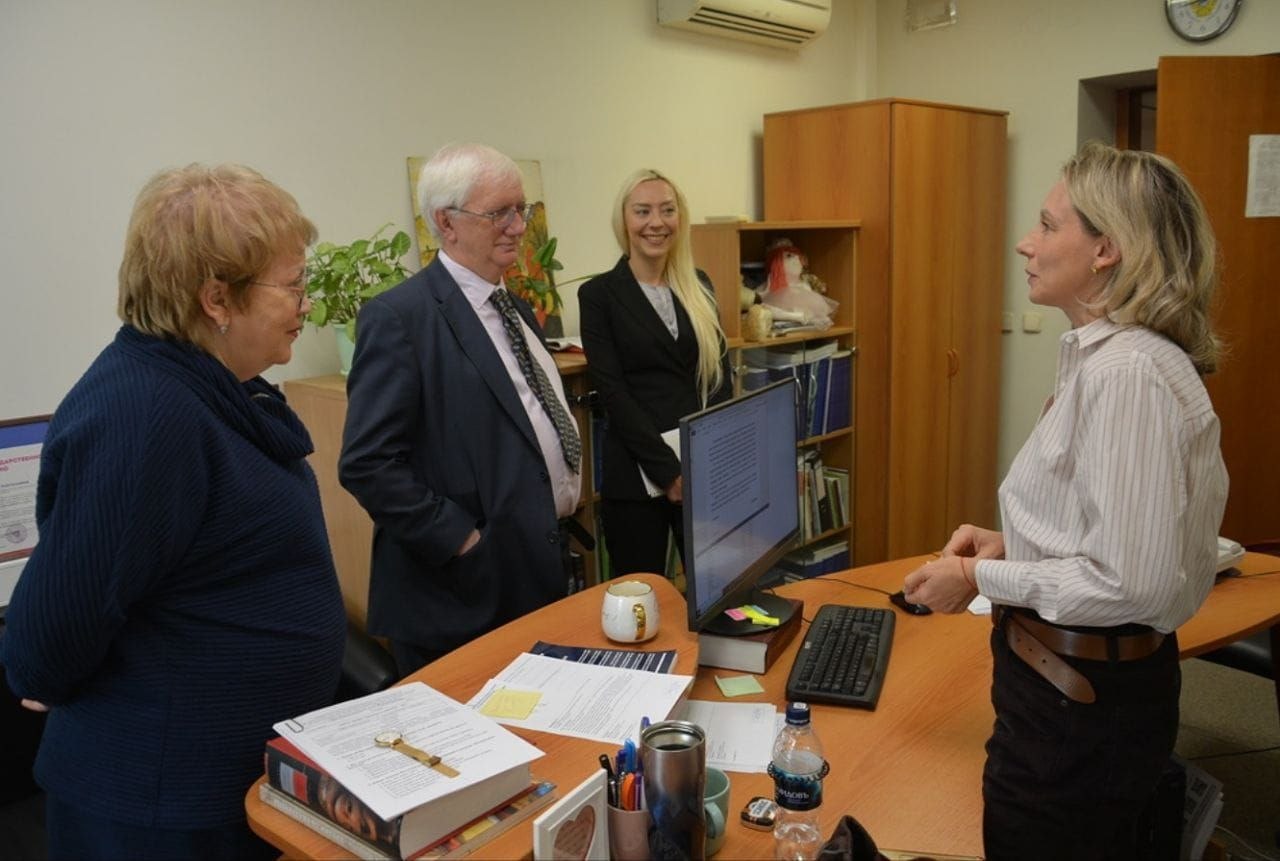
We discussed the kind of classic human rights cases we might consider typical. Tatyana’s team had intervened in the cases of many who had been accused of “publishing false information” over the war in Ukraine. She said that they had been able to convince the courts, even the military courts, that such offences were best dealt with by admonishment and a small fine rather than imprisonment.
But their work went far wider. They dealt, for example, with housing problems – decent housing was viewed as a human right. I met the highly experienced and qualified staff who were working on this – many were lawyers, and almost everyone had a doctorate. They also got involved, for example, over pay and conditions of private sector workers, when employers failed to meet their obligations. The whole gamut of rights for the disabled came under their office. So could cases of environmental protection.
I saw the complaints and requests from citizens piled high on desks, I saw citizen walk-ins being interviewed. I heard accounts of successes, where Tatyana had prevented the privatisation of an emerald mine against which miners were striking, and intervened to stop gold mining contaminating a pristine water source. Evgeny explained to me that Russian government is not a monolith; they have powerful allies but also those who were not appreciative. The total Sverdlovsk team was about 30 professionals, plus a cloud of volunteer NGOs.
I had been expected, but nobody had limited what I could ask, and I was allowed to pull case files at random and ask about them. I left genuinely very, very impressed.
The next event was to be my talk to international law students, which I now noticed was to be another joint event with Yana. Irina told me that this had now moved and would not be at the Urals Federal University as previously planned, but at the new university campus at the Expo Centre where the International Youth gathering was happening. So we headed off there yet again.
On arrival, I bumped into Yana briefly and said hello, but she was once again swept away. I was led into a classroom-style waiting area, and sat there with Margarita and Irina wondering what was happening, as the advertised time for the talk came and went. After some time twiddling my thumbs, I was led into another room, where Yana and Tatyana sat, surrounded by Yana’s staff from Moscow. They looked startled to see me come in, and I felt I was interrupting something. I was motioned to sit in a chair behind Yana and looking at her back. This seemed daft so I stood up and moved the chair round to the front of her – which to be fair, one of her staff helped me to do.
We finally got to have the conversation I felt, rightly or wrongly, that I had been deliberately kept from having with her. I expressed my gratitude at the invitation, delight at how well I had been treated, and admiration for what I had seen of the work of Tatyana’s office.
Yana replied that everybody had been talking about how moving my speech was at the evening meeting on Ukraine the day before. Had I noticed that professional cameramen had actually stepped out from behind their cameras to listen to me? She had not seen that before. I said I was glad if the heartfelt nature of my sentiments had come over. We discussed a little bit what could be done to get others in the West to at least listen to the Russian narrative. She had found western media entirely hostile. I suggested that mainstream media was currently a lost cause, and much more could be done on social media.
I suggested that presentation should not start from claims of perfection; it was powerful to admit things that had gone wrong. Yana said she always tried to reference mistakes she had herself made. I told a couple of self-deprecating anecdotes about my own cock-ups. I felt that I had finally begun to form a human connection with the person who had issued the invitation to me.
Yana then explained that the coming meeting with students was scheduled for one hour. She would talk for half an hour, then would introduce me. I could speak as long as I liked and leave the remaining part of my half hour for questions. We then went into a classroom which had about 50 chairs, of which about half were full. The audience did not seem very engaged and people wandered both out and in during the event. Yana gave essentially the same powerpoint presentation I had already seen three times now. At the end of it she introduced me fulsomely, then she and Tatyana stood up and left the room together, much to my surprise.
I was left on my own facing about twenty people who were fairly plainly in the international youth delegate category, and not the international law students I had been expecting to address. I had mentally prepared specifically on international law points, and decided to go through with these. I will not bother you with them except to say that I spoke of the meaningless propaganda designation of “shadow fleet” to justify piracy of Russian tankers. I gave in detail the example of the vessel Smyrtos seized by the British Navy off the Isle of Wight, after its Cameroonian flag registration had been withdrawn while the vessel was at sea, following British and French pressure on the Cameroonian government.
There were no questions from the audience, but afterwards one Russian student came up to me and asked how a person could verify truth from untruth in these difficult times. I stated it was very hard, but my advice was to be sceptical of official narratives. He then made it plain he did not accept what Yana had said about neo-Nazi influence in Ukraine. I told him that my take was that everything that Yana said was true, but of course it was not the whole truth on the subject. Research and an open mind are key.
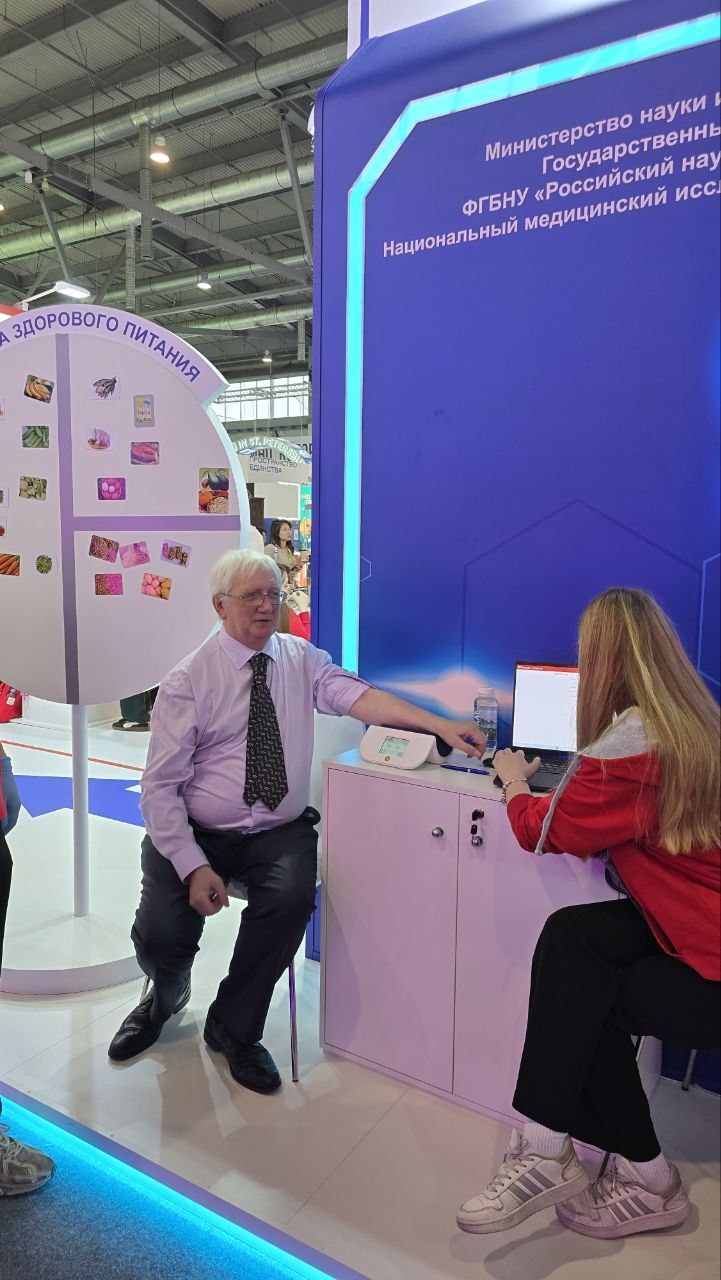
We then wandered back into the youth festival again. I looked through the literature stall, and placed my left arm in a machine that was said to estimate your medical age. Mine came out somewhat improbably as 48, rather to the consternation of the young lady administering the test. It is good to know that while I am pretty knackered, my left arm still has many years ahead of it.
The next item on the agenda was to be in the audience for a talk Foreign Minister Sergei Lavrov was to give at the Festival, in the same venue that I had mentioned Palestine.The programme also stated that I would be seated in the audience with Yana Lantratova but, true to form, the enigmatic Yana had returned to Moscow. There was rather an anxious press of people hoping to get in. I met there three of the law academics I had met on the first day. They had just come from the university where they had waited much of the morning with hundreds of international law students who had been awaiting my lecture. They had not been told it was called off until well after its supposed time.
I apologised deeply and said I had no idea at all what had happened. I had been told the venue was switched. This was quite truthful. I do not know if the lecture was effectively cancelled because of me, or just as an administrative convenience for Yana’s programme. I felt very bad to have let the university down.
So I found myself sat in the front of the second row with the indefatigable Tatyana. I was immediately behind the equally formidable Maria Zakharova, foreign ministry spokesperson, and more to the point behind her still more formidable bank of hair.
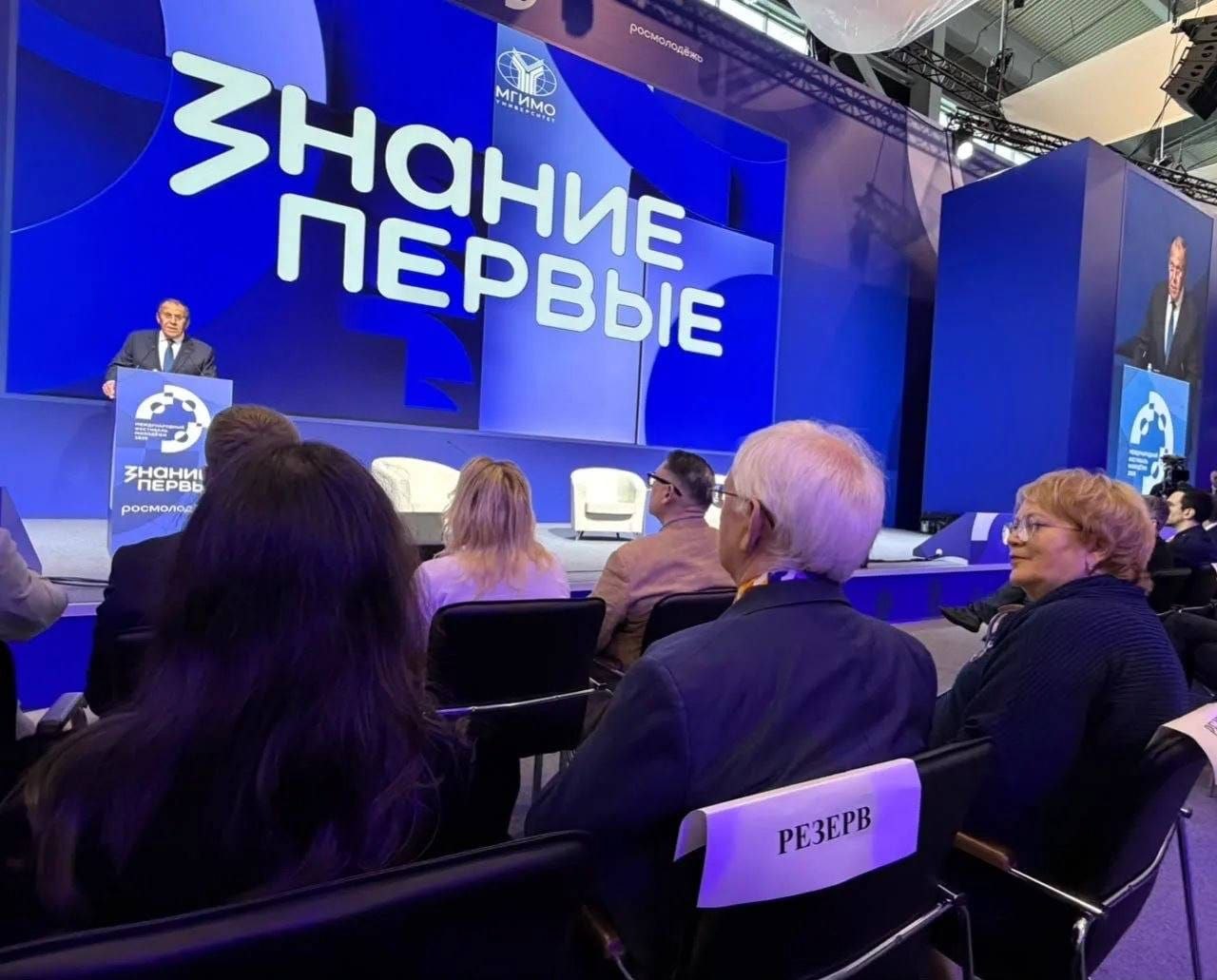
Lavrov spoke for over an hour, and with the fluency one expects of him, on the arrival of a multipolar world. The Global South and East, he said, were no longer content to be extras in somebody else’s system; new centres of gravity in Eurasia, Africa and Latin America were insisting on their own interests and their own resources. The West treated this as an assault on a birthright rather than as history moving. Sanctions, pressure and the stirring of conflicts were the methods of a dominance that could feel itself slipping.
The UN Charter, applied in full and as a whole rather than picked over for convenient articles, already contained the only workable law of a world of equals: sovereign equality, non-interference, the settlement of disputes without the minority claiming the right to dictate. Reality, he suggested, was forcing even those who had never much believed in that equality back towards the Charter, because the alternative was a permanent emergency in which rules were what the powerful said they were.
Lavrov then answered questions for over a further hour. Unfortunately those asking the questions were the participants in an international seminar for young diplomats that, for some reason, was also taking place in Ekaterinburg. The questions were therefore achingly dull, from young careerists representing the interests of their countries. The tedium was broken occasionally by Lavrov losing patience, but there were a couple of points of real interest to me.
The first was that Lavrov went out of his way to mention Scottish Independence. He mentioned again, as he had to the Ambassadors two days earlier, that the Russian attitude to Scottish INdependence was governed by the principle of self-determination as specified in the UN Charter, and that Russia rejected the hypocrisy of western powers which asserted the principle of self-determination over Kosovo, but advanced the principle of territorial integrity against it when it came to Crimea.
Lavrov went straight on from this point to say that Russia thought UN structures were correct and in general opposed substantive UN reform, but the position of the P5 on the Security Council was interesting. The UK was obviously not the great Imperial power it had been in 1946, and Africa and Latin America were badly under-represented. He mused on this specifically in the context of his immediately preceding remarks on Scottish Independence.
As I have spent the last two years briefing Russia’s most senior diplomats on the question of Scottish Independence and specifically its opening up the question of the UK security council seat, I was obviously thrilled to hear Lavrov voluntarily go there.
Lavrov also spoke of western illegal interception of Russian oil, and of the legally empty use of the term “shadow fleet”. He narrated the story of the oil tanker seized after its Cameroonian registration was revoked under the pressure of western powers, while the vessel was at sea. Margarita afterwards noted that Lavrov had spoken in the identical language to me just before on this incident. I said that we were both quoting my blog post. I had not merely published the story, it was I who had researched it and discovered what had happened in Cameroon regarding UK and French aid threats. Lavrov did not namecheck me, but he did separately namecheck John Mearsheimer, a sign that alternative media does count in Russia.
Yet again Yana and her team were hosting me for dinner, with Ilya having finally given up and Evgeny taking over the vodka toasting role. There was no reticence in talking about the misfortune of the cancelled university lecture and what had caused it; though nobody seemed to know much more than I did. Ulugbek drove me back for a relatively early night, while Irina and Margarita went off to buy another suitcase to pack the great volume of gifts I had been accumulating.
When Margarita and Irina arrived the next morning, we noted that the real work of the visit had been done. There were no more meetings or speeches planned. Our first stop was at the Urals Museum of Fine Arts – where yet again Tatyana was waiting for us.
The museum highlighted its collection of fine cast ironware, and particularly a tented pavilion which had won prizes at the Paris Exhibition of 1900. I was given a tour of this by the curator who explained every item in detail. We then looked at a number of other cast iron items, all finished in a charcoal-based black paint.
The sculpture and the casting really were remarkable, and I could fully appreciate the difficulty of achieving such extremely fine detail in cast iron – and was prepared to accept that this was a world best by the local foundries at the end of the 19th century. But what I could not understand was, why? The materials for making bronze were readily available, so why this determination to do something intricate and delicate with extremely difficult cast iron?
We proceeded to look at other items of which the curator was deeply proud, in stonemasonry and local gemcraft. It was indeed impressive and enjoyable. 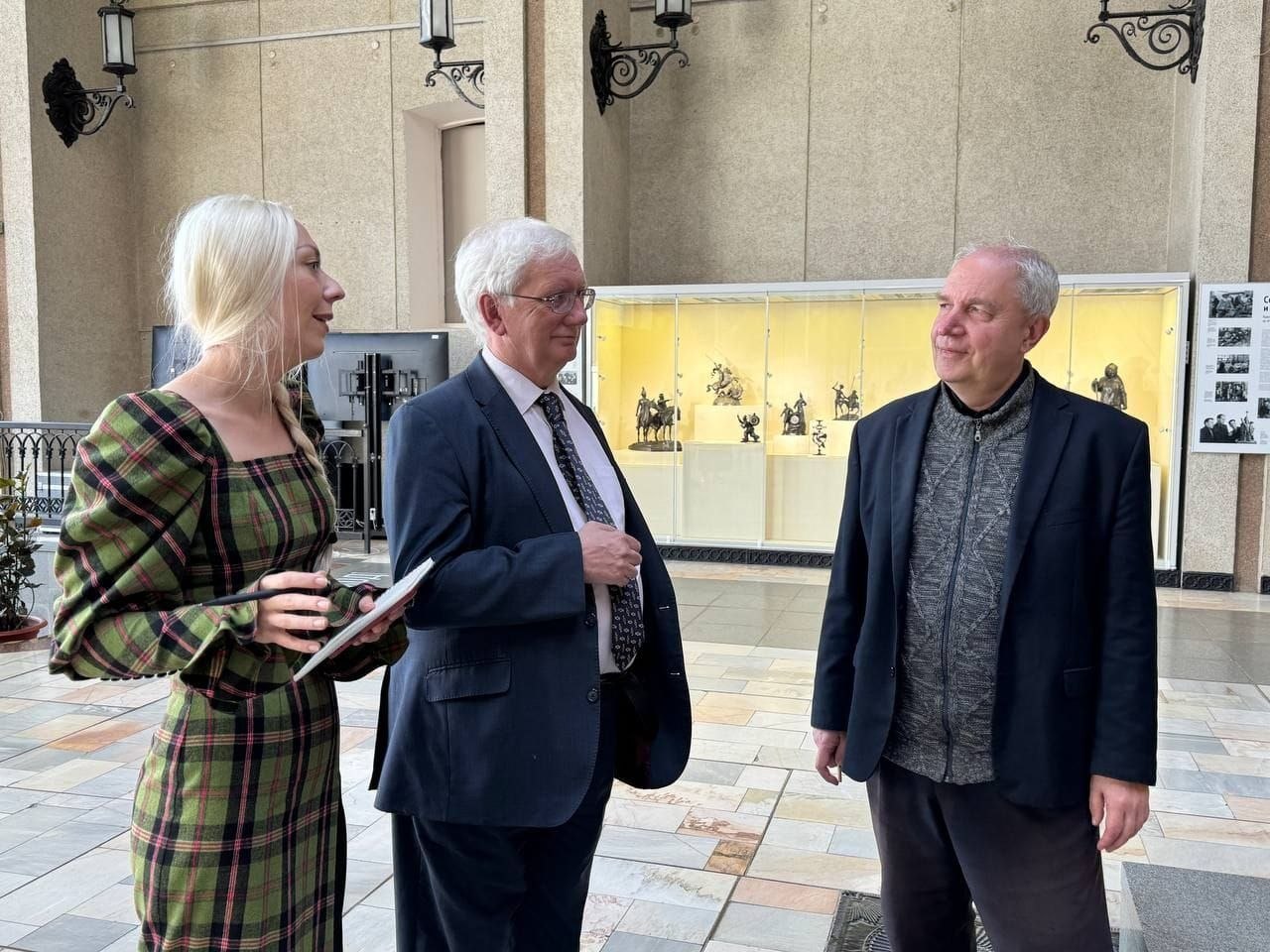
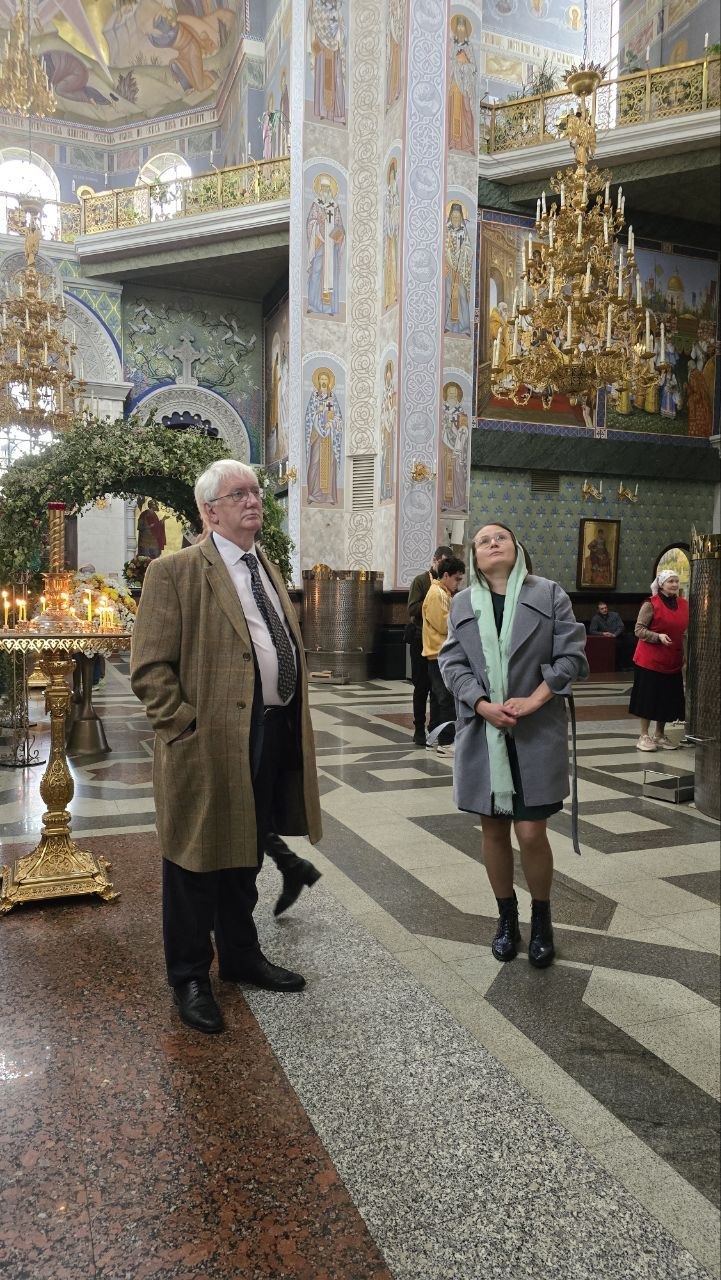
We next moved on to the Church on the Blood, the cathedral built on the site of the murder of the Romanovs, after the Ipatiev mansion in the basement of which the murders had taken place was demolished in the 1970s.
The church was much prettier, and less heavy, inside than I expected, with a really pleasant colour palette throughout in light blues and yellows. The lower floor included some wonderful iconography and the actual site of the basement where they were shot, painted and illuminated in a lurid red. You could not enter this area but viewed it from a scarlet platform above. A priest intoned prayers for the dead, in which visiting women joined with wailed responses of Alleluia.
We then proceeded to the museum in the nearby Archbishop’s residence, where there were a number of interesting exhibits and photos, including an alleged telegram from Zinoviev in St Petersburg to Lenin in Moscow, which appeared shorter and more explicit than the famous Zinoviev telegram of 16 July 1918. Other items – family ration books, embroidery by the girls, a birthday card from the Tsarevich to his father – are affecting but less historically interesting.
I was left again pondering where all this Tsarism stands within Russian nationalism. The cult of the Royal Family is of course particularly centred on Ekaterinburg. Russia is not a secular society – in opinion polls around 80% of Russians describe themselves as religious, the large majority of them Orthodox but including a large Muslim minority. Religiosity is not declining, and the position of the Orthodox within Russian nationalism appears to have government support, including a strong emphasis on conservative family values. At a time when the nation is embroiled in a war and facing threats of much wider attack, that narrative is important.
I think we can say that official history designates the Bolsheviks as bad guys. When I last visited Russia I found the human rights community concerned at a possible rehabilitation of Stalin. That does not seem to have happened in any wide sense, though the achievements of the Second World War are still more central to the national narrative.
I had made one final request before departure, and that was to visit a supermarket. I wanted a normal supermarket for everyday Russians, and found one from a national chain that sits somewhere about the Morrisons market position. The car park was full, but not of new or high-end cars. I had deliberately avoided an elite supermarket.
I found it extremely well stocked, with everything that you would find in your local supermarket. Fruit and veg were priced lower than in the UK, and there was no shortage of imported exotic fruits. In dairy, there was a very good selection of locally produced fresh goods, again cheaper than the UK. Foreign brands like President and Parmalat were readily available, and seemed to me very slightly more expensive than in the UK.
There was no sign of any absences through sanctions – Lipton’s tea and soft drinks, Coca-Cola from Abu Dhabi or much cheaper Dobry Cola produced by the local ex-Coca-Cola bottler. Sanitary products and OTC medicine appeared perfectly normal. Wines were very similar to what you would find in your local supermarket, both in range and price. There were several blended and malt whiskies, a bit cheaper than in the UK. Beer ranged from 50 pence for 330 ml of a local brew, to £1.80 for a Grolsch.
The most startling exception was the meat counter, where again everything was available and very much cheaper than in the UK, perhaps half the price. In short, the majority of staples – milk, oil, cheese, meat, vegetables, local fruit – were substantially cheaper than in the UK, while other products were on balance a little cheaper.
It is also worth noting that eating out was far cheaper than in the UK. For the standard of restaurant we had been frequenting, prices were about half. It was also notable that we were, every single time, immediately offered Grey Goose vodka and French wine in restaurants. You had to positively request Russian.
It is often worth noting at this point that I witnessed absolutely no queues for fuel at garages. The streets were very clean. Housing and public buildings looked in excellent condition, with no signs of dilapidation, including in large public housing blocks. I saw no homeless person or beggar and encountered in four days of going all round the city and outside it, not one single bump or pothole. As a public good, the city appeared in far better condition than those of the UK.
We went on to an interview with a local television station, which was very enjoyable and overran from 15 to 40 minutes. We then had our final lunch together as a team, for which Tatyana rejoined us – she had been away most of the morning preparing election observation duties. I then returned to the hotel and changed into my kilt and full Highland rig. The final item on our agenda was a ballet Gala at the Opera House and performance of Le Corsaire.
Here I am arriving with Tatyana and Evgeny. I am sorry for the absence of Irina from all these photos – it was her taking them! 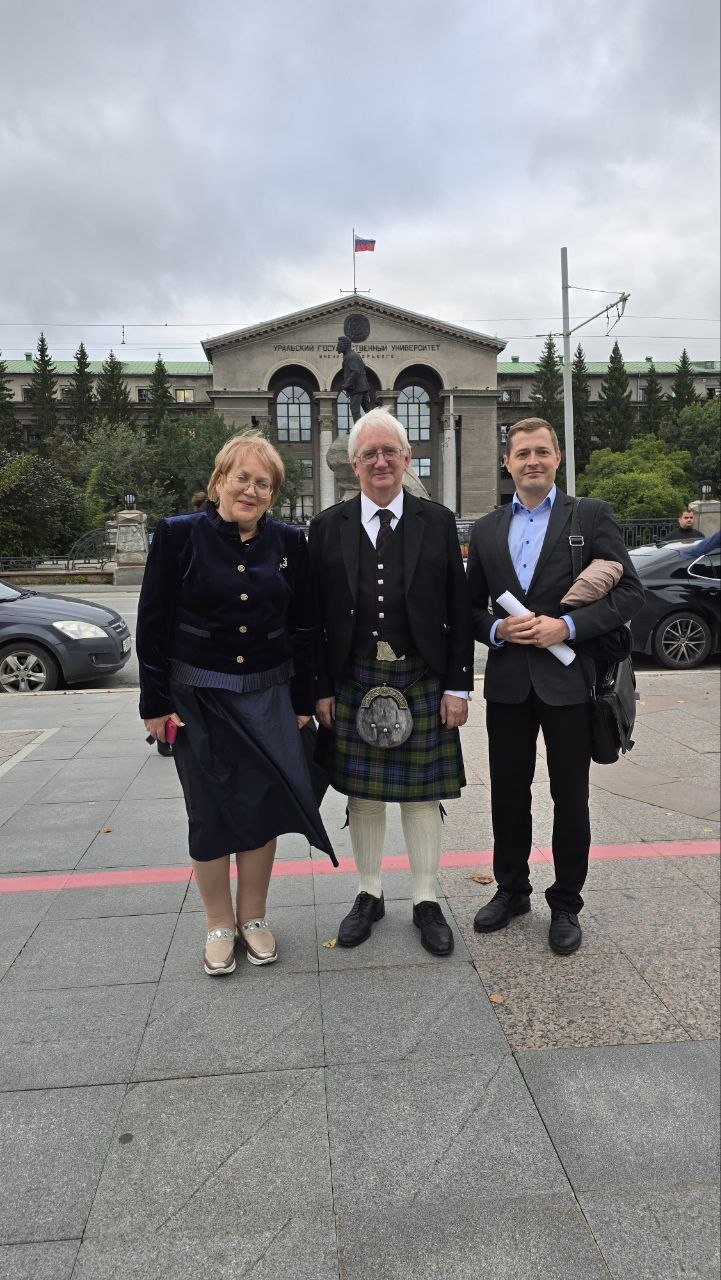
This was a world premiere of a new adaptation. I am afraid to say I did not find it terribly successful. It combined a radical new treatment, with a new score, elements of modern dance, container ships, supercars, people trafficking and very dodgy racial stereotyping of Arabs, with long segments of the original ballet with original costumes, music and choreography. The effect was dissonant and largely nonsensical. The second half was very largely from the original. The professional standards in all disciplines were high, though the prima ballerina in particular appeared more at home in the modern segments.
It was the season opening gala and therefore brought out the local elite in full fig, both the Bohemian artist set and the wealthy oligarch set, the latter with a stunning display of trophy wives and girlfriends and great glitter of jewellery. I did not feel in the least out of place in my kilt, and posed with a great many people for selfies in the reception. Byron of course was a Scot, so there is that excuse.
The kilt being a great icebreaker I had any number of enjoyable conversations. One that particularly stuck with me was with a clinical psychologist whose main practice is administering polygraph tests. She said that couples frequently come to her for joint testing over infidelity or marital dispute and she always tries to persuade them not to do it. It almost never helps and never ends well, if not over the suspected event then over something else. I am obliged to say I did not meet anybody who was more impressed by the ballet than I was; Russians tend to be refreshingly candid.
But here is a thought. Here with my nationality obvious from my attire, and throughout my visit when I had met scores of people in everyday situations, I received no hostility from anybody. On the contrary I received constant kindness, hospitality and consideration. This from a population which is acutely aware that it is under missile attack with missiles supplied from the UK, and where the Western powers, including the UK, are openly and regularly threatening war.
Yet in this circumstance I did not only encounter zero personal reserve or hostility, I did not hear a single threatening or aggressive posture. Officially, Lavrov spoke of a multipolar world, support for the United Nations, the rule of international law and the rejection of violence. Nobody at any stage, including injured veterans from the Ukraine War, spoke of a desire for war or made any threat against the West. The war in Ukraine itself was not glorified but viewed as an extremely unfortunate necessity which everybody wanted to end as soon as possible.
I returned to the hotel after the ballet and packed, before they drove me to the airport. Irina and Margarita stayed with me right until I boarded the plane approaching 3am. We drank malt whisky and camomile tea which Tatyana had called to order for me before the journey. I left with real regret at parting from newly made friends, and a feeling of astonishment at the drive to paint these people as enemies, barbarians and people we must kill.
I have given an honest account of what I saw and what I did. Yes, I was on an official programme, but I encountered scores of people, many of whom were not following an official narrative. I acknowledge that I did not have a chance to look at issues like conscription, or the ability of opposition political parties to contest the elections.
But then you do not need me to do that. The BBC, the Guardian, Reuters, CNN are all present and travel and report across Russia, and regularly bring you the propaganda picture. You can read it any time. But consider this. Russia Today and Sputnik Radio were closed down in the UK, totally. There are no Russian journalists free to operate in the UK unless they write the British government line, while British journalists, including the totally hostile, still operate in Russia. I could read the super-Russophobic Guardian in Russia anytime, with no VPN. Those facts in themselves are sufficient to destroy the simplistic narrative of “free West vs authoritarian Russia”, and should at least make you realise that there is more to see and hear than the western narrative.
As western elites struggle to hold the consent of their populations during a period of declining standards of living for ordinary people and a massively expanding wealth gap to the billionaire class, they need an enemy to focus hatred and resentment away from themselves. They use immigrants at home and Russians abroad. I just spent a few days with those Russians, and could not have met more warm, human, decent and well-motivated people. I met with kindness and consideration even when I didn’t fit entirely into their agenda. I encountered no xenophobia, no hate and no extremism, and absolutely no desire for war.
Russian people are like us. They want peace, happiness and a decent society for their children to grow up in. They have the same problems as the rest of us in facing up to the excesses of late stage capitalism. They too like us struggle against the authoritarian instincts of a political elite.
Russians are not our enemy. Do not let people try to convince you that they are.
Anybody is welcome to republish and reuse my work, including in translation.
My work has no funding at all except for your subscriptions. If you already, subscribe I would be grateful if you could check if your subscription is still active. Over 80% of my subscriptions lapse when debit or credit cards expire: the systems do not warn you.
Because some people wish an alternative to PayPal, I have set up additional new methods of subscription payment including Patreon account and a Substack account ; if you wish to subscribe that way. The content will be the same as you get on this blog. Substack has the advantage of overcoming social media suppression by emailing you direct every time I post. You can if you wish, subscribe free to Substack and use the email notifications as a trigger to come to this blog and read the articles for free.
I am determined to maintain free access for those who cannot afford a subscription.
Choose subscription amount from dropdown box:
PayPal address for one-off donations: [email protected]
Alternatively by bank transfer or standing order:
Account name
MURRAY CJ
Account number 3 2 1 5 0 9 6 2
Sort code 6 0 – 4 0 – 0 5
IBAN GB98NWBK60400532150962
BIC NWBKGB2L
Bank address NatWest, PO Box 414, 38 Strand, London, WC2H 5JB
Bitcoin: bc1q3sdm60rshynxtvfnkhhqjn83vk3e3nyw78cjx9
Ethereum/ERC-20: 0x764a6054783e86C321Cb8208442477d24834861a