We still don’t have a decision on whether the Scottish judicial review of Palestine Action can proceed. Lord Young is thinking about it. Last Thursday’s hearing went about as well as it could go. The UK government produced no written argument and barely seemed to be trying. They moved in court for the Scottish judicial review to be suspended until after the decision of the Supreme Court in the English case. They said it was on the same grounds as they won the suspension before: the use of judicial resources and that a Scottish judicial review would be too expensive.
I have to say this made me furious. It is not too expensive to deploy the police to arrest and charge hundreds of people, to drag them all before the courts for hundreds of hearings, and potentially to keep thousands of these “terrorists” in jail in the UK. Unlimited resources are available for all of that. But a three-day court hearing in Edinburgh, to determine whether any of that is legal, would be too expensive.
The UK government also argued there is not enough time, the Court of Session is too busy, and there are not enough clerks with the necessary security clearance to service closed sessions to hear secret evidence from the security service.
A number of the objections the UK government had put forward at the last hearing were not advanced again. They dropped res judicata – the claim that the English decision is binding on Scotland. They dropped the claim that the court was not competent to refer the case to the Inner House of the Court of Session for speedy decision. They also did not object that our amendments to the petition amounted to substantive change that would need new permission to proceed.
In short, the UK’s government’s objections were so half-hearted and flimsy we were rather bemused by it. I am afraid that my own interpretation is that they are so confident that the judge is fixed that they don’t need to try.
The problem is that the government had no convincing arguments the last two times they won and maintained a “sist” or suspension. There was no argument in court about the fact that that suspension had now ended – the UK government was asking for a new one. I still have not the slightest inkling what was the rationale behind that suspension, which was terminated by the Supreme Court deciding to hear the Ammori appeal, but equally would have been terminated by the Supreme Court deciding not to hear the Ammori appeal.
Having been refused twice before, the sist had been granted when the Advocate General, a UK government minister, turned up in person to argue for it. The arguments had not changed, it was simply deference to the UK government by Lord Young. It appears they are confident that will still hold.
In England we have multiple court decisions over Palestine activism and for the most part they give enormous concern about the willingness of judges to bow to extreme executive authoritarianism. The most egregious example may be Judge Sarah Plaschkes and her egregious attempts to have Tony Greenstein jailed over alleged support for Hamas – which carries up to 14 years imprisonment.
Tony Greenstein’s acquittal is a wonderful victory, echoing that of Natalie Strecker in Jersey in establishing that support for the Palestinian legal right of armed resistance to occupation cannot be equated to support for Hamas, Hezbollah or any other proscribed organisation. That Tony’s acquittal was unanimous is very important.
It is also notable that the acquittal occurred in affluent Kingston – and juries are local – not in an area where you might expect we would get natural sympathy from UK minority communities.
Tony himself wrote on his blog:
Judge Sarah Plaschkes Spewed Bile & Venom as Her Determination to Have Me Convicted was Thwarted
Numerous other observers were shocked during the trial by her continued efforts to hamper the defence. All context was forbidden, both in terms of Tony’s large body of writings and in terms of any discussion of the Genocide in Gaza or the history of Israel/Palestine, or what really happened on October 7. Even Greenstein’s police interviews were redacted so that the jury could only see those parts of the transcripts which the prosecution wished them to see – which when you think about it is deeply shocking. Plaschkes demanded to see questions for cross-examining the police in advance.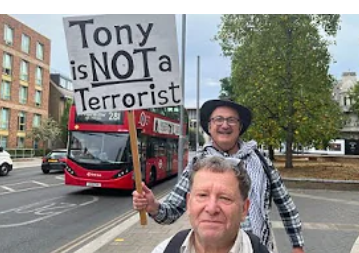
As is common now, the judge explicitly barred the jury from being told that they have an absolute right to acquit according to their conscience, and being aware of the potential sentencing consequences.
As is becoming common, Greenstein dismissed his lawyer temporarily and did his own closing speech, so he could say things in opposition to the judge’s rulings, including outlining what the jury had not been allowed to see, which his lawyer could not do without risking professional disbarment.
Plaschkes could not control her hate and fury at the end, once the jury returned with their verdict. She described Greenstein’s closing speech as “the ramblings of an old man”. His speech was cogent and evidently compelling, and Tony Greenstein is a substantially greater intellectual than the Zionist functionary Plaschkes.
Plaschkes stated that she had considered finding Greenstein in contempt of court and encouraged the prosecutor to report him for contempt of court. The prosecuting barrister, embarrassed by Plaschkes’s open venom, refused to do so.
What is plain is that juries are the only area of hope in the “justice” system. There was a very significant development in the second Filton case, where eight people were tried as alleged “organisers” of the attack on the Israeli mass-murder factory. In the first Filton case, MI6 client judge Johnson had given extremely harsh sentences through his post-verdict avocation of a “terrorist connection”.
This is an extraordinary new legal strategy by which the sentencing for ordinary criminal charges may be radically increased if the judge, and the judge alone, decides there is a terrorist link post verdict. The jury has no say on whether there is a terrorist connection or not, and the judges hide from the jury the possibility of this happening at all.
But the public are not stupid and do not live under a rock. The jury sent a note in the second Filton case to the judge Patrick Field asking him whether there would be sentencing under “terrorist connection”. Field replied to the jury that this was “not your concern”.
We do not know what drives individual juries, but it is very probable that the jury’s refusal to convict seven of the accused of anything, and bringing in just one single count of criminal damage, was influenced by knowledge of the lengthy and disproportionate prison sentences the judge could impose under terrorism connection.
This is just one particular example of juries being repelled by the draconian persecution of activists by the state, in order to maintain complicity in a Genocide. The refusal of juries to convict is the only real defence the people have left at the moment. It is notable that the charges levied against placard holders supporting Palestine Action have been restricted to those carrying a jail sentence of up to six months – and therefore not allowing a jury trial.
Here is something astonishing which Judge Field did allow. The first case charged six people who entered the factory at Filton with violent disorder. None was convicted. The second case charged eight people who were not present at all with violent disorder, as a matter of “joint enterprise”. But how could they have participated as “joint enterprise” in something another jury had already decided did not happen? What “joint enterprise”?
I can give you one solitary example of a decent judge. In Preston, Judge Robert Altham said he would not be adding a “terrorist connection” to charges of criminal damage of paint sprayed and windows broken on a Barclays Bank, who provide Elbit with financial services. He ruled that the extent of damage was not sufficient. That is however the limit of the good news I can bring you from Preston as seven people were arrested outside the Court and charged with supporting Palestine Action. 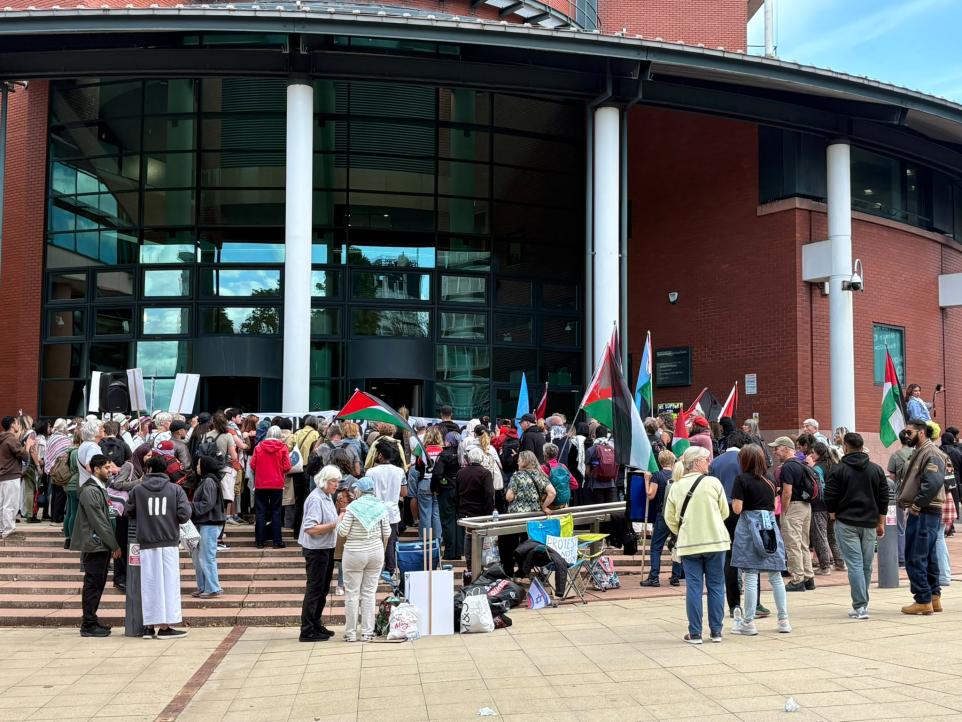
Do read Tony Greenstein’s blog about the extraordinary series of judicial rulings before he got to the courtroom and in front of a jury. It is an incredible tale of judicial and ministerial bias and corruption that deserves a book in itself. The dice are hugely loaded against us, but the fight continues.
I am afraid we do desperately need more funds to get through this. All the delay and procedural trickery set out above is designed to bleed us dry and, to be honest, it is working.
Please do not contribute if it causes you difficulty. If you know people who are able to afford to help and likely to be sympathetic, please do contact them and ask their assistance. We are trying to keep a lot of very good people out of prison.
You can donate through the link via Crowd Justice, which goes straight to the lawyers, or through this blog.
https://www.crowdjustice.com/case/scottish-challenge-to-proscription/
Alternatively by bank transfer:
Account name
MURRAY CJ
Account number 3 2 1 5 0 9 6 2
Sort code 6 0 – 4 0 – 0 5
IBAN GB98NWBK60400532150962
BIC NWBKGB2L
Bank address NatWest, PO Box 414, 38 Strand, London, WC2H 5JB
Or crypto:
Bitcoin: bc1q3sdm60rshynxtvfnkhhqjn83vk3e3nyw78cjx9
Ethereum/ERC-20: 0x764a6054783e86C321Cb8208442477d24834861a
On the second part of your article, you know why they were acquitted? well its because they had a jury, as soon as they remove the juries and they’ll try their hardest to do, they’ll be no acquittals in cases like those ones – you had no jury and look what happened to you – Alex Salmond did have one, and it helped greatly.
On the first part of your article, I hope it goes well, but I certainly don’t trust the Scottish judiciary to do the right thing – they are as corrupt as the COPFS.
The lesson to be learned here is that expensive lawyers and corrupt judges will get you precisely nowhere other than an appearance before the bankruptcy courts. Time for plan B.
Aye. Get Tony Greenstein to represent you, Craig! They can’t disbar him!
Excellent.
Zionism During the Holocaust by Tony Greenstein.
A must read.
David Ben Gurion on the kinder transport to England pre WW2. ‘if I could choose between saving all the children or just half that went to Palestine I would have chosen the latter.’
Had it not been for Zionists tens if not hundreds of thousands of Jews would have been saved from the Holocaust.
I second that. It is well researched wth voluminous citations.Have lent my copy out and now want it back 🙂
Another separate recommendation “Prelude to Israel: An Analysis of Zionist Diplomacy, 1897-1947” first published in the 1950s by Alan R. Taylor. Roughly a 120 pages of clear readable English with citations.
I have searched everywhere for a copy of this book but it seems to be unavailable at present, does anyone know where I can get hold of one?
Craig wrote:
– What is plain is that juries are the only area of hope in the “justice” system.
And we must apply this principle to politics too. We need Citizens’ Assemblies, drawn at random from the populations of the countries of the so-called UK, who no longer wish to be united under Westminster and wouldn’t want to be a kingdom if they read this. We need sortition, because anyone who gets real power instantly becomes a Supporter of Genocide, if they weren’t already.
– “…anyone who gets real power instantly becomes a Supporter of Genocide”
This is about to be tested. Again. –
“You Called Gaza a Genocide Last Year, Louise Haigh.
So Why Not Act Now You’re in Government?”
https://zeteo.uk/p/you-called-gaza-a-genocide-last-year
“…anyone who gets real power instantly becomes a Supporter of Genocide”
or do they become a supporter of genocide in order to get real power? “Now, Louise, we would really like you to be in the government, we think you have a lot to offer, but some of your writings could be construed to be a bit anti-Semitic, if you know what I mean…”
Do they get real power or do they get telt. It is pretty hard to make the case that the UK was ever a democracy. We went from oliogarchy to vassal of US oliogarchy. Starner couldnt have made it more clear regarding Diego Garcia that Donald Trump decides what happens to the UK colony. That special relationship they always go on about? It’s called subservience.
Britain is occupied by the USA.
Starmer initially denied the USA use of British bases for attacking Iran. But he was letting bases in England be used as staging posts for US aircraft heading to the conflict zone. This involved large US airborne refuelling tankers crossing the Atlantic from the USA and landing in England. The tankers had fighter escorts. One of these fighters went off its declared flight path and flew over central London instead. Starmer then promptly gave the USA permission to fly bombing runs to Iran from England and Diego Garcia.
Confused: Why Fascism is in the headline but not mentioned in the text?
Craig’s latest piece is hardly Hamlet without the prince given that it vividly delineates a pattern of state authoritarianism encroaching upon longstanding and hard fought for civil liberties in a manner most associated with fascist regimes.
And all this to avoid offending an apartheid state plausibly accused of genocide.
I haven’t done an extensive search, but the only MSM outlet that came up in the list of results when I did a search re >tony greenstein not guilty< was BBC News. Now if Tony had been found guilty I have little doubt that most of the MSM would have covered it.
Anyway, in the process of doing a search I came across a couple about Gary Lineker sharing a video of Tony, both published a couple of days ago (but you can't see much unless you're signed up). Here are the headlines and subheadlines:
The Jewish Chronicle:
Gary Lineker shares video of ‘notorious’ antizionist comparing Zionism to Nazism
Tony Greenstein was speaking after being acquitted of inviting support for Hamas last week
And The Telegraph:
Gary Lineker shares post linking Zionism to Nazis
Former Match of Day host reposts video of anti-Zionist Tony Greenstein after he was cleared of inviting support for Hamas
I won’t bother putting links to them.
The MSM only reports on what is acceptable to the regime and its corrupt agenda. So, genocide is good, criticising genocide is bad. But, confusingly some stories that cannot be reported don’t fit the apparent agenda.
https://www.rt.com/news/644646-rochdale-grooming-gang-retrial/
Also this from RT, as the Bear ponders – about striking Perfidious overseas military bases.
“British military facilities and equipment in Ukraine and beyond could become legitimate targets for Russian strikes if Kiev continues to use UK-supplied weapons for attacks on Russian territory, Foreign Ministry spokeswoman Maria Zakharova has warned.
The comments come amid rapidly deteriorating relations between Moscow and London, and a day after Ukrainian forces reportedly used British-French Storm Shadow/SCALP missiles in a strike on Donetsk that wounded at least eight civilians, including two children.
“We have repeatedly warned that the response to Ukrainian strikes using British weapons against Russian territory could be directed against any British military facilities and equipment in Ukraine and beyond,” Zakharova said during a press briefing on Thursday.
Those responsible for attacks on Russian civilians will be punished, she added, warning that their “accomplices and instigators” will also face consequences.”
“We have repeatedly warned that the response to Ukrainian strikes using British weapons against Russian territory could be directed against any British military facilities and equipment in Ukraine and beyond,”
There’s the problem, Russia does need to decisively act, otherwise the provocations will continue.
It’s worth asking why the traditional media has decided en masse to ignore the Greenstein case and its outcome. My suspicion is that the usual powers that be are greatly worried that Tony’s refusal to be cowed by the judge, and his magnificent final speech, will be used as a blueprint for how to defeat the pro-Zionist machinations of the state, and that juries everywhere will be encouraged to go on voting with their conscience, in defiance of judicial orders.
Those who have reported the case include Jonathan Cook, Crispin Flintoff, Damo of ‘Damo Rants’, Katie Halper (in the US) and The Canary. The Jewish Chronicle printed a predictable report based around the judge’s furious ‘ramblings of an old man’ remark to the jury. The BBC briefly mentioned the verdict without comment. From Owen Jones not a squeak.
Government statistics make quite interesting reading. For one thing they only differentiate different types of terrorist offences in a broad way so that a placard holding pensioner is the same as a suicide bomber for statistical purposes.
https://www.gov.uk/government/statistics/operation-of-police-powers-under-tact-2000-to-march-2026
Although there were 3,061 arrests for terrorism-related activity in the year ending 31 March 2026, (a rise of 1,186% compared with the previous year) and most of these (92%) resulting from the impact of Palestine Action proscription (2,819 out of 3,061 arrests) only 18 % had been so far charged.
Scroll further down the flowcharts to conviction rates and the results are zero under every category.
The Supreme Court considered two cases effectively of chargeability under Section 12(1A) of people arrested soon after October 7th 2023 and identified the legal criteria on which to base a prosecution which these two met. As far as I can see neither has been convicted of whatever they were supposed to have done at the time.
The British justice system is certainly in a sad and sorry state when people arrested under 12(1A) – are simply held in limbo and the CPS twists its main criteria of adequate evidence and high chances of a conviction before prosecuting.
Greenstein’s case nowhere met those thresholds. Then prosecutors and judges do their malicious best to overturn the idea of innocent until proven guilty by proceeding on the basis that they have to disprove a prejudgment that they are already guilty.
“Fascism” is not too strong a word to include in the article title because that is the British State today. But thank goodness for juries.
Not every kind of authoritarism is fascism. Fascism is a popular movement of the low middle class; every fascist or semi-fascist state, therefore, had a volunteer fascist militia that provided political violence. These were the Blackshirts in Italy, SD in Germany, Crossed Arrows in Hungary, the Falange in Spain, and so on. Even Pinochet’s Chile had their Patria y Libertad militia. Such militia can integrate later on into the state institutions, but it must be there from the start. Until UK has any such formations, the talk about fascism is misleading and useless. So far I see authoritarism of state institutions only.
“Tommy Robinson’s” mob. The Home Secretary called them out against the protesters for Palestine back in November 2023. In May this year they were given central London in preference to the annual Nakba remembrance demo; the vast majority of them didn’t even know that “Robinson” had tricked them into marking Israel’s Jerusalem Day, when the Israeli government buses Israeli fascists into Jerusalem to terrorise, spit at and beat up Palestinians including Christians, and vandalise their premises.
Can you explain who they are? If they are paid goons, this does not count.
“Tommy Robinson” is a paid goon – paid by Israel-supporting billionaires. His supporters (of which there are tens of thousands) are just useful idiots, racists, mostly stupid and English.
Israel and its billionaire supporters are promoting the far right all over the world, as a vehicle to promote hatred and distrust of – well, they pitch it as Islamism, Islam and Muslims, but anyone Asian, Arab, Iranian, or otherwise brown skinned is a target. Same in the USA and all over Europe.
There are other groups too elsewhere, e.g. the British nationalist thugs in the north of Ireland who recently rioted and set fire to homes. As in England, these groups are motivated by ideology – racism, hatred of minorities, hatred of socialists or anyone insufficiently right wing – they aren’t paid. There are quite major media outlets encouraging them, e.g. GB News.
These thugs get quite a bit of support from Reform UK. Nigel Farage encourages and makes excuses for them; makes public statements that justify their violence.
In Scotland it’s the British Unionists, a lot of them supporters of the Rangers football club; they rioted in Glasgow after the Independence Referendum in 2014. In all the countries of the so-called UK, it’s very much associated with British nationalism, and British militarism abroad. It’s a bit confused in England because they don’t know the difference between England and Britain. Always the British Union flag (the “Union Jack”) and the Israeli flag seen together. They get drunk, get violent and set fire to things. They often get caught because they video their antics and post it to social media. When they get prosecuted they claim to be the victims of “wokeness” and “two tier policing”.
Thank you, Clark.
Clark. Thanks for pointing out that the racists are English, your unbiased Scottish views clarify where the problems lay !
So what you are saying is that anti-immigration sentiments can be fused with anti-Palestinian/pro-Israel attitudes?
SB: “Clark. Thanks for pointing out that the racists are English, your unbiased Scottish views clarify where the problems lay ! “
Clark isn’t Scottish.
Stevie Boy, er, I think you’d best read my comments again because that isn’t what I wrote. Or are you ironically playing a role in which you “don’t know the difference between England and Britain”?
Yuri K – “So what you are saying is that anti-immigration sentiments can be fused with anti-Palestinian/pro-Israel attitudes?”
Yes, they’re very consistently fused and have been for at least a decade, though it has been more intense since 2023. “Tommy Robinson” spends a lot of his time in Israel, many of his social media posts explicitly state that he is there, he has posted photos of himself on top of an Israeli occupation forces tank, and has said that he would fight for Israel – though I’m sure he could if he really meant it.
It’s far more than “anti-immigration sentiments”. These people set fire to accommodation they believe to house immigrants, set fire to mosques, vandalise the premises of solicitors providing immigration services, and threaten, intimidate and attack people. It’s entirely fair to call them fascists.
“just useful idiots, racists, mostly stupid and English”
And Yuri K, these thugs don’t get sentenced as terrorists, nor do they get charged with terrorism offences. Judges don’t rule out their defence arguments or restrict the arguments they may present to the court, as they do to environmental activists and supporters of Palestine. The media don’t describe the right wing thugs as terrorists. “Terrorism” is reserved for supporters of Palestine, who never attack people, thousands of them charged under Blair’s 2001 terrorism act just for holding up placards. The government does however enact legislation against immigrants to appease the right wing.
We have growing fascism in the countries of the so-called UK: government, all but one political party, judiciary, legacy media, and street thugs, all moving in the same direction. And the same entities all support Israel.
Stevie Boy, yes, I see that now you’ve pointed it out. That was my first comment, and I defaulted to my own perspective which is from England. Then I remembered similar thuggery in the north of Ireland, followed by further afterthoughts. But in all countries of the so-called UK, their nationalism overwhelmingly is British. Only the ones in England are confused about their own national identity.
Yuri K, it’s not really surprising. Israel was made by the British Empire.
“Israel was made by the British Empire.”
No, it was made by the British home government. The Empire was opposed, i.e. the administration in Cairo and Delhi. The Balfour Declaration was led by the British variety of Christian Zionists, which Lloyd George for example certainly was.
Laguerre, fair enough – maybe. More your subject than mine, really. But I’ll argue (1) empires are controlled ultimately by their home governments, and (2) the home government embarked upon the establishment of Israel because they saw it as a strategic advantage.
“the home government embarked upon the establishment of Israel because they saw it as a strategic advantage.”
Of course it is the home government who decides, which is why it happened. But it’s like with the relationship of the US and Israel today, choosing the Zionists was actually against the strategic interests of Britain in the Middle East, as they figured out finally in Palestine by 1939. The British government could have misunderstood its own interests, but in my opinion the reason was more likely financial. Britain was in a bad way financially at the end of the 1WW, and very close to the revolution which overturned many of warring states. Choosing Zionism was necessary for avoiding financial and consequently military collapse, and afterwards they couldn’t get out of it.
Laguerre, again, fair enough, but in that case why is what remains of Westminster’s empire still supporting Israel?
(I don’t expect Burnham to do anything truly effective to oppose Israel; he’ll do just enough to counter Zack Polanski’s popularity.)
Pardon my mistake, SA in Germany, of course.
Clark: As I recall, the late Russian nationalist Konstantin Krylov (1967-2020) was friends with Avigdor Lieberman; essentially, Krylov tried to copy Zionism in creating his version of Russian nationalism. So this is not surprising.
Yep; the same pattern, again and again. Israel serves as the pilot project, hence the intense support it attracts from authoritarians everywhere. So the genocide in Gaza is a warning to all of us of what authoritarianism will inflict upon those who resist. Israel must be defeated and dismantled.
“The ramblings of an old man” is an extremely clear case of judicial bias. It’s like calling someone Curlytop, Foureyes, or Sambo.
Is there a procedure by which those not directly involved in the case can report a judge for this?
– “Is there a procedure by which those not directly involved in the case can report a judge for this?”
Possibly here:
https://www.complaints.judicialconduct.gov.uk/
It’s well worth reading Tony Greenstein’s blogpost about the trial; he has interesting legal advice in the second half of the article, including reference to Archbold Criminal Pleading, Evidence and Practice:
https://azvsas.blogspot.com/2026/08/victory-jury-acquits-me-of-terrorism-at.html
More government statistics from the above link to show that it is using its Terrorist Laws to campaign against its own dissenting people and not against the young, radicalised, suicidal bombing immigrant Islamists that it and the media perhaps fondly imagine the police are arresting.
“Age
Of the 2,819 arrests on suspicion of supporting Palestine Action, where the age is known, 2,561 (91%) were aged 30 or above. Arrests linked to support Palestine Action have considerably altered the age profile of arrests in this period, with these arrests having an average age of 59, compared with 31 for all other arrests.
Ethnicity
Of arrests linked to supporting Palestine Action, where the ethnicity is known, arrests for those of White ethnic appearance accounted for 97% of arrests (1,738 out of 1,800).
Nationality
Of those whose arrests were linked to supporting Palestine Action, and whose nationalities are known, 96% (1,870 out of 1,949) consider themselves British or British dual nationality”.
Guardian reports US issues sanctions against UK-based direct action group Palestine Action.
Yep, I just now caught it on the BBC News channel (went on there to check out about Nepal, which I only first heard about an hour or so ago). Looks like it’s been widely covered by the MSM (Trump and his nazi buddies proscribing PA, that is), unlike the news about Tony being found Not Guilty.
I wonder what took them so long?!
I just checked out the BBC News article about it, and this is what it says first off:
The US has imposed sanctions on Palestine Action, designating it as a terrorist group.
The US Department of the Treasury said it had “taken action” against the UK-based group, which it accused of supporting “numerous acts of terrorism since July 2020”.
Supporting Palestine Action became illegal in the UK in 2025 after the government banned it under anti-terror legislation.
…..’supporting “numerous acts of terrorism since July 2020″‘. Needless to say, if PA supported some act of terrorism back in July 2020 (let alone numerous OTHER acts of terrorism in the following years), they would have been arrested and charged and now serving ultra long prison sentences.
US designates Palestine Action a terrorist group
https://www.bbc.co.uk/news/articles/cn4kzd7k2nvo
Just checked to ascertain when the group was founded and:
Palestine Action was publicly launched on 30 July 2020 when activists broke into and spray-painted the interior of Elbit Systems’ UK headquarters in London.[26] The organisation was co-founded by Huda Ammori, daughter of a Palestinian father and an Iraqi mother, and Richard Barnard, a long-term left-wing activist….
https://en.wikipedia.org/wiki/Palestine_Action (under the sub-heading History)
Right, so THAT’s where they got the ‘July 2020’ from. So like the good little nazi shitheads they are, yet again they’re lying through their mass murdering genocide-supporting rotten psychopathic teeth.
So, on second thoughts, I wonder if the US has in fact actually ‘proscribed’ PA – ie is ‘designating’ them the same thing?…. not that it makes much difference, except that maybe proscribing them had to be done through Congress or whatever. The key thing is the sanctions of course. Anyway, just checked out the coverage by The National, and it includes some details not mentioned in either the BBC News article, or the Guardian article SleepingDog posted a link to:
US sanctions Palestine Action and other ‘far-left groups’ over alleged support for terrorism
https://www.thenationalnews.com/news/us/2026/08/26/palestine-action-us-sanctions/
This looks like a very interesting report, entitled Europe’s Proscription of Palestine Solidarity, albeit very long. I’ve only read the first couple of paragraphs, and the following section near the end:
As the evidence above demonstrates, the proscription of Palestine solidarity groups across Europe is not random but systematic. The bans on Palestine Action in the UK, Samidoun in Germany, and the pending ban on Urgence Palestine in France lay bare a deliberate strategy to criminalise Palestine solidarity while obscuring state complicity in the Israeli genocide against Palestinians and the broader project of ethno-nationalism and settler-colonialism in Palestine. These measures are only one part of a vast imperial apparatus that relies on branding anti-colonial resistance as ‘terrorism’, twisting legal frameworks to suppress movements that challenge Western hegemony and imperial interests. Far from a break with the past, this repression echoes colonial tactics of emergency rule, where vague ‘counterterrorism’ laws suspend rights, enforce racialised double standards, and sanitise state violence under the guise of ‘security’.
Europe’s Proscription of Palestine Solidarity
https://elsc.support/resource/europes-proscription-of-palestine-solidarity/
It doesn’t appear to be dated, but in quickly skimming through it checking dates mentioned, it looks like it must have been posted in either August, September or October last year. Also came across the following two, connected, articles, which I’ve not heard about before:
Palestine Action Germany activists just carried on the group’s legacy by smashing up an Elbit factory
https://www.thecanary.co/trending/2025/09/09/palestine-action-germany-elbit/ (September 9th, 2025)
Trial of ‘Ulm 5’ activists: How Germany is dealing with its Palestine Action case
https://www.bbc.co.uk/news/articles/c0l2k1ew677o (May 29th, 2026)
They also de-listed the Syrian government yesterday, now it’s safely under the control of an ISIS headchopper.
https://www.democracynow.org/2026/8/26/headlines/us_delists_syria_as_a_state_sponsor_of_terrorism
Yes, the fact that jury was in leafy Kingston reveals how isolated the British ruling class are on Israel, despite their control of the public conversation.
The US Terror/Genocide Backing/Pirate State – doesn’t care how stupid it looks, to those looking in from the outside.
“The US has labeled Palestine Action a terrorist group, marking the first time that a British left-wing organization has been targeted by US terrorism sanctions. The US Treasury also blacklisted two other left-wing groups.
Palestine Action was added to the US’ list of Specially Designated Global Terrorist organizations on Wednesday, according to a statement posted online by the US Treasury Department. Under the department’s sanctions, the group will have any of its bank accounts or property in the US frozen, while its members could be barred from entering the country.”
Here are some interesting news: https://greatreporter.com/2026/08/25/erasing-gaza-from-the-frame-french-sports-festival-removes-football-photograph-after-pro-israel-pressure/
The pettiness and vindictiveness of the Zionist lobby is only matched by the cowardice of these public bodies.
Unfortunately, such anonymous political pressure has become a new trend. For example, the mural portrait of Iryna Zarutska, a Ukrainian refugee murdered by a black psychopath (later deemed insane) in Charlotte, NC, was installed in Providence, RI, but later it was declared to be “controversial” and removed. The city mayor Brett Smiley never explained what the “controversy” was and who were “the local leaders” who demanded mural removal, so one can only guess.
So the king of England is distraught over the disaster in Tibet and Nepal – (flash floods etc) the PM of England has pledged to give £5 million quid to help the folk in the disaster, the media is broadcasting about the disaster continually – the media is filming the Nepalese and Tibetan community in England – and how they are sticking together, the piece of glacier that caused the floods, and how it broke-off the main body – has been analysed upside down and inside out.
Now compare this full blown media coverage by all the media – to that of the genocide in Gaza carried out by the Zio-Monsters and supported by the English PM who is pro-Israeli, and you can clearly see that the English MSM are a bunch of hypocrites and general b*stards.
Add the the almost utter silence from the same MSM b*stards over the US Terror/Genocide Backing/Pirate States blockade on Cuba which has left hospitals and schools without power, and also a severe reduction in foods – and you get a crystal clear picture of the evil -that the US/UK and the West in general backs.
Distubringly it is not only politicians, I often check the comments below news article on Facebook what “regular” folks say and are constantly creeped out on what people are saying: the arrogance, the hateful racism and the seduction of israeli propaganda is tragically working. Pro-israel comments are often upvoted way more than comments critical of Israel and so on and one can not always blame bots, a considerable part of the western populace are still unfazed by the atrocities by Israel. One thought that after 3 years of live streamed carnage that the pro-israeli crowd would change their minds right? Nope. it is like no matter how much evidence from UN, Amnesty, HRW, ICC and so on but still the facts and reality do not matter for these people.
Jack.
Its not that the majority of folk on social media platforms are pro-Zio-Monster, the amount of bots and pro-Israel security service personnel paid to spout their shit is on the up, they don’t in any way – represent the majority of Western societies feelings towards the Zio-Monsters, who are not pro-Israel.
The UN is not a fighting force, it can put some peacekeepers on the ground – but Israeli troops would just kill them – ICC personnel have been threatened with bodily harm – as have their families and they have also been sanctioned by Israel’s number one attack dog the US, of which many countries are afraid to upset – due to sanctions placed against people and businesses – as for Amnesty and HRW, I think both have been captured on certain matters – and one of them is the genocide in Gaza.
If I’m being honest no country is willing to go out on a limb to stop the genocide in Gaza, it appears to me that Palestinian lives don’t matter that much – only Iran and Yemen have done anything significant – also many many Western leaders – politicians and business folk have been severely compromised by the Epstein Files – and to aid the utterly oppressed Palestinians would see their evil deeds against children exposed, so they stay quiet or even cheer lead for Israel – for me Israel only respects power, and it will keep on infiltrating, destroying, murdering and causing wars until it is stopped for good – that would’ve happened a long time ago – if it didn’t have the US attack dog backing it.
TACO is a thing, but it’s possible the whole Kushner-Trump episode, 2016-2020, and 2024 onwards, lately without Adelson, will seriously damage the US military which anyway isn’t half as strong as its PR (including in video games) suggests. It could kidnap Maduro successfully but it lost in Afghanistan and Iraq and it’s getting its fat a*se kicked all over the place by Iran too.
October is traditionally a good month for a financial crash…
Yes the US Terror/Genocide Backing/Pirate State’s military reputation has been damaged – with regards to its unprovoked war on Iran, in the movies the US military are always portrayed as the good guys, when in real life the US are the bad guys.
I’m not a fan of Iran’s theological regime – but the US has no right whatsoever to just attack Iran, to crush it on behalf of the Zio-Monster regime, and to steal Iran’s assets.
I can only hope that the West Asian countries now make some sort of peace with Iran – now the USA’s facilities in their nations have been destroyed – however the USA is coming at Saudi Arabia from another angle promising to build nuclear energy plants, and provide nukes in a deal, a deal that MUST include SA recognising and normalising realtions with Israel.
Israel spends a fortune on PR (USA tax revenues). Remember how Israel flew influencers to the promised land last year for training in right-think. Also, Israel controls social media, so you only see what they want you to see.
Social media is not the voice of the people it’s the voice of the zionist establishment. If you swim in that cesspool don’t be surprised at the stink.
Yes, Israel has increased its annual propaganda budget to approximately $730 million for 2026, a nearly fivefold increase from the $150 million allocated in 2025.
https://www.timesofisrael.com/israel-just-quintupled-its-pr-budget-to-730-million-experts-say-it-wont-work/
They are shutting down any potential source of opposition. Last week it was discovered that the Democrat leader in the US House of Representatives Hakeem Jeffries* had met secretly with Trump’s son-in-law, the arch-zionist Jared Kushner. Shortly afterwards Jeffries appointed the Democratic party’s hardest-core Israel Firsters to key posts on the House Foreign Affairs Committee.
https://www.youtube.com/live/KIr4Dq-DZag?is=_aKeWsXt0Udrt-KC
(discussed from 16:20 mark)
* Jeffries himself is known as ‘AIPAC Shakur’ for the ferocity of his zionism. In one speech to AIPAC he adapted George Wallace’s infamous segregation slogan to ‘Israel Now, Israel Tomorrow, Israel Forever!’
But surely there is opposition to AIPAC Shakur from the radical new faces in the US Democratic party?
Well, when anti-Genocide supporters expressed horror at Jeffries’ meeting with Kushner, the ‘radical mayor of New York’ Zohran Mamdani stated during a press conference that he ‘proudly’ continues to support AIPAC Shakur’s bid to become House Speaker.
So that’s the impact 3 years of Genocide has made on the US Democratic Party.
@Stevie – “Social media is not the voice of the people it’s the voice of the zionist establishment. If you swim in that cesspool don’t be surprised at the stink.”
Agreed. And this applies not just to things like Facebook, X, Bluesky, etc., that stupid morons spend hours each day reading and posting their pathetic thoughts to. It also applies to sectoral places such as Stack Exchange (a “home” to most of the world’s computer programmers, and specifically designed as such by former Occupation paratrooper and kibbutz boss Joel Spolsky), Mumsnet , etc. etc.
Some people’s criticism of “the media” goes completely out of the window when it’s a question of “social” media.
There is no “people” right now other than that which is under management, willingly participating in the same.
I am not an elitist, but conditions are certainly such that vanguardism is now the way. This wasn’t true in say the 1960s or even the 1980s. As hard as steel, as clear as glass!
Stevie Boy
Yes the social media platforms have hidden al lot of the Zio-Monsters war crimes in (Gaza and the West Bank, and now Lebanon as well) from us, they are as you say pro-Israel – Westminster is so deeply imbedded with the Zio-Monsters, that the taxpayer paid for IOF killer to have therapy,
https://www.declassifieduk.org/exclusive-uk-funded-therapy-for-israeli-soldiers/
You didn’t vote for that to happen – your politicians are meant to work for you – not some foreign oppressive squatting military force that’s committing genocide.
You have to remember that your average Briton has been subject to pro-Israeli propaganda since birth so that it has become the accepted view, along with everything else they learned as a child, like which way is up and why you get wet if you go outside when it is raining. Such lifelong programming is hard to shake off, and most people are not even aware that it ever happened.
Yes, to meet a person who can think for themselves and who is ready to take in new information and readjust is nowadays extremely rare. Most have never done it.
Imagine if a child tried it at school. The teachers would be onto them like hyenas, whipping up the crowd too. Message: this is what not to do, and this is what you must participate in.
I spent yesterday working on my laptop in my car on a public street and almost everyone who walked along the pavement in front of me was picking at a little microwave tracker. Some were even holding up their trackers to record – for advertising and surveillance companies, and, to summarise, for the corporate state – what should have been going straight into their eyes and getting processed by their brains.
It’s not rare for a person faced with a new experience, even such as going into a room they haven’t been into before, to enter “phone first”.
Soon this will be the normal way that many people relate to other people in daily life. You don’t want to lose the benefits of “hay-eye” in telling you what the other person is thinking and feeling, and how trustworthy they are, and the % chance of getting what you want, etc. etc., right?
The word here, and it was used about previous capitalist technological revolution too, is DESKILLING.
The Marxist approach DOES still apply. This is not just the deskilling of production in the narrow sense. It is the extreme deskilling of social reproduction, in pretty much all aspects of life.
Bayard
Yes Bayard that is correct – like Scots who have been conditioned to have a colonised mindset that the UK is a real entity over 300+ years – folk from Scotland and the rest of the UK have also – as you say, been fed on a diet of Israel good – Arabs bad, and if you don’t comply you are anti-Semitic, we’ve also been fed a diet of Russia bad – and China bad, whilst we’re also told the USA is good, and that there’s this special relationship with them.
Bayard
Unfortunately it is the same all over the West in my view, here in Sweden the pro-israelis are without a doubt dominating on social media.
Perhaps the ultimate cause for this development is the right-wing boost since Trump got elected that bolstered right-wing causes and views (like pro-zionism) in general?
Jack
The ruling western elite’s policies are deeply unpopular. But instead of accepting that, they prefer to put that unpopularity down to Russia somehow covertly conducting a successful information war and controlling the narrative. It’s so palpably absurd.
Even intelligent liberals have persuaded themselves that Russia is somehow rubbish at everything on the battlefield, but at the same time, exceptional at information warfare; persuading the gormless western masses to dislike their elite’s policies on Ukraine, the Middle East and Israel. Genuine concerns about escalation in Ukraine and potential nuclear-use are dismissed as arising from said ‘information warfare’, convenient huh?
Finland’s President, Alexander Stubb, claimed, in a recent interview, that it’s “impossible” for Russia to escalate via use battlefield tactical-nuclear weapons, because… wait for it : a visiting Chinese diplomat told him, last year, that their use would be unacceptable to China. So the comfort he offers his fellow Finns, for his hawkishness, in prodding the nuclear-armed bear next door, is derived from an throwaway comment by a Xi underling of the CCP? Were you Finnish, you’d think, WTF?
No money for social care in the UK but here’s a spare five million for Nepal, oh and by the way, the gurkhas can have no rights after serving in the UK military. Hypocrites ?
Yeah, but it’s only five mill, that’s chicken feed really and cheap for such a PR opportunity. Nothing compared to the billions spent on the utterly essential process of opposing Russia. You have to remember that Britain is the only country where sterling can be spent, so there are no prizes for guessing what will happen to that £5M; it will end up being spent back here in the UK. All foreign “aid” is a bung to British industry and/or asset values.
Interesting how British regime media is referring to the “Nepal-Tibet” border, not the Nepal-China border, whereas in fact the regime’s position is supposed to be that it recognises Tibet as part of the PRC. The recognition is more than de facto, even if I think they’ve never gone as far as saying explicitly that they recognise PRC sovereignty over Tibet de jure.
They think they are so clever at the Foreign Office, and in this instance they seem to be throwing mud at the Chinese embassy straight after they’ve left the polo field and called their bankers for some reason. It’s probably part of the trade sanctions game in this week’s part of the Trump era. One thing we can be sure of is that this has been noticed at the PRC’s British desk.
The Zionists will probably be in the flood-hit area already,
harvesting organs and kidnapping“using their expertise at disaster relief”.Stevie Boy.
£5 million is a fair chunk of change no matter who says what – one can only wonder juts how much taxpayers cash consecutive Westminster governments have given to Israel and Ukraine, yet on today’s news I see 3 out 5 people in England and Wales haven’t seen a NHS dentist in over 2 years – add in that there’s nowhere near enough social houses being built, corridor care is now a long term thing in hospitals if your lucky enough to get taken into a hospital, and doctors appointments are few and far between.
I know that a previous colonial admin leader in Scotland Sturgeon – gave the Neo-Nazi dictatorship running Ukraine £67 million of taxpayers cash – without our consent, the treacherous b&stard even took 27,000 Ukrainians into Scotland many lived on luxury liners – with an onboard dentist and doctor until they were fast tracked into homes – homes meant for Scots.
Not quite right. The SG gave a £65 million contribution towards the UK’s overall military assistance. The SG gave £4 million towards humanitarian help. Just over 1,000 Ukrainian refugees were housed temporarily on cruise ships in Glasgow and Edinburgh … what is your problem with that, other than spite?
JM.
https://www.gov.scot/publications/ukraine-sponsorship-scheme-in-scotland-statistics-january-2024/pages/total-numbers-of-visa-applications-issued-visas-and-arrivals/
And
Yes the £65 million quid is right, plus £40 million in humanitarian aid
https://www.heraldscotland.com/news/24136166.scotland-aid-ukraine-close-40m-two-years/
Oh its far more than spite Mr, Scotland is a colony being asset stripped – its folk suffer from all manner of colonial ailments – we never gave the colonial admin permission to bring the families of Neo-Nazi’s to Scotland – just as the English never gave Westminster permission to sneak in 27,000 Afghan traitors to England, some with 14 family members – and we only know this because of an accidentally released email.
“£5 million is a fair chunk of change no matter who says what”
Not really, it’s less than the cost of 300 metres of motorway or 100 metres of new railway line.
It is as if these client Judges are too stupid to realise that they have home addresses but no not have the annonymity of the security services nor the security of the government shills.
I wonder how ancient this phenomenon is. Didn’t Antigone invoke natural law in accusing her judge (Creon) of criminality?
I assume that when judges are thinking it over or send for “reports” they are waiting for the Home Office to tell them what to do.
or tell them what’s acceptable and how much leeway they have.
That’ll be Mossad’s office in Westminster !
Interesting that the British authorities seem incapable of deciding whether or not the Zionazis can have a big part of Victoria Tower Gardens, right next to the Houses of Parliament, for their “holocaust memorial centre” (to commemorate what Germans did in Poland to citizens of Poland, Hungary, and the USSR about 85 years ago).
Perhaps the decision will come when a prime minister has been put in a “will he stay or will he go” position?
Then there are questions of what tunnel connections there will be to the building, whether traffic will be stopped when certain VVVIPs arrive and depart (as it is outside 10 Downing Street on Whitehall), and who actually polices what goes on in there – in practice, not in theory……………as if we didn’t know……….. Imagine if there were something going on in there that impacted on British national security for example… something that might concern MI5, which has its HQ almost across the road from Victoria Tower Gardens………
In related news, the Home Office is apparently trying to shut down, or severely limit the scope, of the undercover policing inquiry(Spycops).
The Guardian carries a piece by Imran Khan KC (link) on the bogus justifications they’re deploying : https://www.theguardian.com/commentisfree/2026/aug/28/home-office-spycops-inquiry-doreen-stephen-lawrence
And this, gives more background and may be pertinent to direct action :
One officer, cover name ‘Jason Bishop’ – HN3 – infiltrated anti arms trade groups, including CAAT, from 2001-2005. He was part of the core organising group for Disarm DSEI – the campaign against Defence and Security Equipment International – the world’s largest arms fair that takes place every two years in London. Bishop was a signatory on the group’s bank account, was involved in transport logistics, and was, at times, responsible for collecting the group’s post.
As a close friend and trusted person within the organising group, he was also involved in committing criminal damage against arms companies. He drove for several actions, and was involved in covert actions involving throwing paint and glueing locks at company offices. There are also files that showed he was involved in the initial planning for an action against MoD vehicles that were being used to transport bombs to RAF Fairford during the illegal war with Iraq.
https://caat.org.uk/news/take-action-to-stop-the-home-office-shutting-down-the-undercover-policing-inquiry/
Today’s ‘future ‘SpyCops’ scandal, which will again see embarrassed officials testifying under oath in maybe ten, twenty years time, over the idiocy of their overreach, is the expansion of surveillance and the largely automated, use of AI, to collect and assess everyone on criteria shrouded in official secrecy. Absolutely no debate, nor any transparency how they are using this compute capability, to police society and opinion for ‘wrongthink’ i.e. dissenting from official narratives. But be in no doubt : everyone is being assessed and pigeonholed, in a way most would find absolutely outrageous.
The US Terror/Genocide Backing/Pirate State, which has already stolen and sold two Venezuelan oil tankers – is digging up old obsolete laws, to allow it to steal whatever ships it wants on the high seas, and claim them as booty.
“The United States Department of Justice is reportedly exploring the revival of an obscure, 19th-century maritime legal framework known as “Prize Courts” to accelerate the seizure of Iranian oil tankers and their cargo.
According to a Thursday report by Bloomberg, the move is designed to bypass the lengthy procedures of modern civil forfeiture, allowing US authorities to confiscate sanctioned vessels and their contents with unprecedented speed during ongoing hostilities.
Proponents of the strategy argue that such measures are a necessary component of modern economic warfare.”
RoS
Craig’s return trip there should be interesting. Trump’s coerced – with the threat of violence – 100-year oil ownership deal, seems absolutely outrageous. I know the country is on its knees, after the earthquake, but what is Delcy Rodriguez doing? Venezuelan rebels could resort to sabotage, rather than allow this theft of their natural resources. Venezuela does get $19 per barrel, apparently ,but that is nowhere near the market value and certainly won’t be in the future, not when adjusted for inflation and oil market shocks. In 2025, Venezuela accused the United States of the “greatest extortion” at an emergency session of the UN Security Council in New York, remember.
The most depressing thing, is how the US Democrats have nothing to say about this extortion of a sovereign country. Has the US fallen to the point where piracy and international gangsterism is supported by both major parties?
Good points Goose the below first.
“US President Donald Trump has announced that Washington will pour Venezuelan crude into America’s emptied Strategic Petroleum Reserve, dressing up the seizure of a sovereign nation’s wealth as a “gift” to the American people.
In a Truth Social post on Sunday, Trump wrote: “One of the things I am going to do with the Venezuelan Oil is fill up the Strategic National Reserves which, because of Sleepy Joe Biden, has been virtually emptied. The ‘topping out’ process will begin very shortly, and is a Gift from Venezuela to the People of the United States.””
I have to agree with you Goose on Delcy Rodriguez, I think she’s sold the jersey’s as they say read the link below for a large scale picture.”
“Following the US kidnapping of President Maduro earlier this year, Acting President Delcy Rodriguez has yielded to American demands and even welcomed Israeli military into the country, reversing Venezuela’s long-standing solidarity with Palestine.
This has raised serious questions regarding the current situation in Caracas.
Has Venezuela’s Bolivarian Revolution been betrayed?
That’s been the raging debate since the US kidnapping of President Nicolas Maduro on the 3rd of January this year.”
https://www.presstv.co.uk/Detail/2026/08/21/774765/Delcy-Rodriguez-betrayal-of-Madura-Chavez-and-Bolivarian-revolution-
Judge them by what they do, not what they say …
“UK has billions in contracts with firms tied to illegal Israeli settlements. … At least 17 companies linked to illegal Israeli settlements in the occupied West Bank hold United Kingdom public-sector contracts worth more than 2.1 billion pounds ($2.85bn), an Al Jazeera investigation reveals.”
https://www.aljazeera.com/news/2026/8/28/uk-has-billions-in-contracts-with-firms-tied-to-illegal-israeli-settlements
The UK is intimately involved in the genocide of the Palestinians. Partners, fact.
Have posted a haiku on the Contemporary Poetry forum [p.2].
I have also posted a translation/interpretation of a classic Chinese quatrain by Li Po [aka Li Bai] called Qiuet Night thoughts. I hope you enjoy.
Thanks for those, you may interested to know that Li Bai is the poet featured in the Reflections of China exhibit in Disney Epcot, which I had the good fortune to see earlier this century.
PS. I found out, though that Li Bai, certainly a colourful character, was like an older mentor to Du Fu who is apparently considered even greater. There’s a BBC documentary on Youtube.
Thanks M.J.
I’ll click on the link but I suspect it may be the documentary by the excellent Michael Wood ?
What would Li Bai [aka Li Po] and Du Fu make of the contemporary world ?
In the Epcot film Reflections of China Li Bai says “When Marco Polo traveled this way, he called Sujo the Venice of the East. I suppose, if I had traveled to Europe, they would now call Venice the such of the West!” So he might find our world as interesting as his own, but also unstable (towards the end of his life).
But Du Fu would identify with disappointment, war, famine leading to bereavement (lost his son), poverty and exile, and having experienced suffering throughout his life, I imagine he would have much sympathy with our world. But he wrote his poetic works despite his troubles, to the very end, a most remarkable man.
“Ukrainian president Volodymyr Zelensky has been issuing statements thanking Israeli Prime Minister Benjamin Netanyahu and Israeli President Isaac Herzog for their support, gushing about the “bilateral cooperation, trade partnerships, and strong people-to-people bonds” between the two countries.
These statements have been causing a lot of cognitive dissonance for a particularly annoying category of western progressive. You know the type. The ones who say both “Slava Ukraini” and “Free Palestine” and act like cheerleading for a NATO proxy war is an act of anti-imperialist resistance.”
https://www.caitlinjohnst.one/p/youre-a-terrorist-if-you-resist-genocide
Remind you of anyone ?
I noted the statement by Zelensky to Netanyahu, that Ukraine and Israel have a common enemy, Iran. Iran should never have given weapons to a dictatorship to help it invade a democracy – but being an autocratic regime even worse than the Shah’s, should we be surprised?
It gave Netanyahu the perfect excuse to say to Zelensky, ‘See, we are a democracy like you, with a common enemy.’ Just as apartheid South Africa made itself to be a fellow democratic ally to the West against Communism (and to a large extent the tactic worked).
But justice prevailed against apartheid in South Africa, and hopefully it will also do so in Palestine. And as for Ukraine, I hope they will succeed in driving out the dictatorial invader ASAP, especially with the additional help from the British government and also the EU. I congratulate Andy Burnham on the recent brilliant and courageous decision to giving Ukraine the blueprints for valuable military hardware, that they can make it for themselves.
corr. ‘decision to giving’ -> ‘decision to give’
” Iran should never have given weapons to a dictatorship to help it invade a democracy – but being an autocratic regime even worse than the Shah’s, should we be surprised?”
My only surprise is that you seem unable to see that your entire world view in these matters is based on two completely unevidenced value judgements and that you should expect anyone else to take the slightest notice of it.
Stevie Boy
The Finnish government has released info that it has come to a MoU with the Zio-Monsters – the opposition parties are utterly disgusted that a Finnish government could do that with them – during a genocide.
Meanwhile Volkswagen – want to rush though a deal with the Zio-Monster arms manufacturer Rafael to produce weapons.
The governments of the Finns and Germans are just reverting to type, ie. Nazi-ism and hatred of Russia. Unfortunately, a common trait amongst the decadent west.
A Greek Tragedy about to unfold.
“Israel and Greece have signed a massive 3 billion euro ($3.5 billion) deal, under which the Tel Aviv regime will beef up the Mediterranean country’s defenses and build a “multi-layered” missile system for it, as the two sides continue to expand their military relationship.
The Israeli ministry of military affairs said in a statement on Monday that the multi-billion-dollar weapons deal is the largest-ever with Athens, and marks one of the biggest in Israel’s history.
The “Achilles Shield” agreement, named after the Greek mythological figure Achilles, will see Israel export several systems, including David’s Sling and SPYDER, manufactured by Rafael, and BARAK MX, manufactured by Israel Aerospace Industries, according to the ministry.
The statement also declared that this marked the first time that Israel will supply another country with a “complete defense array against a wide range of threats,” including ballistic missiles and drones.”
Interestingly (?), two of the major destinations for the genocidal rats fleeing Israel are: Cyprus and Greece. So, moving weapons there makes sense as they act as a security blanket for the murdering scumbags.
https://thecradle.co/articles/the-exodus-israel-cannot-afford
Also, worth remembering that our favorite jewish, nazi, pygmy has launched drones in the Med to attack Russian shipping. Some sources identify Crete in Greece as the launch site.
https://www.ekathimerini.com/politics/foreign-policy/1290338/ukraine-strikes-russian-shadow-fleet-tanker-off-crete/
Since the days of ‘the Colonels’, Greece has always veered to the right and happily taken bungs from NATO and the CIA.
https://www.globalsecurity.org/intell/ops/greece.htm
Greece is playing a dangerous game, Turkey watches …
I posted another haiku earlier today. It is on p.2 of the forum Contemporary poetry. I tried to use the space bar to provide punctuation but the progam did not recognise this when it uploaded. Therefore anyone interested to view it will need to puctuate the haiku themselves.