My detestation of the urban sub-culture which spawned the recent crime wave is longstanding. It is ugly, self-centred, materialistic and vicious, and in large part imported from the United States. Those who disliked my views on the looting, if surprised have not been paying attention in the past.
But the House of Commons debate is managing to look like a manifestation of a still uglier sub-culture. Fat-jowled smug men who look like that caricature of the yeomanry at Peterloo, and shrill unpleasant lean-faced women.
So far they want the revocation of the human rights act, powers to close down Twitter, censorship on the internet, tax allowances for married couples (sic), and have suggested that the killing of Ian Tomlinson was a good example to follow.
By comparison Cameron is coming over as almost sane. But he himself has said that convicted looters should lose their social housing. This is crazed populism. I am in favour of custodial sentences for looters. But the custodial sentence should be aimed at better equipping for participation in society. How on earth can you achieve rehabilitation if you deliberately force homelessness? Putting criminals homeless on the streets will reduce crime? Does anyone really believe that?
Presumably he does not intend to throw family dependants on the street too, or does he?
The Guardian has a whole stream of articles, each under the heading “UK Riots”. Actually pretty well every mainstream media outlet is using the term “UK Riots”, as a simple google search affirms.
Bollocks. These are English riots. Glasgow is as poor as North London or Salford, but people up here are not burning out their neighbours. Newsnight Scotland last night had a discussion of what was happening in England, which it struck me could as well have been a discussion of Haiti.
I have the cheering thought that whether it is the sickening sight of the looters or the sickening sight of David Cameron, it must be crossing numerous Scottish minds that England is a liability best jettisoned.
The British foreign office looks more stupid than ever today after the Transitional National Council, which it has recognised as the Government of Libya, collapsed. Its entire executive committee has been sacked by its head, Mustafa Jalil. The committee had organised the murder of its own army commander, former pro-Gadaffi killer General Younes, and appears to have been dismissed for incompetence in organising the cover-up. Nobody really knows if Jalil has the authority to dismiss everybody else, but as neither he nor they were elected in the first place, it is a rather fine point.
What is for certain is that the “government” of the TNC is not recognised by the people doing the acutal fighting. The rebels of Misrata have actively repudiated the TNC, while the most succesful of the rebels in the field, to the south west of Tripoli, do not appear to have any firm links with other rebel groupings and are largely Tuareg particularists.
Anyway, all is well. The complete collapse of the self-murdering TNC is in fact a sign of strength. Hague’s Foreign Office issued the following yesterday:
“the dismissal of the executive committee demonstrates the strength and maturity of the NTC.”
Pick yourself off the floor, stop laughing and read it again:
the dismissal of the executive committee demonstrates the strength and maturity of the NTC.
As someone who used to work there, I find it deeply disturbing that large amounts of taxpayers’ money are being spent within the FCO to produce this surreal propaganda.
The truth, of course, is that for Hague and Clinton the TNC has to exist only as a numbered Swiss bank account for oil revenues and arms sales to flow through. As long as that account number exists, an actual physical opposition, self-appointed, blood-steeped or whatever, is an irrelevance to western governments.
But this show is Janikova’s triumph. Constantly on stage, and with vast swathes of classical text to pick her way though, she navigates the highs and lows, the drama and the lightness, the moral complexity, with charisma and aplomb.
– Craig Singer
I was, incidentally, quite wrong in my view that the show would be better simplified. Now it is working properly (within the technical limitations of the Edinburgh fringe) Matt Eaton’s soundscape adds tremendously to the atmosphere and experience of the play. I was bigoted in commenting adversely on something of which I was not qualified to judge the potential.
I am proud of Nadira – I am hoping that eventually, rather than allude to her as my wife, people will think of me as just her husband. Of course, not only is she working with an extremely complex classical text, she is working in her fourth language. The mind boggles. Nadira is marvellous, but so is the whole cast.
If I have one quibble with Craig Singer’s revue, it is that I don’t think either Euripides or Stella Duffy had me in mind at any stage! Nor have I ever claimed to be a statesman. So I don’t quite like the little dig at me over an allusion that is entirely in his own head.
Happily, the show is starting to find its audience. Attendances have crept up to around eighty a night, and still growing, largely by word of mouth and it looks like Edinburgh people rather than Festival visitors.
After reminding people that because government is bad, it does not follow that all its opponents are good, here is a terrible reminder that the British government remains a greater force for evil than the rioters.
Comments on my last post revealed many of the regular commenters here to be victims of what I might call “The Good Delusion” – a belief that anyone at odds with the political and economic establishment must be good, as the establishment is unjust and corrupt. But the sad truth is that vicious materialism and sociopathic behaviour is neither confined solely to the upper classes nor in all cases instigated by them.
I should for example be grateful for an explanation by some of the commenters on my last post as to why the following is an act of revolutionary vanguardism, constitutes a protest against government spending cuts or is a product of police stop and search powers:
The answer is that such claims are ludicrous. The idea that all thuggery is the fault of the bad example of the Bullingdon Club or of higher university tuition fees is an absolute nonsense. And I speak as somebody who is utterly opposed to any tuition fees paid by students, absolutely deplores the privilege that the Bullingdon Club represents, and is completely against stop and search.
The idea that no personal blame can be attached to the looters because of their background or of government policies, is one with which I have no sympathy. Strangely those who hold that the looters are blameless victims of oppression tend to be the same people who have no sympathy for the policemen who get injured, whatever their motives or circumstances that led them to join the police. Apparently all looters are innocent and all police are villains. What nonsense!
In direct answer to another critical commenter, you are quite wrong in stating that all my information came from the media. It did not. As far as I know, the store security guards badly beaten up in Newham have not been reported yet in the MSM, for example. How were the attacks on those people justified, who were just trying to earn a living? What about those leaping for their lives to escape fires, or who had their flats attacked with firebombs? What of the bus driver pulled from his bus and beaten up so the bus could be wrecked? The cabbie who had his arm broken trying to defend his takings?
There is a key fact here. The vast majority of those arrested have existing criminal records – many of them very long indeed. This is not a spontaneous uprising of a repressed class. This is a large number of existing criminals seeing an apparent opportunity to rob and mug with little chance of being caught as they temporarily overwhelmed the police. Anyone who believes these were frustrated would-be university students is so warped by ideology as to have descended into gibbering idiocy.
Frankly the idea that these were oppressed representatives of a suffering class is an insult to the very many decent people in low paid work and without work who struggle to get by and never burn down anyone’s home, mug anyone or loot electronic bling from shops.
Some commenters also have chosen to allude to my own middle class background. There are a very few people who frequent this site who have known me since childhood. I can guarantee you that I grew up in much greater material deprivation than almost any of the criminals out looting. It is a simple matter of fact that I owned no clothes which were not secondhand, other than underwear, until after I went to university. I never had a watch. But did that entitle me to go and loot a shop and burn out the people living above it?
I was brought up, with my siblings, by my mother and grandfather. He was a coalman from the genuine British working class tradition, a lifelong socialist, entirely-self taught. He used to read to me from Burns, Hazlitt and Tressell. When in doubt on any moral question, I always consider what old Henry would have done. If anywhere near, he would have been out there with his coal shovel defending people against the vicious looters trying to attack them, ruin their livelihoods and burn them out. Any of you who cannot see that that is the authentic tradition of the British people, are suffering a case of the good delusion which is beyond repair.
I don’t think that I have seen anything like the widespread criminality sweeping England, in my lifetime. It may happen in LA or the Paris bainlieus, but not England. Watching it from the sanity of Scotland enhances the feeling of it happening somewhere I don’t know.
It is necessary to be plain about one thing. This is not, in any sense, a legitimate political protest. Nor is it a revolt of the deprived, homeless and starving. Few of those arrested are coming to the attention of the police for a first time. What is happening is that the burgeoning criminal underclass is realising that it is now large enough to defy society if it can concentrate its forces quickly in specific localities.
This is not a race issue. This is the social mileu from which Jade Goody, Amy Winehouse and Wayne Rooney (all of whom have had close associations with people imprisoned for violence) emerged just as much as it is gangs of Somalis and Nigerians – and it is indeed that too. It is a product of a contemptible urban sub-culture driven by a detestation of education and an avid materialism. That its devotees can argue that the corrupt bankers and politicians are morally no better is a perfectly valid point, but no justification.
They are not destroying the homes and livelihoods of politicians and bankers, but of ordinary decent people.
The policing does raise vital questions. The Met has 30,000 officers. Tonight it will have 16,000 out on the street, including reinforcement from elsewhere. Why on earth did it only have 6,000 out last night across the whole of London, when everyone knew what would happen? And why then did they simply watch looters? Senior officers had decreed that the “containment” tactics used to control political demonstrations should be used here. What arrant nonsense. You don’t just cordon off areas in which looters are allowed to loot.
There are root problems in society which have caused this, but the immediate cause is impunity. The criminally minded witnessed that they could loot what they wanted, while the police would merely stand and watch. As a result, more and more joined in and the situation has gone from bad to worse. One thing which has been under-reported is the amount of personal violence that has been used, with people mugged in the streets, cab and bus drivers attacked and people stoned as they ran from burning flats.
I have no problem at all with calling for the deployment of baton rounds, tear gas and water cannon. If nobody has been burnt to death so far, it is a miracle. If the odd looter gets killed by the police by accident by a baton round, I would view that as very sad but something they brought upon themselves. I would not bring in the army at the moment, but the force of society should be brought to bear by the immediate enlistment of any volunteer with no criminal record as a temporary special constable. They should look to enlist tens of thousands.
I have just been watching live BBC helicopter footage of a group of young criminals attempting over a long period to break into a bookmakers and other businesses in (I think) Hackney. Police in full riot gear were just down the street, watching and making no attempt to disperse them.
I have been on perfectly peaceful demonstrations and been pushed around by policemen acting far more aggressively – and in hugely greater numbers – against non-violent protestors than they are reacting against violent criminals against whom, frankly, the police should be reacting with force; proportionate, but force.
I am not going to post much yet on events in North London, because I do not understand them. I have a strong urge to sympathise with those rioting as an oppressed underclass, but am well aware that they come from an urban sub-culture which I despise in virtually every aspect, and has no connection to working class tradition or ethics. Nor does this seem genuinely to relate to an embattled ethnic community feeling it is defending itself, as in Broadwater Farm or Bristol. You have to look back to events like the Gordon Riots to find parallels that seem to make any sense. The arson and looting is not justified, full stop.
On the other hand, it is impossible not to note that some of the key looting targets – Aldi, Lidl, JJB sports – are themselves emblematic of our deep, dark social divide. They are places Boris Johnson and David Cameron and most of the aspirant middle classes would not be seen dead in. That the looters come from a deeply ignorant, viciously materialistic, educationless sub-culture that ought to be despised, does not mean that the individuals themselves could never have been different, given opportunities they did not have. It is not to sympathise with the actions of the vicious, to ask how we created them in such numbers.
That police kill people too readily and with too much impunity is undoubtedly true. But that is only the spark. The existence of the gunpowder is the real problem. The existence of a society in which the gulf between rich and poor grows ever wider, and there is never even the remotest prospect of socially productive labour for a great many, was always likely to have these results.
These riots are not an isolated phenomenon; but together with the excesses of the banks and the collapse of public services, are all part of a much wider malaise as the capitalist engine has stalled in a vast mesh of corruption and croneyism.
I am blogging standing up and feeling very foolish. I did something very painful to my back on Saturday by napping in the afternoon tightly coiled in a leather chair. I now can’t bend at all.
I couldn’t go to the theatre yesterday, and everyone is telling me that Nadira’s performance was absolutely incredible, the best yet. Here is a piece Nadira penned on her approach to the role:
On Playing Medea – Nadira Janikova
Medea represents a huge challenge for an actress.
First, it is probably the greatest female part written before Shakespeare’s Cleopatra. Second, you have to convey on stage the power of somebody who is a demigod, or quarter god to be more precise – her grandfather is Helios, the sun. Most difficult of all, you have to find the human side of somebody who commits the most unnatural and terrible of all crimes – the murder of their own children.
I look inside myself to find those aspects of my own experience which relate to those of Medea. Like her, I am from Central Asia – she from Colchis, I from Samarkand. I grew up in a society where women’s roles are defined for them and where, whatever the law, the wealthy and powerful often have more than one wife. It helps that I have a sympathetic director, Sarah Chew, who has experience of living in Iran and of working in African cultures.
I can also relate to specific aspects of Medea’s dilemma. Like her, I am a political exile who cannot return to my homeland. She faces exile from her new home, Corinth, and nowhere to go. When I first came to the UK, I was in exactly this dilemma. My partner Craig Murray had been sacked as British Ambassador to Uzbekistan after whistleblowing on extraordinary rendition. I was on holiday with him in the UK, and suddenly I could never go back.
My visa expired, and the FCO organised for me to get a student visa to study drama, but said we had to leave the country to apply. We flew to Dublin, and there I was refused a British visa! I faced the prospect of having absolutely nowhere I could go. It was devastating. This is Medea’s acute problem at the start of the play.
Medea also complains of the gossip about her, exacerbated because she is a foreigner and because of her husband’s position. In my past I had to work in nightclubs to survive, and in Britain I suffered tabloid exposes and exaggerations of my past, the real aim of the press being to damage my partner.
My Uzbek passport expired in 2005 and I was refused a new one. I lived stateless for three years and I assure you it is a horrible feeling of insecurity, like you are not really a human being, especially as I was under tabloid attack at the same time. Eventually the President of Ghana, John Kuffour, took pity on me and granted me temporary citizenship – just as Ghana used to do for ANC exiles. There is a parallel there to Medea turning to the Athenian king for help. In 2010 I finally was given a British passport.
I have also come across the routine racism that immigrants suffer everywhere, and of which Medea complains.
Finally, of course, I am a mother and I understand the bonds that Medea breaks. But you must realise that unwanted royal children had little chance of survival in Ancient Greece, as potential rival claimants to the throne. When Philip died, to give just one example, Alexander the Great and his mother Olympias killed his half-siblings instantly.
In the play, Jason was contracting a new dynastic marriage. In killing her children, Medea was doing herself what she had lost the power to prevent. That would have been axiomatic to Ancient Greek audiences, but her terrible dilemma is less clear to modern British. I think that understanding is essential to the character and the play.
Audiences the last few days have hovered between forty and fifty. I do hope they will pick up, though I am not quite sure how that could be achieved. No reviews as yet – again, with so many things on in Edinburgh, it is difficult just to get noticed.
A financial system in which the face value flow of funds was vastly greater than the face value flow of goods traded is a bubble. The “bailout”, or payment of vast sums of ordinary people’s money to bankers to keep this crazed system going, could never make it sane.
Allowing bad banks to go to the wall was not just possible, it was essential. Instead the poor are in deep hock simply to maintain the lifestyles of awesome consumption led by the political and financial elites. That is the immediate cause of the services cuts and tax increases sweeping the Western world. The fact this is no solution at all to funny money explains why trillions were wiped off world stock markets last week. The explanation is simple; those trillions never existed in the first place.
There is some quite good analysis of the current situation by Will Hutton . But while his analysis of the problems is basically correct, he demands a radical solution and then proposes a sticking plaster. Reducing the stock of debt by deliberate inflation is not going to solve the problem for a decade, and is predicated on making part of the situation still worse by creating yet more, even more worthless, fictitious money.
Britain is not immune to this at all. UK debt is about 410% of GDP – worse than Italy. Crazed right wing ideologues believe that, as in the UK there is a much higher ratio of private sector to public sector debt, this does not matter. That is nonsense. It might have some validity if that private debt related to the purchase of capital machinery for manufacture, but actually the vast majority of it is related to consumption, and of course most of all to sustaining a housing market inflated to ludicrous prices. Much of the rest relates to credit card funded holidays in Ibiza.
A total collapse of the UK housing market is one of the necessary and highly desirable outcomes of the current crisis. The really radical action that is needed is a repudiation of debt by governments and by ordinary people.
Government could have paid individuals and companies their full bank deposits, and let the bad banks collapse, for less than a quarter of the cost of the bailout. That approach is needed now, with government repudiating debt while guaranteeing individual deposits as the banks fall. We should then make new banking institutions based on the financing of actual trade and investment projects, not on speculation in derivatives. There will be awful dislocation effects, but less extreme than the suffering over the next thirty years of everybody working for the bankers.
Governments, of course, will not be that radical. But people with time will see that they have been duped; a (in one sense) fortuitous series of events has done more in this last five years to improve the vision of the blinkered masses as to the true nature of their masters, than anything in the preceding six decades. I would dearly like to see a repudiation of private debt, with neighbourhood solidarity in physical resistance to throwing people on the streets, to bailiffs and to essential service cut-offs.
I think there is a serious possibility that this will not sound as improbable in a few years time as it does today.
China’s call today for a new global reserve currency to replace the dollar spells the beginning of the end of the American Empire. China holds most of the dollar credit in the world, and that of course gave China a powerful incentive to maintain dollar hegemony. That China now views the risks to world trade from the US’ indebtedness, to outweigh the potential loss in value of its own dollar reserves, is the tipping point that spells the inevitable beginning of the end of the US empire.
The reserve currency system has since 1795 allowed empires to be built on the economic output of weaker powers. If you achieve sufficient economic power and control of resources that yours is the currency everyone holds, you can print as much of it for yourself as you like and the devaluation effects are spread around not just your economy, but everyone else who holds your deposits. Being the reserve currency is a license to print money. Both the British and the Americans used this position to build military forces which could dominate both formal and informal empires. Both eventually experienced overreach, with military expenditure pushing deficit finance to the point of implosion. Then you lose reserve currency status.
It happened to the British and now it is happening to the Americans.
The colossal 4.7% a year of its wealth the US throws away on defence and security expenditure (broadly defined) – more than double the European average – is a huge factor in US indebtedness. There is an extraordinary failure to mention this in the mainstream media. It seems to be an Emperor’s New Clothes thing. It is the one area of expenditure the xenophobic hatemongers of the Tea Party want to see increased, and the existence of Empire causes all career politicians to compete in public displays of patriotism. That has been a political fact since the dawn of time. Defence spending is a sacred cow, unmentionable in the United States. They probably have a couple of decades to come fully to terms with the fact that they will no longer be in a position to invade who they will in order to control their mineral and other commodity resources. As with the British empire, the beetle on its back will kick its legs a while yet. It will be painful for them.
I shall enjoy it. I never claimed to be a good person!
I was sacked for opposing – within the Foreign Office – a secret UK government policy of cooperation with torture. Not only was I sacked, I was charged with eighteen reputation wrecking allegations, ranging from sexual blackmail through financial impropriety to alcoholism, of all of which I was eventually cleared. Throughout this process and still today, the Government claimed I was lying about the policy of collaboration with torture.
They never denied any of the detail of my evidence, but rather attacked my “credibility”, which aided by the corrupt press/media nexus was sufficient to keep my information out of the mainstream.
Now the Guardian has irrefutable evidence that what I said is true, and there was indeed a secret policy of torture which implicates the top of the British political, diplomatic and intelligence establishments. Simon Jenkins nailed the extent of this a year ago, although I think I am entitled to point out there was at least one senior UK civil servant who actively tried to stand against it – me.
Ian Cobain at the Guardian deserves huge kudos for tenaciously tracking down this evidence for many years. I am delighted he has succeeded. It proves my own testimony is absolutely true.
But it also demands an answer to a key question – how much did Sir Peter Gibson know of this secret policy of collaboration with torture, when he was Commissioner for the Intelligence Services?
There are only two possibilities – either he knew, in which case he may himself be criminally culpable, and certainly cannot head the inquiry into the matter. Or this secret policy was kept hidden from the Commissioner himself. Either way it should be a huge story. Why is nobody asking?
I have today sent the following email to the Inquiry, following up my earlier submission of documentary evidence:
My dear Sara,
I have not as yet decided to join the boycott of the inquiry by human rights groups. I have the strongest desire to help the establishment of the disreputable truth on this matter. But there are a couple of questions I need answered before I can make up my mind:
You will have doubtless seen the new revelations yesterday and today in the Guardian of key policy documents revealing a policy of cooperation with torture to obtain intelligence, despite known illegality. I need to know whether Sir Peter Gibson ever saw the documents referred to by the Guardian, in his previous role with the intelligence services.
This is a vital question. If he did see these policy documents in his previous position, he is indelibly compromised and I suggest that you too may wish to consider whether you wish to continue to be associated with this process.
Secondly I need to know whether the documents I have sent to you were among those provided to the inquiry by the Foreign Office, if not if they have subsequently been provided, and whether they will be published by the inquiry unexpurgated?
Yesterday a middle aged man and woman, who looked the epitome of Morningside respectability, had tears on their cheeks as the lights came up at the end of our Medea. It told of the amazing power of theatre, and the unchanging nature of human emotion and experience, to see these solid burghers so moved by a three thousand year old tale.
It was a stunning performance. The first night’s technical glitches having been almost completely resolved, the actors were fully engaged, almost scarily so in the case of Nadira. It is a peculiar thing to see someone you love so inhabited by a torn and ultimately psychotic personality, if only for seventy minutes.
I was honest with you about the first night disaster, and I am equally honest in saying how proud I am of this production now it is working. Last night was undoubtedly one of the most gripping nights in the theatre I have ever experienced. The cast are just tremendous. We had our first major critic in yesterday, and I will leave them to tell you about Nadira, but she was extraordinary. Sarah Berger is long established as an actress of great power, and her telling of the death of Creon and his daughter is truly horrifying; all the hairs on the back of my head stood up. Richard Fry is an established star of the Fringe, and to see him acting outside his one man show genre reveals new aspects of his enormous talent. His characterisation of Jason is as compelling as it is unexpected.
I feel elated this morning. But theatre requires an audience, and that we absolutely don’t have yet. I think last night’s paying customers amounted to twelve. That was always my greatest fear; how nowadays do you get an audience for something serious at the fringe, which is nowadays mostly a lucrative larkabout for people off the telly?
Paul Daniels comes out of the dressing room as we come in. He is actually very nice, friendly and unaffected. Nadira often has some amusing insights into British life, having grown up happily shielded from our popular culture. The first day she came out and whispered to me “There’s a weird old man carrying a rabbit in there”!
I hope you realise why I am not yet back to normal blogging. Hopefully once things settle…
We had rather a humbling first preview of Medea yesterday. I am sure it is quite wrong of me in terms of theatrical etiquette to blog about it, but it was really not good.
The main problem was the sound. There is sound running through much of the performance – waves, and a pulsing heartbeat noise as the action hots up, as well as various other effects at key moments, like yells and bells, and also some songs.
For reasons I don’t understand and are apparently connected to a change of soundcard on the venue computer, it all went very wrong. First the sound effects were far too loud – the sea in the opening scenes sounded like they were acting on the deck of the Titanic as it slipped under – and secondly they were completely out of synch, so the actors were reacting to noises off which had not in fact happened or were ignoring very loud noise events indeed which had just happened but shouldn’t have.
I presume as something to do with the same computer problem, the lighting went wrong as well – Nadira laughed this morning that it is difficult to soliloquise while trying very hard to work your way into any available light. On top of which twice during the performance the house lights came full on.
The cast were wonderful in these circumstances – including Nadira, if I may say so, but obviously struggled to maintain full intensity throughout. Now everyone is working like crazy to try to solve these problems by tonight – being Edinburgh Fringe, without any access to the venue to solve them!
Actually, being an old-fashioned sort of person, I should be delighted if this all resulted in a much simplified production, pared down to the actors and the text.
Sorry to have been away. Putting on this show is really exhausting. It is not exactly fun either – the Edinburgh Festival Fringe is really scarey, because with competing shows numbered in five figures, just letting people know you exist is a struggle. Actually the Edinburgh Fringe is in one sense a good example of an absolutely thriving, vibrant and creative artistic event – arguably the best in the world – in which the great majority of what is going on is nothing to do with taxpayers’ money. I am sorry to say I an almost entirely against taxpayer spending on what some officially sanctioned fool has decided constitutes worthy art.
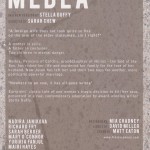
One great pleasure of Nadira’s involvement in this project has been meeting Stella Duffy. I knew of her before, but had not read anything by her as far as I remember. Her Medea is rendered in blank verse, and both the rhythms and the imagery are absolutely fantastic.
I have been read to by Nadira many, many times – I presume this is the fate of all partners of actors – and actually I am lost in admiration of Stella’s use of words, and the sustained intensity of the evocation of emotion. Images are artfully set in clusters of words, each carefully selected and placed.
It has given me severe self doubt about my own books. I know I am not trying to write poetry, but I do tend to slap words on the page just as they enter my mind. I have actually started to revise bits of my new book to try to make the writing finer – something I have never done before. Most of Murder in Samarkand I just wrote once, and never looked at or revised. Indeed, at one point I produced over 40,000 words at a sitting, without sleep. I thought that was quite an achievement. Now I am feeling less sure.
Off today with what seems a huge expedition to Edinburgh for the Festival – the company for Medea is about 20 people, and the scenery is, err, large (and beautiful).
No time to blog. Just to note that Hague is still pathetically claiming not to know that the Libyan “government” he recognised just murdered its own general. Meanwhile Pamela Geller has attempted to hide the evidence by deleting and editing her published encouraging correspondence with an anti-Muslim extremist in Norway who was building a secret “arms cache” – but she has been caught red-handed by another kind of cache, a web cache! See the wonderful comments under yesterday’s “Who funded Breivik” thread. Congratulations to the team!
Complete collapse of England’s top order for the second innings in a row. It seems to be a classic case of South Africans unable to cope with typical English conditions enabling swing.
There is an extremely important article here on Breivik’s funding, by Justin Raimondo.
It also makes plain that not only did Pamela Geller post a string of virulent anti Norwegian-Muslim articles on her website, not only did she travel to Norway to address a hate rally, not only did Brehvik post to her website and quote it as an influence. She actively supported and encouraged those planning to use terrorism.
This is an excerpt from an email she says she received and posted on her blog:
“I am running an email I received from an Atlas reader in Norway. It is devastating in its matter-of-factness.
“Well, yes, the situation is worsening. Stepping up from 29 000 immigrants every year, in 2007 we will be getting a total of 35 000 immigrants from somalia, iran, iraq and afghanistan. The nations capital is already 50% muslim, and they ALL go there after entering Norway. Adding the 1.2 births per woman per year from muslim women, there will be 300 000+ muslims out of the then 480 000 inhabitants of that city.
“Orders from Libya and Iran say that Oslo will be known as Medina at the latest in 2010, although I consider this a PR-stunt nevertheless it is their plan.
“From Israel the hordes clawing at the walls of Jerusalem proclaim cheerfully that next year there will be no more Israel, and I know Israel shrugs this off as do I, and will mount a strike during the summer against all of its enemies in the middle east. This will make the muslims worldwide go into a frenzy, attacking everyone around them.
“We are stockpiling and caching weapons, ammunition and equipment. This is going to happen fast.
As Raimondo says, Geller goes on to say that she is protecting the proto-terrorist’s identity so he won’t be arrested. We do not know how this wannabe terrorist in Norway relates to Breivik or his other “cells”. Geller may know but the police are not asking her.
There can be no doubt at all that, were Geller a Muslim, this amount of evidence and connection would have her in jail by now. Do not hold your breath.
Just two days after the UK joined the US and France in recognising the unelected Transitional National Council as the government of Libya, the TNC has murdered its top military commander and two of his aides. To put it mildly, this makes Obama, Sarkozy and Cameron look rather foolish.
General Abdel Fatah Younis was placed under arrest by the TNC on allegations of double dealing, and was being brought back to Benghazi under escort, when he and his senior officers were killed – by Gadaffi loyalists, claimed the TNC, without any explanation as to how they managed to kill the prisoners without any conflict with their escort.
I have been telling everybody for months that the unelected TNC contains some very unsavoury characters. General Younis was Gadaffi’s former Minister of the Interior and he was by no means the only member of the TNC to be steeped in Gadaffi’s crimes. He is not going to be much loss as a military commander. He had plenty of experience of killing people with Gadaffi, but they tended to be tied to chairs at the time. This experience proved not readily transferrable to the battlefield. But his brigade was the most organised and equipped force the rebels had, and they are now joining in the general internal rebel shoot-up in and around Benghazi.
This has actually been caused by the release of billions in Libyan government assets to the rebels by the west. This was Clinton’s master stroke, designed to benefit western arms companies with huge orders and enable them to sweep aside Gadaffi with all this firepower. Unfortunately, the rebel leaders are much more interested in stealing the money and have immediately started to fight over it. Gadaffi has been saved by his enemies being asked to advance through a field the Americans have strewn with gold. Rather predictably, they have stopped to fill their pockets. It is already being noted that key TNC members are spending a great deal more time in Doha, Dubai, Paris, Zurich and Geneva than they are in Benghazi and Misrata.
Meanwhile, the Hague/Cameron solution to all problems – presumably endorsed by Clegg – is to intensify the bombing. It is beyond despair.