Monthly archives: July 2026


Scottish Independence: Set the Date! 278


The Scottish Government urgently needs a bold and radical approach to achieving Independence in spite of the firm London veto on a referendum. It is plain that there is no plan at present.

The Scottish Parliament has a pro-Independence majority and government. This is how to achieve Independence consistent with international law and practice.

1) Set a Date for Independence

The First Minister should write to the Prime Minister informing him that a referendum is preferred, but if there is no prior referendum then he will invite the Scottish Parliament to declare Independence on a specified date (I suggest 14 September 2029).

State that an Independent Scotland will then hold a confirmatory plebiscite in February 2030.

2) Canvass the International Community and Tee Up a UN General Assembly Vote

Independence is not primarily a matter of domestic law. It is existence as a state recognised by other international states. What actually makes you a state is not any domestic act, but recognition by other states, expressed formally through recognition by the UN General Assembly and obtaining a seat at the United Nations.

As part of a team from Liberation Scotland and Salvo, I have been lobbying diplomatic missions of the UN to this end for 18 months now. We have found enormous support for Scottish Independence and literally no outright hostility. What we have repeatedly met is astonishment that the Scottish government and/or the governing party the SNP, has made no effort to carry the case to the international community.

At the time of writing to the Prime Minister, the First Minister should write to the Foreign Ministers of all UN states and say the following:

  1. The Scottish Government will invite its majority in the Scottish Parliament to declare Independence on 14 September 2029.
  2. Scotland is a clear nation state which existed as a fully independent nation state for over 700 years, with all the formal features of a state including extensive diplomatic relations with other states. It has a clear and uncontested border with England.
  3. The Scottish Government now wishes to recover the Sovereignty of the nation through the abrogation of the Treaty of Union of 1707. A supposed voluntary union can by definition be dissolved. The self-determination of peoples is an inalienable Charter right.
  4. The Scottish Parliament is democratically elected. A referendum would have been preferred but the UK government refuses to agree to one, because it knows there has been a consistent pro-Independence majority for some time.
  5. Scotland is ready to play its full part as a member of the international community, joining the 15 European states that have gained or regained independence since 1990, and the 65 states that have gained independence from the United Kingdom.
  6. The Government of Scotland will establish clear control of its territory as of the date of Independence.
  7. Scotland will welcome the support of the international community in reclaiming its sovereignty, and requests assistance in obtaining a vote on recognition at the UN General Assembly in October 2030.

This should be followed up with extensive in-person lobbying of member states, at the UN and other international organisations, including but not limited to the Council of Europe, OSCE, BRICS, African Union and other regional organisations.

If the Courts block expenditure this activity can be carried on without public expense but with Scottish Government endorsement, or if that is blocked with SNP/Greens endorsement. Liberation and Salvo have already proved that other nations are prepared to engage with Scottish Independence representatives right up to senior Ambassadorial level. I have done it myself. Representatives from or credentialed by Scotland’s governing parties will be still better received.

3) Planning to Secure Scotland

There needs to be a strategy in place for carrying through the Independence declaration. The single most important criterion that states take into account in deciding whether to accord recognition of a state, is whether its government actually has de facto control of its territory.

This is where Catalonia failed. Its referendum was disrupted by brutality to which it had no answer. Scots must be prepared to stand for Scotland.

Advance preparation must be needed for the following, to be immediately implemented on declaring independence:

1) Oaths of allegiance.

On Independence all public servants must immediately be asked to sign oaths of allegiance to the government and community of Scotland, renouncing any previous allegiance. The alternative is immediate suspension during a two-week grace period to reconsider pending dismissal.

The allegiance to Scotland of public servants is essential, particularly those involved in law enforcement. Judiciary, police and security services are of the highest importance. All national civil servants, whether employed by the UK or Scottish governments, should also be required to take the oath.

2) Establishment of central bank accounts.

The Inland Revenue is already established separately in Scotland and should be instructed to pay all revenue, both personal and corporate, into Scotland’s accounts. Other revenue-collecting departments, principally customs and excise, should act similarly with all necessary arrangements planned in advance.

3) Institution of Key Ministries

Establish embryo Defence, Foreign and Home Affairs ministries with prepared key personnel.

4) Institutional Arrangements for Cross Border Public Bodies

Devolution has limited the number of cross-border regulatory and other bodies with authority in Scotland, but any UK ones should be told immediately they no longer have authority in Scotland and need urgently to identify their Scottish operations for full autonomy in cooperation with the Scottish government.

5) Physical Control of Public Buildings

This needs to be a popular movement to regain Independence. The people should be mobilised to take physical control of all UK government buildings in Scotland, and of key institutions like the law courts and the BBC, to guard against any attempt at physical retention by unionist holdouts.

6) Blockading of the armed forces

Scottish units should be asked to take the new Oath of Allegiance. In the immediate term to avoid any repeat of tanks in George Square, military establishments containing troops not loyal to Scotland should be subject to peaceful and friendly civilian blockade, not allowing armed forces to leave base with their weapons.

It is worth a side note that Independence support is strongest in what we historians call the fencible section of the population: where indeed it is overwhelming. The Scottish government has three years to prepare this activity: again legal challenges may mean some work has to be done outside Government structures. There is no shortage of ability or willingness in the SNP itself and the Independence movement, if the Scottish Government will seek to collaborate rather than to exclude.

Effect of This Approach

There is currently no pressure whatsoever on Andy Burnham to agree to a referendum, and every sign that the Scottish Government are content to pick up their pay checks for another five years, having pulled up their armchairs comfortably to the referendum roadblock.

By announcing a date for a declaration of Independence if there is no referendum, immediate pressure would be put on Burnham to avert a constitutional crisis and a situation with potential to turn violent.

Burnham would be in a politically very weak position – all he is being asked for to avert this serious crisis is a democratic vote. There is no compelling reason to refuse the democratic vote other than naked retention of power over Scotland, but nothing is being done to highlight the issue and make it important.

Lobbying which will bring a focus on Scotland’s national status and the denial of the right to self-determination will also be very uncomfortable for the UK internationally. The UK is very unpopular, not least over Gaza. Breaking up the UK as a means for opening up UN reform and the membership of the security council P5 is very desirable to much of the world. Scotland also benefits from a widespread international understanding and sympathy that it has done remarkably little to exploit.

The British government position is internationally indefensible – not least because it is the opposite of the position the British government has adopted in relation to the rest of the world.

These quotes are from the British government’s intervention before the International Court of Justice in the Kosovo hearings:

“In most cases of secession, of course, the predecessor State’s law will not have been complied with: that is true almost as a matter of definition.”

And the still stronger formulation:

“Nor is compliance with the law of the predecessor State a condition for the declaration of independence to be recognised by third States, if other conditions for recognition are fulfilled. The conditions do not include compliance with the internal legal requirements of the predecessor State.”

Every Scottish nationalist should have these British government quotes hardwired into their brain. The British government argues one position abroad and a different position at home.

Being Serious About Independence

It is a logical impossibility to believe both that Scotland is a nation with the right of self-determination, and that Independence requires permission from London. The Scottish government’s attempt to hold both these incompatible positions has resulted in its current impotence.

The only way to make progress is to make plain to Andy Burnham that a straight veto of democracy and the rights of the Scottish nation will not be accepted. Ultimately Scotland will take its Independence – preferably with London’s cooperation, but if necessary without it.

Let me put it this way. If, in the end game, you are not prepared to stand unarmed in front of a British army tank to achieve Independence, you are not actually a supporter of Scottish Independence at all.


————————————————————————————-

Anybody is welcome to republish and reuse my work, including in translation.

My work has no funding at all except for your subscriptions. If you already, subscribe I would be grateful if you could check if your subscription is still active. Over 80% of my subscriptions lapse when debit or credit cards expire: the systems do not warn you.

Because some people wish an alternative to PayPal, I have set up additional new methods of subscription payment including Patreon account and a Substack account ; if you wish to subscribe that way. The content will be the same as you get on this blog. Substack has the advantage of overcoming social media suppression by emailing you direct every time I post. You can if you wish, subscribe free to Substack and use the email notifications as a trigger to come to this blog and read the articles for free.

I am determined to maintain free access for those who cannot afford a subscription.

Choose subscription amount from dropdown box:

Recurring Donations


PayPal address for one-off donations: [email protected]

Alternatively by bank transfer or standing order:

Account name
MURRAY CJ
Account number 3 2 1 5 0 9 6 2
Sort code 6 0 – 4 0 – 0 5
IBAN GB98NWBK60400532150962
BIC NWBKGB2L
Bank address NatWest, PO Box 414, 38 Strand, London, WC2H 5JB

Bitcoin: bc1q3sdm60rshynxtvfnkhhqjn83vk3e3nyw78cjx9
Ethereum/ERC-20: 0x764a6054783e86C321Cb8208442477d24834861a 


View with comments

Narratives of Moral Conflict: Karim Khan and Delcy Rodriguez 193

Social media is not conducive to nuance. In the interest of reach, cut and dried positions are more effective and binary moral judgement expected. This leads to over-simplification of complex issues, and to skipping over facts inconvenient to your chosen narrative.

There are issues affecting two high-profile people where it is worth considering the detail before coming to a firm view – and in doing so perhaps acknowledging that we may not have sufficient information to make that view more than provisional.

I want to look at the furores around Karim Khan and Delcy Rodríguez.

Karim Khan has been dismissed as Chief Prosecutor of the International Criminal Court, by the Bureau of the Court (consisting of the diplomatic representatives of its member states). This follows a lengthy investigation in which three judges found there was no evidence that met the standard of criminal proof, set against member state committee reports that argued in effect that in cases of workplace harassment, the standard of criminal proof is not applicable.

The essential background is that Khan had requested and obtained arrest warrants for Benjamin Netanyahu and two Israeli ministers, pursuant to charges of war crimes against them.

The allegations against Khan did not emerge until after the Netanyahu arrest warrant.

The effort to remove Khan was undoubtedly promoted within the ICC structures by those governments aligned with Israel. The Israeli government itself appears to have been actively pushing for Khan’s removal.

The very well-connected Israeli journalist Guy Azriel, from right-wing Israeli TV channel i24NEWS, has posted that a team of Israeli diplomats was involved in promoting the allegations against Khan. Azriel is a former Israeli diplomat himself and well plugged in.

The ICC has of course suffered from massive pressure from Israel and the United States, with sanctions applied to its judges and personal threats made directly against both judges and staff.

Karim Khan has stated that his family were threatened by Israel. But just as I noted that the allegations against Khan only emerged after the obtained arrest warrants against Netanyahu, we should note that Karim Khan only spoke about this after the sexual allegations.

Yet none of this makes the allegations against Karim Khan automatically untrue. All of that could be true, but the sexual harassment genuine.

That is the viewpoint of Em Colquhoun in this opinion piece in the Canary. Colquhoun also notes correctly that the ICC has a long history of pro-Western narrative bias in its targets for prosecution, and ludicrously targeted Hamas figures for prosecution as “balance” to the Israel warrants.

On December 3 2023 I wrote extremely critically of Karim Khan:

I saw the prosecutor of the International Criminal Court shuttled around Israel and the West Bank in a fleet of armored Toyotas, looking like the most arrogant of VIPs, while refusing to act against Israel and seeking to “bothsides” the genocide unfolding before our eyes.

I realised that Karim Khan KC, brother of an ex Tory MP, himself should by rights be charged with complicity in war crimes.

Karim Khan is not a standout crusader for justice who sought to redress the balance of ICC prosecutions. He only sought the Netanyahu charges when the war crimes of the Israelis in Gaza became so blatant that they could no longer be avoided. The limited number of warrants in circumstances where the entire Israel cabinet and senior IDF command are plainly implicated in Genocide, alongside thousands of soldiers, is glaring. But Khan did appear assiduously to be pursuing the warrants against Netanyahu, Smotrich and Ben Gvir, and Israel was sufficiently worried to actively seek to displace him, with eventual success.

I part with the Canary article where it argues that where the truth of the sexual abuse allegations is not plain, the appearance of impropriety is sufficient to warrant dismissal.

What? This is extraordinary. “It doesn’t matter if you did it, it looks like you could have done it” is an extraordinary measure of guilt. What does it mean in practice?

In my diplomatic career, I frequently travelled in many countries and to many conferences with female staff who often were subordinate to me, and we would quite normally stay in neighbouring hotel rooms. I never had any non-professional relationship with any of the staff concerned and no allegation was ever made against me. But if one had been, I don’t see how I could have avoided Colquhoun’s appearance test.

What would be the consequences in practice? A man could never be alone in a room with a junior colleague, could never travel for work with one? Otherwise there is the appearance of impropriety?

This is nonsense. It is not just nonsense, it is nonsense of a return to Victorian societal standards and actually a threat to the advances in women’s professional status.

The problem with the conveniently timed allegations against Khan is that we have seen the playbook often. The state weaponises sexual allegations, and the agency of apparently left-wing commentators like Colquhoun, to undermine and even destroy those whom the state sees as a threat – as Khan had somewhat unexpectedly become.

Let me give you a personal anecdote.

When I was attempting to stop the acceptance of intelligence from torture by Western intelligence services in the War on Terror, I was suddenly faced with 18 disciplinary charges. They were sprung on me at a meeting in FCO personnel department, where I was told that they would be investigated if I did not accept reassignment to a less controversial Ambassadorship.

I did not accept and an investigation commenced.

One of the charges was that I had extorted sex from visa applicants. I was astonished by this accusation. After months of investigation I was eventually faced with a visa application form as the evidence against me. It had written on it – I do not know by whom, but not by me – “Ambassador says approve”.

The application form was for a young lady named Albina Safarova – a person I had never met in my life. Furthermore it eventually transpired Ms Safarova had not made any complaint against me and had not claimed I had ever met her. The only “evidence” of any kind was “Ambassador says approve”, written by an unknown hand on an application form.

There is more. I started to get messages from many people who had worked for me. It became obvious the FCO was systematically contacting all the women I had worked with in my 22-year career with them, and was encouraging them to make accusations against me.

They could not find one person to accuse me. Many of those contacted still worked for the FCO. It was made plain that their employer would like them to make complaints, yet none did.

In my own case, I know for certain that the state fabricated a sexual abuse accusation against me because I was seen as having become a threat.

This happened to me in 2003. I suspect in today’s peculiar atmosphere the state may have had more success in getting me completely cancelled, despite the complete lack of relevant evidence and the absence of any woman actually accusing me of anything. Doubtless there were situations where Em Colquhoun could have discerned an appearance of impropriety, even though nothing actually happened.

I was eventually cleared of all 18 charges. It is impossible accidentally to make 18 separate accusations against somebody, all of which turn out to be untrue. I was disciplined for having revealed the allegations existed, and eventually forced out.

I subsequently saw sexual allegations weaponised against close personal friends of mine, each of whom was seen as a threat to the State – including Julian Assange and Alex Salmond. I know that I was innocent, and everything I know of their cases makes me believe those two were also. Otherwise, you have to believe that people who have dedicated their lives to anti-imperialist causes are routinely, sexual psychopaths. This is akin to believing Jeremy Corbyn is an anti-Semite.

You would also have to explain why Murray, Assange and Salmond have faced formal investigation when nobody on the Epstein list has – and then further explain why all the resources of the Deep State, fully deployed, were unable to convict the anti-Imperialists.

We do not know how events in the ICC will play out. There is no doubt whatsoever that the UK, EU and allies will seek to obtain the appointment of a Zionist prosecutor who will deprioritise or even drop action against Netanyahu. I expect they will succeed; but we shall see.

I do not know the truth about the Karim Khan allegations. It is important to repeat that. But I am deeply, deeply suspicious of their timing. Any abuse of power imbalance at work, if it existed, is very bad. It has come to be a part of the narrative surrounding the ICC’s actions against Netanyahu. We also have the facts of the Genocide in Gaza and Lebanon, and the scale of the everyday sexual abuse of Palestinian detainees.

So we have potentially two wrongs, the just resolution of which has come into conflict through circumstance and timing.

The first potential wrong is an individual instance of sexual abuse in the workplace by Karim Khan. I do not know if this is true or not. But I do know it has been weaponised by those seeking to stymie the investigation of the second wrong. The second wrong is Genocide and war crime on a mass scale. I do know for certain that this is real.

If pursuing the first alleged wrong does indeed come to prevent justice for the definite crime against humanity, it is difficult to see that as a desirable outcome.

Now, gentle reader, I give you an elegant segue. Let nobody think I do not work at my writing.

Just as Karim Khan was removed as prosecutor of the International Criminal Court, Venezuela announced it was withdrawing from it. Left-wing commentators immediately seized on this as further evidence that Venezuela is under Trump’s direct control. Yet the withdrawal decision was pronounced by new Foreign Minister Felix Plasencia, a man of impeccable left-wing credentials who survived Chávez’s extremely thorough purge of the diplomatic service and earlier served as Foreign Minister under Maduro. The reasons Plasencia gave were impeccably left-wing and entirely valid, relating to the ICC’s Western bias and disproportionate action against leaders from the Global South.

If Venezuela had done this a year ago, it would have seemed a move consistent with the values of the Bolivarian revolution. But happening now, it all seems too convenient that it aligns, in practical effect if not in expressed motivation, with Donald Trump’s campaign against the ICC. It does so at a time when US and Israeli troops have been in the country providing earthquake relief.

The presence of the Israelis had sparked the first demonstration in Caracas by hitherto loyalist Chavista elements against a policy of Delcy Rodríguez’s government.

There has been much written recently about the appropriation of Venezuelan oil revenues by the Trump administration. This remains an entirely illegal arrangement, with no founding agreement by the Venezuelan government and based on straight military force. The US still has naval ships off the Venezuelan coast to intercept any tanker not carrying oil to a US Treasury-approved destination.

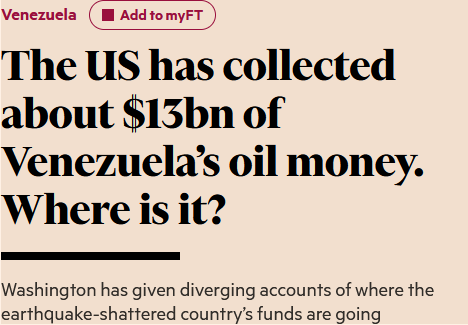
The USA has been illegally selling Venezuela’s oil. It has not physically occupied the oilfields, but Venezuela has been filling tankers with oil for which the US Treasury has collected the payment. Trump has boasted repeatedly of the huge amounts of money his administration has made from Venezuelan oil. The Financial Times this week ran an article on Venezuela’s missing oil money.

The answer to this question is a prime example of the truth taking us away from the simple narrative that gives a comfortingly clear picture. The answer will surprise you. I have direct first-hand knowledge of this from my time in Venezuela and from access to the highest levels of government there.

The US Treasury has been paying Venezuela its oil revenue regularly and promptly. It has been paying 97.5% of it into the Venezuelan treasury within one week of receipt. 2.5% of it has been retained by the US Treasury as a “fee”. The idea of a transaction fee for illegal military seizure of control of the asset is a blatant racket, but that is the extent of the American depredation.

So the total amount the USA has stolen from Venezuela is about $300 million to date, not the billions Trump has claimed. In fact the US naval operation to blockade Venezuelan tankers (and kidnap President Maduro) will have cost much more than the money the US has made from its illegal venture. It is however not in anybody’s interest to say so, of which more in a moment.

There had been an initial period when the money was going to a personal account in Qatar rather than the US Treasury, and no doubt at that time Trump was considering what he could get away with. But that only lasted a couple of weeks, and that money was recovered quickly into the new arrangement.

I can only state for certain that 97.5% was being paid over within a week for the first four months of the period, until I left Venezuela. But it is my understanding that it has continued smoothly.

There is more. The US has been selling the Venezuelan oil at a 5% discount to the world price. How you calculate a benchmark price for Venezuelan crude before applying the discount I am not sure, as the stuff is quite particular. But – and here we get into the realms of inconvenient facts a lot of my audience will not wish to hear – this compares to the 15% discount that China was imposing when it was the main recipient of Venezuelan crude.

On top of which, China was making payment not within a week, but with a delay of months and sometimes years. Plus China was deducting money at source for repayment of Chinese loans to Venezuela. These loans were genuine and for excellent infrastructure projects, but obviously the deduction of repayments from oil revenues hit Venezuelan government fiscal flexibility hard.

So the truth is that Venezuela is (even apart from the price bonanza from the Hormuz closure) getting a great deal more revenue from the United States than it was from China (and Russia) and getting it much quicker. That is an inconvenient fact if ever I heard one.

The Rodríguez government does not trumpet this, as it does not wish to appear complicit or happy with a client relationship that is imposed on it and illegal. The Trump Administration does not trumpet this, because it wishes its base to believe it is making billions out of Venezuela, not engaged in a military-led venture that is actually costing billions.

That is why the whereabouts of Venezuela’s money is a mystery. I know the answer because I was told and shown at the highest levels of government. I actually both phoned and emailed the Financial Times to try to tell them the answer to their front-page question, but they did not reply to me.

However, the basic and rather dull answer is that Venezuela’s money is in Venezuela.

I would add to this a point which Delcy Rodríguez made to me personally. Venezuela had never voluntarily stopped selling oil to the United States. The USA imposed sanctions on Venezuela, not the other way round. In a free world, the United States would be the largest destination for Venezuelan oil and is the country’s most obvious economic partner – a point made by Anya Parampil in her excellent book Corporate Coup: Venezuela and the End of US Empire.

The difficulty is the United States’ unwillingness to engage in fair trade with anyone.

What Venezuela desperately wants is the normal ability to trade fairly with any other country, including the ability to supply Cuba. It has been prevented from doing so because the Western powers are desperate to destroy any state running an alternative economic model – which if capitalism were genuinely an economically superior system, they would have no need to do. China did not impose the sanctions on Venezuela, but exploited its advantage from them.

The USA has imposed a classic Imperialist resource-extraction operation.

The imperial extraction does not lie primarily in the headline price paid for the crude. The oil can only be sold through and to US-approved companies, which capture the larger margins in trading, refining, shipping, financing and marketing. Venezuela receives payment for the raw commodity (minus the small fee), but is locked out of the higher-value stages and denied the freedom to sell to other buyers. That is how classic resource imperialism frequently works: control of commodity access, logistics and the value-added chain rather than simple open seizure of the export revenue.

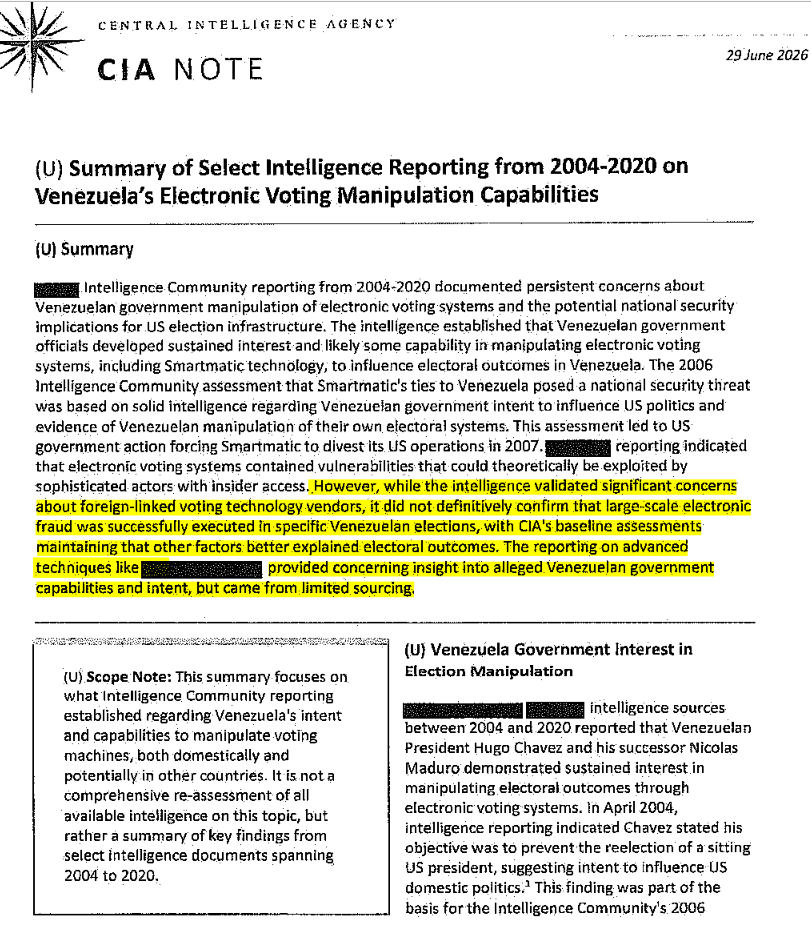
There was a stunning Freedom of Information release last week of a CIA note that indicated that the CIA did not believe that the Venezuelan elections from 2006 to 2020 were significantly affected by election fraud. So the imposition of the vast bulk of Western sanctions which crippled Venezuela over that period – and at one point caused devastating famine and mass emigration – were knowingly based on a lie.

My own investigations in Venezuela led me to believe that opposition claims that they won the 2024 Presidential election – claims promoted by all the Western powers – were equally untrue and the “evidence” incomplete and often forged.

Venezuela has obtained very little by way of sanctions relief from the Trump administration, and appallingly it has received no sanctions relief at all from Western nations to help it cope with the devastating earthquake. This has made it difficult for the relief charities to pay for anything, move goods and equipment to Venezuela or operate there at all. The Western media has delighted in making claims of government inefficiency in earthquake response, while never mentioning the crippling effect of decades of sanctions on government supply chains.

In truth, the resilience of Caracas has been extraordinary. I am in contact with the team I assembled in Caracas and a score or so of other friends and contacts. Mobile phone contact was never cut to the large majority and only for a few hours to those who did lose access. Electricity has been almost constant, and so has potable water supply.

What is more, the massive Russian- and Belarusian-built social housing blocks – which I had greatly feared would have collapsed with huge loss of life – withstood the earthquake comparatively well. It was the modern glass and steel blocks in the wealthier areas which proved most prone to disaster. That may be due to those areas being on flatter alluvial land more prone to shake.

Of all the decisions for which Delcy Rodríguez has been criticised from the left, the one with which I struggle most has been the acceptance of an Israeli earthquake relief team, with accompanying IDF PR personnel. For Israel, which buried tens of thousands of children under rubble, to be parading its assistance in digging people out of rubble, is too much for me.

But consider this. You are Delcy, and your capital has just suffered as much catastrophic damage and loss of life in an hour as Gaza did in many months. You have thousands of people potentially alive and desperate to be dug out. Could you turn down any offer of specialist relief in those circumstances? It was an agonising decision to be forced to make. I received a personal assurance from the Venezuelan government that the Israeli deployment was temporary and had a time limit which, if true, means they have already gone.

I have struggled with this. But ask yourself this question before you condemn, as I asked myself:

If your own children were buried under rubble, and an Israeli rescue team to hand, would you forbid them to dig your children out? When you have considered that question, then you can condemn the Venezuelan government.

I would not, I think, have allowed the Israelis to come and conduct an exercise where I suspect propaganda value to them was in the event greater than any real help: but I am not on the ground to verify what they really did.

It is worth noting here that repeated speculation that Venezuela is about to normalise diplomatic relations with Israel is so far unfounded. I was told in person by the recently departed foreign minister that Venezuela had made plain to the Trump administration that, in its new enforced relationship with the United States, a red line on the Venezuelan side was the anti-imperialist alignment of its foreign policy. That appears to be the case, as reflected at the UN, where Venezuela has not switched to the US camp. [This paragraph was amended on 28 July to reflect the fact that, while it participates in all committees and debates at the UN, Venezuela is currently suspended from voting in the General Assembly due to arrears].

Delcy Rodríguez’s point that Venezuela never voluntarily stopped trading with the USA is also relevant to its position with the IMF. Venezuela never left the IMF. Chávez said that he would, but then changed his mind. Maduro also did not leave the IMF.

Contrary to much disinformation, Venezuela has therefore not rejoined the IMF. Nor has Venezuela accepted an IMF loan, a Structural Adjustment Programme, or any IMF budget-monitoring mechanism. What Venezuela has done is to take some 500 million dollars in Special Drawing Rights to which Venezuela was entitled. Access to these had been blocked by financial sanctions, which were voided by the slight easing under Trump.

The money was Venezuela’s share of a general release to assist developing countries through the COVID years. Venezuela was simply blocked from its share. It was, in effect, Venezuela’s own money. To portray taking this as some “betrayal” of socialist values is ludicrous.

I have no reason to adjust the assessment of Delcy Rodríguez that I reached after careful study. In fact I have the strongest reinforcement, in that I now know with absolute certainty that Delcy Rodríguez did not betray Maduro. I have had direct access to documentary, eye-witness, audio and visual evidence that conclusively showed me that:

  • Maduro was aware of his likely kidnap and stood down armed resistance.
  • In the preceding weeks Rodríguez had been approached to cooperate with Maduro’s removal and had adamantly refused.
  • On the night of his kidnap Rodríguez was present, furious, refusing US overtures and seeking every avenue for Maduro’s immediate release.

I believed these things to be true from first-hand accounts before I wrote my last major article on Venezuela: I am now absolutely certain they are true.

Venezuela abjured the path of armed resistance to the poised US forces. Venezuela is a quarter the size of Iran, has far weaker armed forces and is within direct bomber range of the United States. It is a pacific country and has chosen to try to ride out the Trump storm, while maintaining the key benefits of the Bolivarian Revolution – especially free and universal education, free healthcare, widespread pensions and the commune system.

The Chavista system already drew much criticism from the international Left for simply aiming to spread these social benefits from oil revenues, while allowing capitalists to dominate the rest of the economy. Communal ownership of means of production and distribution was growing organically, particularly through the communes, but there has been no fundamental change to the capitalist sector in a mixed economy. It is this factor which makes accommodation with US capitalist firms possible.

This is dependent on the Venezuelan government tolerating US predator capitalism and the US government tolerating Venezuelan wealth distribution. This is the basis on which Rodríguez has been avoiding war and waiting for Trump to pass. It is the basis on which Trump has been exerting no pressure for regime change in Caracas, where he said again this week that Venezuela was “not ready” for early elections.

Where there is room for genuine criticism from the Left is that this approach effectively cooperates with imposed American imperialism in key economic sectors; that the US is seeking to expand its monopoly into other Venezuelan mineral resources; and that imagining this is temporary and the Democrats would now be any better is probably illusory.

But a devastating war is the only currently available alternative, and that definitely would destroy Chávez’s social achievements.

There is no plain right or wrong answer. All of Rodríguez’s options are bloody awful, compounded by the rightward shift of Latin American governments and the new US-backed electoral fraud next door in Colombia. Those who have romantic notions of wearing bandanas and brandishing AK-47s in mountains and jungles have for the most part not seen children die in agony. This is not easy.

I have addressed two apparently disparate topics. What unites them is simple. In both cases the available facts are messy, the moral weights pull in more than one direction, and the political incentives of powerful actors are obvious. Social media, and much of what now passes for political commentary, cannot tolerate that. It demands a clear good guy, a clear villain, and the suppression of any fact that complicates the story.

That demand is not moral clarity. It is intellectual laziness dressed up as principle. It produces the spectacle of people who will not look at the timing of the allegations against Khan, or at the actual flow of Venezuelan oil money, or at the evidence of Rodríguez’s conduct on the night Maduro was taken, because those facts make the preferred narrative less comfortable.

There are truths that conflict. There are sometimes choices in which every available option is bad. Facing that reality, weighing what is known against what is only alleged, and then deciding, is the actual work of political and moral judgement. Declaring the complexity itself illegitimate, and treating those who acknowledge it as morally suspect, is the opposite of seriousness.
The age we are in rewards the opposite. That is not a reason to join in. An important concomitant of this viewpoint is that I absolutely have no claim always to be right. If I have guided you through the facts and some key issues around them, and helped stimulate you to form your own opinions, then I am very happy.


————————————————————————————-

Anybody is welcome to republish and reuse my work, including in translation.

My work has no funding at all except for your subscriptions. If you already, subscribe I would be grateful if you could check if your subscription is still active. Over 80% of my subscriptions lapse when debit or credit cards expire: the systems do not warn you.

Because some people wish an alternative to PayPal, I have set up additional new methods of subscription payment including Patreon account and a Substack account ; if you wish to subscribe that way. The content will be the same as you get on this blog. Substack has the advantage of overcoming social media suppression by emailing you direct every time I post. You can if you wish, subscribe free to Substack and use the email notifications as a trigger to come to this blog and read the articles for free.

I am determined to maintain free access for those who cannot afford a subscription.

Choose subscription amount from dropdown box:

Recurring Donations


PayPal address for one-off donations: [email protected]

Alternatively by bank transfer or standing order:

Account name
MURRAY CJ
Account number 3 2 1 5 0 9 6 2
Sort code 6 0 – 4 0 – 0 5
IBAN GB98NWBK60400532150962
BIC NWBKGB2L
Bank address NatWest, PO Box 414, 38 Strand, London, WC2H 5JB

Bitcoin: bc1q3sdm60rshynxtvfnkhhqjn83vk3e3nyw78cjx9
Ethereum/ERC-20: 0x764a6054783e86C321Cb8208442477d24834861a

View with comments

Where Are We Going? 275

An advert for the RNLI caught my attention because it indicated that the majority of their income comes from bequests in wills. The pitch was that, after you provide for your loved ones, you should leave money to the RNLI. I have no problem with this, having generations of lifeboatmen in my ancestry, but it tied in with criticism I had seen recently on X of “boomers” for hoarding wealth.

It appears to me simply true that those of my generation were able to acquire wealth, often largely invested in residential property, simply in the normal course of our working lives. It also is true that succeeding generations do not appear so easily to do this.

It is not that wealth is no longer created. It is that my generation benefited from a social democratic consensus in which wealth was much more equally spread around society. I lived through and witnessed in real time the destruction of the social democratic system that produced that outcome – the advent of neoliberalism and its mechanisms of deregulation and globalisation.

This framing is misleading, however. The establishment narrative is that extreme wealth concentration and inequality is the natural order of things and that deregulation is the removal of artificial constraints. But actually the opposite is the truth. The entire economic structure is unnatural. The very concepts of capital itself, of company structures, of banking systems, of taxation are each a carefully manufactured construct.

Extreme concentration of wealth is produced by design, not by accident. Hedge funds, family offices, share dividends, banking bonuses, massive salaries – none of this is ordained either by God or by nature. It is a construct which is becoming unworkable.

The chief executive of a FTSE 100 listed company now earns over 130 times the median UK salary. Listed companies are themselves the less extreme end of capitalist excess. I am struck that this median salary itself is about £38,000 pa. I was earning £38,000 as a muddling diplomat in about 1995, 30 years ago. Wage stagnation for ordinary people is stunning.

In 1985 I bought my first home for £32,000. My salary was £14,500. Those same little terraced houses in Abbey Wood now sell for over £400,000. They have gone from twice a normal salary to ten times the average salary. I have no idea how a normal person can buy a house now. But the housing market is only a symptom of the distorting effects of the extreme inequalities of late capitalism.

Foodbanks, benefit dependency, lack of career progression opportunity, the collapse of social mobility. This is all incredibly unhealthy. The rise of the world’s first trillionaire and of incredible concentrations of wealth. I stood for election in Blackburn – a city with pockets of real deprivation and, incredibly, seven billionaires.

Wealth is largely digits in laptops. Some of it translates into physical control of property or productive units. All of it needs to be fundamentally rebalanced in favour of those who actually produce the wealth. The accounting tricks of Jim Ratcliffe do not amount to wealth creation. In fact asset stripping and dismantling of productive capacity is much more often the path to riches than producing material things.

The world is deeply sick. Society needs a thorough and imaginative re-engineering, with altruism as a founding principle.


————————————————————————————-

Anybody is welcome to republish and reuse my work, including in translation.

My work has no funding at all except for your subscriptions. If you already, subscribe I would be grateful if you could check if your subscription is still active. Over 80% of my subscriptions lapse when debit or credit cards expire: the systems do not warn you.

Because some people wish an alternative to PayPal, I have set up additional new methods of subscription payment including Patreon account and a Substack account ; if you wish to subscribe that way. The content will be the same as you get on this blog. Substack has the advantage of overcoming social media suppression by emailing you direct every time I post. You can if you wish, subscribe free to Substack and use the email notifications as a trigger to come to this blog and read the articles for free.

I am determined to maintain free access for those who cannot afford a subscription.

Choose subscription amount from dropdown box:

Recurring Donations


PayPal address for one-off donations: [email protected]

Alternatively by bank transfer or standing order:

Account name
MURRAY CJ
Account number 3 2 1 5 0 9 6 2
Sort code 6 0 – 4 0 – 0 5
IBAN GB98NWBK60400532150962
BIC NWBKGB2L
Bank address NatWest, PO Box 414, 38 Strand, London, WC2H 5JB

Bitcoin: bc1q3sdm60rshynxtvfnkhhqjn83vk3e3nyw78cjx9
Ethereum/ERC-20: 0x764a6054783e86C321Cb8208442477d24834861a

 

View with comments

Extreme Unionism and Res Judicata 119

Unsurprisingly, today at the Court of Session Lord Young refused to lift his suspension or “sist” of the Scottish judicial review of the proscription of Palestine Action. He did however grant us leave to appeal against this decision.

What was surprising was an extreme extension of the UK government’s argument.

The UK government stated that Huda Ammori in England and Craig Murray in Scotland are the same litigant, because both are in essence representing Palestine Action.  This case therefore is Res Judicata – a matter already judged. It has been decided in London by the Court of Appeal of England and Wales.

This is an astonishing claim. A matter decided in another jurisdiction cannot be Res Judicata. The Labour government is here asserting in terms that the High Court of England and Wales has jurisdiction over Scotland.

This would of course be in direct breach of the Act and Treaties of Union. That this is no misunderstanding was underlined in court by use of the words “Antiquarian” and “Desuetude” in relation to “18th Century legislation”.

The Crown had already made the argument of “comity” in the previous hearings, and Lord Young had accepted the principle of “comity” in his ruling suspending the Scottish judicial review. “Comity” is the principle that neighbouring jurisdictions should seek to adopt the same approach out of mutual respect. But here the Labour government went much further and is denying the right of the Scottish courts to decide differently.

The UK government did not merely invite the Court of Session to follow the English decision out of comity. It argued that the matter is already res judicata — that because both proceedings are, in substance, brought by Palestine Action, the Court of Appeal’s ruling in England has already determined the issue for Scotland as well. This is a much more radical position than has normally been taken between the two jurisdictions.

If accepted, this argument would mean that the finality of Scottish judicial review proceedings in reserved matters could be determined in London. That would represent a significant practical shift in the relationship between the two legal systems that have coexisted since the Union.

This is of course consistent with Andy Burnham’s declared intention to reduce the powers of the Scottish parliament and introduce more direct funding from London to Scottish councils, and his questioning of the Barnett financial settlement. The Labour Party is adopting aggressive unionism.

Incidentally Lord Young today denied that “comity” had been his primary reason for suspending the judicial review. Having sat through that hearing and ruling, I have to say, you could have fooled me. It appeared plainly his primary reason. If that wasn’t it, I have no idea what his motive was. Pretty well the only other reason he gave was to save money on the cost of a judicial review.

Which I suspect is a lot less than the cost of banging up in jail a lot of mostly elderly people for the “terrorism” offence of holding placards.

This case has revealed in startling detail the contempt for Scotland of the Labour Party. It was demonstrated brazenly when Nepo baby Catherine Smith KC, Advocate General for Scotland (a UK govt minister) told the last hearing that CONTEST Scotland, the Scottish government’s counter terrorism strategy organisation which includes Police Scotland, the Crown Office and the security services, was a “local board” whose opinion that Palestine Action did not meet the bar of terrorism could be ignored.

The disclosure papers reveal that nobody in Scotland was consulted by the Home Office before the proscription of Palestine Action. The Israeli Embassy were consulted, but the Scottish government were not. The arms industry was consulted, but Police Scotland were not. No civil society organisation in Scotland was consulted.

Yet policing and human rights are not reserved matters.

That lack of any consultation in Scotland is going to be a key point at the actual review, when we eventually get the Scottish judicial review.

Lord Young did not today accept the res judicata argument – that won’t even get to be heard unless we eventually get out of the endless procedural thicket into which he has deliberately steered the case.

We gained ground today. Lord Young clarified that the Scottish judicial review is paused until the Supreme Court decides whether it will hear the Ammori appeal, after which our judicial appeal may resume.

What the purpose of such a pause could be, other than to allow the Crown then to argue there is not time for a Scottish judicial review before the Supreme Court hearing, is entirely unclear to me.  Our KC, Aidan O’Neal, at this point became as furious with the judge as I have ever seen a KC exhibit in court, decrying the “delay, delay, delay”.

But unless the Establishment stitches up a very quick Supreme Court hearing, there is a better chance we may finally get the Scottish judicial review than appeared likely yesterday. We also have the chance to appeal to get the Scottish judicial review running.

I have to say I am furious at the total lack of interest shown by the Scottish government and the SNP in this case. It is addressing fundamental constitutional questions and the UK government is directly seeking a maximalist unionist gain in reducing the autonomy of Scottish courts from London. But the Scottish government – which could have intervened in the case – has shown no interest whatsoever and is just pretending it is not happening.

The Scottish government has also had the ability this whole time to instruct Police Scotland that arresting people for holding placards is not a priority “crime”, and they should concentrate on burglary, rape and other such violence. But they have not done that either.

One consequence of this just being ordinary citizens against the unlimited resources of the state, and of the continued use of procedural devices to postpone the judicial review, is that we have simply run out of resources. The legal team told me on the steps of the court after today’s hearing that we simply do not have the funds to appeal against today’s decision.

In short, unless there is a substantial uptick in crowdfunding I am going to have to throw in the towel. I am very aware we cannot expect the same people to give again and again – and a great many of the 1800 people who donated so far are not in a good financial position themselves. It is also a real limitation that, as no big organisation is with us, the only real outreach is my own heavily shadowbanned social media.

But somehow we need to fight this.

Again please contribute if you can but do not contribute if it causes you difficulty. If you know people who are able to afford to help and likely to be sympathetic, please do contact them and ask their assistance. We are trying to keep a lot of very good people out of prison.

You can donate through the link via Crowd Justice, which goes straight to the lawyers, or through this blog.

https://www.crowdjustice.com/case/scottish-challenge-to-proscription/

Alternatively by bank transfer:

Account name
MURRAY CJ
Account number 3 2 1 5 0 9 6 2
Sort code 6 0 – 4 0 – 0 5
IBAN GB98NWBK60400532150962
BIC NWBKGB2L
Bank address NatWest, PO Box 414, 38 Strand, London, WC2H 5JB

Or crypto:

Bitcoin: bc1q3sdm60rshynxtvfnkhhqjn83vk3e3nyw78cjx9
Ethereum/ERC-20: 0x764a6054783e86C321Cb8208442477d24834861a
 

View with comments

The Ditching of Nigel Farage 228

Nigel Farage is the most consequential British politician of the 21st century. Certainly a more important historic figure than any of the last eight Prime Ministers. Tony Blair is the only realistic rival.

Without Farage, the UK would never have left the European Union. Farage’s role in forcing the issue to the top of the political agenda, and putting electoral pressure on the Tory Party which Cameron sought to assuage through a referendum, was indispensable.

Subsequently Farage has been central to placing racism at the centre of British electoral politics. Farage has been key to redirecting the frustrations of ordinary people at twenty years of falling living standards, while wealth concentrates to an incredible degree in the hands of the billionaire class. That the blame for this has been loaded onto hapless immigrants, rather than those looting the economy, owes much to Farage. He has more than anybody made UK elections revolve around who can promise the most blood-curdling measures against immigrants.

In doing so, Farage appeared to have shattered the UK’s two-party system. He certainly brought about the biggest shift in Labour/Tory dominance since 1921. It was entirely thanks to Farage splitting the right-wing vote, that Starmer could gain a thumping parliamentary majority with just 32% of votes cast, under the UK’s appalling electoral system. Reform had the same effect in the recent Scottish parliamentary elections, enabling the SNP to win 57 out of 73 constituency seats despite a 10% drop in their vote.

Even after all the abuse hurled at Farage by the media in recent weeks, Reform still leads in UK opinion polls.

I am by nature diametrically opposed to Reform’s brand of politics. For me tolerance, empathy and compassion are the most important virtues in life, and I deplore the atavism and racism which is Reform’s stock-in-trade. I also detest their anti-intellectualism, while the stupidity of believing that the hardship to ordinary people caused by the structural imbalance of late capitalist systems, is somehow the fault of poor refugees, fills me with contempt.

I am however relaxed about leaving the EU.

It has become a right-wing bloc of a very unpleasant nature, under leadership of von der Leyen and Kallas. The sight of MEPs chanting “send them back” in the European Parliament was chilling. I am glad to be out of it. However the decision to reject all sensible trading arrangements with the bloc has greatly damaged the UK economy and harmed the prospects of young people. Again at base this was due to Farage’s electoral pressure on the Tory Party and Johnson’s desire to exploit the sentiment which Farage had created.

I would argue that Blair is in fact a more harmful and more evil figure than Farage.

Blair fundamentally changed British society by gutting the political instrument prepared to use the power of the state to improve the condition of the working class – the Labour Party – and turning it into another reliable agency of neoliberalism. The Uniparty in Britain started with Blair. His government furthered privatisation, particularly of services within the NHS, and ended free university education. Together with Brown, Blair brought in the ruinous Private Finance Initiative, to guarantee looting by private capital of public provision. Brown went on to bail out the banks in the biggest single transfer of wealth from poor to rich in history.

Blair killed hope and progress – in addition to the millions he killed in wars. He now rakes in large multiples of the money made by Farage, from even dodgier sources, while receiving none of the media scrutiny.

Farage of course did not change history on his own. He was relentlessly promoted by both state and corporate media for decades. He has been by a mile the most frequent guest on BBC Question Time, and the relentless media promotion started when he ought to have been an obscure figure, from a party, UKIP, which had never won an election.

In 2005, when I left the FCO and went on to fight Jack Straw in Blackburn in the General Election that year, Nigel Farage contacted me and invited me to lunch. As an Independent I had obtained 5.0% of the vote in Blackburn. UKIP had got 2.2% of the UK vote. Despite having just 2.2% of the vote and no MPs, Farage was already all over the BBC and massively promoted by the newspapers.

Farage said he wanted to explore my joining UKIP. I did a little research, and declined the invitation, finding too much evidence of racism. But interestingly, Farage’s approach to me emphasised his opposition to the Iraq War and to the attack on Human Rights in the name of the “War on Terror”. I believe he was genuine about this – and it is forgotten now that Farage was an outspoken, though in 2001 not very important, critic of the Iraq War – a position he has never repudiated.

All main party politicians are frontmen for other interests. They are owned and controlled by the defence industries, by Big Pharma, by the Israeli lobby, by media barons, by the media industry. Sometimes there is an element of symbiosis, where a politician becomes so confident in the power they exercise in the state as to feel able to address the billionaire class on equal terms, but this is rare.

Farage was promoted, systematically, into a major political figure by intense media coverage. He took full advantage of this, and is a canny operator. His bluff manner and ease in social situations makes him appear different to polished politicians – he can drink a pint without making it look like a rare stunt for the cameras. He was of course always a creature of the wealthy, who promoted him so assiduously.

But having helped turn the dial of politics so far to the right, Farage has been left stranded as it moves rightward still. One problem for him is that Farage is not actually a real racist. He is prepared to pander to racism, to whip it up and exploit it for votes. That is perhaps morally worse than being an actual racist. But Farage does not actually hate brown or Muslim people.
Nor is he enthusiastic for war or NATO expansion.

In the age of the apartheid nurtured, openly racist Elon Musk, the forces that propelled the career of Nigel Farage now want Tommy Robinson and his ilk. Farage is not a stone-cold killer. Trump has cooled his relationship with Farage, and even Farage’s eventual coming round to support Trump on Iran hasn’t changed that.

In UK politics, competing with Shabana Mahmood and Kemi Badenoch, Farage actually comes over as slightly more decent than they are. Politics have moved so far to the right that Farage has nothing really to offer.

When it comes to downright vicious authoritarianism, Robert Jenrick, Rupert Lowe and others now look a far better prospect to the billionaires, with Tommy Robinson as their King (mostly) over the water.

So poor Farage has been dumped. With an extraordinary coordination, all of the media suddenly savaged him. The BBC, the Murdoch press, the Daily Mail, all of those who put him in place have bitten great lumps out of him in just the last three weeks. Farage’s sordid personal financial dealings are revealed bit by bit.

I don’t see a way back for Farage, though he will get re-elected in Clacton. Mainstream media exposure has been his only weapon. It was devastating when fully lined up behind him, but what has he now?


————————————————————————————-

Anybody is welcome to republish and reuse my work, including in translation.

My work has no funding at all except for your subscriptions. If you already, subscribe I would be grateful if you could check if your subscription is still active. Over 80% of my subscriptions lapse when debit or credit cards expire: the systems do not warn you.

Because some people wish an alternative to PayPal, I have set up additional new methods of subscription payment including Patreon account and a Substack account ; if you wish to subscribe that way. The content will be the same as you get on this blog. Substack has the advantage of overcoming social media suppression by emailing you direct every time I post. You can if you wish, subscribe free to Substack and use the email notifications as a trigger to come to this blog and read the articles for free.

I am determined to maintain free access for those who cannot afford a subscription.

Choose subscription amount from dropdown box:

Recurring Donations


PayPal address for one-off donations: [email protected]

Alternatively by bank transfer or standing order:

Account name
MURRAY CJ
Account number 3 2 1 5 0 9 6 2
Sort code 6 0 – 4 0 – 0 5
IBAN GB98NWBK60400532150962
BIC NWBKGB2L
Bank address NatWest, PO Box 414, 38 Strand, London, WC2H 5JB

Bitcoin: bc1q3sdm60rshynxtvfnkhhqjn83vk3e3nyw78cjx9
Ethereum/ERC-20: 0x764a6054783e86C321Cb8208442477d24834861a


View with comments

Palestine Action Proscription: We Fight Back 259

I publish below in full the Note we have submitted to Court today to re-establish the separate Scottish judicial review of the proscription of Palestine Action. Not only is the state doubling down on prosecution of pro-Palestine activists, a new National Security State Threats Bill is being fast tracked through parliament to extend the attack on free speech.

Under this bill receiving a benefit including “information” from a state entity designated as “hostile” by the Home Secretary will be a crime bringing up to 14 years in prison. So publishing casualty figures from Iranian sources, for example, will be terrorism. Publishing information about Ukrainian attacks on Russia will be illegal.

This is the relevant clause of the Bill. My emphasis:

17C Obtaining etc material benefits from a designated body
(1) A person commits an offence if—
(a) the person—
(i) obtains, accepts or retains a material benefit which is not an excluded benefit, or
(ii) obtains or accepts the provision of such a benefit to another person,
(b) the benefit is or was provided by or on behalf of a designated body, and
(c) the person knows, or having regard to other matters known to them ought reasonably to know, that the benefit is or was provided by or on behalf of a designated body.
(2) A person commits an offence if—
(a) the person agrees to accept—
(i) a material benefit which is not an excluded benefit, or
(ii) the provision of such a benefit to another person,
(b) the benefit is to be provided by or on behalf of a designated body, and
(c) the person knows, or having regard to other matters known to them ought reasonably to know, that the benefit is to be provided by or on behalf of a designated body.
(3) Material benefits may include financial benefits, anything which has the potential to result in a financial benefit, and information…

Please note there is specifically no public interest defence, no journalism defence and it is to be illegal to receive true information. It is not about the spread of disinformation, it is about the spread of information contrary to the British state narrative. Receiving information from a designated enemy of the UK is the offence, whether you publish it or not.

There in no modern precedent for this in peacetime. It is being forced through all its parliamentary stages – three readings, amendments and two Lords sittings – in a single day. I have repeatedly said that liberal democracy has collapsed. I do not need further proof.

Under the current legislation, yesterday prominent international lawyer Dan Kovalik was detained in Liverpool, his phone and laptop seized and he was questioned about his support for Palestine. Dan is a lawyer. He is entitled to lawyer/client confidentiality. His clients include the President of Colombia and other international figures. The UK is a rogue state.

The UK state is currently attempting to gaslight us with a concerted campaign of messaging about a few millions in aid to Gaza – much of which is concentrated on assisting ethnic cleansing by various medical and educational routes for people to leave Gaza. But with Labour Friends of Israel member Andy Burnham to take over as PM with former Chair of Labour Friends of Israel James Purnell as his Chief of Staff, support for the Genocide will continue unabated.

The absurd National Security (State Threats) Bill shows that attack on dissidents and free speech will continue at home too. The debanking by Lloyds of The Canary is another prong of the extraordinary destruction of civil liberty under New Labour.

So I am determined not to bow to the sisting of the Scottish judicial review and we have lodged a motion to “reclaim” or restart proceedings.

We have not yet reached the actual Scottish judicial review or had any chance to give the arguments we will use there. It is my intention that we will attack the proscription in the most fundamental way, making these points among others:

  • There is an active obligation on states to do everything possible to stop a Genocide. By contrast, the UK has done everything in its power to facilitate Genocide, including protecting its supply chain.
  • It is patently absurd to call a non violent direct action group a terrorist organisation
  • The state should not be treated as neutral or infallible by the courts. The false narrative on Iraqi WMD, and the terrible deaths and destruction to which that narrative led, should be a warning the state can get it very wrong.
  • As a former senior civil servant who was in the FCO during that period, I can testify to the pressures on civil servants and agencies to produce the evidence and policy recommendation that Ministers wish to hear
  • The evidence base produced by JTAC to support the proscription recommendation was fundamentally untrue. The Filton jury proved that the Met Police and JTAC assertions of escalating violence, carrying weapons with intent to harm, did not happen as a matter of fact. The jury rejected the aggravated burglary and violent disorder.
  • Only one Palestine Action activist has ever been convicted of an offence of violence, and there the jury specifically found no intent
  • Lady Justice Carr in the Appeal Court judgement both relied on Sheriff McCormick’s sentencing remarks in the Thales case. But there were no convictions of violence in the Thales case. Sheriff McCormick misrepresented the evidence. Last week he the Sheriff Appeal Court in Scotland overturned his finding of anti-Israeli racism against Mick Napier of Scottish Palestine Solidarity Committee. The inaccurate and frothing remarks of one zionist Sheriff are not a basis for proscription.
  • Lady Justice Carr ruled that the Home Secretary must be given “appropriate latitude” and a “wide margin of appreciation” in security cases. But the Home Secretary should not be idealised. They are a politician, and in this case a politician who is parti pris. Yvette Cooper is massively financed by the Zionist lobby. The courts should operate in the real world not in an idealised and unrealistic one.

Lady Carr’s judgement is entirely and directly predicated on the notion that in any conflict in law between the state and the citizen, special deference should always be given to the state as more noble and trustworthy. That reasoning is fundamentally flawed.

To get heard at all we have to roll back Lord Young’s extraordinary ruling that the English Court of Appeal judgement should be accepted as law in Scotland in the interests of “comity”. This overturns centuries of doctrine on the separate jurisdiction of Scotland going back to the Treaty of Union itself – though it does reflect what had in truth been the unchallenged though illegal practice of deference to England in such matters.

I live in Scotland and it is in Scotland that my human rights are being restricted, The English Court of Appeal simply has no jurisdiction over me or ability to cancel my right to a judicial review before the courts of my own jurisdiction in my own country, a review which crucially had already been granted on the merits of the case.

This is the Note we have entered in support of our Motion. Before you read it please understand that we cannot continue the case without funding. This is incredibly expensive, and we have been through months of lawfare where the UK government has continually stalled the action, increasing the costs until we have real difficulty continuing. Please speak to anyone you know who is sympathetic and has some financial ability to help. Over 1700 people have donated so far.  Donation links at the end of the page.

The Note published below addresses only the procedural question of lifting the sist and allowing the Scottish judicial review to proceed. It does not set out the full substantive case against the proscription of Palestine Action. That will be developed once the case is back before the Scottish courts. In summary, the Note argues:

  • The English Court of Appeal has no jurisdiction to bind Scottish courts on matters of Scots law.
  • The principle of “judicial comity” does not require Scottish courts to follow the English decision.
  • The requirement under the Court of Session Rules for the “speedy determination” of judicial reviews has been ignored.
  • The UK Government’s litigation strategy north and south of the border is inconsistent and designed to delay resolution.
  • The proper course is for the Lord Ordinary to report the case to the Inner House so that Scotland’s highest civil court can determine the matter under Scots law.

The substantive arguments against the proscription itself — including the state’s obligation to prevent genocide, the flawed evidence base, and the improper deference shown to the Home Secretary — are set out above and will be developed fully in the restarted proceedings.

For ease of reading I have deleted many pages of footnotes from the Note.

PAPER APART FOR THE PETITIONER

1. THE PETITIONER’S MOTIONS

1.1 The petitioner moves the court:

(1) To recall the sist granted on 28 May 2026, in respect that the Court of Appeal handed
down its judgment in Ammori v SSHD (Appeal No. CA-2026-000583) on 15 June
2026 ([2026] EWCA Civ 721), and the question of onward appeal from that decision
was resolved as regards the Court of Appeal by that court refusing on 22 June 2026 the
applicant’s application made to it under CPR 52.3B (which application was opposed by
the Home Secretary) for permission to appeal to the UK Supreme Court.

(2) To invite the Lord Ordinary to report the whole cause to the Inner House for a ruling
under and in terms of rule 34.1(1) of the Rules of the Court.

2. RECALL OF THE SIST

2.1 On 28 May 2026 the court sisted this cause till such time as the Court of Appeal gave its
judgment in Ammori v SSHD (Appeal No. CA-2026-000583) “and the question of onward
appeal to the UK Supreme Court being resolved”. The court also adopted a fall-back
position of the sist being lifted by effluxion of time to 27 September 2026, if the question
of onward appeal to the UK Supreme Court had not been resolved by that date.

The non-applicability of forum non conveniens considerations in the present
case

2.2 There is no dispute that the Scots law principle of forum non conveniens (which was
subsequently imported into English law 1) may apply in public law cases. But in Tehrani
v Secretary of State for the Home Department [2006] UKHL 47, 2007 SC (HL) 1 Lord
Hope noted at para 59: that
“the plea of forum non conveniens can never be sustained unless the court is satisfied
that there is some other tribunal having competent jurisdiction in which the case may
be tried more suitably for the interests of the parties and for the ends of justice.”

2.3 But for a court to be able to uphold a plea of forum non conveniens it requires (1) that the
courts of England have jurisdiction to adjudicate over the matters at issue between the
parties in Scotland and (2) there is an identity between the parties in the different
litigations. Neither of these conditions apply in this case: the English courts have no
jurisdiction to determine any matters of Scots law (including whether Palestine Action has
lawfully been proscribed as a “terrorist organisation” as a matter of Scots law); and the
petitioner in these Scottish proceedings is different from the applicant in the English
proceedings.

2.4 The UK wide proscription of Palestine Action does not in any way change the fact that
Scotland and England remain wholly distinct legal jurisdiction whose systems of criminal
law, in particular, “are as distinct from each other as if they were two foreign countries”,
as Lord Hope put it in R v Manchester Stipendiary Magistrate, Ex p Granada Television
Ltd [2001] 1 AC 300, 304G—H.

2.5 And just why in the present case it be should thought in the interests of the parties who
have sought to support Palestine in Action Scotland, and who are facing (the threat of)
prosecution in Scotland by the Lord Advocate under Scots law that there cease to be any
consideration of the merits of the challenge under Scots law to the proscription of Palestine
Action as a terrorist organisation is not explained, whether by the UK government in
seeking the sist or by the Lord Ordinary in granting it.

The decision of the EWCA in R (Liberty) v. Prime Minister and the principle of
“judicial comity”

2.6 Because there is no identity between the applicant parties in the English and Scottish
judicial reviews and because these judicial review deal with different, and non-
overlapping, issues of law (respectively: whether or not Palestine Action has lawfully been
proscribed in England and Wales under English law; and whether or not Palestine Action
has lawfully been proscribed in Scotland under Scots law) the Advocate General could not
include a plea of forum non conveniens in her Answers.

2.7 Given that there was no identity of parties and no identity of issues the Advocate General
instead referred to and relied upon before this court a “soft law” principle of “judicial
comity”, relying heavily in this regard on observations from the Court of Appeal in England
and Wales in R (Liberty) v. Prime Minister [2019] EWCA Civ 1761 [2020] 1 WLR 1193
(Lord Burnett of Maldon CJ, Sir Terence Etherton MR, Dame Victoria Sharp P).

2.8 The issue of public law which was being discussed in R (Liberty) v. Prime Minister [2019]
EWCA Civ 1761 [2020] 1 WLR 1193 wasprecisely that raised and considered by the Inner
House in Vince v. Advocate General for Scotland [2019] CSIH 51, 202 SC 90. This was
whether the court could and should positively ordain the Prime Minister to carry out his
duties under Section 1(4) of the European Union (Withdrawal) (No 2) Act 2019 to “seek to
obtain from the European Council an extension of the period under Article 50(3) of the
Treaty on European Union ending at 11.00pm on 31 October 2019 by sending to the
President of the European Council a letter in the form set out in the Schedule to this Act
requesting an extension of that period to 11.00pm on 31 January 2020 in order to debate
and pass a Bill to implement the agreement between the United Kingdom and the
European Union under Article 50(2) of the Treaty on European Union’’.

2.9 But unlike the situation arising with the proscription of Palestine Action across the UK,
the issue of decision in Liberty/Vince had no direct implications for individuals’ civil
liberties, nor did it involve the criminalisation of conduct across the various legal system
within the UK.

2.10 By contrast, those who seek by their action in Scotland to support Palestine Action are
subject to Scots law, and would be liable to prosecution at the instance of the Lord
Advocate under Scots criminal law and procedure.

2.11 It is therefore necessary – as a matter of legal certainty – for the position in Scots law
to be authoritatively determined. As we have seen this can only be done by a Scottish court,
and not by any court sitting within the English legal system, including the UK Supreme
Court sitting in an English appeal, even where (which is not guaranteed) it has allowed
intervention from parties from other parts of the United Kingdom. This is because Article
XIX of the Acts of Union 1707 provides, as a fundamental condition of the Union between
Scotland and England that
“no Causes in Scotland be cognoscible by the Courts of Chancery, Queens-Bench,
Common-Pleas, or any other Court in Westminster-hall; and that the said Courts, or
any other of the like Nature, after the Union, shall have no Power to cognosce, review,
or alter the Acts or Sentences of the Judicatures within Scotland, or stop the Execution
of the same.”

2.12 Accordingly, no court in England and Wales has jurisdiction to pronounce orders
which purport to extend to the realm of Scotland. This extends (as Lord Mansfield –
speaking against the background of the terms of the Acts of Union of which he would have
been well aware and to which he would have been particularly sensitive, being himself a
Scot raised in Scone in Perthshire – confirmed) to the writ of habeas corpus:
“to foreign dominions, which belong to a prince who succeeds to the throne of England,
this Court has no power to send any writ of any kind. We cannot send a habeas corpus
to Scotland”

2.13 In claiming in Liberty in a judgment handed down on 22 October 2019 that it is “wrong
as a matter of principle for litigants to press for determination of issues which are already
being litigated in another jurisdiction within the United Kingdom in public law cases”, the
Court of Appeal seems to have invented or newly minted constitutional principle. This
was not a constitutional claim which appears to have been known to, or applied by, the
very same (formally Divisional) Court (Lord Burnett of Maldon CJ, Sir Terence Etherton
MR, Dame Victoria Sharp P) in its judgment handed down just six week before on 11
September 2019 in Miller v. Prime Minister [2019] EWHC 2381 (QB).

2.14 In Miller – despite the fact that the Scottish proceedings of challenging the prorogation
of Parliament had already been raised and determined at first instance in Cherry v.
Advocate General for Scotland [2019] CSOH 70, 2020 SC 13, and this decision of the Lord
Ordinary was already known to be on appeal to the Inner House, before the English court
even heard argument – Lord Burnett of Maldon CJ, Sir Terence Etherton MR, Dame
Victoria Sharp P sitting as a Divisional Court did not – whether on grounds of judicial
comity or forum non conveniens – decline to hear the case, and allow the Scottish litigation
to take its course. Instead, they decided to hear the case as a matter of English law and
hand down its judgment, noting as follows (at paras 1-2):
“1. …. The main issue we have to decide is whether the decision of the Prime Minister
to seek the prorogation of Parliament is justiciable (is capable of challenge) in Her
Majesty’s courts or whether it is an exclusively political matter.
We heard argument on Thursday 5 September and the following morning gave our
decision. We concluded that the decision of the Prime Minister was not justiciable. It
is not a matter for the courts.
In formal terms we granted permission to apply for judicial review but dismissed the
claim. We acceded to an application that any appeal from our order could leap-frog to
the Supreme Court pursuant to section 12(3A)(c) of the Administration of Justice Act
1969 should leave to appeal be granted.
“2. Parallel proceedings were progressing in Scotland. They had been issued long
before the order to prorogue Parliament had been made in the context of a growing
concern that the Prime Minister might secure prorogation either side of the date
appointed by statute for the departure of the United Kingdom from the European
Union, currently 31 October 2019. Their focus changed following the prorogation
order.
On Wednesday 4 September Lord Doherty sitting in the Outer House of the Court of
Session dismissed the claim. He too concluded that this was not a matter for the courts.
An appeal is proceeding in the Inner House of the Court of Session. We have had the
advantage of reading Lord Doherty’s judgment.”

2.15 In sum, the discussion, observations and decision of the EWCA in R (Liberty) v. Prime
Minister concerning the principle of “judicial comity” is simply not a reliable guide to how
that concept might be applied within the context of the UK constitution, and in particular
as regards parallel litigations being pursued occurring at the same time north and south of
the border. It should be treated with extreme caution. To quote the Advocate General’s
own words in relation to Cherry and Miller litigations concerning the prorogation of
Parliament:
“Those cases arose during an exceptional period on matters of critical and immediate
national importance and must be viewed in that context.”

2.16 Precisely the same (if not more so) can be said of the Vince and Liberty litigations. The
Liberty decision is in any event readily distinguishable from the present proceedings. It
does not establish any general approach to be followed by this court. It certainly does not
give an authoritative or accurate account of the principle of judicial comity, certainly as it
might be prayed in aid within the UK.

The decision of the UKSC in Jwanczuk

2.17 Instead, the more authoritative and most recent discussion of that principle of judicial
comity in the decision of the UK Supreme Court in R (Jwanczuk) v Secretary of State for
Work and Pensions [2025] UKSC 42 [2026] AC 699. As the UK Supreme Court notes in
its judgment (at para 61 – emphasis added):
“[A]s a matter of practice based on comity and good sense, rather than on legal rules
of precedent, decisions of any of the appellate courts of England and Wales, Northern
Ireland or Scotland will be treated as having persuasive authority when a similar legal
point arises in one of the other jurisdictions. The weight which is attached to them will
generally depend, in the first place, on how convincing the reasoning is found to be.
Where practical problems are liable to result if the earlier decision is not followed,
those will also be a relevant consideration. …. The question which arises in this appeal
is whether greater weight should be given to a decision, and if so, how much weight,
where it concerns the interpretation or application of a statutory provision which
applies in more than one jurisdiction, or where, as in the present appeal, distinct but
identical statutory provisions apply in different jurisdictions”.

2.18 The UKSC Jwanczuk decision was handed down on 20 November 2025. It therefore
postdated both the Court of Appeal in Liberty and the order of 16 May 2025 of
Chamberlain J in R (Juliette Poynter and others) v the Secretary of State for Work and
Pensions to stay an English JR pending a decision (then at avizandum) of the Lord
Ordinary, Lady Hood, in Fanning v Secretary of State for Work and Pensions [2025]
CSOH 50, 2025 SLT 787. Jwanczuk was therefore a UKSC decision in a case to which
the UK Government was a party and it had been decided well before the sist hearing.

2.19 The Advocate General appears to have referred this court, very much in passing, only
to paragraph 100 of the Jwanczuk UKSC decision. This is where the UK Supreme Court
observed that “pragmatic good sense, is generally for the appellate courts of the United
Kingdom to treat each other’s decisions on the interpretation of legislation with great
respect, since it is undesirable that there should be conflicting decisions on the
construction of provisions which are intended to apply in the same way in more than one
jurisdiction”.

2.20 But it is clear from the Jwanczuk UKSC decision read as a whole that these remarks
in paragraph 100 were never intended to be read in isolation. They are immediately
followed paragraph 101 where the UK Supreme Court in Jwanczuk states unequivocally
that “however, appellate courts should not regard themselves as being under an obligation
to follow decisions which they consider to be wrong. They do not require to identify some
other compelling reason for departing from a wrong decision. They do not have to identify
exceptional circumstances. It is better that they should explain clearly why they consider
the decision to be incorrect, give what they consider to be the correct decision, and grant
leave to appeal to this court so that the difference of views can be resolved without undue
delay”.

2.21 Because this court appears not to have been referred fully to the UKSC decision in
Jwanczuk as a whole there is a danger that this court made its decision to grant the
Advocate General’s motion per incuriam inadvertently misdirecting itself in law (notably
in the court’s observation that “where the identical matter extending to Scotland has been
argued and determined by a competent court in the UK, it is contrary to the principle of
comity for this court to seek to re-litigate that issue”). That would appear to be an
allusion to what was said in paragraphs 28-29 in R (Liberty) v. Prime Minister [2019]
EWCA Civ 1761 [2020] 1 WLR 1193. But what is said there is not consistent with what the
UK Supreme Court overall says in Jwanczuk.

2.22 The decision of the UK Supreme Court in Jwanczuk, a case in which the UK
Government (of which she is a member) was a party, was clearly central to the question of
the weight that should be afforded in the present case to this claimed principle of judicial
comity. In their jointly authored judgment in Jwanczuk the UK Supreme Court held that
the Court of Appeal of England and Wales (Underhill, Elisabeth Laing and Falk LJJ in
[2023] EWCA Civ 1156 [2024] KB 275) had misunderstood and misapplied the principle
of judicial comity when the Court of Appeal dismissed the Secretary of State’s appeal.
Arguably too judges of the Court of Appeal of England and Wales in in R (Liberty) v. Prime
Minister [2019] EWCA Civ 1761 [2020] 1 WLR 1193 also failed properly to understand,
expound and apply the principle of judicial comity in that case.

2.23 The Court of Appeal of England and Wales in Jwanczuk wrongly thought that the
principle of judicial comity across the UK required the English courts to follow the decision
of the Court of Appeal in Northern Ireland in O’Donnell v Department for Communities
[2020] NICA 36 [2021] NI 490. Despite the judges of the Court of Appeal of England
and Wales holding and expressing some doubts about the correctness of that NICA
decision, the English court held that the NICA interpretation was to be followed in England
and Wales, because the EWCA judges were unable to say that the NICA decision was
“clearly wrong” or that there were other “compelling reasons” to depart from it.

2.24 In their jointly authored opinion in Jwanczuk Lord Reed and Lady Simler instead
confirmed (at § 92) that
“a decision of an appellate court in one part of the United Kingdom on the decision of
an appellate court in a different part of the United Kingdom is not a matter governed
by the law of precedent”
and (at § 94) that in the different jurisdictions of the United Kingdom, in relation to
“legislation which applies across the United Kingdom (or Great Britain, as the case may
be) … it is even more important that statutory provisions should be interpreted
correctly than that they should be interpreted consistently”.
Their judgment further noted (at §§ 66, 67, 98, 101, 102) that
“66. … [C]onsiderations of comity and practicality strongly encourage the adoption of
a common approach, but the Scottish and English courts will nevertheless diverge
where they are unable to accept the correctness of each other’s decisions. The adoption
of this approach has not caused practical problems in the administration of the
criminal law …
67. … When it comes to questions of civil law, any differences between the approaches
adopted by the intermediate appellate courts to legislation which applies across the
United Kingdom can normally be resolved by an appeal to the Supreme Court. Indeed,
the resolution of such differences is one of the justifications for the Supreme Court’s
existence. […]
98. … It cannot any longer be assumed that similarly worded legislation enacted in
different parts of the United Kingdom should necessarily be treated in the same way.
There are different legislative and executive bodies, which may be acting for different
reasons, and on the basis of different background material.
Issues of justification under the Human Rights Act 1998, in particular, generally
depend on judgements about legislative choices made in the light of conditions in the
jurisdiction to which the legislation applies, and the constitutional arrangements in
place in that jurisdiction. […]
100. … [I]t appears to us that the best approach, as a matter of pragmatic good sense,
is generally for the appellate courts of the United Kingdom to treat each other’s
decisions on the interpretation of legislation with great respect, since it is undesirable
that there should be conflicting decisions on the construction of provisions which are
intended to apply in the same way in more than one jurisdiction. As we have indicated,
it may be appropriate to attach particular weight to another court’s view of the
meaning of statutory language where it is difficult to say with any confidence that one
interpretation is correct and another is wrong. Somewhat less weight may attach to
another court’s interpretation of a similar but different provision.
101 However, appellate courts should not regard themselves as being under an
obligation to follow decisions which they consider to be wrong. They do not require
to identify some other compelling reason for departing from a wrong decision. They
do not have to identify exceptional circumstances.
It is better that they should explain clearly why they consider the decision to be
incorrect, give what they consider to be the correct decision, and grant leave to appeal
to this court so that the difference of views can be resolved without undue delay”
(emphasis added).

2.25 What may properly be drawn from the UKSC decision in Jwanczuk is that it is
fundamentally important for the proper functioning of the multi-jurisdictional
constitutional polity of the United Kingdom that the primary appellate courts within each
of those jurisdictions are confident in their ability and constitutional duty to make their
own decisions – independently of what other appellate courts may have decided – on what
is the correct interpretation in and for their particular territorial jurisdiction, even of
statutory provisions which are common across the UK. They must not consider themselves
to be bound by the decisions made in another jurisdiction.

2.26 In Marshall v. Caulfield [2004] EWCA Civ 422 [2004] ICR 1502 (in a decision upheld
by the UKSC in Jwanczuk) the late Laws LJ, made the point that even where the
substantive statutory law is identical north and south of the border even first instance
courts and tribunals are not bound by decisions of the Scottish courts (whether the Inner
House or indeed in employment the Employment Appeal Tribunal when sitting as a
Scottish court north of the border). He stated (at §§ 32-33):
“Now, statutory provisions which give dominion to courts in one jurisdiction
(international or otherwise) over courts in another are apt, here at least, to father
constitutional tensions.
But it is at least clear, and here is the point on this part of the case, that it would be a
constitutional solecism of some magnitude to suggest that by force of the common law
of precedent any court of England and Wales is in the strict sense bound by decisions
of any court whose jurisdiction runs in Scotland only or—most assuredly—vice versa.
Comity and practicality are another thing altogether. They exert a wholly legitimate
pressure. Mr Hogarth’s argument on this part of the case is thus in my judgment
mistaken. The EAT here was not obliged by law to follow the Court of Session. And
this court certainly is not”.

2.27 The fact that Scotland and England remain different legal systems, means that the
decision of the courts in England are of comparative law interest only and in no sense
constitute any form of binding authority on Scottish courts, no matter how low in the
hierarchy of courts the Scottish court or tribunal might be, or high within the English legal
system the English court decision at issue might be. Indeed as Lord Neuberger observed
in Willers v Joyce and another (No 2) [2016] UKSC 44 [2018] AC 843 at paragraph 22:
“22. …. The traditional view in Scotland has been that, subject to some possible
exceptions, judgments of the House of Lords in English appeals are at most highly
persuasive rather than strictly binding”.

2.28 And this position has, of course, been statutorily reaffirmed by the Westminster
Parliament in relation to decision of the UK Supreme Court when it provides in Section 41
of the Constitutional Reform Act 2005, so far as relevant, as follows
“41. Relation to other courts etc
(1) Nothing in this Part [3 concerning the UK Supreme Court] is to affect the
distinctions between the separate legal systems of the parts of the United Kingdom.
(2) A decision of the [UK] Supreme Court on appeal from a court of any part of the
United Kingdom, other than a decision on a devolution matter, is to be regarded as the
decision of a court of that part of the United Kingdom.”
“Speedy determination” as the “key principle” in judicial review procedure in
Scotland

2.29 Further and in any event, the court appears to have granted the Advocate General’s
motion for a sist in these judicial review proceedings on the understanding that “a sist of
proceedings, whether on an agreed or opposed basis, is a regular feature of litigation”,
without having been referred to the relevant Rules of Court set out in Chapter 58 which
contain the principles which are applicable specifically to judicial review applications, as a
distinct form of recourse to the courts in public law matters.

2.30 Rule of Court 58.11(2) specifies that
“when permission is granted, the Lord Ordinary must make such orders for further
procedure as are appropriate for the speedy determination of the petition” (emphasis
added).

2.31 “Speedy determination” is the key principle for judicial review procedure.4 The aim is
“to focus the issues so that the court can reach a decision upon them, in the interests of
sound administration and in the public interest, as soon as possible”5 (emphasis added).

2.32 The only express mention of the possibility of the court pronouncing a sist within the
context of Chapter 58 judicial review procedure is within the context of the pre-permission
procedure for intimation, service and advertisement of the petition, the lodging of answers
and relevant documents, and notification of intention to contest. Rule 58.4(5)(h) allows
that the court might sist the cause for legal aid, but only, per Rule of Court 58.4(4), after
having “regard to the need for the speedy determination of the petition” (emphasis
added).

2.33 Rule 58.12(2) again specifies that “at the procedural hearing the Lord Ordinary may
make such order for further procedure as is appropriate for the speedy determination of
the petition and in particular may make any of the orders listed in rule 58.11(2)” (emphasis
added).

2.34 Yet Rule of Court 58.11(2) does not list the sisting of the cause as being a possible option
in terms of the court’s procedure in judicial review application where permission has been
granted.

2.35 In this, the judicial review rules are to be contrasted with various Rules of Court
applying to procedures other than judicial review, where express provision is made
regarding the possibility of the court pronouncing a sist.

Where was the legal foundation in the Rules of Court for the court pronouncing
the sist of 28 May 2026?

2.36 Against the general principle of statutorily construction that expressio unius est
exclusio alterius it is unclear just what was the legal basis upon which the Advocate
General for Scotland relied as giving this court the power to pronounce a sist in these post-
permission judicial review proceedings, given that the possibility of pronouncing a sist is
not listed among the particular orders which may be pronounced by the court in relation
to the speedy determination of a judicial review petition once permission has been granted
for it to process,7 and there is nothing in the Rules of Court applicable to judicial review
procedure which would allow for it.

2.37 The Advocate General therefore has this further question to answer in these
proceedings: why, when seeking a sist of these post-permission judicial review
proceedings, did the Advocate General fail to identify to the court any specific Rule of Court
on which she relied as the source of a power to sist and made no reference to principle of
“speedy determination” which applies to the procedure to be adopted in judicial review
application, both before (per Rule of Court 58.4(4)) and after permission has been granted
(Rules of Court 58.11(2) and 58.12(2))?
Sist is ex facie not conducive to “the speedy determination” of the judicial review
petition.

2.38 Whatever the presumed legal basis upon which the sist was founded and pronounced,
it clear that ex facie the 28 May 2026 order for sist does not constitute “an order for further
procedure which is “appropriate for the speedy determination of the petition.”
The court’s past interlocutors to be construed and applied consistently with the
requirement for “speedy determination” of this judicial review petition.

2.39 What this means is that – in the event of any ambiguity in the wording of the
interlocutor pronouncing the sist – the court is obliged under and in term of Rule of Court
58.11(2) to adopt and apply any possible interpretation of that order which shortens the
period of the sist, over any alternative reading which might lengthen it. This is an
application of the general rule of construction in favour of validity.

2.40 Any alternative reading (even if a possible reading) which would result in the sist being
in place for a longer rather than a shorter period cannot – consistently with the court’s
duty to ensure the speedy determination of this petition for judicial review – be adopted
by the court.

2.41 A final resolution of this issue as to whether or not this decision is going to be
considered by the UK Supreme Court would have been if the Court of Appeal had given its
permission to appeal against its decision (such as was done by it in Benkharbouche v.
Embassy of the Republic of Sudan [2017] UKSC 62 [2019] AC 777 granting the Secretary
of State for Foreign and Commonwealth Affairs’ application to it for PTA to the UKSC8).
We would then all know, for certain, that the case was going to the UK Supreme Court for
its consideration and determination.

2.42 But that is not what has happened in this case. Instead, it is common ground that the
Court of Appeal summarily refused on the papers filed on Monday 22 June 2026, the
applicant’s application for permission to appeal to the UK Supreme Court. As far as the
Court of Appeal is concerned the question of appeal to the UKSC has resolved by it. So
what we can say is that the Court of Appeal is now functus.

2.43 As we have noted, in order to have been properly and lawfully pronounced by the
court, the court’s interlocutor of 28 May 2026 imposing a sist has to be read in a manner
which is compatible with the principle of speedy determination of this judicial review
application.

2.44 It is wholly compatible with the wording of the court’s interlocutor of 28 May 2026 –
and one which is consistent with the speedy determination requirement – for the court to
find that on the fact of this case the sist conditions have been purified and therefore the
sist has fallen.

2.45 This is because the Court of Appeal duly gave its judgment in Ammori v SSHD on 15
June 2026 [2026] EWCA Civ 721 and one week later, on 22 June 2026, duly resolved, as
far as it is concerned, the question of onward appeal from this judgment to the UK
Supreme Court by refusing such permission to appeal.

2.46 It is presumed that the Advocate General will say that an alternative reading of the
court’s interlocutor is to be preferred, which involves the procedure in this judicial review
being paused until and the question of whether or not there was going to be onward appeal
to the UK Supreme Court has been resolved by the UK Supreme Court.

2.47 It is open to the “disappointed would-be appellant” in the English proceedings within
28 days of the Court of Appeal’s refusal to make an application direct to the UK Supreme
Court for its permission to appeal against the Court of Appeal judgment. And the UK
Supreme Court typically takes 6 to 8 months – and sometimes as much as a year – before
giving its decision on whether or not to grant such permission to appeal. These are
significant delays.

2.48 This would not be compatible with the “speedy determination” principle and is
therefore not a reading of the interlocutor one which it is open to the court to prefer over
the petitioner’s reading of it.
The UK Government’s position before the courts north and south of the border
is incompatible with the requirements of “speedy determination”

2.49 In any event, one may question the Advocate General as to what the UK Government’s
true position on this matter of the need for speedy determination of these Scottish
proceeding.

2.50 The litigation strategy from the UK Government as represented by the Advocate
General to date in these Scottish proceedings has appeared to be one of “kicking the can
down the road”, as far as the court will allow it. But that is simply not compatible with the
“speedy determination” principle which applies in these Scottish judicial review
proceedings.

2.51 The UK Government appears to want to treat these judicial review proceedings as if
they were a commercial litigation. It is submitted that its adopted litigation strategy runs
contrary to its constitutional responsibility of seeking clarity and a final authoritative
ruling from the courts on the crucial issue of public law, constitutional law and Convention
rights raised by these applications. The approach taken by the UK Government both in
the English proceedings (and in the Scottish proceedings) to date is frankly impossible to
reconcile with the (now canonical) observations of Lord Walker of Gestingthorpe
(dissenting on the result) in Belize Alliance of Conservation v Department of Environment
[2004] UKPC 6 [2004] Env. LR 38 at para 86 that
“it is now clear that proceedings for judicial review should not be conducted in the
same manner as hard-fought commercial litigation.
A respondent authority owes a duty to the court to cooperate and to make candid
disclosure, by way of affidavit, of the relevant facts and (so far as they are not apparent
from contemporaneous documents which have been disclosed) the reasoning behind
the decision challenged in the judicial review” (emphasis added).

2.52 In the English judicial review proceedings south of the border the UK Government has
to date adopted an approach of alternatively seeking to impede delay the English judicial
review proceeding or demanding the expedition on the part of the applicant (for example
in seeking PTA from the EWCA) as it suits their litigation strategy. Thus:
– the UK Government first of all opposed permission being granted to the applicant in
the English proceedings: R (Ammori) v. Home Department [2025] EWHC 2013
(Admin) (per Chamberlain J. judgment handed down on 30 July 2025)
– the UK Government then unsuccessfully appealed against the grant of permission to
take the judicial review: R (Ammori) v. Home Department [2025] EWCA Civ 1311
[2026] WLR 1000 (per Lady Carr CJ, Lewis LJ, and Edis LJ judgment handed down
on 17 October 2025.
– the UK Government lost in the substantive hearing of the judicial review application
before the Divisional Court: R (Ammori) v. Home Department [2026] EWHC 292
(Admin) [2026] HRLR 9 (per Dame Victoria Sharp President of the King’s Bench
Division, Swift J and Steyn J handed down on 13 February 2026.
– the UK Government then sought and obtained an expedited hearing of its appeal to the
Court of Appeal with hearing dates between 28 to 30 April 2026.
– as noted above some 6 week later, on 15 June 2026 a 5 judge Court of Appeal (Lady
Carr CJ, Sir Geoffrey Vos MR, Edis LJ Vice President of the Criminal Division of the
Court of Appeal, Lewis LJ and Whipple LJ handed down its decision upholding the Uk
Government appeal.
– once the EWCA judgment was handed down the UK Government then immediately
filed a motion with the Court of Appeal requiring that the applicant apply to that court
for permission to appeal to the UK Supreme Court by 22 June 2026 (i.e. just seven
days of that court’s substantive decision upholding the UK Government appeal
– an application for permission to appeal to the UK Supreme Court was duly put before
the Court of Appeal by the applicant on 22 June 2026. But the UK Government then
opposed the grant of permission, which was then refused by the Court of Appeal.

2.53 Had the concern of the UK Government truly been for there to be a final authoritative
decision applicable across the UK on the lawfulness of the proscription of Palestine Action
it would have supported the applicant’s PTA application. As we have seen from what
happened in Benkharbouche v. Embassy of the Republic of Sudan [2017] UKSC 62 [2019]
AC 777 Such support from the UK Government would have rendered it far more likely that
the Court of Appeal would grant permission to appeal to the UK Supreme Court.
Inconsistency in the UK Government’s position depending on whether facing
courts north and south of the border

2.54 Given its decision to oppose PTA before the Court of Appeal it may reasonably be
anticipated (for the sake of consistency if nothing else) that the UK Government will also
oppose any application for PTA made by the applicant direct to the UK Supreme Court.

2.55 The Advocate General can and should be asked by the court to confirm to it just what
the UK Government’s position is on this matter.

2.56 But it all rather looks as if the UK Government in the English proceedings is seeking
to delay (and indeed bring an end to this case at the level of the Court of Appeal decision
without further consideration by the UK Supreme Court.

2.57 The underlying claim and thrust of the position of the UK Government north and
south of the border is in fact contradictory and impossible to reconcile.

2.58 In the Scottish proceedings, the UK Government position as represented by the
Advocate General has been that the present proceedings should really be paused, until the
UK Supreme Court has given permission to appeal and then it can authoritatively
determine for the whole of the UK the legal issues raised by these challenges..

2.59 But in the English proceedings, the UK Government is actively seeking to stop the case
going on to the UK Supreme Court.

2.60 Such opportunistic “cakeism” being demonstrated by the UK Government depending
on which side of the border it is being called to account, is not a position which this court
should tolerate or permit to continue.

Conclusion on first part of the motion
2.61 The petitioner therefore renews the first part of his motion and moves this court, for
all the reason set out above, formally to lift the sist which was imposed on these
proceedings on 28 May 2026.

3. FURTHER PROCEDURE – REPORT TO THE INNER HOUSE

3.1 The Advocate General appears to be proceeding on the basis or assumption that if the UK
Supreme Court on an appeal from the Court of Appeal of England and Wales upholds the
lawfulness under English law of its proscription as a terrorist organisation in England and
Wales, this this ruling will apply equally to and for Scotland (and to and for Northern
Ireland).

3.2 And if the UK Supreme Court says that Palestine Action cannot properly be proscribed
under English law then – on the Advocate General’s analysis at least – it must follow it
cannot have been properly proscribed under Scots law or under Northern Irish law, again
on the assumption there are no principles specific to English law, Scots law or Northern
Irish law that might allow for a different approach on this issue to be taken across the
internal national jurisdictions of the UK.

3.3 But as we have seen from the UKSC decision in Jwanczuk that is to approach matters from
completely the wrong way round. What Jwanczuk tells is that the courts in each of the
jurisdictions of the UK have to reach their decision independently of how courts in other
UK jurisdictions have reached them.

3.4 One of the central planks offered by the Home Secretary in justification of her decision to
proscribe Palestine Action as a terrorist organisation was an incident in Scotland in June
2022. In her written statement to the House of Commons made on 23 June 2025 (over 3
years after the Glasgow incident) she said this of it:
“During Palestine Action’s attack against the Thales defence factory in Glasgow in
2022, the group caused over a million pounds worth of damage including to parts
essential to submarines.
The Sheriff, in passing custodial sentences for the attackers’ violent crimes, spoke of
the panic among staff who feared for their safety as pyrotechnics and smoke bombs
were thrown in the area where they were evacuating.
He further recorded the extent of damage to legitimate business activities which
included ‘matters of nationwide security’ and disputed the groups’ claims its actions
were non-violent.”

3.5 But it is important to bear in mind that in the English proceedings no challenge is made to
the Home Secretary’s statement made in justification for the order at issue that what
occurred during a protest incident at Thales SA, in Glasgow on 1 June 2022 constituted
acts of terrorism on the basis that they involved the use or threat of action which was said
to “serious damage” to, and only to property and was “designed to influence a government
to advance a political, religious or ideological cause” such as to fall within the ambit of
section 1 of the Terrorism Act 2000.

3.6 Because the Claimant’s application for permission for judicial review on this was refused
in the Administrative Court below (see R (Ammori) v Home Secretary [2025] EWHC 2013
(Admin) at [77]-[80]), the retrospective characterisation of what is said to have happened
in Glasgow on 1 June 2022 at Thales SA as “terrorism” is not a matter which can be
disputed in the English proceedings. Indeed the Court of Appeal (in its judgment at para
150) relies heavily on what it understands from the sentencing sheriff’s reported remarks
as happened in Glasgow on 1 June 2022 in support of its finding in favour of the lawfulness
of the Home Secretary proscription of Palestine Action as a terrorist organisation.

3.7 This is a matter which can however usefully and properly be examined in the present
Scottish proceedings. A court in Scotland is in far better position to understand and
situate the circumstances of the June 2022 protest action at Thales SA in Glasgow in
respect of which the five individuals charged all pled guilty to charges of breach of the
peace. Two of these five also pled guilty to “damaging property” in gluing their hands to
the edge of the roof. And one of the five, in addition, pled guilty to behaving in a threatening
or abusive manner when police arrive to de-bond her hands from the roof when she was
obstructive and required to be restrained using leg restraints. The first four accused were
sentenced by the Sheriff to serve a total of 12 months incarceration and the fifth who
resisted arrest received a total sentence of 14 months imprisonment.

3.8 Much was made by the Home Secretary and by the courts in England and Wales that the
sheriff mentioned in his remarks the setting off of “pyrotechnics including smoke bombs”
at the start of what turned out to be a day long occupation of the premises. The sheriff
noted in his sentencing that “in one criminal justice social work report it is said that ‘the
offence is non-violent in nature and was planned as well as intended to cause disruption’”.
He then comments in passing that “throwing pyrotechnics into areas where people are
being evacuated could hardly be described as non-violent”.

3.9 But the reality is that fireworks are not firearms. The throwing of smoke bombs was
charged as and only as “breach of the peace”. None of the individual was charged with any
form of terrorism offences. The justification for the Home Secretary to found on the
circumstances of this case as a primary basis for the proscription in Scotland, as well as
the rest of the UK, of Palestine Action can therefore usefully be considered and determined
by the courts in Scotland in the present proceedings.

3.10 The UK Supreme Court indeed welcomes the opportunity of being able to hear at the
same appeals from the decisions of the (intermediate) appellate courts in relation to
legislation which applies across the United Kingdom. The resolution of any differences in
approach as between the Scottish and English intermediate appellate court is indeed said
in Jwanczuk one of the justifications for the UK Supreme Court’s existence.

3.11 What hearing appeals from Scotland and from England together means is that the UK
Supreme Court to get the benefit of the views of experienced appellate judges from both
sides of the border: see for example: R (Cart) v. Upper Tribunal [2011] UKSC 28/Eba v.
Advocate General for Scotland [2011] UKSC 29; and Cherry v. Advocate General for
Scotland/Miller v. Prime Minister [2019] UKSC

3.12 This course of hearing Scottish and English appeal together ensures, too, that a final
authoritative ruling can be handed down by the UK Supreme Court which unequivocally
applies to both sides of the border and thereby enhances and achieves the legal certainty
required to ensure compatibility with and respect for the Convention rights of all those
many individuals, north and south of the border, affected (including in relation to its
chilling effect) by the decision of the Home Secretary to list Palestine Action as a proscribed
terrorist organisation.

3.13 Against that background it is clear that the proper course to be followed in this case is
for the Lord Ordinary to report this case to the Inner House.

3.14 Accordingly, once the sist has been lifted in accordance with the first part of this
motion, the petitioner moves that the court – acting under and in terms of Rule of Court

34.1(1) – report the cause as a whole to the Inner House for its ruling on the substance of
this judicial review challenge.

3.15 Rule of Court 34.3(2) provides that “[t]he decision of the Inner House on a report to it
under rule 34.1(1) shall be final”: qv Davidson v. Scottish Ministers (No 3): incidental
application re Leave to appeal to House of Lords, 2005 1 SC (HL) 1 at §13.

3.16 This means that any decision of the Inner House, on the court’s Chapter 34 report to
it, is habile to be appealed to the UK Supreme Court (see subsection 40(2)(a) of the Court
of Session Act 1988), provided that the necessary permission to appeal has been granted
by the appropriate court (subsections 40(1) and/or 40(3) of the Court of Session Act 1988).

3.17 The petitioner submits that, instead of considering the petition and answers at a
substantive hearing and reaching his own determination on it, the option of reporting the
case to the Inner House is the most appropriate procedure to be adopted by the court in
all the circumstances of this case.

3.18 If this proposed course of action is followed then it will at least allow the possibility of:
the Inner House making a decision on the Scottish challenge; and then for the UK Supreme
Court to have the benefit of the decision of two appellate courts, respectively determining
under Scots law and separately under English law, the lawfulness of the proscription of
Palestine Action. The UK Supreme Court will then be able to determine this matter finally
and most importantly authoritatively both in and for Scotland, and in and for England and
Wales.

3.19 Any suggested alternative course which may be anticipated from the Advocate General
on behalf of the UK Government – for example that the present proceedings remain sisted
pending the determination by the UK Supreme Court of any appeal against the decision of
the Court of Appeal of England and Wales, leaving the petitioner with the possibility simply
of applying to intervene in any English appeal in the UK Supreme Court – would be wholly
unsatisfactory for at least the following reasons, among others:
(1) Any resulting decision of the UK Supreme Court in a solely English appeal would not
be binding as a matter of precedent in and for Scotland
(2) The UK Supreme Court might choose to deny outright any application for the
petitioners to intervene
(3) Even if the UK Supreme Court allowed the possibility for an intervention by the
petitioner, that court might determine that it will allow limited intervention only on
particular aspects or arguments, rather than the full range of the argument which the
petitioner might wish to present
(4) Any arguments which the UK Supreme Court might allow to be heard from the
petitioner, would be considered and determined against a background of there being
no independent Scottish court consideration of these arguments.
(5) It is particularly important for the UK Supreme Court to hear the views of the Scottish
courts because one of the main justifications on which the Court of Appeal of England
and Wales relied upon in deciding that Palestine Action was engaging in and
advocating for terrorism is a decision and sentencing remarks of a sheriff in a
criminal case at Glasgow Sheriff Court and how the Scottish authorities (the police
the Crown and the sheriff) dealt with it (Ammori, [2026] EWCA Civ 721 paras 53,
150). Therefore, it is crucial that there is a complete and full understanding of the full
details and circumstances of that decision (and all other Scotland related decisions),
which only the Inner House can bring.

3.20 Accordingly the petitioner renews the second part of his motion and once more invites
the Lord Ordinary to report the whole cause to the Inner House for a ruling under and in
terms of rule 34.1(1) of the Rules of the Court.

4. CONCLUSION

4.1 The petitioner in the present proceedings – and the applicant in the English proceedings –
hold the common position that the UK Supreme Court should be afforded the last and
authoritative word on the lawfulness under Scots law and under English law of the
proscription of Palestine Action in Scotland and separately in England and Wales.

4.2 This aim can only be achieved by the court following the course of action which the
petitioner urges on the court.

4.3 The UK Government’s position by contrast seems to be one of impeding or delaying the
final authoritative resolution of these matters, whether in Scotland or in England and
Wales. That course should not be permitted it by this court.

4.4 In all these circumstances the petitioner renews his motion as enrolled and moves the
court to grant both parts of that motion.

AIDAN O’NEILL KC


We desperately need more money to continue this legal case. Each stage of hearing like this costs over £30,000 and the eventual judicial review will cost much more.

Again please contribute if you can but do not contribute if it causes you difficulty. If you know people who are able to afford to help and likely to be sympathetic, please do contact them and ask their assistance. We are trying to keep a lot of very good people out of prison.

You can donate through the link via Crowd Justice, which goes straight to the lawyers, or through this blog.

https://www.crowdjustice.com/case/scottish-challenge-to-proscription/

Alternatively by bank transfer:

Account name
MURRAY CJ
Account number 3 2 1 5 0 9 6 2
Sort code 6 0 – 4 0 – 0 5
IBAN GB98NWBK60400532150962
BIC NWBKGB2L
Bank address NatWest, PO Box 414, 38 Strand, London, WC2H 5JB

Or crypto:

Bitcoin: bc1q3sdm60rshynxtvfnkhhqjn83vk3e3nyw78cjx9
Ethereum/ERC-20: 0x764a6054783e86C321Cb8208442477d24834861a

 

View with comments